Executive Overview
In a significant policy reversal that sent shockwaves through the technology and media landscapes, Twitter imposed a seven-day suspension on Infowars founder and far-right conspiracy theorist Alex Jones in August 2018. The move marked a dramatic departure from the social media platform’s previously steadfast defense of Jones’s right to publish inflammatory content, which leadership had long categorized as protected speech—provided it did not explicitly breach the platform’s rules.
For years, Jones operated with relative impunity across the digital ecosystem, using his high-profile platforms to broadcast malicious hoaxes, baseless conspiracy theories, and targeted harassment. However, the summer of 2018 proved to be a historic turning point. Following coordinated actions by major technology firms—including Apple, Facebook, Spotify, and YouTube—that permanently banned Jones for violating hate speech and harassment guidelines, Twitter found itself standing virtually alone as the final major digital sanctuary for the Infowars broadcaster.
The tipping point for Twitter arrived when Jones published a video urging his followers to ready their "battle rifles" against the mainstream media and other perceived political adversaries. This brazen call to arms directly violated the platform’s strict policies against inciting violence. In the wake of the suspension, Twitter CEO Jack Dorsey faced intense public and media scrutiny regarding the company’s content moderation philosophy, leading to a high-profile interview with NBC News and a series of public clarifications on social media.
This comprehensive report examines the sequence of events surrounding Twitter’s disciplinary action against Alex Jones, the broader industry-wide crackdown on digital misinformation, the philosophical and operational challenges facing platform executives, and the long-term implications for online speech, moderation, and accountability.
Detailed Chronology: The Fall of the Infowars Empire Online
The systematic dismantling of Alex Jones’s digital footprint did not happen overnight; rather, it was the culmination of years of mounting public pressure, documented policy violations, and mounting legal battles.
Years of Harassment and Unchecked Conspiracies
Long before major tech companies took decisive action, Jones and his media outlet, Infowars, had built a lucrative enterprise on the back of sensationalized falsehoods and targeted vitriol. Among his most infamous campaigns was the relentless promotion of the "9/11 truther" movement, false allegations of pedophilia leveled against political figures and private citizens alike—including Special Counsel Robert Mueller—and, most damagingly, his multi-year campaign claiming that the 2012 Sandy Hook Elementary School massacre was an elaborate hoax orchestrated by "crisis actors."
These claims subjected the grieving families of murdered children to years of targeted harassment, death threats, and online abuse, eventually culminating in a series of high-stakes defamation lawsuits that threatened the financial viability of Infowars and Jones himself. Despite widespread condemnation, major technology platforms largely shielded their operations behind a commitment to free expression, arguing that filtering or removing Jones would establish a dangerous precedent of censorship.
The Great Deplatforming (August 2018)
The dam finally broke in early August 2018. Within a matter of days, Silicon Valley’s leading gatekeepers abandoned their hands-off approach, implementing sweeping bans against Jones and his affiliated entities:
- Apple: Removed the vast majority of Infowars podcasts from its iTunes and Podcasts directories, citing a zero-tolerance policy for hate speech.
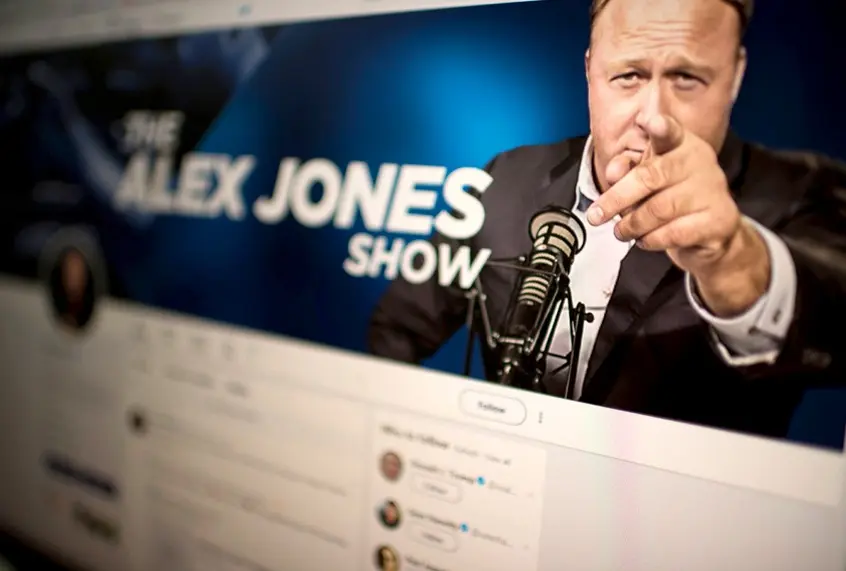
- Spotify: Followed suit by removing multiple episodes of The Alex Jones Show for violating hate content guidelines.
- Facebook: Permanently removed four pages associated with Jones and Infowars, citing repeated violations of policies regarding hate speech and harassment.
- YouTube (Google): Terminated Jones’s primary channel—which boasted over 2.4 million subscribers—along with several secondary channels, after determining that the content violated community guidelines on harassment and hate speech.
Twitter’s Holdout and Eventual Reversal
Amidst this unprecedented industry-wide purge, Twitter remained a notable outlier. When pressed by journalists, civil rights advocates, and concerned users as to why Jones’s accounts were still active on the platform, Twitter executives maintained that while Jones’s rhetoric was deeply offensive, his specific posts had not crossed the line into actionable rule violations.
This defense collapsed on Tuesday, August 15, 2018. Jones published a video clip directing his supporters to prepare their "battle rifles" and confront the mainstream media and political opponents. The explicit call to arms provided the unequivocal policy breach Twitter required. The company promptly locked both Jones’s personal account and the official Infowars account in a seven-day disciplinary "timeout," effectively cutting off his direct transmission lines to millions of followers on the platform.
Supporting Context & Metrics: The Scale of the Digital Reckoning
To fully understand the magnitude of Twitter’s action against Alex Jones, one must analyze the metrics of his digital reach prior to the bans and the immense economic and social pressure brought to bear on technology executives.
Quantifying the Audience
At their peak, Alex Jones and Infowars commanded an extraordinary digital footprint spanning multiple platforms, generating tens of millions of views monthly and driving substantial merchandise and supplement sales.
- YouTube: Over 2.4 million subscribers tuned in for daily broadcasts, with cumulative video views numbering in the hundreds of millions.
- Facebook: Multiple pages managed by Jones and Infowars collectively reached millions of followers, serving as primary distribution funnels for viral articles, videos, and fundraising campaigns.
- Twitter: Hundreds of thousands of followers received real-time updates, links to live streams, and calls to action directly from Jones and his production team.
The Financial and Reputational Toll
The decisions by Silicon Valley giants were not made in a vacuum. They followed sustained advocacy campaigns by civil rights organizations, media watchdogs, and progressive groups—such as Media Matters for America and researchers like Jared Holt—who systematically cataloged and exposed the real-world harms generated by unchecked disinformation networks. Furthermore, advertisers increasingly demanded brand safety, expressing profound discomfort at having their corporate insignia appear adjacent to conspiracy theories denying mass shootings and promoting harassment.
For Twitter specifically, retaining Jones while competitors exercised their terms of service created severe public relations vulnerabilities. Critics accused the platform of sheltering dangerous extremist content under the guise of free speech absolutism, forcing CEO Jack Dorsey and his trust and safety teams to reevaluate how traditional free speech principles apply to modern, algorithmic amplification models.
Official Statements: The Debate Over Moderation and Enforcement
The fallout from Twitter’s disciplinary action prompted extensive public commentary from CEO Jack Dorsey, who used both traditional media appearances and his own platform to articulate the company’s evolving stance on content moderation.
Jack Dorsey’s NBC News Interview
In an exclusive interview with Lester Holt on NBC Nightly News, Dorsey candidly addressed the company’s prolonged resistance to banning Jones, emphasizing the delicate balancing act required to manage a global town square.
"We can’t build a service that is subjective just to the whims of what we personally believe," Dorsey explained to Holt, highlighting the institutional fear of political bias and arbitrary enforcement.
When questioned about the efficacy of a temporary seven-day suspension rather than a permanent ban, Dorsey defended the measure as a standard behavioral correction tool embedded within Twitter’s operational framework:
"I feel any suspension, whether it be a permanent or a temporary one, makes someone think about their actions and their behaviors… Whether it works within this case to change some of those behaviors and change some of those actions, I don’t know. But this is consistent with how we enforce."
Clarifying the Stance on Social Media
Recognizing that his televised remarks could be misconstrued as policy laxity, Dorsey took to Twitter shortly after the interview aired to provide vital context regarding the company’s escalating enforcement model:
"To clarify: I was speaking broadly about our range of enforcement actions, when asked why we timeout functionality on Twitter. I don’t assume everyone will change their actions. Enforcement gets tougher with further reported violations," Dorsey tweeted.
This clarification signaled to the public that temporary suspensions were not mere slaps on the wrist, but rather foundational steps in a tiered enforcement ladder that could ultimately result in permanent expulsion if bad behavior persisted.
Future Outlook: The Ongoing Battle Over Digital Governance
Twitter’s temporary suspension of Alex Jones in August 2018 served as a watershed moment for the technology sector, but it ultimately represented only the opening salvo in a much larger, ongoing war over the governance of digital public spaces.
The Limits of Temporary Measures
While a seven-day timeout temporarily silenced one of the internet’s most prolific conspiracy theorists, it raised fundamental questions about the long-term effectiveness of incremental moderation. Critics argued that temporary bans offered bad actors a strategic roadmap to recalibrate their rhetoric just enough to skirt detection upon their return, without ever addressing the root causes of radicalization and disinformation. For Jones, the suspension was a temporary inconvenience; as soon as the timeout expired, he regained access to his core Twitter following, alongside the platform’s live-streaming subsidiary, Periscope—making Twitter one of the very few digital redoubts where his broadcasting capabilities remained partially intact.
Shifting Industry Standards
The synchronized deplatforming of Alex Jones across Apple, Facebook, Spotify, YouTube, and eventually Twitter established a new industry precedent. It demonstrated that major technology corporations—long reluctant to act as arbiters of truth—could, under intense moral and commercial pressure, coordinate their actions to marginalize individuals who systematically violate terms of service regarding hate speech and incitement to violence.
However, this newfound willingness to police content has also intensified political scrutiny. Lawmakers from across the ideological spectrum have scrutinized how Silicon Valley formulates and applies its rules, with conservative critics accusing tech platforms of systemic bias and censorship, while progressive advocates argue that platforms have historically been too slow and lenient in addressing hate and extremism.
Conclusion
As social media continues to evolve into the primary infrastructure for global communication, political discourse, and news consumption, the dilemmas faced by Jack Dorsey and his industry peers in the summer of 2018 remain profoundly relevant today. The case of Alex Jones exposed the vulnerabilities of open digital architectures when exploited by bad actors weaponizing misinformation. Ultimately, Twitter’s pivot from passive defender of free expression to active enforcer of community standards underscored a sobering new reality for the digital age: maintaining a safe, functional public square requires clear boundaries, consistent enforcement, and an uncompromising refusal to let platforms be weaponized against public safety.