Executive Overview
At the 82nd Venice Film Festival earlier this month, the international cinematic community delivered an extraordinary, twenty-five-minute standing ovation for NAZA, a harrowing documentary directed by Israeli filmmakers Rachel Szor and Yuval Abraham. Yet, while the film received critical acclaim abroad—with reviewers hailing it as a watershed piece of modern investigative cinema—it has simultaneously ignited an unprecedented sociopolitical tempest inside Israel.
The documentary, which takes place on the sun-baked rooftops of Tel Aviv, centers on anonymous testimonies from twenty-four Israeli intelligence agents and soldiers. These service members candidly discuss their operations in the Gaza Strip, offering granular accounts of military strategy, tactical executions, and the staggering human toll of the conflict. In one widely discussed sequence reviewed by Vulture’s Bilge Ebiri, an officer recounts the decision to demolish a building housing five500 people to eliminate a single target, while other interviewees acknowledge the catastrophic destruction of entire neighborhoods and explicitly characterize the campaign as genocide.
Despite the fact that virtually no citizens inside Israel have actually been able to view the film—due to tightly controlled pre-distribution protocols and strategic reassessments by its PR teams—the work has dominated national discourse. The public awareness of its contents has triggered an extraordinary spectrum of reactions, exposing deep fractures within Israeli society. While a minority of intellectuals, journalists, and civil rights advocates defend the filmmakers’ constitutional right to internal critique and journalistic investigation, the overwhelming majority of the political establishment and public sphere have reacted with intense fury.
The backlash has moved rapidly from standard political condemnation to extreme measures. High-ranking government officials have publicly called for the revocation of the filmmakers’ citizenship, while radical social media campaigns have exposed the private residences of their families, openly inviting harassment and physical violence. With upcoming national elections only a month away, NAZA has ceased to be merely a controversial piece of cinema. Instead, it has transformed into a profound litmus test for the survival of Israel as a liberal democracy, pushing the nation’s fragile sociopolitical equilibrium to a dangerous breaking point.
Detailed Chronology
The Venice Premiere and the Spark of Global Attention
The trajectory of NAZA shifted overnight during its world premiere at the Venice Film Festival. Festival attendees, accustomed to heavy-hitting geopolitical documentaries, were visibly shaken by the raw, unfiltered nature of the testimonies presented by Szor and Abraham. The twenty-five-minute ovation signaled immediate critical validation, drawing comparisons to landmark investigative documentaries that expose the inner workings of modern warfare.
However, the international acclaim immediately collided with the realities of an ongoing, high-stakes military conflict back home. Within hours of the festival screening, news of the film’s specific disclosures—most notably the admission of disproportionate targeting and the use of extreme destructive force in densely populated urban zones—began filtering back to Israeli media outlets.
The Blackout and the Information Vacuum
As sensationalized summaries and leaked quotes circulated across digital platforms, the demand to view NAZA skyrocketed within Israel. However, an unexpected information bottleneck occurred. When journalists, including Haaretz cultural reporter Shany Littman, reached out to the film’s public relations representatives for screening links or preview access, they were met with refusals.
Faced with the immediate and volatile political storm, the filmmakers and their distributors placed a temporary freeze on domestic distribution. Consequently, an extraordinary paradox emerged: NAZA became the most intensely debated cultural artifact in the country, despite remaining practically unseen by the domestic populace. This information vacuum allowed rumor, selective quoting, and polarized interpretations to fill the public consciousness, intensifying the sense of national betrayal among critics and heightening defensive anxieties among the general public.
Escalation of State Rhetoric and Safety Threats
The reaction from official state apparatuses was swift and uncompromising. Breaking with historical precedents of government friction over provocative art, the Minister of Culture took the unprecedented step of demanding that Szor and Abraham be stripped of their Israeli citizenship, framing their work not as protected artistic expression, but as an act of treason.
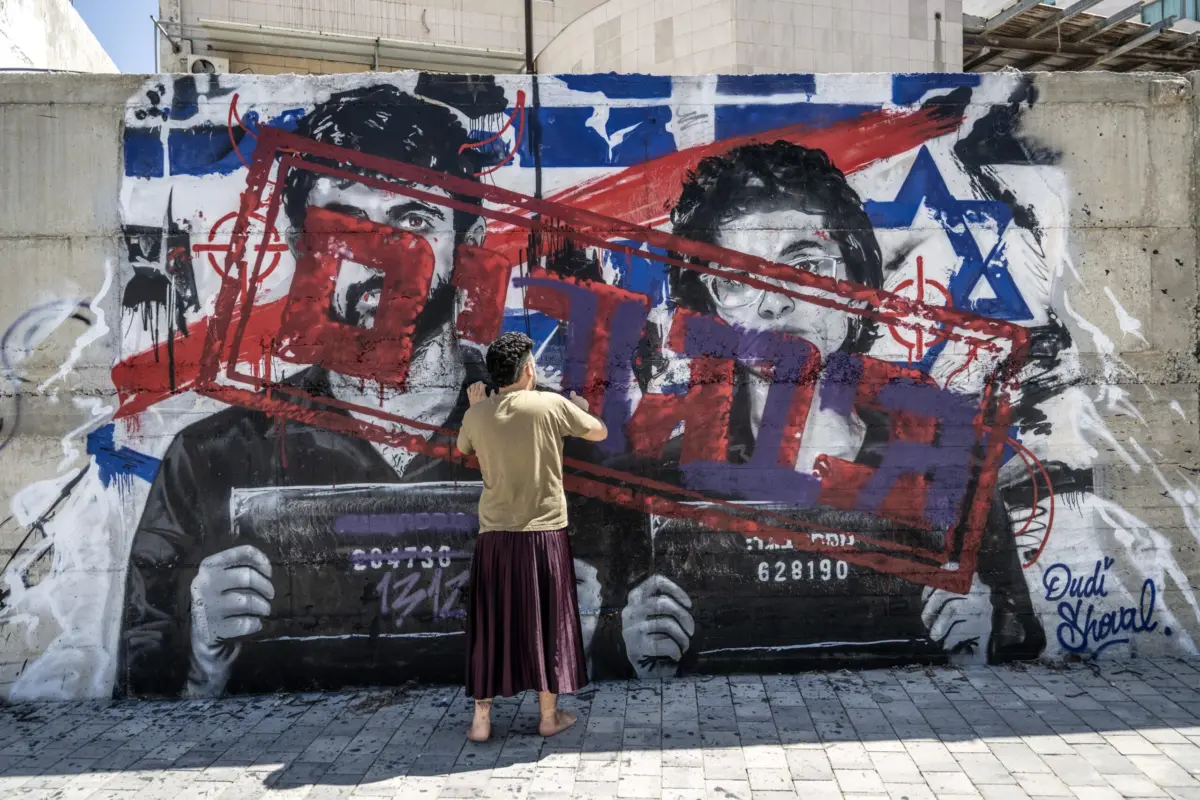
This state-sanctioned hostility rapidly trickled down into the digital ecosystem. Within days, far-right channels and localized social media accounts began circulating specific targeting information. Videos surfaced online featuring individuals standing in front of the suburban homes of the filmmakers’ parents, explicitly broadcasting their addresses and urging the public to exact retribution. The escalation transformed a professional artistic disagreement into an active security threat, forcing the filmmakers into indefinite exile and casting a long shadow of fear over journalists and public intellectuals daring to defend them.
Supporting Context & Metrics
To fully understand the seismic impact of NAZA, one must examine the socio-political metrics and historical context defining contemporary Israel.
The Demographic and Political Landscape
Israel operates under a multi-party parliamentary system that has experienced severe ideological polarization over the past decade. The upcoming elections, looming just a month away from the film’s release, represent a historic junction point. Civil society organizations note a steady erosion of institutional checks and balances, leading many liberal citizens to view the current political climate as an existential threat to democratic norms.
- Political Polarization Index: Public opinion polls indicate a widening chasm between secular, Tel Aviv-centric urban populations—who traditionally champion freedom of expression and judicial independence—and conservative, nationalist coalitions that prioritize security narratives and state cohesion above dissenting discourse.
- Media Consumption and Trust: Trust in traditional media has bifurcated. While outlets like Haaretz attempt to maintain analytical spaces for internal critique, mainstream broadcast networks often reflect prevailing wartime consensus models, viewing internal investigations during active combat as detrimental to national security.
- The "Red Line" Threshold: Sociologists studying the Israeli public sphere note that the threshold for what constitutes acceptable dissent has narrowed dramatically since October 7. Discussions regarding military ethics, previously housed within robust academic and journalistic frameworks, are now frequently categorized through a binary lens of absolute patriotism or active subversion.
Cinematic Precedents
Israel has a rich history of critically examining its military history through film—notable past examples include Ari Folman’s Oscar-nominated animated documentary Waltz with Bashir (2008), which explored the 1982 Lebanon War, and The Gatekeepers (2012), directed by Dror Moreh, which featured candid interviews with former heads of the Shin Bet security agency.
However, NAZA differs fundamentally from these historical retrospectives. It is being produced, released, and debated while active military operations are underway in Gaza. This temporal proximity changes the calculus for the Israeli public, transforming historical introspection into what critics perceive as an active undermining of soldiers currently deployed in the field.
Official Statements & Expert Perspectives
The schism generated by NAZA has prompted fierce commentary from cultural figures, political leaders, and media analysts.
Government and Nationalist Reactions
The official stance of the ruling coalition has been unified in condemnation. In statements released following the Venice premiere, cultural ministers and defense-aligned lawmakers categorized the documentary as hostile propaganda designed to weaponize international judicial bodies against Israel.
"There is a long history of artistic provocation in this country, and our democratic institutions have always tolerated difficult conversations. But what Yuval Abraham and Rachel Szor have done transcends artistic critique. By broadcasting anonymous, unverified allegations to international tribunals while our soldiers are still fighting for their lives, they have committed an act of deliberate betrayal against the state. Their citizenship should be revoked, and they should face the full weight of public alienation."
— Anonymous Senior Cultural Ministry Official
Journalistic and Civil Liberties Perspectives
Conversely, defenders of the film emphasize the vital role of investigative journalism in maintaining democratic health, arguing that genuine patriotism requires an unflinching examination of state and military actions.
In a recent interview on the Today, Explained podcast, Haaretz journalist Shany Littman articulated the deep fear pervading intellectual circles:
"There’s a really long history of films that were criticized, especially by different culture ministers. But I haven’t seen anything like this, like what is happening now. This is really frightening. I’m completely horrified by this… Many Israelis see this day as like the red line or the moment where we will be able to know if we can still live in Israel as a democracy, as a liberal democracy, or that the country has changed in a way that many civil rights and liberties that we think we have are gone."
Littman further highlighted the personal dangers now facing anyone associated with the project or its defense, noting that even routine op-eds supporting the filmmakers’ right to free expression have resulted in targeted harassment and safety fears for family members.
Future Outlook
The long-term ramifications of NAZA’s release extend far beyond the immediate safety of its creators or the outcome of the upcoming elections. The documentary has catalyzed a fundamental debate regarding the future identity of the Israeli state.
1. The Domestic Political Fallout
With elections just weeks away, the rhetoric surrounding NAZA is expected to feature prominently in campaign messaging. Right-wing and nationalist factions will likely utilize the public outrage to galvanize base voters around themes of national sovereignty and resistance against international interference. Meanwhile, center-left and liberal parties face a difficult balancing act: defending freedom of speech and journalistic integrity without appearing indifferent to the security anxieties of a traumatized citizenry.
2. The Future of Israeli Cinema and Dissent
The intense hostility directed at Szor and Abraham establishes a chilling precedent for independent filmmakers, documentarians, and investigative journalists operating within Israel. Financial backing from state-supported cultural funds may become increasingly restricted or subjected to rigorous ideological compliance checks. Creators wishing to tackle sensitive military or political subjects may find themselves forced to seek funding exclusively abroad or operate entirely outside traditional institutional frameworks.
3. International Repercussions
On the global stage, NAZA is poised to become a staple of academic, legal, and political discussions surrounding the conduct of modern urban warfare. As the film secures broader international distribution and potential streaming access, the testimonies of the twenty-four anonymous intelligence agents will likely be cited in ongoing international legal proceedings and diplomatic forums, ensuring that the domestic Israeli storm over the film reverberates across the geopolitical landscape for years to come.