Executive Overview
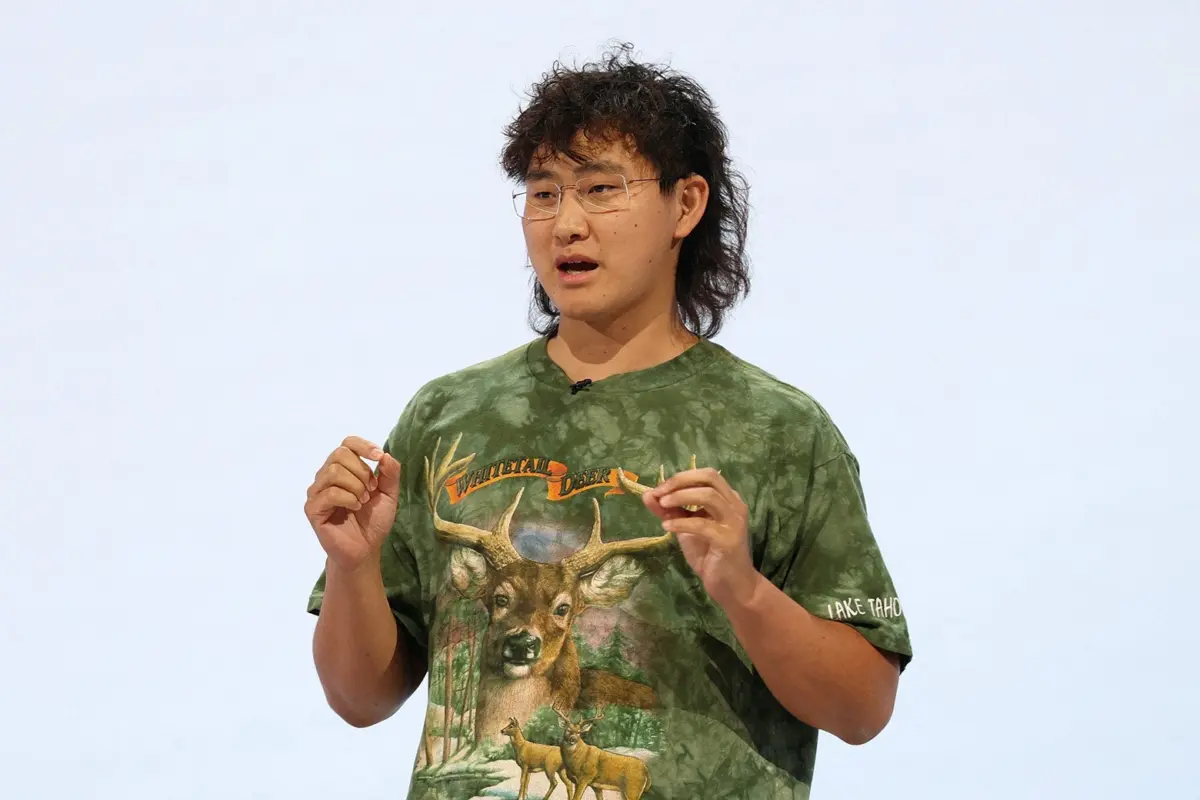
In the high-stakes theater of modern technology, optics are rarely accidental. When Alexandr Wang—once crowned the world’s youngest self-made billionaire following a staggering $7.3 billion valuation for his data-labeling startup, Scale AI—took the stage at the annual Meta Connect conference, he did not project the austere, corporate authority traditionally expected of a premier artificial intelligence executive. Instead, the 29-year-old Meta AI leader stepped into the spotlight wearing a thrifted "Lake Tahoe" camouflage graphic T-shirt, black joggers, Realtree-collaboration Crocs, wire-framed glasses, and a loosely styled shaggy mullet.
The look instantly ignited a firestorm of digital discourse across social media platforms. Observers initially scrambled to price the ensemble, assuming it represented high-end, irony-laced designer streetwear totaling upward of $3,500. Wang quickly corrected the record on X (formerly Twitter), revealing that the graphic tee was a $30 thrift-store find, downplaying his entire aesthetic to project an air of disarming, casual relatability.
Yet, beneath the sartorial subversion lies a calculated psychological strategy. Wang’s makeover is not an isolated incident; it is part of a broader, systemic trend across Silicon Valley. As public skepticism mounts regarding the societal, economic, and privacy implications of aggressive artificial intelligence expansion, Big Tech’s power elite are strategically shedding their traditional executive armor. From Mark Zuckerberg’s transition into oversized luxury streetwear to Palmer Luckey’s trademark Hawaiian shirts at defense-tech contractor Anduril, tech billionaires have discovered the immense utility of looking utterly harmless.
Detailed Chronology: The Evolution of a Tech Titan
To understand the weight of Wang’s recent rebrand, it is necessary to examine his rapid ascent through the upper echelons of the tech industry.
- Five Years Ago (The Prodigy Era): At just 24 years old, Wang’s startup, Scale AI, achieved a massive $7.3 billion valuation. During this era, Wang cultivated a clean-cut, youthful aesthetic characterized by an unbuttoned popped collar and a neat crew cut. He appeared on magazine covers as a boy wonder of the machine learning revolution. However, this shiny exterior masked mounting controversies, including labor investigations into Scale AI’s reliance on overworked and underpaid contract workers across Africa to build massive, intricate datasets and language-model evaluation services.
- The Acquisition Era: Meta, recognizing the critical necessity of securing elite AI talent and proprietary data infrastructure to fuel its ambitious ecosystem, absorbed Wang and Scale AI into its fold through a staggering $14.3 billion capital integration. Wang assumed a leadership role within Meta’s artificial intelligence division, directly steering the technology powering cutting-edge hardware initiatives like Meta’s AI-enabled smart glasses, open-source coding models, and personalized agent platforms.
- Meta Connect (The Rebrand): Stepping onto the stage at Meta Connect, Wang’s new persona was unveiled to the public. Abandoning the crisp button-downs of his early twenties, he leaned entirely into counter-signaling. By curating an outfit that mirrored a part-time DJ or a college dropout with a penchant for thrift stores, Wang fundamentally altered how his presence was perceived by the consumer base.
- The Social Media Correction: Following the event, when internet sleuths speculated that his Crocs were exclusive Balenciaga designs and his joggers were high-fashion Prada, Wang published an annotated diagram on X. He proudly detailed the thrifted origins of his $30 shirt and even playfully pointed out his $5 Calvin Klein underwear, writing, "Excuse me I must correct the record on this slander."
Supporting Context & Metrics: The Mechanics of Counter-Signaling
Wang’s stylistic pivot is a textbook execution of counter-signaling—the practice wherein individuals of high status deliberately adopt markers of lower status or casual indifference to disarm observers and project authenticity. In an era where artificial intelligence companies are aggressively embedding themselves into every facet of daily human life, the stakes have never been higher.
The Financial Scale of the AI Arms Race
- $14.3 Billion: The estimated financial weight of Meta’s integration and investment surrounding Scale AI to secure top-tier data pipelines and leadership.
- $7.3 Billion: Scale AI’s valuation milestone achieved five years prior, which briefly elevated Wang to the status of the world’s youngest billionaire.
- $30 vs. $3,500: The stark contrast between the actual thrifted cost of Wang’s Meta Connect outfit and the speculative luxury valuations initially assigned to it by online commentators.
A Valley-Wide Phenomenon
Wang is hardly alone in his wardrobe transformation. Silicon Valley’s elite have increasingly abandoned standard corporate attire in favor of carefully curated uniforms designed to soften their corporate image:
- Mark Zuckerberg: Once permanently clad in generic gray Brunello Cucinelli crewneck T-shirts, Zuckerberg has progressively pivoted toward oversized Amiri streetwear and custom graphic tees bearing slogans like "Building is my love language." This shift closely coincides with major rollouts for Meta AI and personal agent systems.
- Jensen Huang: The Nvidia CEO has become nearly synonymous with his signature black leather jackets, transforming hardware keynotes into rock-concert-style spectacles.
- Jeff Bezos: The Amazon founder’s style evolution has trended toward flamboyant, leisure-heavy resort wear, standing in stark contrast to his early days as a buttoned-down e-commerce pioneer.
- Palmer Luckey: The 34-year-old co-founder of defense contractor Anduril regularly conducts business with the Pentagon while wearing Hawaiian shirts and cargo shorts—a striking visual juxtaposition for a man manufacturing advanced, AI-powered military surveillance and combat drones.
Official Statements and Industry Insights
The deliberate softening of executive aesthetics arrives at a moment of profound public warophobia and regulatory scrutiny. Critics and civil rights organizations have increasingly raised alarms regarding the invasive nature of modern machine learning tools, automated warfare platforms, and data collection apparatuses.
Industry analysts note that visual choices are deeply intertwined with public trust. During his Meta Connect presentation, Wang unveiled key updates to Meta Muse, the company’s flagship personal AI agent platform, introducing enhanced security measures, a dedicated Mac application, and expanded international rollouts.
However, amidst the technical demonstrations, Wang offered anecdotes that underscored the sweeping reach of these consumer tools, recounting how the AI could track individual user searches—from domestic mishaps like breaking a mother-in-law’s vintage china set to complex vacation planning.
To bridge the empathy gap between cold algorithms and human consumers, tech companies have systematically embraced whimsical imagery. Both Meta and OpenAI have leaned heavily into cartoonish, friendly mascots for their personal assistants (exemplified by internet memes celebrating Meta’s mascot, "Jolly," playfully absorbing rival AI models).
By surrounding themselves with charming branding and dressing like approachable, slightly disheveled peers rather than ruthless technocrats, leaders like Wang attempt to reframe monumental shifts in societal infrastructure as friendly, harmless consumer conveniences.
Future Outlook: The Mask-Off Technocratic Era
As artificial intelligence systems transition from experimental novelties into omnipresent digital operating systems, the psychological gap between the tech elite and the general public continues to widen. We are living through an era of profound technocratic influence, where a handful of unelected executives wield unprecedented power over global information flows, labor markets, and national security infrastructure.
Yet, as the public grows increasingly uneasy about safety, privacy, and systemic displacement, the corporate playbook adapts. It is decidedly easier to swallow the rapid integration of invasive technology when the man asking you to trust his product looks less like an omnipotent data monopolist and more like the casual acquaintance you might run into at a local record store.
Whether dressed in $30 thrift-store camouflage or custom luxury streetwear, Silicon Valley’s architects understand a fundamental truth of modern media: if you can control the aesthetic, you can control the narrative. The billionaire in Crocs does not want you to fear his technology; he wants you to feel entirely at home while he builds the future.