Executive Overview
In the rapidly evolving landscape of consumer artificial intelligence, tech giants and agile startups alike are shifting their focus from simple chat interfaces to "agentic" systems—AI entities capable of executing complex, multi-step workflows across diverse software ecosystems. At the forefront of this shift is Google, which recently unveiled a major restructuring of its experimental AI agent, code-named CC.
Once positioned as an individual productivity tool designed to streamline the corporate workday, CC has been fundamentally re-engineered into a collaborative household coordinator. Operating across email, calendar, chat, and task applications, the updated agent is designed to act as a centralized "chief of staff" for families. From automatically parsing school permission slips and managing complex, multi-carpool schedules to generating weekly meal plans and tracking household bills, CC represents a calculated bet by Google that the ultimate battleground for consumer AI loyalty lies not in the office, but within the domestic sphere.
This strategic pivot occurs amidst a broader industry realization: while enterprise productivity tools are highly lucrative, the "mental load" of managing a modern household remains one of the most underserved, high-friction areas of consumer life. By granting CC its own autonomous digital identity within the Google ecosystem, the search giant is attempting to solve the fragmentation that has plagued household organization for decades. However, as this deep dive explores, the product’s current architectural constraints—most notably a strict 18+ age requirement and reliance on personal Gmail accounts—highlight the complex tension between AI utility, data privacy, and child protection regulations.
Detailed Chronology: The Evolution of CC
To understand Google’s current strategy with CC, it is essential to trace its development from a workspace utility to a domestic coordinator. The product’s lifecycle reflects Google’s broader iterative approach to deploying generative AI.
[Early Phase] CC launched as an experimental workspace productivity agent
      │
      ▼
[May Release] Integrated into Gemini app as "Daily Brief" (Your Day Ahead)
      │
      ▼
[User Feedback] High volume of requests for household/family management features
      │
      ▼
[Current Pivot] Relaunched as a collaborative, multi-member family coordinator
Phase 1: The Workspace Productivity Agent
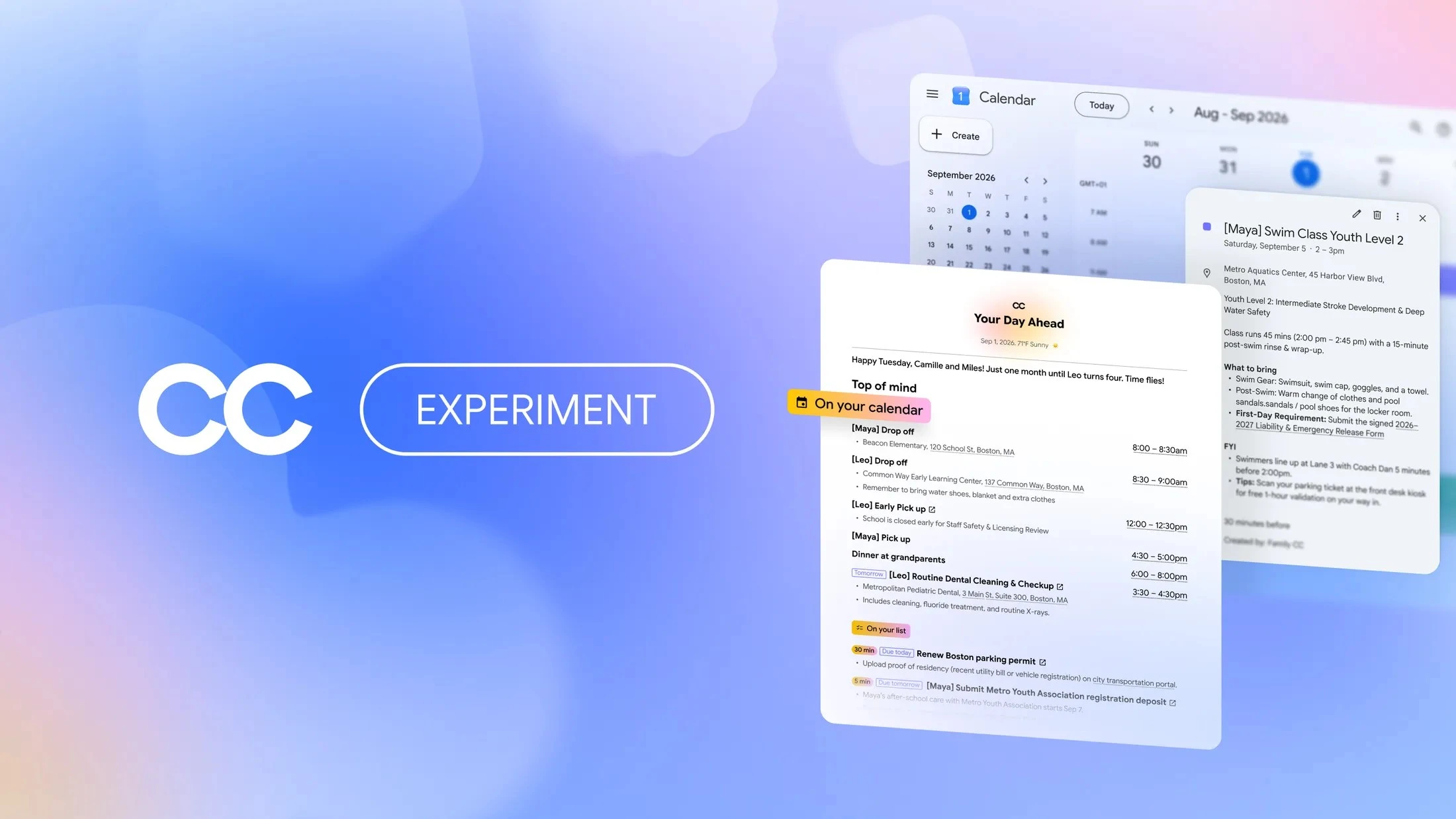
CC began its lifecycle as an experimental, single-user productivity agent. Developed within Google’s advanced research divisions, its initial mandate was to act as an executive assistant. By integrating deeply with a user’s Gmail, Google Calendar, Google Drive, and the broader web, CC synthesized incoming data to deliver a comprehensive, personalized "Your Day Ahead" briefing directly to the user’s inbox every morning.
Phase 2: Integration into the Gemini Ecosystem
In May, Google sought to democratize this technology by integrating the core functionalities of CC into its flagship consumer AI application, Gemini, under the moniker Daily Brief. This transition was intended to showcase Gemini’s ability to act as an active agent rather than a passive conversationalist, pulling real-time calendar events and emails into a coherent, voice- or text-enabled morning summary.
Phase 3: The Household Pivot
Despite its corporate framing, Google’s internal user feedback loops revealed an unexpected trend. Users were consistently attempting to bend the productivity agent to manage their domestic lives. Instead of asking for summaries of corporate strategy docs, users were feeding the system school lunch menus, youth sports schedules, medical appointment confirmations, and utility bills.

Recognizing that the "household manager" role was a highly compelling and retention-heavy use case, Google’s product teams officially shifted CC’s trajectory. This week’s update marks the formal transition of CC from an individual workspace assistant to a multi-user, collaborative household agent.
Operational Mechanics: How CC Manages a Household
Unlike traditional shared calendars or family organizer apps that require manual data entry, CC operates with a high degree of autonomy, leveraging what Google calls an "agentic harness."
The Autonomous Account Structure
In a departure from standard assistant integrations, CC is granted its own unique Google account. This allows the agent to function as an independent participant within a family group. Rather than acting as an extension of a single parent’s account—which raises significant privacy concerns regarding personal emails—CC exists as a neutral, collaborative node to which family members can selectively delegate tasks and information.
Currently, CC supports collaboration for up to six family members.
                          ┌─────────────────┐
                          │  Family Member  │
                          └────────┬────────┘
                                   │ (Selective Forwarding / Auto-Rules)
                                   ▼
┌─────────────────┐       ┌─────────────────┐       ┌─────────────────┐
│  Family Member  ├──────►│   Google 'CC'   │◄──────┤  Family Member  │
└─────────────────┘       │    AI Agent     │       └─────────────────┘
                          └─┬─────────────┬─┘
                            │             │
      ┌─────────────────────▼─┐         ┌─▼─────────────────────┐
      │ Shared Google Calendar│         │  Shared Tasks & Docs  │
      └───────────────────────┘         └───────────────────────┘
Information Ingestion and Selective Sharing
The system relies on a hybrid model of manual and automated information sharing, designed to give users granular control over their data privacy:
- Selective Forwarding: Family members can forward individual emails—such as a birthday party invitation or a PDF of a soccer schedule—directly to CC’s dedicated email address.
- Automated Sender Rules: Users can configure CC to automatically ingest emails from specific senders. For instance, a parent can authorize CC to automatically read and process all incoming emails from
[email protected]or[email protected]. CC also proactively suggests new senders to add to this automated list on a weekly basis, analyzing incoming traffic patterns to identify recurring household coordination vectors.
Autonomous Task Execution
Once data is ingested, CC does not merely summarize it; it executes workflows across the Google suite:
- Calendar Synchronization: If CC processes an email confirming an orthodontist appointment or detailing a school district’s teacher workday, it automatically schedules the event on the shared family calendar, cross-referencing the schedules of all six registered members to flag potential conflicts.
- Document and Sheet Creation: For complex events, such as planning a family vacation or a graduation party, CC can autonomously generate shared Google Docs or Sheets, pre-populating them with structured itineraries or budgeting templates derived from ingested emails.
- Document Processing: CC can parse complex PDFs, such as school permission slips or athletic registration forms. It can extract the required information, fill out the fields on behalf of the parent, and compile shopping lists for required school supplies or sports gear.
- Proactive Clarification & Group Memory: If a forwarded email lacks critical context—such as the location of an away game or the cost of a field trip—CC will flag the omission and ask the family group for clarification. Over time, it updates its "group memory," retaining key preferences (e.g., dietary restrictions for meal planning or preferred driving routes) to streamline future task execution.
Supporting Context, Market Landscape & Sociological Metrics
Google’s pivot with CC does not occur in a vacuum. It represents a direct response to both macroeconomic demographic shifts and an intensifying arms race among consumer AI startups.

The Agentic AI Landscape
The consumer AI sector is rapidly transitioning from "knowledge retrieval" (search and chatbots) to "action execution" (agents). Startups have been quick to recognize that managing the administrative burden of family life—often referred to by sociologists as the "mental load" or "cognitive labor"—is a highly monetizable pain point.
| Competitor | Core Focus | Key Differentiation |
|---|---|---|
| Ollie | Family Assistant | Deep focus on local, privacy-first data processing. |
| Fambot | AI Chief of Staff | Positioned as an executive-level coordinator for busy parents. |
| Google CC | Ecosystem-Native Agent | Unparalleled integration with Gmail, Calendar, Drive, and Google Maps. |
While startups like Ollie and Fambot have built dedicated, niche platforms to address these pain points, Google’s entry with CC poses a significant existential threat. Google’s competitive advantage lies in its native infrastructure: billions of consumers already run their lives on Gmail and Google Calendar. Introducing an agent that operates natively within these existing containers eliminates the friction of downloading a new app or migrating data.
Demographic Realities: The Rise of Multigenerational Households
The utility of a six-member collaborative AI agent is underscored by shifting demographic trends in the United States. According to recent sociological data, including reports highlighted by The New York Times, approximately one-third of young adults (ages 18 to 34) continue to live in multigenerational households with their parents.
Furthermore, the rising costs of childcare have led to increased reliance on extended family networks, including grandparents, live-in nannies, and designated caregivers. Coordinated household management is no longer a two-parent, two-child equation; it is a complex logistics puzzle involving multiple adults operating on highly variable schedules. CC’s capacity to integrate up to six adult accounts directly addresses this modern sociological reality.
Technical Architecture, Privacy, and Key Limitations
To address the intense scrutiny surrounding AI data privacy, Google has built CC on a specialized technical architecture designed to isolate sensitive family data.
The Antigravity Harness
CC is powered by Google’s state-of-the-art Gemini large language models, but its execution capabilities are governed by Antigravity—Google’s proprietary agentic harness. Antigravity acts as a security and operational buffer. It translates the natural language instructions generated by Gemini into structured API calls across Google’s services, ensuring that the AI operates within strict safety parameters and does not execute unauthorized actions (such as deleting critical emails or modifying unapproved calendar events).
To further bolster security, Google notes that CC runs on its own isolated cloud computer. This ensures that a family’s shared data is sequestered, preventing household information from being used to train public foundation models or being leaked across user boundaries.

┌──────────────────────────────────────────────────────────┐
│                   Isolated Cloud Sandbox                 │
│                                                          │
│   ┌──────────────┐     Antigravity      ┌────────────┐   │
│   │  Gemini LLM  ├─────────────────────►│  Agentic   │   │
│   │ (Intelligence│◄─────────────────────┤  Harness   │   │
│   └──────────────┘                      └─────┬──────┘   │
└───────────────────────────────────────────────┼──────────┘
                                                │ (API Actions)
                                                ▼
                                    ┌──────────────────────┐
                                    │ Gmail / Calendar /   │
                                    │ Drive / Tasks APIs   │
                                    └──────────────────────┘
The 18+ Structural Blindspot
Despite the product’s sophisticated architecture, Google’s rollout of CC features a glaring structural limitation: the experiment is restricted to U.S. users with personal Gmail accounts who are 18 years of age and older.
This restriction presents a major operational bottleneck for families:
- The Teen/Tween Exclusion: Middle school and high school students, who generate a massive portion of a household’s logistical noise (extracurricular schedules, homework deadlines, social events), cannot directly interact with CC or link their accounts. Parents are forced to act as intermediaries, manually forwarding emails on behalf of their children.
- The School District Walled Garden: Most modern school districts operate within managed Google Workspace environments, issuing school-specific email addresses to students. Because CC cannot integrate with these restricted enterprise/educational domains, it remains locked out of the primary digital pipeline where school updates, assignments, and athletic schedules originate.
Google’s decision to enforce this age gate is almost certainly driven by regulatory compliance, specifically the Children’s Online Privacy Protection Act (COPPA) and evolving state-level age-appropriate design codes, which impose severe penalties on tech companies that profile or track minors using AI.
Future Outlook & Strategic Implications
Google’s pivot toward family-centric agentic AI marks a critical milestone in the consumerization of artificial intelligence. By transforming CC from a corporate productivity tool into a domestic coordinator, Google is attempting to embed its ecosystem deeper into the daily routines of modern households.
If successful, CC could redefine the relationship between consumers and their personal data. The product positions Google not just as a repository for search queries or emails, but as an active participant in domestic life. However, the success of this initiative will depend on Google’s ability to navigate several key hurdles:
- The Trust Deficit: Entrusting an AI agent with sensitive family scheduling, financial bills, and medical appointments requires an exceptionally high degree of system reliability. A single missed doctor’s appointment or misfiled school registration form could severely damage user trust.
- The Minor Integration Problem: For CC to truly live up to its promise as a comprehensive family coordinator, Google must develop a privacy-compliant framework that allows teenagers and school-issued accounts to safely participate in the agent’s ecosystem.
- Ecosystem Lock-in: By offering a highly integrated, free assistant that leverages Gmail and Calendar, Google could successfully crowd out third-party family organizer apps, further solidifying its dominance in consumer software.
The rollout of CC represents a pragmatic acknowledgment by Google that the future of AI utility is deeply personal. As the waitlist opens for new users in the United States, the tech industry will be watching closely to see if an AI "chief of staff" can successfully tame the chaotic logistics of the modern home.