Executive Overview
The architecture of B2B go-to-market (GTM) teams is undergoing its most profound structural disruption since the advent of cloud computing. For decades, the formula for scaling revenue generation was fundamentally linear: more pipeline required more headcount, which translated directly into hiring armies of Sales Development Representatives (SDRs) and Account Executives (AEs). That playbook is rapidly expiring.
In a stark preview of where modern sales organizations are heading, industry veteran and SaaStr founder Jason Lemkin has orchestrated a radical operational transformation. Once reliant on a traditional sales structure of roughly 10 SDRs and AEs, SaaStr has compressed its human sales footprint down to a single Account Executive. To replace the output of the traditional department, the organization has deployed over 20 autonomous AI agents currently operating live in production.
This seismic shift is not merely an experiment in cost-cutting; it is a complete reimagining of how inbound demand is captured, outbound campaigns are executed, sponsorships are sold, and the vast, previously ignored "long tail" of leads is systematically monetized.
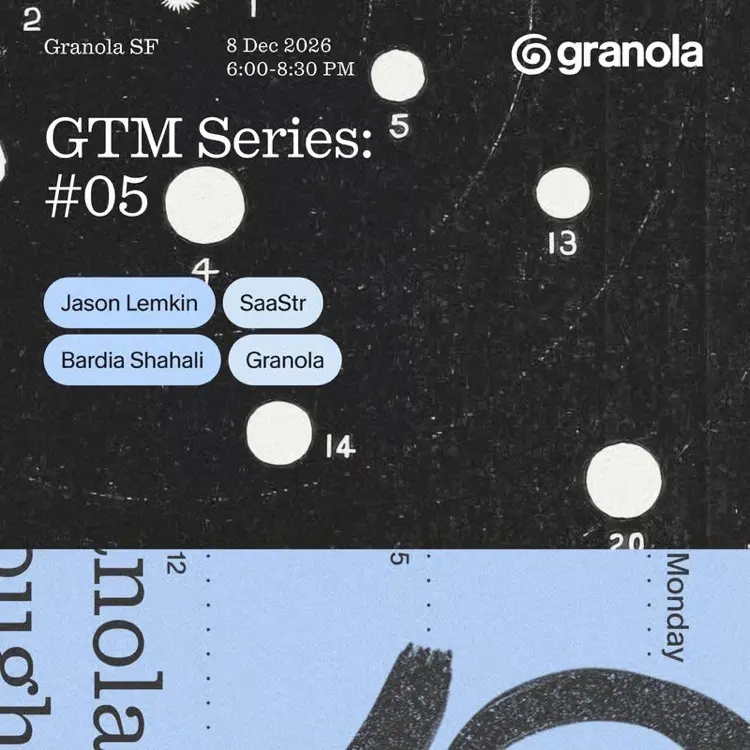
To unpack this transformation, Granola—one of the fastest-growing artificial intelligence applications in the B2B sector—is hosting an intimate, high-signal event in San Francisco on December 8. Part of Granola’s ongoing GTM Series (#05), the gathering brings Lemkin together with Bardia Shahali, VP of Sales at Granola, for a frank, unvarnished working session. Eschewing the noise of traditional 5,000-person convention stages, this exclusive meetup is designed to strip away the marketing fluff and examine the gritty, day-to-day realities of deploying AI agents in high-stakes sales environments.
Detailed Chronology: The Evolution of B2B Sales and the Road to Autonomous GTM
The Traditional B2B Playbook and Its Structural Bottlenecks
For the past twenty years, the scaling blueprint for venture-backed B2B tech companies followed a predictable trajectory. Founders built a product, hired a couple of generalist founders-turned-salespeople, and then raised a Series A or B to fund a massive outbound engine. This playbook relied on human capital saturation:
- The SDR Model: Dozens of entry-level SDRs manually scraped LinkedIn, dialed phone numbers, and blasted generic cold email sequences.
- The Ramp Tax: High turnover rates meant companies were constantly spending three to six months ramping new reps, only to see them churn just as they became productive.
- The Long-Tail Blind Spot: Because human attention is finite and expensive, sales organizations systematically ignored low-ACV (Annual Contract Value) leads, mid-market inquiries, and smaller inbound pockets that didn’t justify human touchpoints.
The Turning Point: The Rise of Specialized Agents
As foundational large language models matured and domain-specific AI orchestration tools emerged, forward-thinking leaders began to realize that the repetitive, data-heavy workflows dominating 70% of an SDR’s day could be automated.
At SaaStr, this realization catalyzed a complete structural overhaul. Instead of using AI merely as a "copilot" to draft emails or summarize notes (the current ceiling for many conservative sales teams), SaaStr took the leap to full agentic workflows. They tore down the traditional departmental pyramid and built an architecture where one human AE oversees a digital workforce of 20+ specialized AI agents.
These agents do not just sleep in the background; they actively run production workflows:
- Inbound Triage & Qualification: Instantly engaging website visitors, scoring intent, and routing high-value prospects while autonomously answering Tier-1 and Tier-2 technical and pricing queries.
- Outbound Prospecting at Scale: Mining market signals, personalizing hyper-targeted outreach based on real-time company triggers, and managing multi-channel sequences without human intervention.
- Sponsorship Operations: Managing the complex lifecycle of securing and servicing event sponsorships, tracking deliverables, and coordinating contract execution.
- Long-Tail Reclamation: Operating tirelessly across thousands of historical leads and low-intent accounts that a human team could never economically justify servicing.
Granola’s Parallel Journey: Scaling Humans and AI Concurrently
While SaaStr compressed its team to lean heavily into agentic automation, Granola represents the other side of the hyper-growth coin. As one of the preeminent AI-driven applications scaling in the B2B space today, Granola’s leadership finds themselves in the crucible of explosive market demand.
Bardia Shahali, VP of Sales at Granola, is actively expanding a human sales organization while simultaneously integrating cutting-edge AI tools into every layer of the workflow. Shahali’s challenge is multi-dimensional: how do you hire and scale a human sales team during a period when the very definition of sales work is mutating week by week?
This dichotomy—SaaStr compressing down to lean agentic workflows versus Granola scaling up human capacity while augmenting with AI—forms the intellectual core of the upcoming GTM Series #05 session. Both leaders are solving the exact same fundamental business problem, yet they have arrived at profoundly different operational models determined by company stage, Average Contract Value (ACV), and GTM motion.
Supporting Context & Metrics: The Mathematics of Agentic Sales
To truly comprehend why leaders like Jason Lemkin and Bardia Shahali are obsessing over GTM agents, one must examine the underlying unit economics and performance metrics governing modern sales engineering.
The Cost-Per-Pipeline-Generated Equation
In a traditional SaaS sales model, the Fully Loaded Cost (FLC) of an SDR includes base salary, commissions, software licenses (Salesloft, ZoomInfo, LinkedIn Sales Navigator, Salesforce/HubSpot), management overhead, and recruiting costs. When factoring in average ramp times and standard 30% to 50% annual turnover in junior sales roles, the cost per qualified opportunity can escalate rapidly.
Conversely, production-grade AI agents fundamentally alter this equation:
- Zero Ramp Time: Agents are deployed with pre-trained institutional knowledge, product catalogs, and messaging frameworks instantly.
- Infinite Scalability: Scaling outbound volume from 1,00p accounts to 50,000 accounts requires compute scaling, not linear hiring sprees.
- Predictable Operational Margins: Software-driven execution eliminates human error, emotional burnout, and missed follow-ups.
Where Human Expertise Matters Most
The narrative that "AI is replacing all salespeople" is overly simplistic and inaccurate. What is actually occurring is a bifurcation of the sales role:
- Commoditized Tasks (Automated): Prospect research, cold list building, initial outreach, calendar scheduling, CRM data hygiene, and basic FAQ handling are now squarely in the domain of autonomous agents.
- High-Value Nuance (Retained by Humans): Complex enterprise negotiations, executive relationship building, strategic alignment, creative problem-solving, and emotional intelligence remain strictly human domains.
This explains why SaaStr’s model retains a single, highly leveraged Account Executive. That human is no longer wasting 80% of their day on administrative toil and cold-calling unverified lists. Instead, they act as an AI wrangler and enterprise closer, stepping into conversations only after the AI agents have qualified intent, nurtured the lead, and surfaced high-probability closing opportunities.
Official Statements & Industry Perspectives
The upcoming Granola GTM Series session is intentionally structured to strip away the theoretical jargon surrounding artificial intelligence and ground the discussion in operational reality.
In a recent preview of the event, Jason Lemkin emphasized the raw, unscripted nature of the upcoming gathering:
“We’re doing something a bit different. No stage, no 5,000 people, no badge line. Just a room at Granola’s HQ in San Francisco on December 8, a real conversation about agents for GTM, and time to hang out after.”
Addressing the dramatic shift in SaaStr’s internal operations, Lemkin highlights the stark contrast between historical norms and modern execution:
“Not long ago, SaaStr had a pretty normal B2B sales team. About 10 SDRs and AEs, the usual tools, the usual ramp times, the usual turnover. Today it’s 1 AE and 20+ AI agents running in production. That’s how we sell sponsorships, work inbound, run outbound, and follow up on the long tail of leads that no human team ever gets to.”
Bardia Shahali, bringing the perspective of a hyper-growth AI vendor scaling its own sales apparatus, notes that the industry is navigating uncharted territory. Building a sales organization while the foundational software stack is evolving daily requires a delicate balance of experimentation and discipline:
“Granola is scaling a sales team up. We [SaaStr] scaled ours down and rebuilt it around agents. Both can be right depending on stage, ACV, and motion, and that’s what we’ll dig into.”
Future Outlook: What’s Next for Autonomous GTM?
As we look toward the remainder of the decade, the conversation around AI in sales is shifting from “Can this technology work?” to “How fast can we architecture our workflows around it?”
1. The Death of the Traditional SDR Tier
The entry-level SDR role as it has existed for the past fifteen years is facing an existential crisis. Companies that continue to throw human bodies at cold-email volume games will find themselves structurally uncompetitive against lean rivals operating agentic pipelines that can execute hyper-personalized outreach at a fraction of the cost and zero latency.
2. The Rise of the "GTM Engineer"
As sales teams transition from managing people to managing software, a new archetype is emerging within revenue organizations: the GTM Engineer. These are professionals who understand pipeline generation not just through the lens of charisma and phone skills, but through API integrations, prompt engineering, agent orchestration, and automated data enrichment workflows.
3. Nuance Over Dogma
As Lemkin and Shahali plan to dissect during their San Francisco working session, there is no universal silver bullet. A seed-stage enterprise selling high-ACV multi-million-dollar cybersecurity suites will require a radically different balance of humans and agents compared to a product-led growth (PLG) motion capturing thousands of self-serve signups. The winners of the next GTM cycle will be those who accurately assess their motion and ruthlessly optimize the human-to-agent ratio.
Event Details & How to Participate
For founders, revenue leaders, and modern GTM operators looking to move beyond surface-level AI hype and understand the actual mechanics of agentic sales infrastructure, GTM Series #05 offers a rare educational and networking opportunity.
- Date: December 8
- Location: Granola HQ, San Francisco, CA
- Featured Speakers:
- Jason Lemkin (Founder, SaaStr)
- Bardia Shahali (VP of Sales, Granola)
- Format: Intimate working session, deep-dive tactical Q&A, and post-event networking.
- Registration: Due to the physical capacity constraints of hosting a real conversation rather than a massive convention hall, space is strictly limited. Industry practitioners are encouraged to request an invitation immediately via the official registration portal:
👉 Request to Join via Luma
Attendees are encouraged to bring their hardest, most granular questions regarding the architectural, operational, and cultural challenges of integrating autonomous agents into live production sales environments. With both Lemkin and Shahali committing to stick around for extended Q&A and networking, Session #05 promises to be one of the definitive tactical GTM briefings of the season.