Executive Overview
As artificial intelligence shifts decisively from conversational chatbots to autonomous, execution-focused digital workers, enterprise software is facing an existential reckoning. The foundational infrastructure of modern business—built on the assumption that a human is the primary actor driving workflows, updating fields, and navigating user interfaces—is straining under the weight of machine-speed automation.
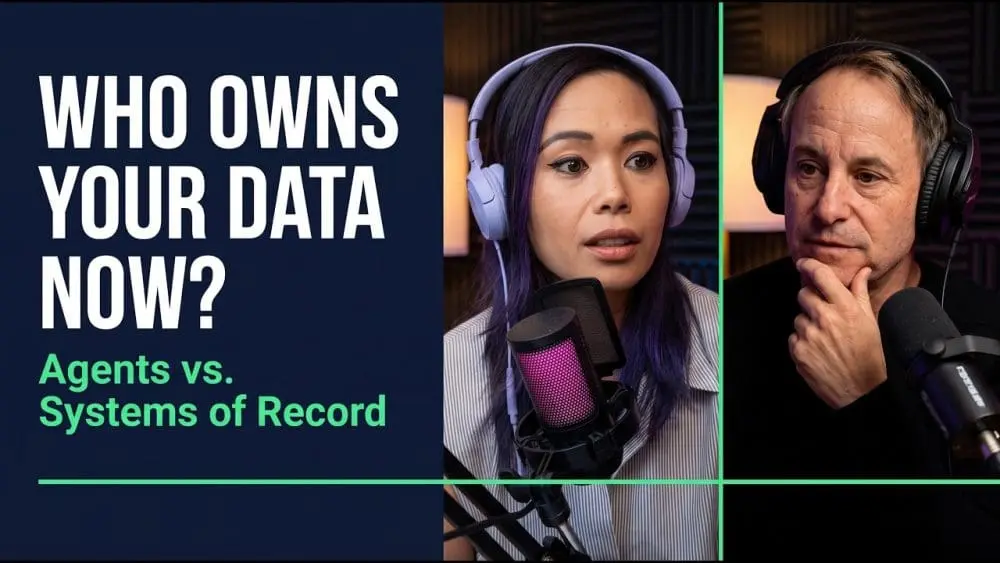
In Episode #013 of The Agents, hosts running an 8-figure B2B AI business with over 20 autonomous agents deployed in production laid bare the operational realities, architectural clashes, and strategic breakthroughs of living in an agent-first world.
The core thesis is simple yet disruptive: When AI agents take over your systems of record, everything changes.
Traditional Customer Relationship Management (CRM) platforms, API pricing models, data storage architectures, and partner ecosystems were designed for human cadence. When autonomous agents enter the picture—continuously enriching records, logging metadata, and processing millions of actions in real time—the cracks in legacy software become canyons. From unexpected storage overage bills on Salesforce and high-profile platform cutoffs like ServiceTitan’s expulsion of Podium, to the rise of headless architecture and autonomous hyper-personalization, enterprise tech is entering a volatile transition period.
This report provides an in-depth analysis of the operational shifts, infrastructural bottlenecks, and strategic playbooks emerging as autonomous agents permanently reshape the enterprise stack.
Detailed Chronology: The Frontline Realities of Agentic Production
Deploying more than 20 agents in a live, high-stakes B2B environment yields daily friction points that do not appear in software demo environments. The experiences shared on The Agents map out a clear chronology of how autonomous systems interact with—and strain—traditional enterprise software.
Phase 1: The Data Explosion and the Salesforce Overage Shock
The friction began innocently enough. Weeks after migrating core marketing data into Salesforce, the team received an automated notification: they were rapidly running over their data storage limits.
For co-founder Amelia, the alert was baffling. "We’re barely in there," she noted. Human logins were virtually nonexistent; neither founder had actively logged into Salesforce in over a week.
The culprits were the autonomous agents. Operating continuously in the background, agents were writing task records, email sends, opens, clicks, call metadata, and real-time enrichment data into the CRM. Within roughly 30 days, data volume surged from 5GB to 40GB, translating to approximately 21 million individual records.
This unexpected velocity highlights a structural hazard for modern tech stacks: deploying AI agents against legacy CRMs causes data storage lines to scale exponentially, often triggering punitive storage and API cost structures that destroy software ROI.
Phase 2: The ServiceTitan-Podium Showdown
While internal overage bills are an operational nuisance, platform-level conflicts signal a deeper tectonic shift. The recent high-profile breakup between ServiceTitan and Podium serves as a warning shot for the entire SaaS ecosystem.
ServiceTitan has long operated as the dominant system of record for the home services trades. For nearly a decade, Podium fed leads into ServiceTitan through an integrated partnership that benefited both companies and served roughly 1,000 mutual customers.
The relationship fractured when Podium evolved past a simple lead-gen utility. By crossing nine figures in agent-driven revenue, Podium’s autonomous agents began talking directly to customers, scheduling appointments, tracking jobs, and ultimately holding the customer record. A partner that once handed off a discrete, isolated piece of work was suddenly replicating core functions of ServiceTitan’s own system of record.
ServiceTitan’s response was swift: a 30-day notice severing the integration for a thousand joint customers. While ServiceTitan publicly maintained that third-party platforms are welcome to access records and compete, they drew a hard line at integrations attempting to displace the core system of record.
This conflict foreshadows sweeping disruption in Customer Experience (CX) and support software. If an autonomous agent on a third-party website successfully acquires, converts, and retains a customer end-to-end, the underlying CRM may become entirely obsolete.
Phase 3: The Rise of "Headless" CRMs and Infinite Customization
Faced with the limitations of monolithic software, the team’s custom AI Vice President of Revenue—dubbed "10K"—evolved organically into a headless Salesforce implementation.
Initially built without any CRM integration, 10K gradually connected to Salesforce to pull baseline data, only for the agent to discover deeper utility across the stack. Today, 10K orchestrates six distinct operational nodes: classic Salesforce CRM, Qualified, Momentum (for call recordings), Agentforce, Marketing Cloud Next, and a custom quote-to-cash application interfacing with PandaDoc, Bill.com, and QuickBooks.
Crucially, the creators built an entire 8-figure business on top of this architecture without human operators needing to touch the native Salesforce UI for years.
However, this headless paradigm introduces a strategic paradox for enterprise software vendors: The same architectural flexibility that makes a system 10 times more useful also makes it 10 times easier to leave. An AI agent capable of interfacing smoothly with a single API can pivot just as easily to three others.
Phase 4: Scaling Hyper-Personalization via Multi-Layered Agentic Workflows
The true payoff of headless agent architecture materialized during renewal season. Historically, customized renewal pitch decks were reserved exclusively for top-tier "Diamond" sponsors, as human employees lacked the bandwidth to build dozens of bespoke presentations.
Using 10K as the underlying engine, Amelia deployed a renewal agent that generated fully customized, data-backed pitch decks in roughly half a day.
The agent systematically harvested information across fragmented data silos:
- CRM Data: Account executives, historical contract values, lifetime value (LTV), and email engagement metrics.
- Interaction History: Qualified conversation transcripts and Momentum call histories.
- External Systems: The SaaStr WordPress API, social media metrics, podcast archives, and Bizzabo event lead counts.
- Unstructured Communications: Direct email threads bypassing standard CRM logging.
Using the Gamma API to preserve authentic branding, logos, and visual assets, the agent generated hyper-customized decks for lower-tier "Silver" sponsors—accounts that historically suffered from the lowest renewal rates. The results defied conventional sales norms: the Silver sponsors, receiving bespoke presentations for the first time, responded at higher rates than the Diamond tier.
Supporting Context & Metrics
To fully grasp the economic implications of agentic operations, industry leaders must examine the quantitative divergences between human-era and machine-era software usage.
- The 1,000x Cost Differential: An architectural comparison commissioned via Claude revealed that storing 21 million records in a legacy CRM environment is roughly 1,000 times more expensive than storing the exact same data footprint in a modern relational database like Postgres, Neon, Supabase, or Databricks.
- The 40GB Velocity: Autonomous enrichment and event logging pushed internal data storage from 5GB to 40GB in just 30 days—representing 21 million discrete database writes generated entirely by machine actors.
- The API Pricing Trap: Many legacy enterprise software vendors are responding to shrinking human seat counts by hiking API fees. However, because agent-driven data generation scales by 10x to 100x, a nominal 20% API price hike transforms into an effective 200% to 2,000% tax on accessing one’s own corporate data. Such models inevitably incentivize enterprises to migrate data storage outside traditional vendor ecosystems.
- The Discovery of Shadow CRMs: Legacy systems that were previously neglected due to export friction—such as event ticketing and attendee management platforms like Bizzabo (utilized since 2018)—are now effectively classified as primary CRMs once operationalized by AI agents capable of querying neglected databases effortlessly.
Official Statements and Industry Insights
The insights from Episode #013 underscore a profound shift in software philosophy. Key philosophical takeaways from the leadership team include:
-
On Database Architecture and Legacy Costs:
"This isn’t Salesforce being a bad actor. They have real costs on a database architected for an era when the customer was a human clicking a UI a few dozen times a day. Nobody priced for agents writing constantly."
-
On the Futility of Metering Data Access:
"Raising the per-call price on top of data growing 10x to 100x isn’t a 20% increase, it’s 200% or 2,000%, to reach our own data. What that buys you is our decision to put the next 100GB somewhere else. What customers want is cost tied to outcomes and resolutions, not a meter on reaching their own records."
-
On Agentic Guardrails and Hallucinations:
"Amelia wrote DON’T MAKE UP NUMBERS into the renewal agent four separate times. It still occasionally invents one… Never let them send the follow-up unsupervised."
-
On Protocol vs. Browser-Based Execution:
"Everyone is on Model Context Protocol (MCP) right now, and a lot of these connectors are slow enough that the agent goes around them. The hard half is being the tool the agent reaches for while it’s doing the work, and being fast enough that it doesn’t route around you."
Future Outlook: The Next Frontier of Autonomous B2B Operations
As the enterprise software landscape adapts to autonomous workflows, the boundary between software utility and infrastructure ownership will continue to blur. Several key trajectories are defining the immediate future:
1. Outcome-Based Pricing vs. Usage Metrics
As enterprises migrate petabytes of agent-generated data away from legacy CRMs toward elastic, developer-first databases, SaaS vendors clinging to punitive API metering will experience severe churn. The market is rapidly pivoting toward outcome-based pricing models, where software value is measured by resolutions, conversions, and completed workflows rather than metered data retrieval.
2. Guardrails, Narratives, and Human-in-the-Loop Validation
The realization that even heavily prompted AI agents will occasionally fabricate metrics ("DON’T MAKE UP NUMBERS") has solidified a new operational protocol: Agree on the narrative before the agent builds anything. By establishing human-approved strategic guardrails prior to automated execution—and maintaining human supervision on outbound touchpoints—organizations can harness machine scale without sacrificing brand integrity.
3. Instantaneous, Zero-Touch Inbound Proposals
Building on the success of automated renewal workflows, the next frontier for advanced agentic stacks is instantaneous inbound conversion. Rather than routing high-intent prospects through static "Contact Us" forms or calendar schedulers, future B2B funnels will deploy multi-layered agents that instantly analyze inbound company profiles, cross-reference historical success metrics, and generate custom, data-backed proposals before a human sales representative ever enters the room.
This report is an analytical recap of Episode #013 of The Agents, featuring Amelia Lerutte, focusing on the practical deployment of AI agents in production environments. Industry practitioners can experience these insights live at SaaStr AI Annual 2027, scheduled for May 11–12 in the San Francisco Bay Area.