Executive Overview
In the high-stakes, hyper-capitalist corridors of Silicon Valley, image has always been a strategic weapon. For decades, the uniform of the tech titan evolved from the casual fleece vest of the Web 2.0 boom to the austere, high-fashion minimalism of Mark Zuckerberg’s custom Brunello Cucinelli gray T-shirts. But as public skepticism regarding artificial intelligence, surveillance capitalism, and monopolistic power reaches an all-time high, the industry’s most powerful architects have quietly pivoted to a new, counterintuitive uniform: looking completely, disarmingly harmless.
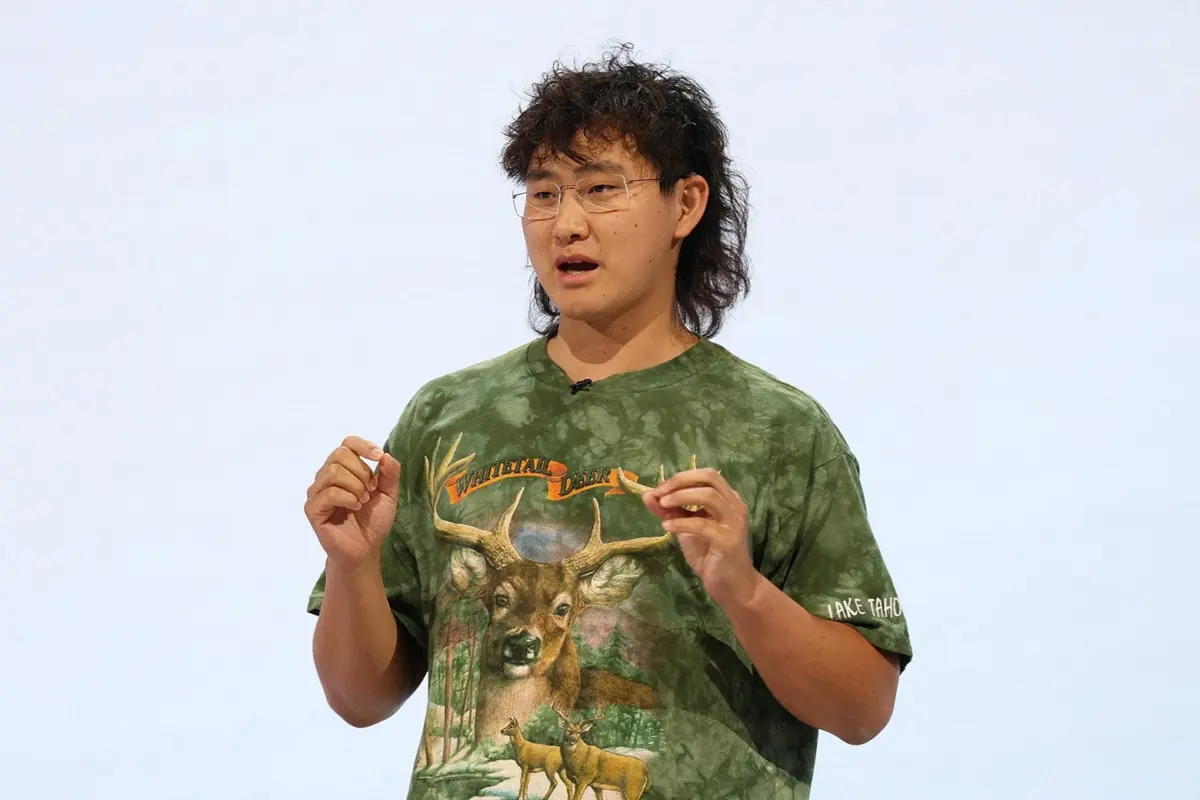
This aesthetic migration was on full display at the recent Meta Connect conference, where Alexandr Wang—the 29-year-old wunderkind turned Meta artificial intelligence executive—stepped onto the keynote stage. Eschewing the sharp corporate tailoring or sleek tech-bro gear typical of a multi-billion-dollar acquisition, Wang sported a shaggy mullet, wire-framed glasses, black joggers, Realtree camo Crocs, and a thrifted graphic T-shirt reading “Lake Tahoe.” The look instantly ignited online discourse, with social media users frantically speculating whether the ensemble carried a $3,500 luxury price tag. Wang quickly took to X to clarify the record, posting an annotated breakdown revealing his outfit cost a mere fraction of that—including a $30 thrifted tee and $5 Calvin Klein underwear.
Wang’s stylistic choices are far from an isolated eccentricity. Across the tech sector, industry leaders are aggressively shedding their corporate armor in favor of "countersignalling"—the deliberate deployment of casual, quirky, or unpretentious fashion to mask immense corporate power and soften public resistance to disruptive technologies. From Palmer Luckey’s perpetual Hawaiian-shirt-and-cargo-shorts uniform while building Pentagon warfare tech, to Zuckerberg’s transition into oversized graphic tees bearing slogans like “Building is my love language,” Silicon Valley is executing a coordinated masterclass in vibe management. This article examines the anatomy of this aesthetic shift, the high-stakes context of Meta’s multi-billion-dollar AI ambitions, and why the tech elite desperately need you to see them as your quirky, unthreatening peers.
Detailed Chronology: From Prodigy to Meta’s AI Vanguard
To understand Alexandr Wang’s current branding evolution, one must trace his meteoric and controversial rise through the tech landscape.
Five years ago, Wang was a 24-year-old phenom whose data-labeling startup, Scale AI, achieved a staggering $7.3 billion valuation. The milestone temporarily crowned him the world’s youngest self-made billionaire. At the time, media profiles favored a polished, albeit youthful, aesthetic: unbuttoned collars, crisp crew cuts, and an earnest expression that projected corporate maturity far beyond his years. Behind the headlines, however, Scale AI was building the foundational architecture for the modern AI boom. By employing massive networks of overseas contract workers—frequently under scrutiny for grueling labor practices—Scale AI manufactured the clean, labeled datasets and large-language-model evaluation services that propelled OpenAI, Meta, and others into the generative AI era.
Fast forward to the present day. Now 29, Wang has formally integrated into the corporate machinery of Meta following a staggering $14.3 billion investment and acquisition pact designed to fold him and his expertise directly into the social media giant’s core artificial intelligence labs.
Meta Connect served as Wang’s grand re-introduction to the public stage in this new capacity. Stepping under the stage lights in his now-infamous thrifted Lake Tahoe shirt, Realtree camo Crocs, and loose mullet, Wang cut a silhouette that baffled fashion commentators and tech analysts alike. Rather than looking like a titan of global technological infrastructure, he resembled a part-time record store clerk or an exhausted indie musician.
When online sleuths attempted to decode the outfit as high-end luxury streetwear—speculating about Balenciaga footwear and Prada trousers—Wang stepped in with precise, almost defensive transparency. By publishing an annotated diagram of his wardrobe, he transformed the discourse from a critique of tech wealth into a populist-adjacent comedy routine, complete with an arrow pointing to his $5 Calvin Klein underwear. Yet, beneath the internet banter lies a calculated transition: Wang was preparing to unveil Meta Muse, the company’s flagship suite of personal AI agents, while dressed as the least intimidating human being in the room.
Supporting Context & Metrics: The Mechanics of Countersignalling
The phenomenon of tech executives weaponizing casual fashion is rooted in a well-documented psychological strategy known as countersignalling—conveying high status or immense power by deliberately flouting the traditional markers of that status.
The Evolution of Tech Uniforms
- Mark Zuckerberg: Once defined by his rigid adherence to minimalist gray luxury tees, Zuckerberg has undergone a noticeable rebranding. Alongside his appearance at Meta Connect wearing an oversized shirt emblazoned with “Building is my love language,” his wardrobe has shifted to accommodate the rollout of Meta AI and heavy investments in consumer-facing spatial computing and smart glasses.
- Jensen Huang: Nvidia’s chief executive transformed from wearing standard-issue corporate polos into an unyielding ambassador of the black leather jacket, mirroring the rock-star status of his silicon chips that single-handedly power the global generative AI race.
- Palmer Luckey: The co-founder of defense tech firm Anduril provides the most jarring example of tactical fashion. While building autonomous, AI-driven battlefield drones and securing massive Pentagon contracts, Luckey maintains a strict dress code of Hawaiian shirts and cargo shorts. The tropical prints serve as visual noise, actively distracting from the lethal stakes of his enterprise.
The Financial Stakes at Play
The aesthetic choices of these executives coincide with unprecedented capital expenditure in artificial intelligence. Consider the scale of recent investments:
- Meta’s Scale AI Influx: Meta committed $14.3 billion to secure Wang and integrate Scale AI’s capabilities into its ecosystem. This infrastructure directly feeds Meta’s high-profile hardware and software gambits, including its AI-powered smart glasses, open-source coding models, and the Meta Muse personal agent ecosystem.
- The Surveillance Economy: Palantir’s aggressive marketing push—including trendy chore coats in its merchandise lines—arrived concurrently with multi-million-dollar government contracts, such as a $30 million agreement with Immigration and Customs Enforcement (ICE) to build an "ImmigrationOS" surveillance platform.
When corporations are deeply embedded in military applications, data harvesting, and pervasive behavioral tracking, the utility of looking like an approachable, slightly scruffy outsider becomes invaluable. By leaning into self-deprecating humor and budget clothing, executives create a psychological buffer between their products and the public’s growing anxieties regarding safety and surveillance.
Official Statements and Public Discourse
The intersection of tech power, fashion, and public relations has drawn fierce scrutiny from cultural critics and privacy advocates alike. As tech companies transition from abstract software providers to omnipresent personal agents integrated directly into human communication, the branding messaging has shifted from "move fast and break things" to "we are just like you."
During his Meta Connect presentation, Wang demonstrated the expanded capabilities of Meta Muse, highlighting new security measures, a dedicated Mac application, and international deployments. In an attempt to humanize the technology, Wang shared anecdotal use cases of how users might interact with their personal AI agents, noting instances ranging from planning a family vacation to managing the fallout of breaking a mother-in-law’s favorite china set.
Yet, critics argue that these charming, homespun anecdotes mask the aggressive data aggregation underpinning the platform. The mascot of Meta Muse—a glossy, cartoon assistant named Jolly—alongside competing cartoon mascots from OpenAI, reflects a deliberate design philosophy: make the artificial intelligence look like a harmless children’s toy rather than an advanced behavioral tracking algorithm.
In his social media defense regarding his outfit, Wang quipped, "Excuse me I must correct the record on this slander," vehemently denying that his glasses were Gucci or his shoes engineered by Balenciaga. By framing luxury accusations as "slander," tech executives actively cultivate an image of down-to-earth relatability.
However, cultural analysts remain unconvinced. The underlying reality of technocratic rule remains unchanged: regardless of whether an executive wears a $30 thrifted graphic tee or a $3,000 designer suit, the entities they command are actively consolidating unprecedented levels of wealth and behavioral data.
Future Outlook: The Mask-Off Technocracy
As we look toward the future of artificial intelligence and consumer technology, the tension between friendly aesthetics and raw corporate power will only intensify. The race to dominate personal AI agents—fought bitterly between Meta, OpenAI, and other tech giants—is not merely a technical competition; it is a battle for psychological real estate on billions of personal screens.
The era of the hoodie-wearing college dropout is officially dead, replaced by a more sophisticated archetype: the self-aware, thrift-shopping, meme-literate technocrat. These executives understand that direct intimidation no longer works in an era marked by antitrust investigations, labor disputes, and widespread public unease over automated surveillance. Instead, they offer us a comforting illusion. They dress like your high school friend who studied theater, or your cousin who dabbles in DJing, hoping that if you find them charming enough, you will overlook the vast machinery of data extraction humming quietly in the background.
When Mark Zuckerberg stood on stage declaring that "building is my love language" while sporting pastoral streetwear, and Alexandr Wang stepped up in Realtree Crocs to pitch omnipresent AI personal agents, they were executing a unified strategy for an uneasy public. They are building a world dominated by automated intelligence, but they want you to trust them while they do it. The clothes may change, but the empire-building remains absolute.