Executive Overview
In the high-stakes theater of modern technology, the physical presentation of Silicon Valley’s power brokers is undergoing a calculated metamorphosis. The archetypal uniform of the hyper-wealthy executive—the austere, monochromatic minimalism once popularized by Steve Jobs and later mimicked by a generation of venture capitalists—is being systematically dismantled. In its place, tech leaders are weaponizing a deliberate, anti-establishment casualness, adopting styles that project approachability, harmlessness, and anti-authoritarian charm.
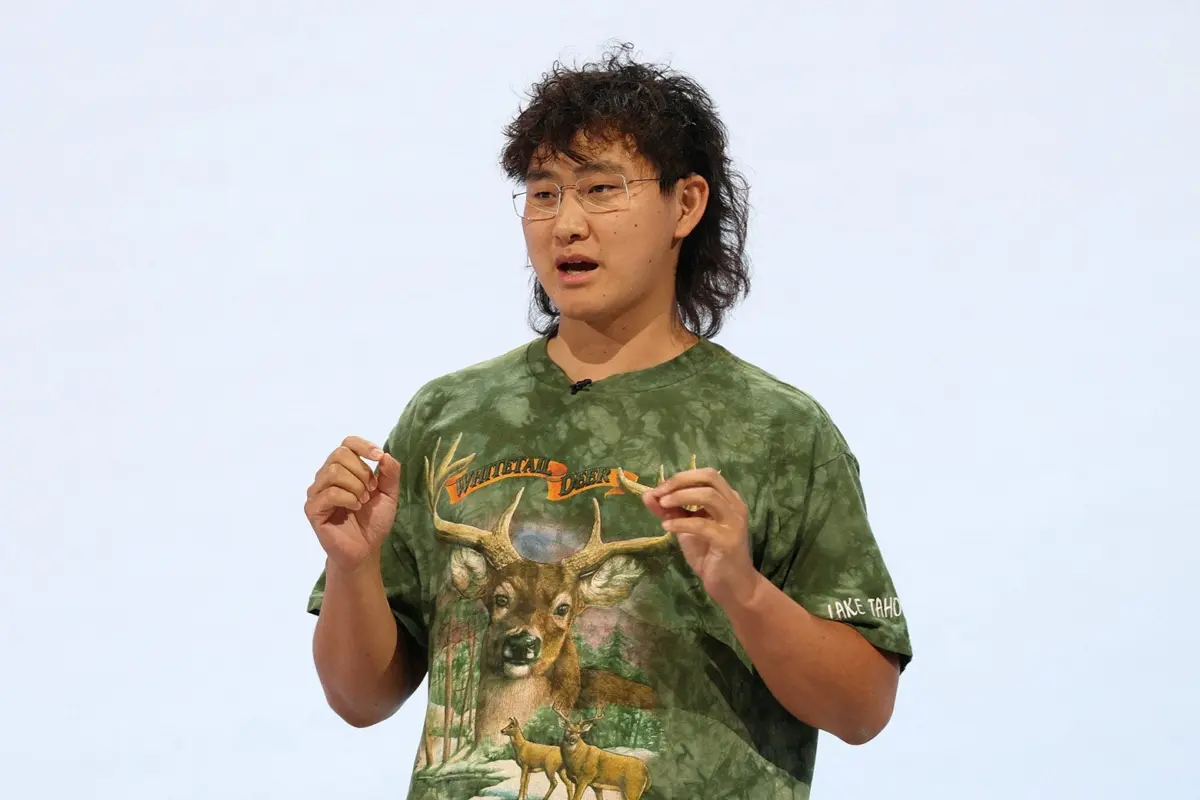
Nowhere is this shift more acutely illustrated than in the recent public rebrand of Alexandr Wang. Five years after his data-labeling juggernaut, Scale AI, rocketed to a $7.3 billion valuation and minted him the world’s youngest self-made billionaire at age 24, Wang has returned to the spotlight under a different banner. Following Meta’s blockbuster $14.3-billion absorption of Scale AI to anchor its artificial intelligence division, Wang took the stage at Meta Connect sporting a chaotic, thrift-store-inspired ensemble: a Realtree camouflage "Lake Tahoe" graphic T-shirt, black joggers, matching Realtree Crocs, wire-framed glasses, and a shaggy, undone mullet.
This stylistic pivot is not merely a quirk of personal expression; it is part of a broader, industry-wide phenomenon of "countersignaling." As Big Tech faces mounting public skepticism, regulatory scrutiny, and moral backlash over data privacy, autonomous warfare contracts, and the societal disruption wrought by generative AI, executives are desperately seeking to soften their edges. By dressing like part-time DJs, high school weed dealers, or church pastors, these architects of mass surveillance and automated dominance aim to project a singular message: We are just like you. You can trust us.
Detailed Chronology: The Evolution of an Aesthetic
To understand Wang’s dramatic stylistic pivot, one must trace the rapid, breathless trajectory of his career alongside the shifting cultural expectations of the tech elite.
2021: The Boy Wonder of Scale AI
When Scale AI hit its landmark $7.3 billion valuation, Alexandr Wang was the quintessential wunderkind. Gracing magazine covers with an unbuttoned popped collar, a clean-cut crew cut, and wide-eyed youthfulness, Wang fit the classic Silicon Valley mold of the wunderkind genius. Behind the fresh-faced innocence, however, lay a rapidly scaling operation. Scale AI quickly found itself under intense public and investigative scrutiny—most notably in San Francisco—over its labor practices. The company relied heavily on armies of overworked and underpaid contract workers across Africa and developing regions to curate, label, and annotate vast datasets essential for training the large language models (LLMs) powering the industry’s crown jewels. Despite these controversies, Wang remained the poster boy for raw, youthful technical prowess.
The Meta Acquisition and the Meta Connect Debut
Fast-forward to the present day. Now 29 and securely positioned as an elite executive at Meta following a $14.3-billion ecosystem integration, Wang’s aesthetic has executed a 180-degree turn. Stepping onto the stage at Meta Connect to present updates to Meta Muse—Meta’s flagship push into personal AI agents—Wang stunned tech observers with his outfit.
The internet immediately erupted into speculative analysis. Online commentators assumed the look was a high-fashion, irony-soaked statement, guessing that the Crocs were Balenciaga collaborations and the joggers bore a Prada label, putting the total cost of the outfit at upwards of $3,500. Wang quickly took to X (formerly Twitter) to set the record straight with an annotated diagram. He revealed that the graphic tee was a $30 thrift-store find, his Calvin Klein underwear cost $5, and his footwear consisted of standard Realtree hunting-collaboration Crocs.
The Broader Silicon Valley Makeover
Wang is far from alone in his quest for a wardrobe overhaul. The tech industry has become a petri dish of calculated image transformations:
- Mark Zuckerberg: Once bound indefinitely to gray Brunello Cucinelli crewnecks, the Meta CEO has pivoted to oversized Amiri tees and, more recently, a "Hillsong pastor" aesthetic featuring slogans like "Building is my love language."
- Jensen Huang: The Nvidia chief executive traded garden-variety polo shirts for an omnipresent, signature black leather jacket aesthetic that has become as recognizable as his company’s GPUs.
- Jeff Bezos: The Amazon founder transitioned from a mild-mannered executive into a tabloid fixture sporting patterned silk shirts and aviator sunglasses that evoke the look of a chaotic corporate vacation.
- Palmer Luckey: The 34-year-old co-founder of defense tech firm Anduril builds the next frontier of autonomous battlefield weaponry for the Pentagon while maintaining a strict uniform of Hawaiian shirts and cargo shorts.
Supporting Context & Metrics: The High Stakes of "Countersignaling"
The pivot toward casual, disarming aesthetics is directly proportional to the rising social and political friction surrounding artificial intelligence. As the public grows increasingly wary of the technology’s footprint—from environmental degradation and algorithmic bias to mass surveillance and automated warfare—tech companies are facing a crisis of legitimacy.
The Economics of Trust and Acquisition
The financial stakes underpinning these image campaigns are staggering. Meta’s $14.3-billion injection into Scale AI was not merely an investment in infrastructure; it was an acquisition of talent meant to spearhead Meta’s aggressive push into foundational AI models, smart glasses, open-source coding architectures, and personal agent software.
When a company pours tens of billions of dollars into technologies that consumers view with justified apprehension—such as always-on AI glasses or invasive personal data-aggregators—the corporate image must adapt. It is significantly harder to fear a product when the man presenting it looks like someone who might bum a cigarette outside an indie rock concert.
The Military-Industrial Complex Goes Casual
This psychological distancing through fashion is most starkly evident in the defense tech sector. Palantir, which secured a multi-million-dollar contract with Immigration and Customs Enforcement (ICE) to build the controversial "ImmigrationOS" surveillance platform, raised eyebrows by releasing a trendy "chore coat" in its corporate merch line. Days prior, the company published a combative mini-manifesto defending its mandate to build technology designed to execute warfare overseas.
Similarly, Anduril’s Palmer Luckey pairs the development of AI-powered battlefield drones with the relaxed, vacation-ready aesthetic of a tropical resort attendee. This is textbook countersignaling: projecting a harmless, counter-cultural identity precisely while engineering systems designed for lethal efficiency. The visual dissonance acts as a psychological buffer, soothing public anxiety by making catastrophic power look approachable.
Official Statements and Industry Discourse
The intersection of fashion, corporate PR, and technological deployment has sparked fierce debate among cultural critics, ethicists, and industry insiders.
When confronted with the viral speculation surrounding his Meta Connect outfit, Alexandr Wang defended his authenticity on social media, writing:
"Excuse me I must correct the record on this slander."
Using an annotated graphic, he insisted that his look was born of thrift rather than haute couture, pushing back against the idea that he was flaunting ultra-luxury wealth. Yet, this very defense plays into the populist theater of modern tech leadership. By emphasizing that his underwear cost $5 and his shirt was thrifted, Wang distances himself from the predatory image of the billionaire class, even as he oversees infrastructure that consolidates unprecedented control over global data streams.
Critics, however, remain entirely unpersuaded. Observers have noted that the gamification and "cute-ification" of AI extends far beyond human wardrobes and directly into product design. Both Meta and OpenAI have increasingly relied on glossy, cartoonish mascots to represent their personal AI agents—such as Meta’s mascot, Jolly, or OpenAI’s playful UI elements.
As noted by cultural commentators, coating multi-billion-dollar surveillance and data-harvesting engines in the aesthetic of a children’s cartoon or a slacker’s wardrobe is a deliberate strategy. It sanitizes the machinery of data extraction, replacing cold technocratic authority with an inviting, frictionless consumer experience.
Future Outlook: The Mask-Off Technocracy
We have officially entered an era of mask-off technocratic rule. The general public is acutely aware that a handful of unelected executives wield unprecedented influence over human communication, labor markets, national security, and geopolitical conflict. The concentration of wealth and power held by modern tech monopolies has no historical precedent.
Yet, despite this widespread awareness, the machinery of adoption rolls forward. Tech companies do not necessarily need the public to love them; they simply need consumers to find their tools too frictionless and entertaining to resist.
This is where the billionaire in Crocs finds his true utility. By dressing down, cracking self-deprecating jokes on social media, and wrapping complex algorithms in the comforting armor of Gen-Z and millennial counter-culture aesthetics, executives like Wang are attempting to bridge the impossible gap between dystopian corporate power and everyday relatability.
As Zuckerberg stood alongside Wang at Meta Connect—sporting a tee emblazoned with the ironic slogan "Building is my love language"—the subtext was clear. The tech elite are no longer pretending to be humble servants of the public good; they are architects of a new reality. They would simply prefer that you don’t look too closely at the machinery while you slide down their data-driven water slide—preferably while wearing comfortable, unpretentious footwear.