Executive Overview
In a major leap forward for serverless computing and cloud-native architecture, Amazon Web Services (AWS) has announced the general availability of an enhanced custom event bus for Amazon EventBridge. Purpose-built to address the mounting structural complexities of multi-account, enterprise-wide event-driven applications, this new paradigm fundamentally alters how modern engineering organizations handle distributed event routing.
For years, organizations building event-driven systems on Amazon EventBridge typically initiated their journey with a single custom event bus housed neatly within a solitary AWS account—an approach that functions harmoniously when managed by a single, tightly knit team. However, as serverless adoption proliferates across large enterprises, organizational scaling introduces architectural friction. Adhering to AWS multi-account best practices, businesses routinely find themselves provisioning isolated accounts for individual teams. To bridge these infrastructural silos and successfully route events across accounts, platform teams have historically been forced to deploy intricate webs of cross-account rules and bus-to-bus configurations.
This work-around inevitably reintroduced the very operational friction that serverless architectures were originally designed to eliminate. Platform engineering teams lost critical visibility into event subscription topologies, cross-account routing charges compounded unpredictably, and workloads requiring stringent capabilities like event ordering were forced to implement brittle custom workarounds or abandon serverless patterns altogether.
The newly released enhanced custom event bus solves these friction points at the root. By allowing organizations to deploy a single, centralized event bus shared transparently across all AWS accounts within an entire organization, AWS has eliminated the administrative overhead of cross-account configurations. Bolstered by native event ordering guarantees, a streamlined and powerful Subscriber resource, robust content-based deduplication, payload deserialization features, and a modernized ingress-egress pricing model, this release signals a mature evolution in how cloud architects design, scale, and govern enterprise-grade event-driven ecosystems. Existing classic event buses remain fully supported and operational, ensuring a seamless, non-disruptive migration path for legacy workloads.
Detailed Chronology: From Multi-Bus Workarounds to Unified Organization-Wide Governance
To fully appreciate the significance of this release, it is essential to trace the architectural evolution of Amazon EventBridge and the operational challenges that motivated its engineering teams to conceptualize an entirely new bus resource.
Phase 1: The Single-Account Paradigm
In the early days of serverless event-driven design, applications were predominantly monolithic within the context of a cloud account. Developers relied on a single custom event bus. Publishers broadcasted state changes, and localized rules evaluated patterns to trigger downstream targets such as AWS Lambda functions or Amazon Simple Queue Service (SQS) queues. The operational overhead was minimal, and observability remained high because all producers, routers, and consumers resided within clear organizational boundaries.
Phase 2: The Multi-Account Proliferation and Architectural Friction
As cloud footprints expanded, enterprise security and compliance mandates required organizations to distribute workloads across hundreds or even thousands of distinct AWS accounts. To maintain decoupled architectures, teams needed to publish and consume events across these structural boundaries.
The standard approach required platform engineers to construct complex cross-account permission policies, resource-based policies, and bus-to-bus target chains. This introduced several cascading issues:

- Loss of Visibility: Central platform teams could no longer easily track who was subscribing to which events, creating an obscured web of dependencies.
- Cost Inefficiencies: The legacy pricing model charged for events as they traversed bus boundaries and cross-account targets, leading to unpredictable cost multiplication at scale.
- Operational Bottlenecks: Application teams were frequently blocked, waiting on platform administrators to provision and wire up cross-account routing permissions before they could deploy new microservices.
Phase 3: The Introduction of the Enhanced Custom Event Bus
Recognizing these deep-seated pain points, AWS engineers set out to redesign the custom event bus from the ground up. Announced today, the enhanced custom event bus introduces native organization-wide sharing, completely circumventing the need for manual cross-account wiring.
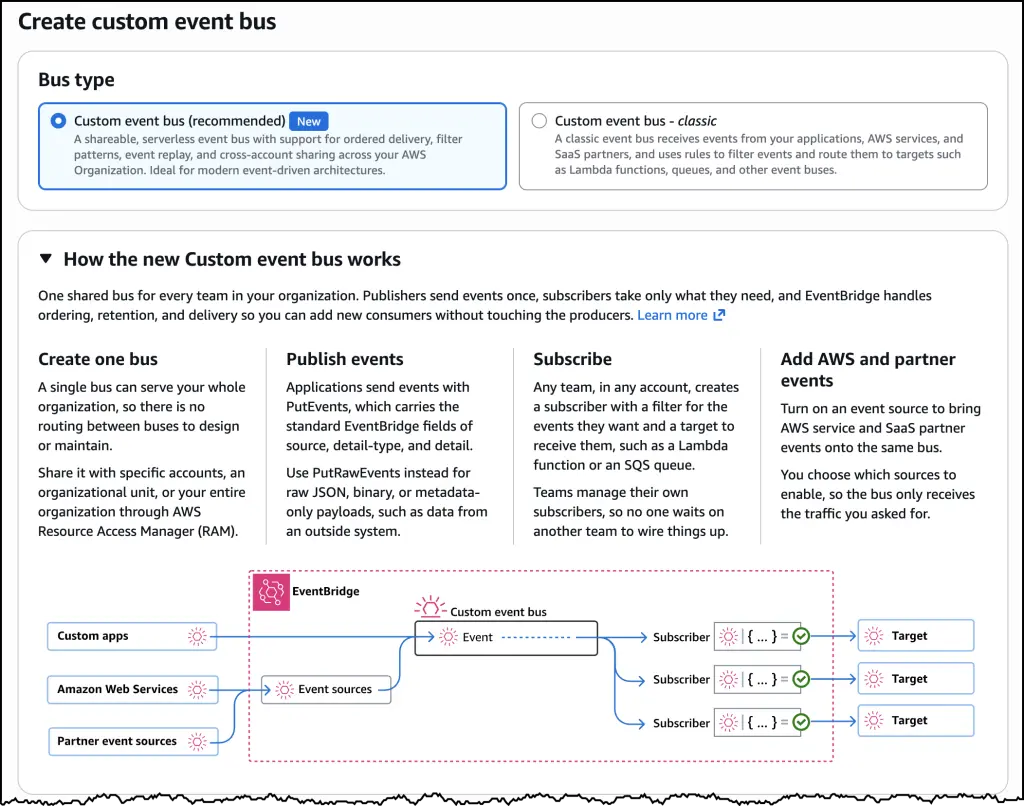
When navigating the AWS Management Console, architects are now greeted with a clear bifurcation on the Create custom event bus page: Custom event bus (the recommended new option featuring ordered delivery, filter patterns, event replay, and cross-organization sharing) and Custom event bus — classic (retained to ensure uninterrupted continuity for existing production workloads).
Configuring the new bus leverages AWS Resource Access Manager (AWS RAM). By turning on "Enable event bus sharing" and selecting "Allow sharing only within your organization," platform administrators can target an entire AWS account ID, an entire organizational unit (OU), or specific IAM roles and users. This integration means teams can instantly publish and consume on a shared infrastructural backbone without writing a single line of custom cross-account plumbing.
Supporting Context & Metrics: Solving Scale, Ordering, and Deduplication
The architectural enhancements embedded within the new custom event bus extend far beyond simple resource sharing. AWS has systematically addressed the most demanding technical requirements of modern distributed systems, focusing on throughput capacity, sequential integrity, and payload transformation.
Expanded Quotas and Organization-Wide Visibility
Fragmentation has long been an unwelcome side effect of strict resource limits. In previous iterations, when subscriber limits on a single bus were reached, organizations were forced to fracture their event topologies across multiple disparate buses, compounding routing complexity.
The enhanced custom event bus ships with a robust default quota of 10,000 Subscribers per bus, with provisions to request even higher limits upon enterprise demand. This expansive threshold enables platform teams to establish a true, unified central event backbone for the entire enterprise. Publishers emit events into the ecosystem without needing prior knowledge of downstream consumers, while application teams independently construct and manage their own subscriptions. Centralized visibility remains intact, granting platform administrators fine-grained control over publisher and subscriber permissions.
Solving the Event Ordering Dilemma
Event-driven design principles traditionally dictate that consumers should be engineered around asynchronous, decoupled patterns where the exact sequential timing of events is irrelevant. However, real-world business domains frequently break this idealized assumption.
Consider a modern logistics or fleet management application: vehicle telemetry and driver location updates must arrive and be processed in strict chronological sequence. If out-of-sequence events are processed concurrently, routing algorithms and real-time tracking systems can make critical decisions based on stale or inverted data states.

The enhanced custom event bus natively bridges this gap by supporting both asynchronous and ordered patterns on the very same bus:
- EventGroupId Integration: Publishers can attach an optional
EventGroupIdpayload attribute when emitting an event. - Sequential Delivery: EventBridge ensures that events sharing the same
EventGroupIdare delivered strictly in sequence to subscribers configured for ordered delivery. - Concurrent Freedom: Simultaneously, other subscribers on that same bus can consume those exact same events asynchronously without ordering constraints.
To robustly support ordered processing, the enhanced bus introduces synchronous invocation for targets such as AWS Lambda. In synchronous mode, EventBridge waits for confirmation of successful processing before acknowledging the event. This elegantly eliminates the historical anti-pattern of placing an Amazon SQS FIFO queue directly between an event bus and a Lambda function purely to enforce sequencing and reliability.
The Unified Subscriber Resource
Managing event subscriptions in legacy EventBridge environments required developers to juggle a fragmented array of distinct resources: individual rules, isolated target configurations, scattered retry policies, and separate dead-letter queue (DLQ) destinations.
The enhanced custom event bus introduces the consolidated Subscriber resource. This unified construct encapsulates event filtering, target routing, retry logic, and failure handling into a single, highly manageable entity. Furthermore, Subscribers feature variable start time options, drastically simplifying scenarios where teams onboard new consumer applications or initiate event replays to recover from downstream application faults or hydrate newly deployed services.
Advanced Event Evaluation: Deduplication and Transformation
Distributed networks are notoriously prone to transient network failures, timeouts, and packet retries, which frequently result in duplicate event deliveries.
- Content-Based Deduplication: Publishers can enable content-based deduplication directly on the event bus. EventBridge computes a cryptographic hash of the meaningful components within the event payload, automatically dropping duplicate transmissions that arrive within a five-minute sliding window. This grants publishers exactly-once delivery semantics for erratic sources that lack native idempotency tokens, without requiring developers to manually generate and track deduplication IDs.
- JSONata and Payload Deserialization: Downstream consumers often require data structured in specific schemas that differ from the publisher’s output. Subscribers can leverage powerful JSONata expressions to evaluate, reshape, extract, rename, or compute new values within an event payload before it reaches its target. Additionally, for organizations producing events formatted in Apache Avro or Protocol Buffers (Protobuf), EventBridge can natively deserialize these payloads into JSON. This enables subscribers to execute fine-grained filtering and routing across the entire rich event payload without necessitating custom parsing microservices.
Official Statements and Industry Impact
Industry analysts and AWS internal engineering leadership view this release as a watershed moment for serverless governance.
"As enterprises embrace event-driven architectures to build decoupled, highly responsive microservices, the operational reality of managing cross-account permissions and routing infrastructure has threatened to undermine the core promise of serverless computing," noted a senior AWS product management spokesperson during the release briefing. "With the enhanced custom event bus, we are removing that architectural drag. By unifying resource sharing via AWS RAM, introducing native event ordering with EventGroupId, consolidating management via the new Subscriber resource, and offering a modernized economic model, we are empowering platform and development teams to scale their event-driven applications with unprecedented simplicity, confidence, and cost efficiency."
Early enterprise adopters participating in the preview program have echoed these sentiments, highlighting how the new architecture drastically reduces the operational toil associated with maintaining complex multi-account infrastructure. Platform engineers no longer act as gatekeepers for cross-account event routing, while developers enjoy the structural freedom to innovate rapidly within their assigned AWS accounts while maintaining strict data governance.
A Modernized Pricing Model Tailored for Scale
Economics play a decisive role in the architectural choices of large enterprises. In legacy multi-bus configurations, compounding per-event charges for cross-account routing and bus-to-bus hops could quickly inflate cloud expenditure, occasionally discouraging teams from adopting optimal event-driven patterns.
The enhanced custom event bus introduces a modernized ingress and egress throughput pricing model:
- Publishers pay strictly for the volume of events ingested into the bus.
- Subscribers pay for the volume of events successfully delivered to their respective targets.
This clean separation of cost ownership aligns financial attribution directly with resource utilization, ensuring predictable and cost-effective scaling for both publishing business units and consuming teams. Detailed pricing schedules are publicly available on the official EventBridge Pricing Page.
Future Outlook: The Next Wave of Serverless Innovation
The release of the enhanced custom event bus marks a foundational evolution in how AWS approaches enterprise-scale event routing. By resolving long-standing challenges surrounding multi-account visibility, payload deserialization, content deduplication, and ordered processing, AWS has effectively future-proofed Amazon EventBridge for the next generation of mission-critical distributed workloads.
Immediate Availability
The enhanced custom event bus is available immediately in a wide array of global AWS Regions, including:
- Americas: US East (N. Virginia, Ohio), US West (Oregon)
- Europe: Europe (Ireland, Frankfurt, Stockholm, Spain)
- Asia Pacific: Asia Pacific (Hong Kong, Malaysia, Mumbai, Singapore, Sydney, Thailand, Tokyo)
Cloud architects and platform engineers can provision their first enhanced custom event bus today using the AWS Management Console, the AWS Command Line Interface (AWS CLI), or via automated infrastructure-as-code (IaC) deployment pipelines leveraging EventBridge APIs.
As organizations increasingly transition complex legacy monoliths to agile, event-driven microservices, innovations like the enhanced custom event bus provide the structural foundation necessary to build scalable, resilient, and highly secure cloud architectures without compromising operational simplicity. To begin exploring the new capabilities, developers and platform administrators can consult the official Amazon EventBridge Documentation or navigate directly to the EventBridge Console.