Executive Overview
For half a century, Charles M. Schulz’s Peanuts stood as a towering monument to American newspaper comic strips, capturing the melancholic, philosophical, and humorous dimensions of childhood. Yet, within this vast tapestry of suburban angst and philosophical musings, one character transcended the strip’s human framework: Snoopy.
While later iterations of the world-famous beagle elevated him into fantastical personas—such as the World War I Flying Ace or the sunglasses-wearing campus hipster Joe Cool—Schulz’s foundational brilliance often stemmed from grounding Snoopy in the raw, authentic absurdity of canine behavior.
This retrospective examines five quintessential Peanuts comic strips that strip away the high-flying daydreams to focus exclusively on the core essence of doghood. Rather than leaning into the sentimental "go hug your dog" tropes or the surrealist fantasies that defined his later years, these specific strips showcase Schulz’s masterclass in comedic writing, highlighting the simple, frustrated, and deeply relatable realities of living with a canine companion.
Detailed Chronology: Tracing the Evolution of Canine Comedy
To understand how Schulz mastered the comedic timing of a dog’s internal life, one must examine the chronological trajectory of these five distinct comic strips. From the rough-and-tumble early years of the 1950s to the refined philosophical irony of the later decades, Schulz continuously redefined what a comic strip dog could achieve.
5. The Easy Life of a Dog: Examining Envy
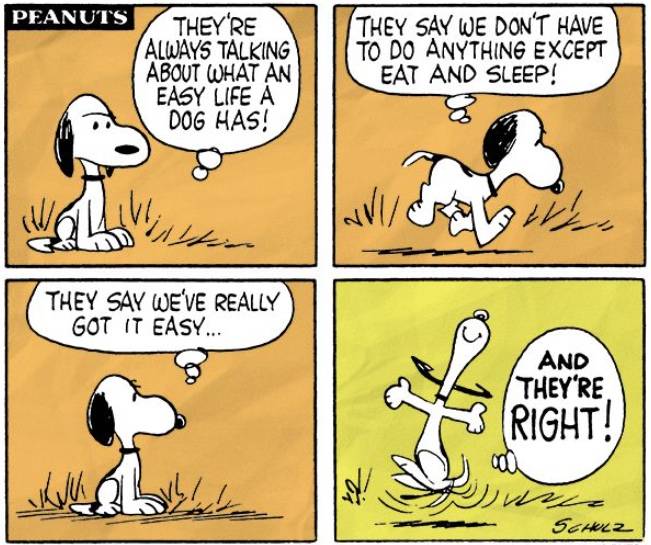
In the lower-tier echelon of canine responsibilities, the domestic dog occupies a tier of enviable luxury. Devoid of employment obligations, tax burdens, or existential career panic, a dog’s daily agenda consists of eating, resting, and occasionally chasing a thrown stick.

In this strip, Schulz addresses the quiet jealousy that humans frequently harbor toward their pets. Snoopy leans directly into this dynamic, casually validating the human suspicion that being a dog is, objectively, a fantastic gig. There are no corporate boardrooms or school reports; there is only the blissful simplicity of existence. Snoopy’s delivery—subtle, smug, and unapologetic—rubs salt into the wound of human anxiety, proving that Schulz understood the quiet comedic friction between human overthinking and canine contentment.
4. January 6, 1952: When Snoopy Bit Charlie Brown
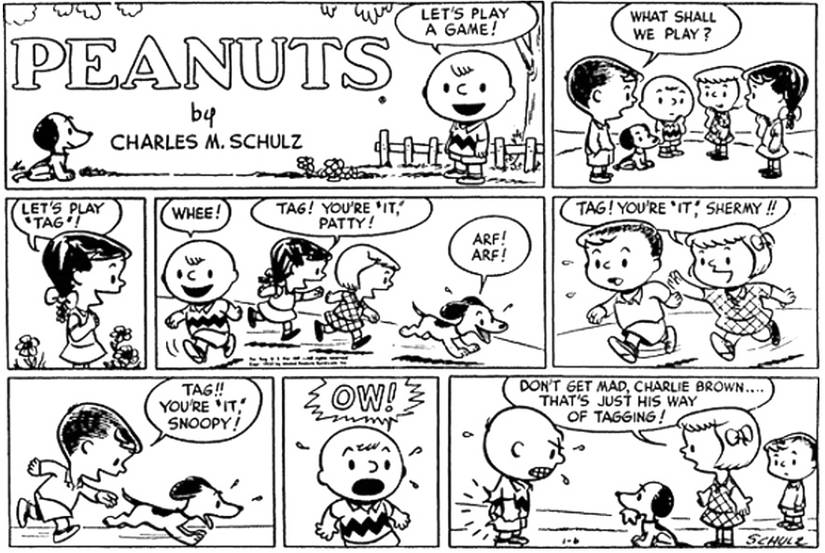
Historical context is crucial when evaluating the evolution of Peanuts. Having debuted in October 1950 as a six-day-a-week daily strip, Peanuts expanded to the Sunday comics section on January 6, 1952. In these early formative years, Snoopy had not yet cultivated the hyper-intellectual, anthropomorphic personality traits that would later define his global brand. He was, by all accounts, a remarkably normal, albeit expressive, dog.
This reality is immortalized in a panel that startles modern readers accustomed to the polite beagle of later cartoons: Snoopy biting Charlie Brown.
The narrative setup involves the neighborhood kids engaging in a standard game of tag. One child tags Snoopy, who instinctively responds in the only language a traditional dog knows—by defending his personal space with his teeth. The result is classic Schulz slapstick: Charlie Brown stands stunned, shouting in pain with the back of his shorts conspicuously torn away, glaring angrily at an entirely innocent Snoopy.
Enter Patty (the original iteration of the character, distinct from the later Peppermint Patty), who delivers the punchline with chilling casualness:

"Don’t get mad, Charlie Brown… That’s just his way of tagging!"
It is a jarring reminder that before Snoopy was sleeping atop his doghouse writing the great American novel, he was capable of shredging Charlie Brown’s trousers during a casual afternoon game.
3. The Meaning of Life (According to an Empty Bowl)
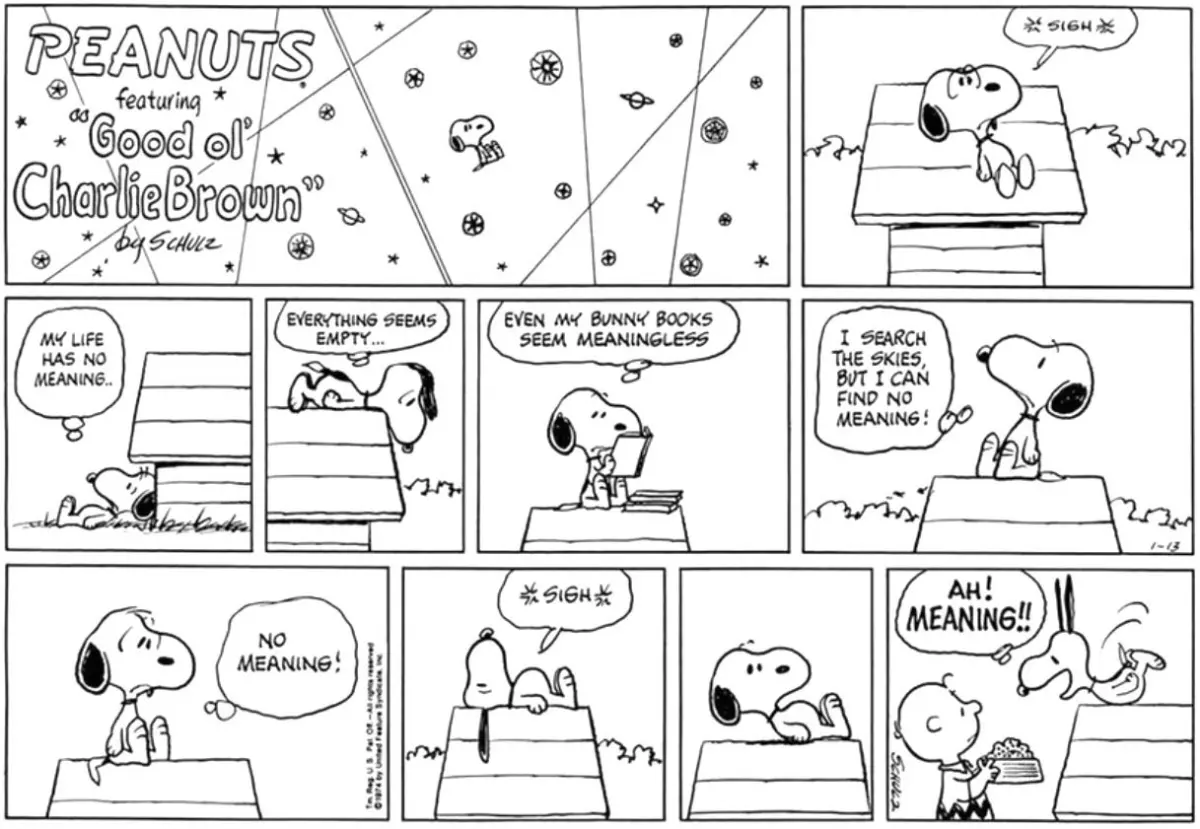
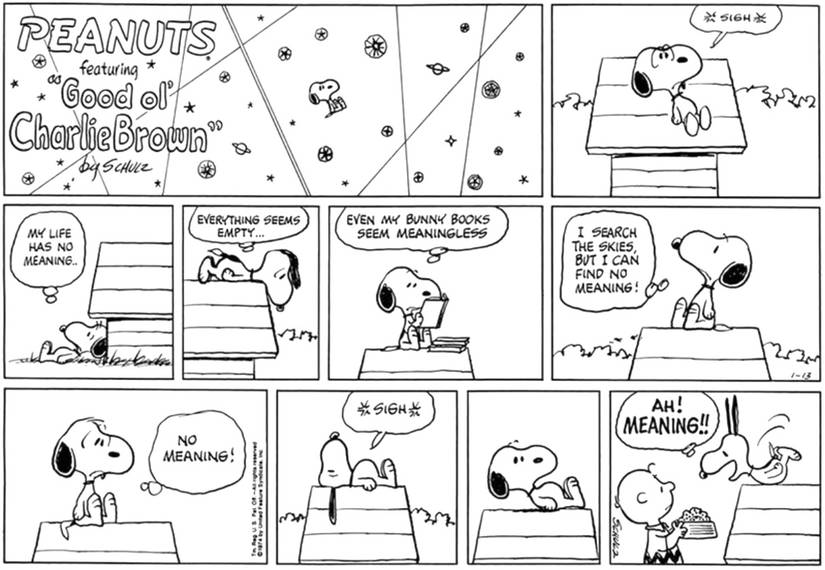
One of Schulz’s greatest rhetorical tricks was endowing Snoopy with deep existential malaise, only to shatter the illusion with a primal animal instinct.
In this strip, Snoopy spirals into a profound psychological crisis. He sits motionless, projecting the unmistakable aura of a deeply depressed human navigating a mid-life (or mid-dog-years) existential dread. Readers are drawn into genuine empathy, wondering what inner demons are plaguing the beagle’s psyche. Is he questioning his place in the universe? Is he grappling with his identity as a non-human entity in a human world?
The tension builds across multiple panels until Charlie Brown walks into the frame carrying a full bowl of dog food.
Instantly, the existential fog lifts. The philosophy vanishes. The higher-order thinking evaporates. Snoopy dives into the bowl with unbridled enthusiasm, his life’s meaning definitively restored. Schulz delivers a masterclass in subversion: Snoopy may intellectualize like a man, but underneath the existential veneer, he remains entirely, unapologetically a dog.
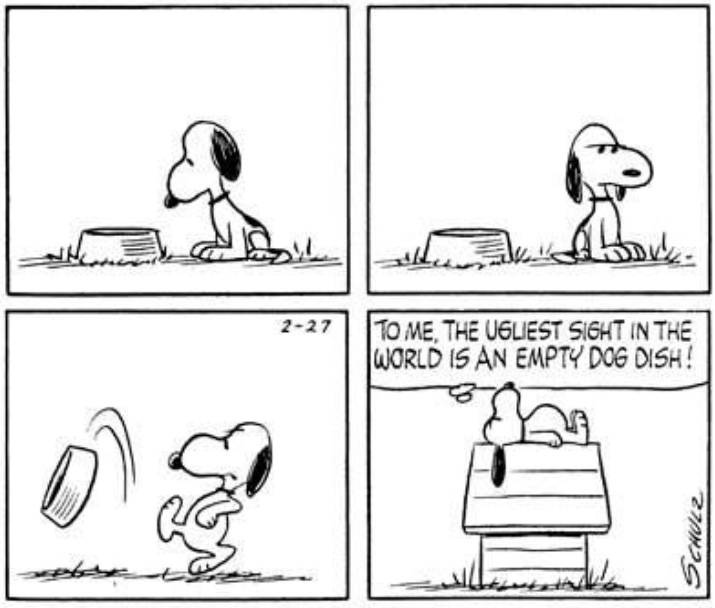
2. One Pissed Pup: The Wrath of an Empty Dish
Dogs possess a delicate emotional spectrum, but few events trigger absolute outrage quite like a neglected mealtime.
Because Snoopy is overwhelmingly characterized by his cheerful, imaginative resilience, seeing him genuinely furious is a rare, high-value comedic event. In this strip, Schulz captures the raw, indignant fury of a dog whose food bowl has been left empty. There is no subtle melancholy here; there is only pure, unadulterated canine wrath.
Schulz milks the visual humor of a domesticated pet glaring daggers at his caretakers, weaponizing the universal pet-owner fear: What happens when the animal realizes we control the food supply?
1. Dog Sleeping Habits: The Intersection of Humor and Affection
Ranking at the top of this dog-centric comedic compilation is a strip that flirts dangerously with the boundaries of Schulz’s own rules. While the author originally set out to curate strictly funny strips devoid of sappy sentimentality, the undeniable reality of Peanuts is that humor and sweetness are inextricably linked.
This strip addresses a profoundly specific canine behavior: the strange, tangled, and seemingly uncomfortable positions dogs assume when they sleep, coupled with their uncanny ability to find warmth wherever they can. As Lucy pontificates on the biological and behavioral reasons behind these quirky sleeping habits, the visual punchline features Snoopy soundly asleep, draped directly across Linus’s head like a heavy fur stole.
It is undeniably cute, yet it functions as a brilliant structural joke about the physical reality of sharing space with an animal that views your body as an extension of its bedding.
Supporting Context & Metrics: The Anatomy of a Comic Empire
To fully grasp the weight of these strips, one must look at the unprecedented scale and cultural footprint of Charles Schulz’s work.
| Metric / Category | Historical Data |
|---|---|
| Active Run Duration | October 2, 1950 – February 13, 2000 (nearly 50 years) |
| Total Daily & Sunday Strips | 17,897 individual strips published |
| Global Syndication Peak | Read in over 2,600 newspapers across 75 countries and 21 languages |
| Primary Canine Subject | Snoopy (introduced two days after the strip’s debut, October 4, 1950) |
Schulz’s genius lay in his economy of line and economy of words. A typical Peanuts strip utilizes a four-panel grid to establish premise, build tension, execute a comedic pivot, and deliver a verbal or visual punchline. When applied to canine behavior, this architectural restraint allowed Schulz to turn mundane domestic observations into universal truths about companionship.
Official Statements and Critical Reception
Literary critics and cartoon historians have long debated the precise mechanism that allowed Peanuts to maintain its cultural dominance for half a century. Unlike action-adventure comics or fast-paced gag strips, Schulz prioritized quiet observational humor.
In historical retrospectives on his career, Schulz frequently noted that Snoopy’s internal monologue was a narrative necessity born out of isolation:
"Initially, Snoopy was just a dog who functioned within the neighborhood dynamic. But as the strip evolved, giving him an internal life allowed me to comment on human behavior from the perspective of an outsider who didn’t have to play by human rules."
Comics historians have similarly highlighted Schulz’s unique ability to oscillate between slapstick and philosophy. According to archival analyses from cartoon preservation societies, Snoopy’s transition from a standard quadruped biting Charlie Brown’s trousers to an upright, fantasy-prone intellectual represents one of the most successful character evolutions in media history. Yet, as these five selected strips prove, Schulz never forgot the comedic goldmine hidden in plain sight: the simple, stubborn, food-obsessed nature of an actual dog.
Future Outlook: The Enduring Legacy of Schulz’s Canine Philosophy
As Peanuts continues to reach new generations through digital syndication, animated specials, and archival publishing projects, the core appeal of Schulz’s work remains untouched.
In an era dominated by hyper-processed media and fast-paced digital content, the quiet rhythm of a four-panel comic strip offers a refreshing counter-narrative. The humor found in an empty food bowl, a torn pair of trousers, or a dog aggressively weaponizing its own lifestyle simplicity transcends generational divides.
Charles Schulz did not merely draw a cartoon dog; he mapped out the emotional blueprint of domestic coexistence. Long after the Flying Ace has landed his Sopwith Camel for the final time, it is these grounded, laugh-out-loud explorations of canine nature that remind us why Snoopy remains the undisputed king of the funny pages.