Executive Overview
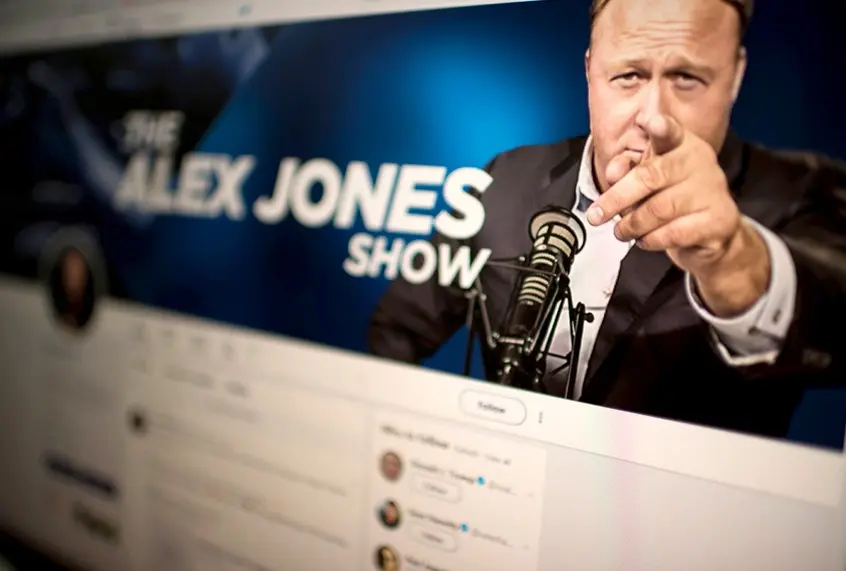
In August 2018, the digital landscape underwent a profound structural shift regarding content moderation, free speech, and corporate responsibility. Twitter’s decision to impose a temporary, seven-day suspension on Infowars founder and far-right conspiracy theorist Alex Jones marked a watershed moment for the platform. For months, Twitter had stood as a lonely outlier among major technology giants, steadfastly defending its choice to keep Jones active on its platform while competitors like Apple, Facebook, Pinterest, Spotify, and YouTube (Google) purged his channels for egregious violations of hate speech and harassment policies.
The suspension was triggered not by the relentless, long-standing misinformation campaigns that defined Jones’s career—such as his denials of mass casualty events—but by a direct, actionable breach of Twitter’s policies against inciting violence. Specifically, Jones had used his personal account to urge supporters to ready their "battle rifles" against journalists and political opponents.
This report provides a comprehensive examination of the events surrounding Twitter’s reversal. It details the chronology of the suspension, the public justifications offered by Twitter CEO Jack Dorsey, the broader industry-wide crackdown on Jones’s digital empire, and the contentious debate over whether temporary "timeouts" are an effective tool or an inadequate half-measure in the fight against coordinated disinformation and targeted harassment.
Detailed Chronology: The Road to the Seven-Day "Timeout"
The Pre-Ban Landscape: Standing Alone
Throughout late July and early August 2018, Silicon Valley experienced a synchronized reckoning over the unchecked proliferation of extremist content. For years, conspiracy theorists, hate groups, and radical commentators had leveraged social media algorithms to build massive audiences, monetize hate, and harass private citizens. Alex Jones, operating through his media outlet Infowars, was the epicenter of this ecosystem.
By early August, the dam broke. On August 6, 2018, a wave of major platforms enacted sweeping bans against Jones. Apple removed several Infowars podcasts from its directory, citing rules against inciting violence and hate speech. Simultaneously, Facebook unpublished four of Jones’s primary pages for violating hate speech and harassment guidelines. Spotify purged multiple episodes of The Alex Jones Show, YouTube terminated the main Infowars channel (which boasted over 2.4 million subscribers), and Pinterest disabled accounts associated with Jones.
Despite this unprecedented cross-industry alignment, Twitter maintained a starkly different policy. In a series of public defenses, Twitter executives argued that Jones had not technically violated their specific terms of service at that moment. The company maintained that banning users based on off-platform behavior or general outrage would create a subjective standard dependent on the shifting political whims of Silicon Valley executives. Consequently, Infowars and Jones remained active on Twitter, making the microblogging platform the final mainstream digital refuge for the controversial broadcaster.
The Catalyst: The "Battle Rifles" Tweet
Twitter’s defensive posture collapsed on Tuesday, August 14, 2018. In a post that directly breached the platform’s core safety policies, Jones used his personal account to escalate tensions, calling on his followers to get their "battle rifles" ready against various perceived adversaries, including members of the mainstream media.
The tweet was an explicit violation of Twitter’s rules and policies, which explicitly prohibit individuals or organizations from using or promoting violence against civilians to further their ideological or political causes. Facing undeniable proof of a direct rule infraction, Twitter took immediate action, locking Jones out of his personal account and the official Infowars account for a mandatory seven-day period.
Supporting Context & Metrics: A History of Exploitation and Defamation
To fully understand the gravity of Twitter’s action—and the criticism it faced for being too lenient—one must examine the vast catalog of harmful falsehoods Jones promoted over the preceding decades.
A Legacy of Conspiracy and Harassment
For years, Jones used his platform to broadcast predatory hoaxes that frequently resulted in real-world harassment campaigns against vulnerable individuals:
- 9/11 "Trutherism": Jones aggressively promoted the conspiracy theory that the September 11 terrorist attacks were orchestrated by the United States government, causing deep distress to grieving families.
- Targeted Accusations of Pedophilia: Jones repeatedly launched baseless, defamatory accusations of pedophilia against public officials, private citizens, and political figures alike—including high-profile targets such as Special Counsel Robert Mueller and tech executives like Mark Zuckerberg.
- The Sandy Hook Massacre Denial: Perhaps most infamously, Jones spent years claiming that the tragic 2012 mass shooting at Sandy Hook Elementary School—which claimed the lives of 20 children and six staff members—was an elaborate hoax staged by the government using "crisis actors."
The Real-World Financial Fallout
The consequences of Jones’s digital reach were not confined to the virtual world. The families of the Sandy Hook victims endured years of relentless harassment, death threats, and intimidation from Jones’s followers, who believed the conspiracy theories broadcast on Infowars.
This sustained campaign of targeted abuse eventually led to multiple landmark defamation lawsuits filed against Jones in Texas and Connecticut. By the time Twitter suspended him in August 2018, these legal actions were already threatening Jones with millions of dollars in financial liabilities—legal pressures that would eventually force his companies into bankruptcy years later. Yet, despite these mounting legal challenges, tech platforms had largely allowed his digital distribution networks to remain intact until the summer of 2018.
Official Statements and Corporate Philosophy
The decision to impose a temporary suspension rather than a permanent ban triggered an intense public debate. On August 15, 2018, Twitter CEO Jack Dorsey appeared on NBC News’ Nightly News with Lester Holt to defend the company’s approach and articulate its underlying philosophy regarding content moderation.
Jack Dorsey’s Rationale: Consistency vs. Subjectivity
During the interview, Dorsey acknowledged that he had personally resisted prior calls to ban Jones because the broadcaster had not crossed the explicit lines outlined in Twitter’s rulebook.
"We can’t build a service that is subjective just to the whims of what we personally believe," Dorsey told Holt, emphasizing the platform’s desire to adhere to objective, transparent standards rather than acting on ideological pressure.
When pressed on whether a seven-day "timeout" was sufficient to alter Jones’s behavior, Dorsey was transparent about the uncertainty of the outcome:
"Whether it works within this case to change some of those behaviors and change some of those actions, I don’t know. But this is consistent with how we enforce."
Dorsey further argued that temporary suspensions serve a psychological function within the platform’s enforcement framework:
"I feel any suspension, whether it be a permanent or a temporary one, makes someone think about their actions and their behaviors."
Clarifying the Policy on Social Media
Following the broadcast of the interview segment, Dorsey took to Twitter to provide further nuance regarding his statements, aiming to dispel the notion that the company expected leniency to automatically yield behavioral reform.
"To clarify: I was speaking broadly about our range of enforcement actions, when asked why we timeout functionality on Twitter. I don’t assume everyone will change their actions. Enforcement gets tougher with further reported violations," Dorsey tweeted.
This clarification underscored a tiered enforcement model: minor or first-time violations within a specific threshold result in temporary restrictions ("timeouts"), while repeat offenses or severe safety breaches escalate toward permanent expulsion.
Future Outlook: The Limitations of Temporary Bans
As the dust settled on the August 2018 suspension, digital rights advocates, media analysts, and civil society organizations questioned whether a seven-day restriction was an adequate response to an actor who had systematically weaponized disinformation for political and financial gain.
While platforms like Apple, Facebook, and YouTube had fundamentally severed Jones’s access to their primary distribution networks through permanent bans, Twitter’s temporary timeout left open the possibility of a return. Furthermore, analysts pointed out that even after being barred from most major networks, Jones retained access to alternative streaming services and fringe platforms, as well as the potential to resume broadcasting via Periscope—a live-streaming video service owned by Twitter—once his temporary suspension expired.
The August 2018 incident served as a critical stress test for social media governance. It highlighted the deep ideological and logistical challenges faced by platform executives as they attempted to balance commitments to open discourse against the urgent necessity of curbing real-world violence, hate speech, and targeted harassment. Ultimately, Twitter’s reluctant and measured step against Alex Jones demonstrated that the era of complete laissez-faire governance for tech platforms had drawn to a close, setting the stage for more aggressive, permanent platform interventions in the years that followed.