In the fast-evolving landscape of enterprise software, long-term partnerships are rarely torn apart by simple contractual disputes. Instead, they are casualties of tectonic shifts in technology. Last week, the cozy nine-year partnership between home-services titan ServiceTitan and customer communication platform Podium came to a sudden, explosive end.
Podium’s co-founder and CEO, Eric Rea, took to social media to reveal that ServiceTitan had given roughly 1,000 shared contractor customers a mere 30 days’ notice that their beloved Podium integration was being abruptly switched off. The timing could not have been worse: it hit home services businesses right in the middle of peak HVAC season.
While public chatter on LinkedIn quickly reduced the fallout to a petty corporate dispute, the reality is far more profound. This is the first major casualty of the "Agent Era." For nearly a decade, Podium operated comfortably as the front-end layer—handling text messages, web chats, and review requests—while feeding critical data back into ServiceTitan, the undisputed system of record for contractors.
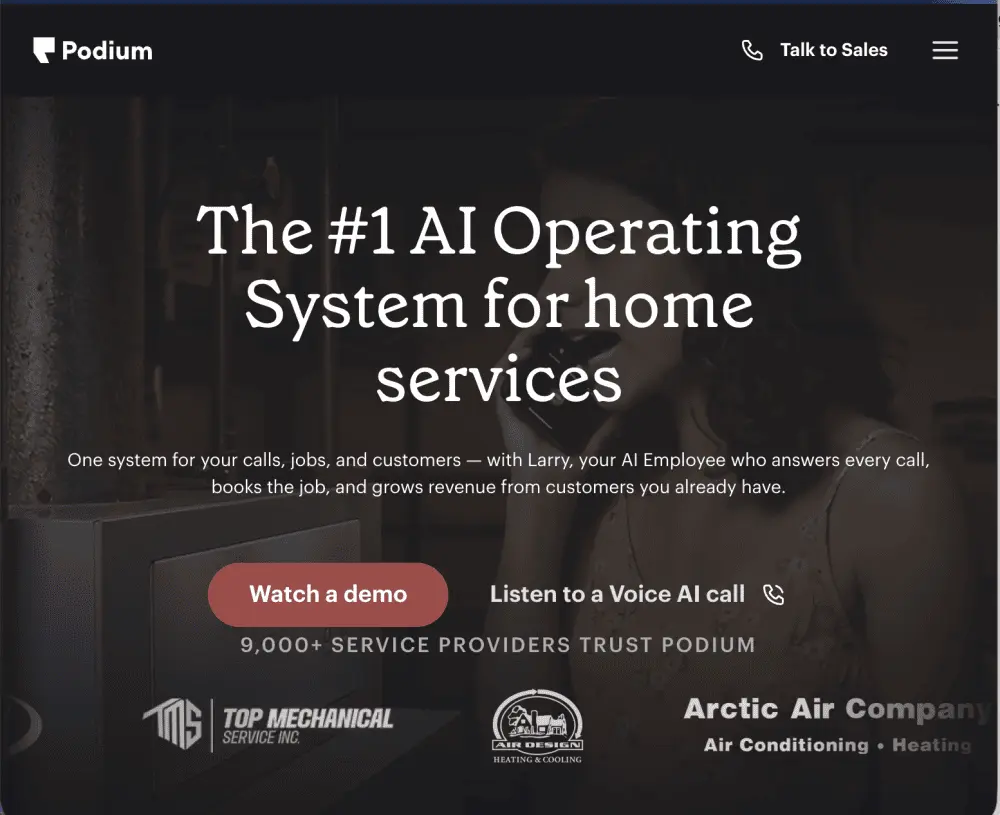
However, the advent of generative AI and autonomous agents changed the rules of engagement. As AI layers became sophisticated enough to absorb the workflows traditionally handled by back-end platforms, Podium expanded its offerings, scaling its agent business from zero to $100 million ARR in under 24 months. It began positioning itself as an autonomous AI Operating System, complete with a fully fledged Field Service Management (FSM) rip-and-replace migration team.
In short, the front-end layer matured to the point where it could consume the back-end. ServiceTitan responded by fortifying its walls, rewriting its API terms to restrict autonomous agents, and introducing strict marketplace certification rules. The result is a cautionary tale for SaaS companies everywhere: when your partner’s product evolves to become your competitor, the ecosystem breaks down, and the collateral damage is borne by the unsuspecting customers caught in the middle.
Detailed Chronology: From Symbiotic Growth to Open Warfare
To understand how a nine-year partnership disintegrated over the course of a few months, one must trace the evolution of the technical and commercial relationship between the two companies.
Years 1–7: The Symbiotic Era
For the majority of their partnership, ServiceTitan and Podium enjoyed a mutually beneficial arrangement. ServiceTitan served as the core system of record for roughly 7,500 contractors, commanding a pricing model based on the number of technicians per month. It handled the heavy lifting of scheduling, dispatching, price books, invoicing, and customer files.
Podium, meanwhile, sat comfortably on the outside. It was the phone number plastered on the side of the plumber’s truck, the friendly webchat bubble on the company website, and the automated text message asking for a five-star review the moment a job was closed.
The integration was deeply entrenched. Contractors relied on four primary data flows: contact sync, lead writeback, payment writeback, and conversation writeback. Three of these four flows pushed vital customer interactions, captured revenue, and message histories directly back into ServiceTitan’s database. For ServiceTitan, Podium made its system stickier by enriching customer records without requiring ServiceTitan to build out complex marketing and communication features. For Podium, ServiceTitan provided a lucrative distribution channel into thousands of high-value contractors.
Crucially, Podium was never exclusive. It maintained identical integrations with competing Field Service Management platforms like Housecall Pro and ServiceFusion. Operating as an agnostic layer across multiple FSMs is a clever strategy—it allows a company to sit above the data layer, quietly building rapport with the end user.
The Turning Point: The Rise of AI Agents
The friction began when Podium successfully transitioned from a marketing communications tool into an autonomous AI platform. Propelled by advances in large language models, Podium’s agent business scaled from zero to $100 million in Annual Recurring Revenue (ARR) in less than two years.
Suddenly, Podium was no longer just asking for reviews; it was fielding inbound calls, booking appointments onto dispatch boards, chasing unpaid invoices, and even pitching service memberships. To support this massive evolution, Podium rebranded itself as an "AI Operating System" and introduced a dedicated migration team capable of porting contact and job histories over from competing FSMs in just 14 days.
This was no longer a marketplace app; it was a migration path. By offering a fast track to pull historical data out of ServiceTitan and replace it with its own native operational workflows, Podium crossed the Rubicon from partner to existential threat.
The Crackdown: Rules and Restrictions
ServiceTitan did not sit idly by as its front-end partner transformed into a competitive replacement. On June 24, ServiceTitan published a stringent new set of Marketplace certification requirements. The policy framework detailed six non-negotiable pillars: security, performance, predictability, data transparency, revenue share, and mutual benefit.
Buried within the documentation was a sentence that telegraphed the inevitable purge:
"ServiceTitan welcomes partners whose products overlap with parts of its own, as long as they’re not using the partnership and ServiceTitan’s support to gradually displace additional parts of ServiceTitan."
Just four months earlier, ServiceTitan had updated its API terms specifically to handcuff autonomous AI agents. The updated terms restricted API access to predefined operation sets, effectively outlawing autonomous agents that use broad read-and-write permissions to make independent decisions across the system. While traditional workflow automation tools survived the purge, autonomous operators were effectively locked out.
When Podium opted not to seek certification under these restrictive, post-AI terms, the writing was on the wall. ServiceTitan pulled the plug, issuing a 30-day notice to 1,000 shared customers during the dead heat of peak HVAC repair season.
Supporting Context & Metrics: The Economics of the Agent Era
The war between systems of record and autonomous front-end agents is fundamentally about where software value accretes. Historically, the software moat was the database. Whoever owned the system of record owned the customer, because migrating historical business data was agonizingly difficult and expensive.
The Compression of Switching Costs
AI has fundamentally compressed switching costs. When Podium can offer a complete 14-day migration of historical jobs, customer files, and contact lists out of ServiceTitan and into its own AI Operating System, the historical database moat begins to evaporate. The value shifts away from the static system of record and toward the dynamic agent layer that interacts with the customer in real-time, closes deals, and manages day-to-day operations.
Despite these headwinds, ServiceTitan’s financial metrics demonstrate that it is aggressively investing to win the agent game on its own turf. According to financial disclosures for the quarter ending April 30, 2026:
Total Revenue: Reached $268.8 million, up 25% year-over-year.
Gross Transaction Volume (GTV): Hit $21.7 billion, a 23% increase.
Net Revenue Retention (NRR): Remained strong at above 110%.
Operating Margins: Non-GAAP operating margin expanded to 15.2%, up significantly from 7.5% the previous year.
Full-Year Guidance: Raised to $1.13 billion.
Simultaneously, ServiceTitan reported negative free cash flow of $9.6 million, driven by massive investments in its proprietary AI suite, "Max," and heavy spending on AI inference architecture. The number of customer locations utilizing ServiceTitan Max more than doubled over the quarter. ServiceTitan is willingly sacrificing short-term margin expansion to defend its territory against encroaching AI agents.
The Certification Landscape
It is worth noting that ServiceTitan’s new rules are not an insurmountable hurdle for every integration partner. Hatch, an AI-powered customer communication platform that services over 1,000 overlapping ServiceTitan customers, successfully navigated the new compliance framework and announced its official certification in February 2026. The distinction between Hatch and Podium lies in their trajectory: Hatch remains a specialized communication layer, whereas Podium expanded its ambitions to encompass the core operational workflows of the FSM itself.
Official Statements and Industry Reactions
The tech community reacted swiftly to the news, framing the dispute through the lens of platform economics and ecosystem governance.
Eric Rea’s viral social media posts highlighted the tension between legacy enterprise software and modern artificial intelligence. Rea shared direct messages from enterprise home service owners who remarked that they had seen nothing comparable to Podium’s new AI agent capabilities. Rea argued that legacy incumbents inevitably try to lock customers in once switching costs rise too high.
However, industry analysts were quick to point out that ServiceTitan’s defensive posture is a rational response to platform cannibalization. In platform ecosystems, the platform owner assumes the financial and operational burden of maintaining the foundational architecture, security compliance, and API infrastructure. When a third-party partner uses that very API infrastructure to hollow out the platform’s core value proposition, the platform owner has every commercial incentive to shut the door.
Furthermore, competing integration partners are now forced to carefully evaluate their product roadmaps. The unwritten rule of the API economy has changed forever: you can integrate with the platform, but you cannot become the platform.
Future Outlook: What the Agent Era Means for SaaS Ecosystems
The ServiceTitan-Podium rupture is not an isolated incident; it is the opening salvo in a broader war that will reshape the software-as-a-service (SaaS) industry over the next decade. As autonomous AI agents become capable of executing complex workflows across multiple software tiers, several structural changes are inevitable:
1. The Redefinition of "Partner"
Platform owners will scrutinize third-party developer roadmaps with unprecedented paranoia. Integration agreements will increasingly feature strict clauses prohibiting API usage that mimics, mirrors, or competes with native product modules. The golden age of open, permissive API marketplaces is drawing to a close.
2. The Vulnerability of Systems of Record
Companies that treat their database as an unassailable fortress are in for a rude awakening. As migration tools become increasingly automated by generative AI, the friction of switching back-end software will approach zero. Systems of record that fail to provide high-value, native intelligence layers will risk being reduced to "dumb pipes"—commoditized databases sitting quietly behind smart, autonomous front-end operators.
3. The Collateral Damage to End-Users
Perhaps the most sobering takeaway from the Podium-ServiceTitan fallout is the precarious position of the end consumer—in this case, the thousands of local contractors who woke up to find their critical business workflows severed overnight. Software companies must realize that when platform politics spill over into operational integrations, it is the small business owner who pays the price.
Final Thoughts
As the Agent Era accelerates, the boundary lines between applications will continue to blur. Front-end layers will push backward into operations, and back-end platforms will push forward into communication and automation. The breakup of a nine-year partnership proves that in the age of artificial intelligence, historical loyalty counts for little when the core architecture of software value is being rewritten from the ground up.