By Saf Malik
Senior Content and Insights Manager
24 September 2026
Executive Overview
The rapid, unbridled expansion of the global digital economy is colliding with an immovable physical reality: a severe scarcity of power, water, and available land. Across the globe, the foundational infrastructure powering the artificial intelligence (AI) revolution and cloud computing boom is facing an unprecedented wave of friction. While the underlying resource pressures—strained municipal water supplies, overloaded electrical grids, and massive land footprints—remain uniform wherever a server farm is proposed, the mechanisms for dealing with these burdens vary wildly from jurisdiction to jurisdiction.
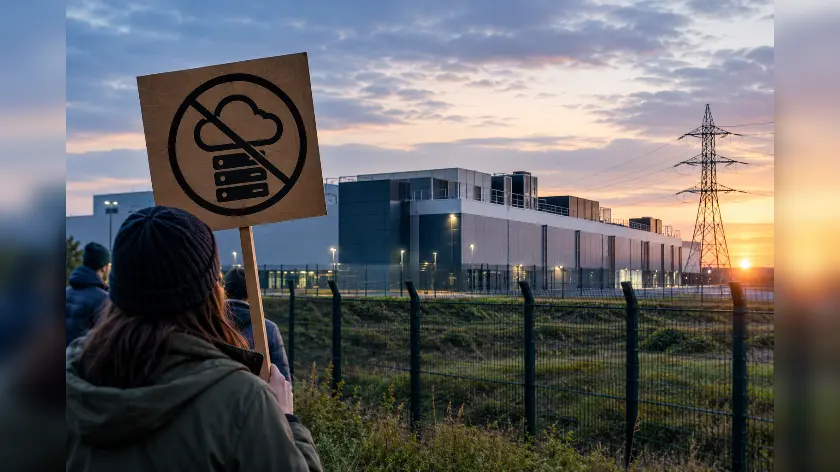
In the United States, decentralized zoning boards and hyper-localized grassroots movements have successfully transformed community opposition into a powerful block against capital deployment. In the first quarter of 2026 alone, local resistance stalled or permanently blocked at least 75 major American projects worth an estimated $130 billion.
Conversely, European resistance operates through institutional channels, strict green mandates, and capacity-constrained electrical grids, while emerging markets in the Gulf and India handle the onslaught through top-down national strategies or regulatory classification gaps.
As financial institutions begin to price community sentiment directly into credit underwriting, and as nations from Malaysia to Scotland implement pre-emptive moratoria, the global data centre industry is undergoing a profound structural shift. Site selection is no longer just a calculation of fiber connectivity and tax incentives; it has become a high-stakes exercise in geopolitical risk management, regulatory navigation, and social license.
Detailed Chronology: The Escalation of the 2026 Backlash
The friction currently reshaping the digital infrastructure landscape did not appear overnight. It is the culmination of years of exponential demand driven by generative AI models, cloud hyperscalers, and enterprise migration, which finally outstripped local utility thresholds by late 2025 and early 2026.
- January 2026: Data Center Watch releases a tracking report highlighting that the number of active community opposition groups in the United States has more than doubled since 2024, reaching 833 groups spread across 49 states. In the same month, residents in Gelang Patah, Malaysia, stage public protests outside a major data centre construction site, sounding early alarms over regional water security.
- February 2026: Recognizing mounting resource constraints, Johor state authorities in Malaysia stop approving new Tier 1 and Tier 2 data centres—the highest water-use categories—shifting mandatory disclosure rules to the pre-approval phase. Meanwhile, Denmark’s national grid operator pauses all new large-scale connection agreements after receiving requests totaling 60GW, nearly nine times the nation’s peak electrical demand.
- August 2026: India’s Ministry of Environment, Forest and Climate Change confirms in a parliamentary briefing that AI data centres do not categorically require national Environmental Clearance under the 2006 EIA Notification, classifying them instead under generic building or township project guidelines.
- July 2026: New York State Governor Kathy Hochul signs a landmark executive order pausing state environmental permits for new data centres drawing 50 megawatts (MW) or more. This executive action coincides with legislative momentum behind the Responsible Data Center Development Act, which sets a 20MW threshold and ties project permits to community benefit funds and prevailing wage mandates. By mid-year, over 300 data centre-related bills have moved through more than 30 state legislatures nationwide.
- September 2026: Scotland introduces a rigorous new environmental direction requiring national ministerial review for every data centre planning application exceeding 50MW, following Edinburgh council’s earlier rejection of a facility over sustainability shortcomings.
Supporting Context & Metrics: The Anatomy of Resistance
The scale of the modern data centre pushback can be measured in hard economic metrics, regional vacancy rates, and shifting financial underwriting practices.

The United States: Grassroots Power and Financial Scrutiny
The financial impact of American opposition is staggering. In Q1 2026 alone, $130 billion worth of investments was frozen. This pushback has graduated from local town halls to institutional boardrooms. Lenders and asset managers no longer view community resistance as a minor administrative hurdle; they are pricing local sentiment directly into credit quality assessments. Community benefit agreements—once informal gestures of goodwill—have matured into rigid, quasi-legal asset classes necessary to secure project financing.
Europe: Institutional Gates and Grid Bottlenecks
In Europe, public concern has manifested as institutional roadblocks, resulting in more than $42 billion in delayed, reworked, or cancelled projects.
- Germany: The Groß-Gerau town parliament voted 18 to 14 to reject a €2.5 billion Vantage Data Centers project, citing insufficient local tax and job benefits weighed against massive structural footprints.
- The Hub Exodus: Vacancy rates across Europe’s core FLAP-D markets (Frankfurt, London, Amsterdam, Paris, Dublin) have plunged to an average of 6.4%, with Frankfurt sitting at an ultra-tight 3.1%. As a result, developers are being pushed an average of 175km away from major hub cities for the 2026–2028 pipeline, compared to just 46km for projects built between 2022 and 2025.
Global Cost and Resource Disparities
The divergence in build costs and resource consumption highlights why hyperscalers are aggressively scouting alternative regions:
- Build Costs: While Western markets face skyrocketing expenses, India offers build costs ranging between $6 million and $9 million per megawatt, compared to a global average hovering closer to $11 million.
- Water Consumption: In the Gulf, where energy costs sit 30% to 50% below global averages, data centres in Saudi Arabia alone consumed roughly 15 billion litres of water in 2024. In Malaysia, the National Water Services Commission estimates that 104 planned data centres could require up to 876 million litres of water daily.
Official Statements and Regulatory Perspectives
Governments, legal experts, and industry observers have increasingly weighed in on how structural frameworks dictate the success or failure of digital infrastructure projects.
- The Procedural Divide: Analysts note that the stark difference between US and European reactions stems from procedural access rather than public sentiment alone. US zoning laws operate through thousands of municipal boards, giving citizens continuous opportunities to block individual sites. Europe concentrates similar environmental and planning objections into fewer, high-level authorities—though exceptions like Ireland’s An Coimisiún Pleanala demonstrate that national bodies can sharply reverse local decisions based on local renewable capacity metrics.
- The Gulf’s Engineering Approach: Legal briefs from firms like Addleshaw Goddard highlight that nations such as Saudi Arabia, the UAE, Qatar, and Oman integrate sustainability directly into overarching state strategies (such as Saudi Vision 2030). Resource challenges—such as water cooling—are framed as technical and engineering hurdles (employing brine reuse and renewable-powered cooling) rather than grounds for adversarial public grievance.
- India’s Regulatory Gap: Environmental and technology lawyers, including Yashasvi Rathore of the Inductus Group, have pointed out that India’s legal framework does not intentionally permit data centres with lax oversight; rather, existing environmental laws were simply never built to categorize them as a distinct project class. Consequently, a data centre typically triggers only generic building-construction clearances focused on dust and drainage, bypassing the rigorous public hearings required of heavy industrial projects like coal thermal plants.
- Malaysia’s Pre-emptive Strike: Malaysian Natural Resources Minister Nik Nazmi Nik Ahmad made clear to the Financial Times that incoming technology operators must pay a premium for water and energy supplies. By rejecting roughly 30% of applications in Johor due to resource limits, Malaysia proved that stringent regulatory intervention can preemptively manage resource strain before grassroots protests can even scale into a national movement.
Future Outlook: Redefining Site Selection for the Digital Age
The global data centre market stands at a critical crossroads. The old playbook of selecting sites purely on the basis of cheap land, fiber connectivity, and tax breaks is obsolete.
In markets where citizens enjoy direct procedural access to zoning and planning boards—such as the United States and parts of Western Europe—developers must factor in long timelines, community benefit agreements, and high probabilities of legal delays. Conversely, in regions utilizing top-down regulatory frameworks (the Gulf) or regions where environmental laws are undergoing modernization (Malaysia and India), the path to approval relies heavily on early resource disclosure, advanced engineering solutions for water and power efficiency, and alignment with national economic visions.
As capital expenditure shifts increasingly toward regions offering lower regulatory friction and robust green energy pipelines, the industry’s long-term survival will depend on its ability to secure a genuine, lasting social license to operate. Until power generation and water conservation technologies catch up with the insatiable demands of the AI era, community pushback and grid bottlenecks will remain the defining arbiters of global digital growth.