By Jacqueline Thomas, Senior Tech Editor
Published: November 13, 2026
Executive Overview
The video game industry has spent the better part of a decade locked in a relentless pursuit of performance parity. For years, developers, hardware manufacturers, and consumers alike have treated 60 frames per second (fps) as the holy grail of modern console gaming. It is widely considered the baseline standard for responsive gameplay, smooth camera panning, and high-stakes combat.
Therefore, when Rockstar Games officially confirmed that Grand Theft Auto VI—the most anticipated entertainment release in history—would be strictly capped at 30 fps across all current-generation consoles (including the recently released, high-powered PlayStation 5 Pro), it sent ripples through the gaming community. For frame-rate purists, the news was a bitter pill to swallow.
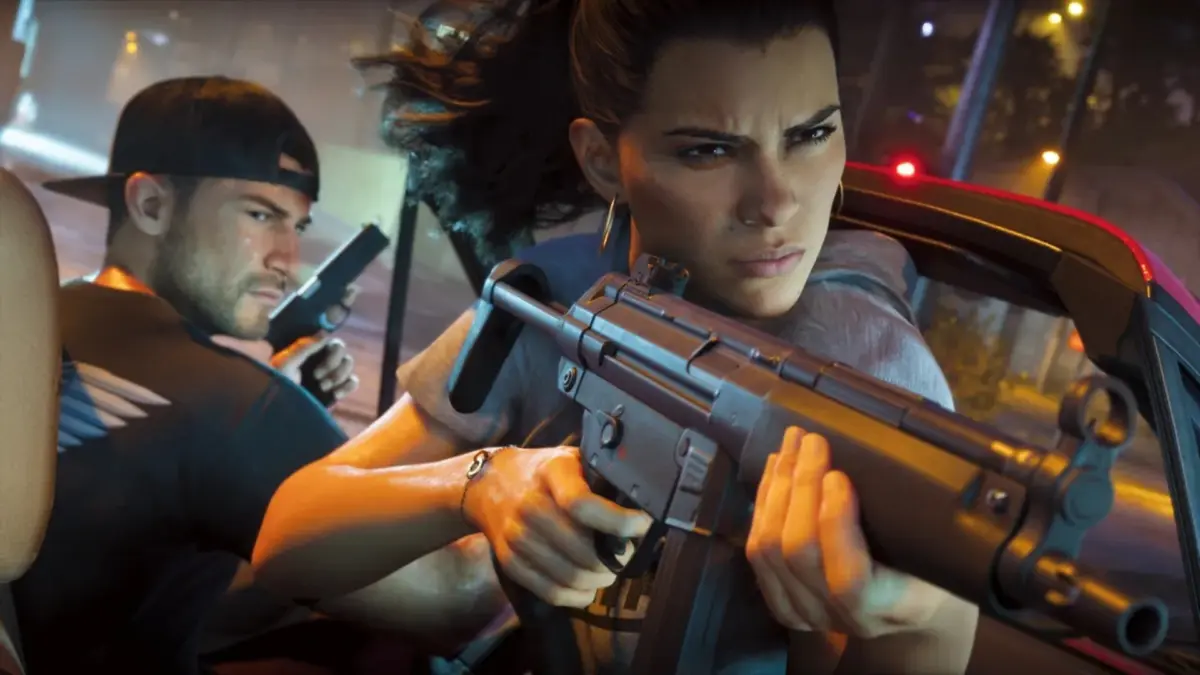
However, as early gameplay clips from regional sources like the Instagram account onlyindade have trickled out into the wild, a fascinating shift in public sentiment has begun to take shape. Despite the heavy compression artifacts plaguing these leaked or early-access snippets, the fidelity on display is so staggering, so visually rich, and so meticulously detailed that it forces a reassessment of what hardware constraints truly mean.
This article explores the technical reality behind Rockstar’s performance targets, analyzes the bleeding-edge graphical techniques driving these incredible visuals, and examines why this unprecedented level of graphical fidelity makes a 30 fps lock not only acceptable, but arguably necessary. Furthermore, we look ahead to what this means for the inevitable PC port, pondering how high-end enthusiast rigs will handle an engine already pushing contemporary hardware to its absolute limit.
Detailed Chronology: The Road to the 30 FPS Confirmation
The journey toward understanding the technical limitations of Grand Theft Auto VI has been defined by years of speculation, leaks, and carefully managed corporate disclosures. To fully appreciate where we stand today, it helps to review the timeline of events leading up to Rockstar’s definitive statements on hardware performance.
The Initial Revelation (December 2023)
When Rockstar dropped the first official GTA VI trailer, the internet practically broke. The trailer showcased a vibrant, densely populated reimagining of Vice State, featuring unprecedented NPC density, complex lighting models, and photorealistic water physics. While industry analysts immediately began questioning how current-generation consoles would handle such a massive, simulation-heavy open world, Rockstar kept its performance metrics close to the chest, focusing instead on setting a new benchmark for open-world immersion.
The Hardware Reality Sets In (2024–2025)
As development continued, hardware experts grew increasingly vocal about the architectural limitations of the base PlayStation 5 and Xbox Series X/S consoles. Both systems rely on custom AMD Zen 2 CPU architectures paired with RDNA 2 graphics blocks. While exceptionally well-designed for their time, these components were already approaching seven years of age by 2026. Open-world games of GTA VI’s magnitude are notoriously CPU-bound, requiring immense processing power to manage physics, artificial intelligence, streaming assets, and complex networking simultaneously. Industry consensus gradually shifted away from the dream of 60 fps, with developers whispering that a 30 fps target was the only realistic mathematical outcome for a game of this scale.
The PS5 Pro Announcement and Rockstar’s Confirmation (November 2026)
The definitive confirmation arrived earlier this week when Rockstar Games updated its official newswire and release documentation. The studio confirmed that GTA VI would run at 30 fps across all consoles, including Sony’s mid-generation refresh, the PlayStation 5 Pro. However, the bitter pill of 30 fps came with a sweetener: proprietary technological integrations. Rockstar detailed that the PS5 Pro version would leverage advanced features like Sony’s PlayStation Spectral Super Resolution (PSSR) upscaling technology alongside exclusive, highly detailed ray-traced shadows and global illumination improvements.
Almost immediately following this announcement, regional footage began surfacing online—most notably via the Dade County-focused Instagram page onlyindade—giving players their very first look at unvarnished, real-world gameplay loops captured in the wild.
Supporting Context & Metrics: Analyzing the Leaked Visuals
To understand why a 30 fps cap is suddenly tolerable, one must analyze the visual data present in the emerging clips. Even when filtered through the heavy compression algorithms of social media platforms, the fidelity on display challenges conventional wisdom regarding console optimization.

Dissecting the Onlyindade Footage
The clips shared by onlyindade offer a glimpse into mundane, everyday moments in fictional Leonida: cars driving slowly down sun-drenched asphalt, pedestrians walking along palm-lined sidewalks, and classic vehicles glistening under dynamic lighting.
- Materiality and Textures: Pausing the footage reveals an extraordinary level of texture work. The asphalt features distinct micro-bumps, cracks, and road debris that look remarkably authentic rather than flat, tiled repetitions. Vehicle paint exhibits complex, multi-layered reflections that accurately warp surrounding environments based on the car’s curvature.
- Ray-Traced Shadows and Lighting: One clip focusing on a vintage 1950s-style blue-and-pink car demonstrates sophisticated shadow behavior. The shadows cast by overhead palm leaves are not generic, hard-edged blobs; they are soft, diffused, and articulate enough to show individual fronds. Furthermore, as an NPC walks past while interacting with a smartphone, their shadow interacts dynamically and seamlessly with the geometry of the vehicle and the ground plane.
- The PSSR Advantage: Given the crispness of the distant geometry—despite the inherent blur of video compression—it is evident that advanced upscaling is doing heavy lifting. On the PS5 Pro, PSSR appears to be maintaining high effective resolution while allowing the GPU to dedicate its thermal and computational budget entirely toward complex ray-tracing pipelines and sprawling draw distances.
The Hardware Bottleneck
It is vital to maintain perspective on the hardware running these experiences. Both the base PS5 and Xbox Series X are working with computing paradigms that are nearly seven years old. When evaluating how smoothly these consoles handle complex open-world geometry, dynamic weather systems, and advanced physics simulations, the fact that the game runs at a stable 30 fps with this level of visual fidelity borders on the miraculous.
However, as a seasoned hardware journalist, I remain cautiously optimistic. Online video compression is notorious for smoothing over jagged edges, hiding texture pop-in, and masking shimmering artifacts on distant geometry. There is a legitimate concern that when players boot up the game on launch day, standard display aliasing on distant streetlights and power lines might prove jarring. Yet, based strictly on current evidence, the engineering feat achieved by Rockstar is undeniable.
Official Statements and Industry Impact
Rockstar’s unwavering commitment to visual storytelling over high frame rates has once again polarized the gaming community, sparking fierce debates across developer forums and enthusiast circles.
Industry veterans have largely come out in support of Rockstar’s decision, noting that open-world sandbox games derive immense value from environmental complexity, dense simulation, and atmospheric immersion—all of which demand heavy GPU and CPU resources.
"When you build a world this reactive, this dense, and this visually complex, every single frame requires a monumental amount of calculations," notes an anonymous senior rendering engineer. "Trying to force a 60 fps lock on current-gen console hardware would have required slashing the draw distances, gutting the NPC density, and stripping out foundational lighting features like ray tracing. Rockstar made the correct creative choice."
The decision also highlights a growing philosophical divide in modern console gaming: the eternal tug-of-war between performance modes (prioritizing 60 fps at the cost of lower resolutions and stripped-down graphical effects) and fidelity modes (prioritizing maximum visual splendour at 30 fps). By choosing a definitive 30 fps baseline, Rockstar has ensured that every player experiences the exact same artistic vision, uncompromised by stripped-down rendering settings.
Future Outlook: The Horizon for PC Enthusiasts
While console players prepare to lock their settings to 30 fps, a completely different conversation is taking place within the PC gaming community. For enthusiasts equipped with high-end desktop hardware, the revelation that GTA VI is fundamentally bound by CPU and GPU limitations on consoles serves as a tantalizing preview of what is yet to come.
The thought process for high-end PC gamers immediately shifts to hardware scaling. Questions currently echoing across enthusiast forums include:
- How will top-tier components, such as an NVIDIA GeForce RTX 5090 paired with an AMD Ryzen 7 9800X3D, handle this engine?
- Will Rockstar deliver a native, uncompromised PC port at launch, or will we face a familiar waiting period?
- What kind of frame rates can we expect when unchained from the 30 fps console tether?
If Rockstar’s previous releases are any indication, the PC version of GTA VI—rumored for a release following the console rollout—will offer unbounded frame rates, vastly superior draw distances, uncompressed texture packs, and fully path-traced global illumination options that would instantly melt current-generation console APUs.
Conclusion
For now, console owners must accept that enjoying the most visually advanced open-world game ever created requires a trade-off: trading the fluid camera motion of 60 fps for a visual feast that frequently blurs the line between computer graphics and reality. And looking at the breathtaking clips circulating online, it is a trade-off that many players—myself included—are more than willing to make, while quietly keeping our eyes fixed on the horizon for the ultimate PC release.