Executive Overview
The enterprise software market is undergoing a profound structural re-evaluation, driven almost entirely by the disruptive force of artificial intelligence. Nowhere is this dynamic more visible than in the stark valuation chasm separating traditional Go-To-Market (GTM) and front-office applications from infrastructure and security giants.
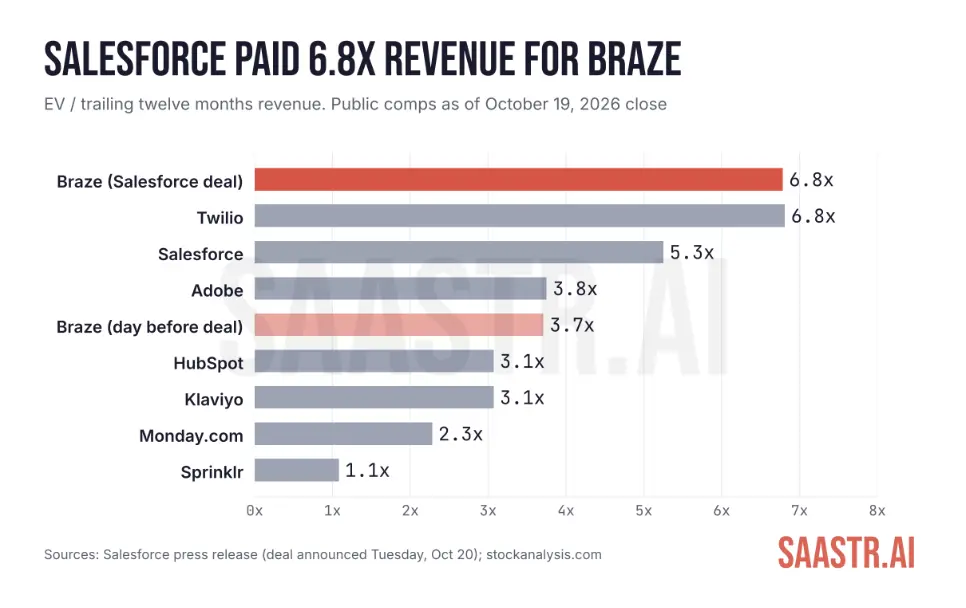
This valuation divergence was brought into sharp relief when Salesforce agreed to acquire Braze for $5.66 billion—a transaction representing 6.8x trailing revenue. While a 6.8x multiple might appear unremarkable in the broader B2B SaaS ecosystem, in the context of public GTM software, it represented a staggering 58% premium over Braze’s closing price just days prior.
A macro-level audit of public multiples reveals a sobering reality: traditional GTM and front-office applications trade at a median of roughly 2.7x enterprise value over trailing twelve months (TTM) revenue. In stark contrast, infrastructure and security stalwarts like Cloudflare, Datadog, and Snowflake command a median multiple of 22.6x—roughly eight times higher.
This article explores the mechanics behind this valuation gap, examining how the rise of autonomous AI agents is fundamentally altering business models, punishing per-seat software pricing, and driving strategic buyers to step in where public markets fear to tread.
Detailed Chronology and Market Dynamics
To understand the current state of software valuations, one must examine the cascading events and market disclosures that defined the mid-October trading period.
The baseline for public GTM multiples has hovered at historic lows due to systemic investor fears regarding software obsolescence. When Salesforce announced its $5.66 billion acquisition of Braze at 6.8x trailing revenue, it shocked public markets where Braze had been languishing at 3.7x revenue. This transaction instantly underscored a glaring disconnect: public markets are heavily discounting companies with legacy business models, while strategic acquirers are willing to pay massive premiums to capture established customer bases and proprietary data pipes.
Consider the growth parity between distinct sectors. In recent quarterly reports, companies like Braze, Klaviyo, and cybersecurity titan CrowdStrike all posted identical year-over-year revenue growth rates of 26%. Yet, the market rewards these identical growth profiles with radically different valuations. CrowdStrike commands an astronomical 42.6x trailing revenue multiple, while Braze trades at 3.7x and Klaviyo at 3.1x.
Even when comparing GTM applications to high-growth cloud infrastructure players, growth differentials fail to explain the multiple gap. While infrastructure giants growing in the mid-30s command higher valuations partly due to superior top-line expansion, CrowdStrike’s identical 26% growth rate compared to Klaviyo demonstrates that growth alone is no longer the primary valuation driver. Instead, the market is pricing in long-term risk: investors are betting that AI will systematically erode the revenue streams of seat-based GTM applications over the next five years, while fortifying the demand for security and infrastructure.
The public markets’ pessimism is further encapsulated by ZoomInfo, which trades under the ticker symbol "GTM." With a market capitalization of $1.14 billion and an enterprise value of approximately $2.50 billion (inflated by substantial debt), ZoomInfo generates $1.26 billion in trailing revenue, resulting in a microscopic multiple of 2.0x. In essence, the public equity of a foundational GTM data provider is currently valued at less than one full year of its revenue.
Supporting Context and Metrics: Infrastructure vs. GTM
The divergence between infrastructure/security and front-office applications is rooted in consumption mechanics.
Every time an autonomous AI agent executes a workflow, it makes backend API calls, stores vector data, and generates system logs. Infrastructure providers—such as Cloudflare, Snowflake, and Datadog—capitalize on this architecture by charging directly for consumption. More AI agents executing workloads automatically translate to higher consumption, driving linear revenue expansion for infrastructure providers.
Similarly, cybersecurity scales with agent deployment. Every new AI agent operating within an enterprise ecosystem represents a distinct digital identity, an API endpoint, and a potential attack vector that must be monitored and protected by platforms like CrowdStrike.
The Death of the Per-Seat Model
Conversely, traditional GTM applications have historically relied on per-seat or per-contact pricing models. AI agents directly cannibalize this revenue framework.
- The Sales SDR Paradox: When an enterprise deploys an AI Sales Development Representative (SDR) capable of executing the outbound volume and conversational pipeline management of five human reps, the software provider loses four software seats.
- Marketing Automation Erosion: When generative AI agents autonomously draft, test, and personalize multi-channel marketing campaigns, marketing teams require fewer human operators logging into platforms like Salesforce Marketing Cloud or HubSpot.
This operational shift is no longer theoretical; it is happening across enterprises of all sizes. Organizations are radically restructuring their human-to-agent ratios. Lean operations demonstrate that modern companies can scale multi-million-dollar revenue streams with a fraction of the headcount they required a half-decade ago, deploying dozens of AI agents to handle tasks that once required dedicated software seats.

While this operational efficiency has not yet fully materialized as catastrophic top-line declines in reported quarterly earnings—HubSpot, for example, posted a healthy 20% growth rate last quarter while trading at 3.1x—public markets are pricing in anticipated long-term revenue attrition.
The Exception That Proves the Rule: Usage-Based GTM
The market does not punish all customer-facing software equally; it punishes seat-based software. Twilio serves as a prime counter-example, trading at 6.8x revenue—matching Salesforce’s acquisition price for Braze.
While Twilio operates in messaging and voice channels similar to those utilized by Braze and Klaviyo, its business model is built on usage. Twilio charges per API message sent and per voice minute consumed. If an AI agent initiates one million customer engagement touchpoints, Twilio bills for one million events. By contrast, an AI agent operating inside a seat-based marketing platform merely replaces a human operator, leaving the software vendor with flat or declining license revenue.
Private Markets vs. Public Markets: The Premium on Next-Gen GTM
While public investors are heavily discounting seat-based GTM apps, private markets are aggressively bidding up the valuation of next-generation, AI-native GTM startups. This dichotomy highlights a profound ideological split between public and private capital allocators.
Private investors are pouring capital into companies that bypass human seats entirely:
- Clay: Raised capital at a staggering $7.1 billion valuation, with annualized revenue expected to approach $200 million—representing an eye-watering 35x revenue multiple, more than ten times HubSpot’s public multiple. Clay succeeds by selling advanced data enrichment workflows and execution layers that autonomous agents and operations teams leverage directly.
- Sierra: Secured funding at a $15.8 billion valuation on roughly $150 million of ARR, commanding a multiple exceeding 100x. Sierra monetizes based on successfully resolved customer service conversations, entirely decoupling revenue from human headcount.
- Rox and Monaco: Early-stage innovators built from the ground up around autonomous sales agents, raising capital at elite valuations ($1.2 billion for Rox on $8 million of ARR).
- Profound: Raised a massive financing round at an $1.8 billion valuation to help brands optimize their digital presence in AI-generated search answers—a crucial enterprise budget line that did not exist two years ago.
Private market investors are not avoiding the GTM category; they are fleeing legacy, seat-based architectures while funding the AI-native platforms designed to replace them.
Strategic Buyers Step In: Why Strategics Pay 2x Public Valuations
Faced with depressed public valuations, strategic buyers are recognizing an arbitrage opportunity. Public markets are pricing GTM assets at 2x to 3x revenue, making traditional Initial Public Offerings (IPOs) an unappealing exit mechanism. Consequently, strategic acquirers and private equity firms are stepping in as the dominant liquidity channels.
Salesforce’s acquisition of Braze at 6.8x trailing revenue—alongside its aggressive acquisition spree including Contentful, m3ter, Fin, Listen Labs, and Loops—demonstrates this strategy. Strategic buyers are not evaluating these acquisitions solely on the target company’s standalone TTM revenue. Instead, they are calculating the lifetime value of integrating these platforms into massive existing ecosystems.
In Braze’s case, Salesforce is acquiring direct access to 2,770 enterprise brands to whom it can cross-sell its proprietary Data 360 and Agentforce AI architectures. For an enterprise software giant, acquiring a sticky customer base and proven product infrastructure at a depressed public valuation is far more cost-effective than building competing products from scratch. When a fundamentally sound company growing at 26% with positive free cash flow trades at 3x revenue, it represents an irresistible target for well-capitalized strategic acquirers.
Future Outlook and Strategic Playbook for GTM Founders
The structural transformation of enterprise software valuations offers clear lessons for founders, executives, and investors navigating the AI era. As the software landscape transitions from human-centric to agent-centric operations, survival and valuation expansion will depend on strategic adaptation.
1. Pivot from Seat-Based Pricing to Usage and Outcomes
Founders must aggressively decouple their revenue models from human headcount. Companies that bill based on consumption metrics, API calls, successful task resolutions, or verified business outcomes—similar to Twilio and Sierra—insulate themselves against the deflationary impact of AI workforce reduction. If automated agents reduce your enterprise customer’s reliance on human staff, software models tied to headcount will inevitably contract alongside them.
2. Isolate and Report AI Revenue Transparency
Public markets struggle to value companies when AI monetization is obscured within legacy revenue streams. If a significant percentage of enterprise clients utilize AI-native product modules, this revenue must be reported as a distinct SKU. Providing granular visibility into attach rates, average deal size (ADS) expansion, and net new ARR contribution allows public market analysts to properly discount legacy erosion and re-rate the stock closer to infrastructure multiples.
3. Acknowledge and Plan for Multiple Compression
Founders cannot assume historical SaaS multiples will return automatically. GTM companies must prove that artificial intelligence acts as a net top-line expansion driver rather than a defensive feature built merely to prevent customer churn. Until legacy GTM players demonstrate that AI can drive consumption-led growth, the valuation gap between infrastructure and application software will remain wide.
The message to the software ecosystem is clear: the era of passive, seat-based SaaS monetization is drawing to a close. The future belongs to infrastructure that powers autonomous agents, and application layer pioneers who figure out how to bill for the intelligence those agents unleash.