By Global Technology & Energy Desk
Published: August 2026
Executive Overview
The explosive global race to scale generative artificial intelligence is colliding head-on with ecological realities, pushing some of the world’s most valuable technology conglomerates into controversial energy-sourcing strategies. In the latest and perhaps most striking indicator of this trend, Amazon has acquired a massive, off-grid power plant under construction in Texas specifically to feed its rapidly expanding network of data centers.
Permitted to emit up to a staggering 33 million tons of greenhouse gases annually, the facility ranks among the largest prospective sources of industrial carbon pollution in the United States. Yet, the environmental toll of Amazon’s new installation extends far beyond its raw output. Rather than utilizing standard, high-efficiency energy generation, the facility relies on simple-cycle gas turbines—an older, significantly less efficient combustion technology.
This decision is not an isolated anomaly. Across the American landscape, tech giants including Microsoft, Google, Meta, and xAI are turning to identical off-grid configurations to bypass grid bottlenecks and secure immediate energy for power-hungry AI training clusters. While these off-grid strategies insulate local residential ratepayers from surging electricity costs and bypass water-intensive cooling constraints, they are quietly midwifing a parallel fossil-fuel-powered infrastructure. Designed to operate for decades, these installations threaten to undermine corporate net-zero pledges and permanently reshape the future of the United States power grid.
Detailed Chronology & Industry-Wide Adoption
The rush toward off-grid, gas-fired generation represents a dramatic shift in corporate infrastructure strategy. For years, major technology companies relied primarily on power purchase agreements (PPAs) tied to existing renewable energy grids or integrated directly into regulated regional transmission organizations. However, the staggering power demands of Large Language Models (LLMs) and advanced deep-learning frameworks have far outstripped the speed at which traditional grid upgrades can be planned, permitted, and built.
The Great Tech-Grid Divergence
As interconnection queues stretch for up to a decade across major grid operators like PJM and ERCOT, tech developers have pivoted to an "islanded" or off-grid model. By bypassing the public utility commission approval process and building dedicated generation assets directly adjacent to data centers, companies can bypass transmission bottlenecks entirely.
Amazon’s acquisition in Texas is the crown jewel of this movement, but it is accompanied by a sweeping wave of similar projects nationwide:
- Meta in Ohio: Energy and infrastructure firm Williams is currently developing at least three power plants in Ohio explicitly to supply Meta’s regional data center footprint, with permit applications confirming a total reliance on simple-cycle gas units.
- Microsoft in Abilene, Texas: Crusoe Energy Systems is constructing a sprawling power installation on its Stargate campus, utilizing 39 separate simple-cycle turbines to meet Microsoft’s intense localized compute demands.
- Google in Texas: Crusoe is also spearheading development for Google’s upcoming Goodnight data center site, with permit filings indicating a reliance on 20 simple-cycle turbines.
- xAI in Memphis, Tennessee: Elon Musk’s artificial intelligence venture has deployed dozens of simple-cycle turbines to directly energize its Colossus 1 and Colossus 2 data center complexes.
In each of these instances, the pattern is identical: massive industrial permits filed for millions of tons of annual greenhouse gas emissions, justified by the urgent, unyielding operational needs of the generative AI boom.
Supporting Context & Metrics: Why Simple-Cycle Turbines?
To understand why tech conglomerates are willingly adopting less efficient technology, one must examine the engineering trade-offs between simple-cycle and combined-cycle gas power plants, alongside the harsh realities of the global supply chain.
Simple-Cycle vs. Combined-Cycle Engineering
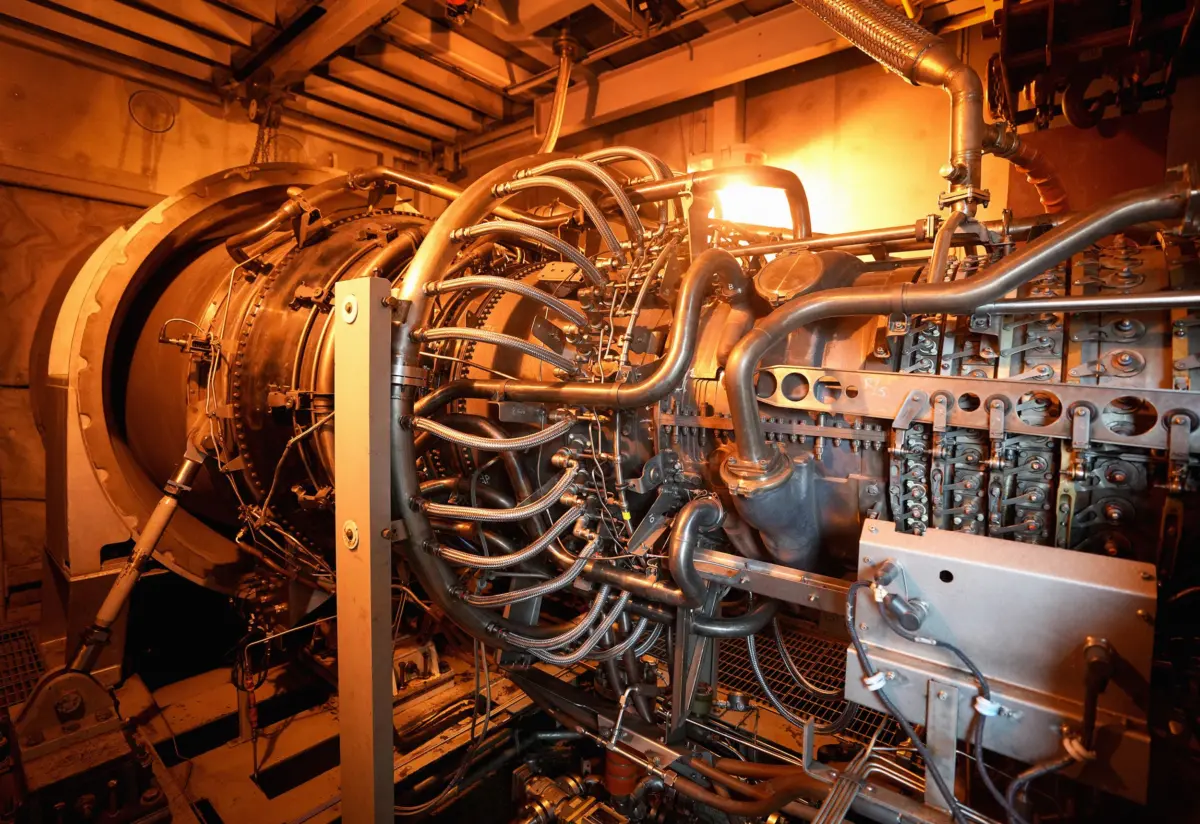
Traditional, utility-scale natural gas power plants overwhelmingly rely on combined-cycle technology. In a combined-cycle unit, fuel and air are mixed and burned in a combustion turbine to create rotational energy. Crucially, the waste heat generated by this primary combustion is captured and redirected to power a secondary steam turbine, extracting significantly more electricity out of every standard cubic foot of natural gas.
By contrast, Amazon’s Texas facility—and the parallel projects built for Meta, Microsoft, Google, and xAI—relies exclusively on simple-cycle turbines.
- The Efficiency Deficit: Simple-cycle units capture none of the waste heat, venting thermal energy into the atmosphere. This drastically lowers overall fuel efficiency.
- The Emissions Reality: According to data from the US Environmental Protection Agency (EPA), even if Amazon’s new facility operates at a mere 50% of its maximum permitted capacity, it will single-handedly generate more annual greenhouse gas pollution than 78 average-sized natural gas power plants combined.
Supply Chain Pressures and the Need for Speed
If combined-cycle plants are measurably cleaner and more efficient, why are developers shunning them? Industry experts point to two primary bottlenecks: supply chain dysfunction and extreme time-to-market pressures.
"Right now, because of the way the supply chain is for turbines, they’re having to go with what they can get their hands on," explains Britt Burt, senior vice president at Industrial Info Resources, an energy market intelligence firm.
The global manufacturing backlog for advanced combined-cycle components, steam turbines, and specialized heat-recovery steam generators (HRSGs) stretches across multiple years. For tech companies locked in a hyper-competitive capital expenditure race, waiting years for grid interconnections or optimized hardware is commercially untenable. Simple-cycle turbines can be sourced, shipped, and installed with relative rapidity.
Volatile AI Loads and Mechanical Stress
Beyond speed, simple-cycle turbines possess unique operational advantages ideally suited for the erratic, volatile nature of AI workloads.
Unlike traditional cloud computing centers, which draw a relatively stable and predictable load of electricity, data centers training massive neural networks experience sudden, violent spikes and troughs in power demand. Simple-cycle units feature fewer moving parts and possess the mechanical agility to spin up to full capacity or shut down almost instantaneously.
According to mechanical engineering experts, this rapid cycling capability makes them uniquely resistant to the thermal and mechanical stresses that would otherwise damage larger, more rigid integrated power systems.
"If you have a highly fluctuating load, it’s better to have 30 things that can individually turn on and off than to have one giant thing that doesn’t like to be turned on and off," notes Stephen Lynch, professor of mechanical engineering at Penn State and director of the school’s Center for Gas Turbine Research, Education, and Outreach.
The Water Conservation Paradox
Interestingly, simple-cycle turbines offer one distinct environmental advantage that developers are quick to highlight: minimal water consumption.
Traditional thermal and combined-cycle power plants require millions of gallons of water daily for cooling towers and steam condensation. In water-scarce regions like Texas, local municipal water supplies are a major flashpoint between communities and data center developers.
Burt estimates that a standard 250-megawatt combined-cycle plant can consume roughly 75,000 gallons of water per hour. By contrast, Amazon’s permit application explicitly frames the adoption of water-free simple-cycle technology as an intentional "environmental benefit," shielding the facility from local water-rights controversies.
Official Statements & Corporate Rationales
The rapid proliferation of off-grid fossil fuel generation has drawn intense scrutiny from environmental advocacy groups, energy economists, and federal regulators. In response, technology companies and their industrial partners have defended their operational choices while reiterating their long-term sustainability commitments.
Amazon’s Defense
Defending the Texas acquisition, Amazon spokesperson Margaret Callahan emphasized that the facility was engineered specifically to protect local consumers from soaring energy infrastructure costs.
"The Texas plant provides on-site generation that won’t raise electricity costs for Texas families," Callahan wrote in an email statement to industry reporters.
Furthermore, Amazon stressed that the infrastructure package is not purely fossil-dependent. The site incorporates complementary solar power generation and large-scale battery energy storage systems (BESS). Callahan reiterated that Amazon remains firmly committed to its corporate pledge of achieving net-zero carbon emissions across its global operations by 2040, noting that the Texas plant is intentionally "designed to transition to grid-connected service as interconnection timelines allow."
Industrial and Regulatory Alignment
Similar defenses have been issued by energy partners building out the infrastructure. Representatives for Williams and Crusoe have consistently maintained that all permitted gas-generation facilities strictly comply with local, state, and federal environmental regulations. They emphasize that the installations are outfitted with advanced emissions-control technologies designed to scrub particulate matter and mitigate nitrogen oxide (NOx) output.
At the political level, the strategy has found cautious, highly polarized support. Both federal regulators and a growing number of state governors—spanning the political spectrum—have quietly encouraged data center operators to bring their own power generation to the table. In regions facing localized grid instability or skyrocketing residential utility bills, off-grid corporate generation prevents tech campuses from cannibalizing grid capacity meant for everyday citizens.
Future Outlook: The Specter of Stranded Assets
As the tech sector races to secure its immediate computational future, energy market analysts are warning of long-term systemic risks.
Historically, simple-cycle gas turbines have functioned as "peaker plants"—infrequently dispatched assets kept on standby to supply emergency electricity to the public grid during peak heatwaves or deep freezes. Transforming them into the foundational, 24/7 baseload power source for multi-gigawatt artificial intelligence clusters turns the traditional energy model on its head.
The Rise of a Parallel Fossil Fuel Grid
By deploying millions of dollars into dedicated, off-grid gas generation designed to last for decades, tech companies are effectively constructing a parallel fossil fuel grid. This private energy ecosystem operates outside the direct oversight of traditional public utility commissions and environmental dispatch mandates.
Yet, this massive capital expenditure carries a hidden, structural vulnerability. The artificial intelligence sector is currently operating under unprecedented investment fervor, with capital injections and compute demand scaling exponentially. Should the speculative AI bubble deflate, or should technological breakthroughs in algorithmic efficiency dramatically reduce the power requirements of future foundational models, these massive power plants could find themselves suddenly obsolete.
If tech companies dramatically dial back their compute capacity or relocate workloads to more efficient facilities, these dedicated off-grid installations risk losing their economic rationale entirely.
"We call that a stranded asset," notes Britt Burt with a chuckle, underscoring the precarious gamble underlying the industry’s rush for power.
Conclusion
Amazon’s acquisition of the massive Texas power plant encapsulates the defining paradox of the artificial intelligence era. In their quest to build the cognitive infrastructure of the future, the world’s most advanced technology companies are increasingly leaning on the most traditional, carbon-intensive energy technologies of the past. Whether these off-grid installations ultimately serve as a temporary bridge to a renewable future or calcify into a permanent, high-emissions parallel grid will depend entirely on regulatory oversight, technological maturation, and the ultimate financial sustainability of the AI revolution.