Executive Overview
For the better part of the last decade, the conventional wisdom of Silicon Valley was anchored in a romanticized archetype: the pure-play, product-led growth (PLG) startup. Founders donned hoodies, avoided the word "sales" like a plague, and believed that if a product were truly exceptional, it would market itself, sell itself, and scale itself. Marketing departments consisted of a single Twitter account, and outbound sales was dismissed as an archaic relic of enterprise software’s past.
That dogma is rapidly dying.
In a recent, widely circulated confession, Amjad Masad, the founder and CEO of software development platform Replit, captured the mood of an entire industry when he wrote: "I thought I hated sales culture. By the end of this year, more than half my company will be salespeople."
Masad’s realization is not an isolated epiphany; it is the leading edge of a massive macroeconomic and structural shift across B2B tech. Driven by an AI boom that is supercharging user acquisition while exposing the limits of self-serve funnels, companies that once prided themselves on zero-touch models are discovering a hard truth: freemium and self-serve do not eliminate the need for a sales team—they merely defer it.
When enterprise procurement departments, security policy analysts, and in-house counsels finally knock on the door asking how to buy properly, four part-time reps in a founder’s inbox are no longer enough. This article explores why the tech industry’s foundational belief in product-only growth is fracturing, how artificial intelligence is reshaping the modern sales force rather than replacing it, and what it truly costs to build a revenue engine at scale.
Detailed Chronology: From Pure Self-Serve to the Inevitable Enterprise Wall
To understand how the technology sector reached this inflection point, we must look at how the threshold for hiring a sales team has evolved over the past decade.
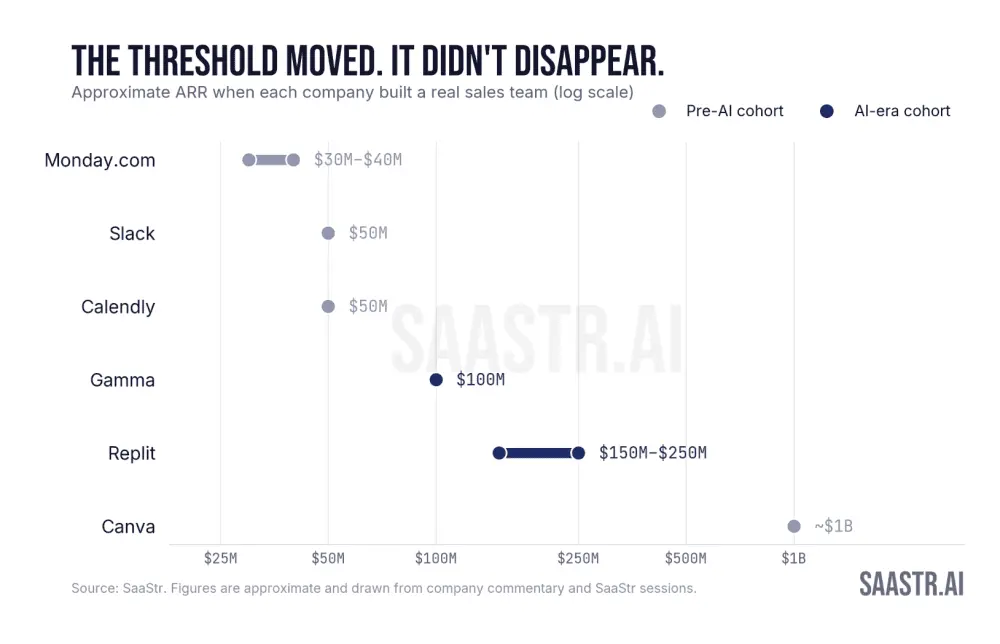
Historically, companies building bottoms-up, self-serve software hit a wall much earlier in their lifecycle. In the pre-AI era of the mid-2010s—typified by breakout successes like Twilio, Slack, Box, Stripe, Monday.com, and Canva—startups typically had to introduce structured sales motions well before hitting $30 million to $50 million in Annual Recurring Revenue (ARR).
However, the advent of generative AI and hyper-efficient go-to-market loops has fundamentally shifted the math. Today’s AI-native cohort is riding massive, self-sustaining waves of organic demand. Companies like Gamma, Lovable, and Anthropic have absorbed staggering volumes of users and revenue through pure product-led motions, scaling to unprecedented heights—often north of $100 million ARR—before institutionalizing formal sales orgs.
The Slack Precedent: Sales by Another Name
The playbook for avoiding early sales has a long history. In February 2015, at the inaugural SaaStr Annual conference, Stewart Butterfield, co-founder of Slack, revealed that his company had crossed the $30 million ARR milestone without employing a single sales representative.
When asked if Slack could reach $100 million without a sales team, Butterfield offered an answer that remains instructive a decade later. Slack did not have traditional outbound reps or sales quotas; instead, they had "account managers." These employees spoke almost exclusively to users who had already decided to buy within their teams, but whose parent organizations required formal vendor reviews, security analysis, and contract markups. Butterfield described the role not as selling, but as "midwifing the sale."
Yet, history shows that this phase is inherently finite. As bottom-up adoption cascades through large organizations—with massive companies eventually discovering dozens of siloed, paid instances of a product—consolidation becomes unavoidable. Consolidation requires a conversation with a human being. By the time Slack crossed the $1 billion ARR threshold, it operated as a hybrid sales-led and product-led powerhouse, with the majority of its revenue anchored in sprawling enterprise contracts.
The lesson is clear: the first sales team never announces itself. It arrives disguised as customer support, account management, or overflowing inboxes. Founders waiting for a definitive moment to "start selling" are almost always missing the reality that the engine is already sputtering under unmanaged enterprise demand.
Supporting Context & Metrics: The Financial Reality of Scale
While the ideological debate between product-led and sales-led growth continues to rage, financial statements and industry surveys offer an uncompromising look at what it actually costs to run a scaled software enterprise.
Public Market Insights: The Split at the Top
An examination of recent GAAP sales and marketing (S&M) expenditures as a percentage of revenue across public software leaders reveals two distinct camps:
- Consumption and PLG-Rooted Models: Companies like Atlassian maintain lower direct go-to-market spending profiles by relying on ecosystems, partner channels, and powerful self-serve motions. However, even Atlassian—historically the poster child for zero-sales software—has watched its go-to-market spend climb significantly faster than its overall revenue growth as it tackles large enterprise accounts.
- Enterprise-First Engines: Traditional giants like Salesforce, HubSpot, and Datadog maintain higher baseline S&M investments to fuel complex, multi-tiered outbound and account-based sales motions.
According to the 15th annual survey by SaaS Capital, which evaluated over 1,000 private B2B companies, median spending on selling costs rests at 15% of ARR (up from 13% the previous year), marketing holds steady at 8%, and customer success/support commands 9%. Notably, equity-backed companies spend roughly 70% more on sales and 100% more on marketing than bootstrapped peers at identical revenue stages. Taking institutional venture capital is, by definition, an agreement to build a scalable revenue engine.

The Headcount Fallacy: Money vs. People
Amjad Masad’s declaration that more than half of Replit will soon comprise salespeople has shocked many observers, but it is vital to separate budget allocation from headcount.
Data from compensation platform Pave reveals that across thousands of tech companies, the median headcount allocation for sales hovers around 10% to 15% of the total organization, with marketing capturing a much smaller single-digit share. Even as a company scales past 3,000 employees, the combined go-to-market headcount rarely breaches 18% to 20% of the company.
Therefore, Replit’s pivot to "half the company in sales" represents an aggressive, front-loaded strategic bet off a lean baseline—not an industry-standard blueprint. It is expensive, highly deliberate, and designed to capture high-intent developer demand before competitors swoop in.
Official Statements & Industry Perspectives: How AI is Reshaping the Playbook
The integration of artificial intelligence into go-to-market workflows has fundamentally altered the anatomy of modern sales teams. Rather than eliminating human sellers entirely, AI is compressing cheap, repetitive tasks while amplifying high-value human expertise.
The Death of the Traditional SDR
Recent surveys by Emergence Capital tracking over 500 venture-backed B2B software companies show that Sales Development Representative (SDR) and Business Development Representative (BDR) teams have experienced the sharpest cuts in the industry. Over a 12-month period, roughly 36% of surveyed companies reduced SDR headcount, turning instead to automated agentic prospecting.
Concurrently, specialized technical roles are expanding. Companies are increasing headcount for Account Executives (AEs), Sales Engineers, and Professional Services.
At SaaStr AI, Vercel COO Jeanne DeWitt Grosser shared a striking case study: deploying an AI-driven lead qualification agent compressed a 10-person qualification team down to roughly 1.2 human operators, running on modest infrastructure costs. Crucially, the displaced human talent was upskilled into more strategic advisory roles, while remaining human SDR quotas jumped 30%.
OpenAI and Anthropic: Scaling the Human Element
Even companies driving the generative AI revolution are discovering that billion-dollar enterprise contracts cannot close via self-serve checkout flows.
At Anthropic, commercial and industry sales leaders note that despite strong self-serve funnels generating over half of new enterprise logos, the company rapidly scaled its startup and enterprise sales teams. By mid-2026, Anthropic had more open sales roles posted than open positions in core AI research and engineering. Why? Because over a thousand major corporations now spend upwards of $1 million annually with the company—complex transactions requiring rigorous procurement reviews, custom terms of service, and direct human relationship-building.
Similarly, OpenAI has embraced agentic workflows internally, utilizing custom AI agents to handle up to 96% of routine sales administrative workloads, enabling its human sales professionals to focus entirely on high-stakes enterprise negotiations.
Future Outlook: Navigating the Inevitable Transition
For technical founders who have spent years building world-class codebases, transitioning to a hybrid sales-and-product organization is fraught with friction. Yet, ignoring the transition carries severe penalties:
- The First Hire is Exceptionally Hard: Recruiting a seasoned Vice President of Sales into a mid-stage company with no established sales culture, messy CRM data, and a founder on record saying they "hate sales" is a daunting recruitment pitch. Great sales leaders demand forecasting discipline and operational clarity.
- Technical Debt Becomes Revenue Debt: Deferring the creation of a sales organization usually means deferring sales infrastructure—clean account data, unified attribution models, and structured CRM pipelines. Building this infrastructure under time pressure later is painful and inefficient.
- Yielding High-Intent Leads to Competitors: As Amjad Masad noted, the psychological weight of watching an enterprise customer willing to pay for your platform slip away to a competitor simply because nobody called them back is debilitating.
What Successful Technical Founders Do Right
The founders who successfully bridge the divide between code and commerce share two distinct traits:
- They Witness the Impact Firsthand: Founders are rarely converted to sales culture by reading management textbooks; they are converted by watching a high-stakes deal close because a human stepped in to negotiate. Experiencing that win firsthand changes a technical leader’s perspective forever.
- They Sell Personally Before Hiring Globally: The best architects of modern sales organizations are those who rolled up their sleeves and sold their product themselves in the early days. By mastering the real objections of buyers, they build sales motions that scale—rather than blindly delegating revenue generation to external hires who have never run the product’s unique motion.
Conclusion
The debate over whether software companies need a sales team is effectively over. While product-led growth remains an extraordinarily powerful customer acquisition engine, it is the starting line, not the finish line.
As software becomes more complex, enterprise demands more stringent, and competition more fierce, the companies that win will not be those that stubbornly resist sales culture. They will be the ones that harness AI to automate the administrative friction of selling, while deploying elite human talent where it matters most: building trust, solving complex problems, and turning digital adoption into enduring enterprise partnerships.