

Executive Overview
In the theater of modern corporate technocracy, few acts rival the spectacle engineered by Elon Musk. On a cool Texas evening, beneath the glare of high-definition lights and a roaring live-stream audience, the Tesla chief executive unveiled what was ostensibly the long-awaited, deeply delayed second-generation Roadster. Proclaiming that onlookers "will not believe" what they were witnessing with their own eyes, Musk promised a vehicle that transcended standard automotive boundaries: a hybrid aesthetic inspired by a 1970s Lotus Esprit and an SR-71 Blackbird spy plane, capable of sprinting from zero to 60 miles per hour in a mind-bending 0.8 seconds.
Yet, the crowning feature of this engineering marvel was not its electric drivetrain, but its adoption of SpaceX-designed cold-gas thrusters. These rocket-derived nozzles were explicitly engineered to provide explosive acceleration vectors and—more audaciously—brief, gravity-defying moments of airborne flight.
For casual observers, the demonstration seemed like standard Musk-era hyperbole, a whimsical nod to science fiction made reality. Beneath the surface, however, financial analysts and industry insiders recognized the stunt for what it truly was: a calculated, high-stakes diversion. The debut of the "flying" Roadster was not designed to herald a golden age of personal aviation, nor was it meant to mark a triumphant new chapter for Tesla as a conventional automaker. Instead, it served as a theatrical smoke screen signaling the twilight of Tesla in its current incarnation.
Industry consensus is hardening around a seismic structural shift: the sunsetting of Tesla as an independent car company and the paving of the road toward a mother-of-all mergers with SpaceX. By utilizing rocket science to sell a car, Musk is subtly laying the groundwork for a $3.5 trillion galactic conglomerate, pivoting away from traditional vehicle manufacturing and toward an autonomous, robotics-driven, and space-faring future.
Detailed Chronology: From the Texas Ramp to the Galactic Horizon
To understand the trajectory of this impending corporate consolidation, one must trace the timeline of Tesla’s strategic pivots and the evolving nature of Musk’s public demonstrations. The journey from traditional electric vehicle pioneer to artificial intelligence and aerospace titan is marked by deliberate, calculated escalation.
The Spectacle in Texas
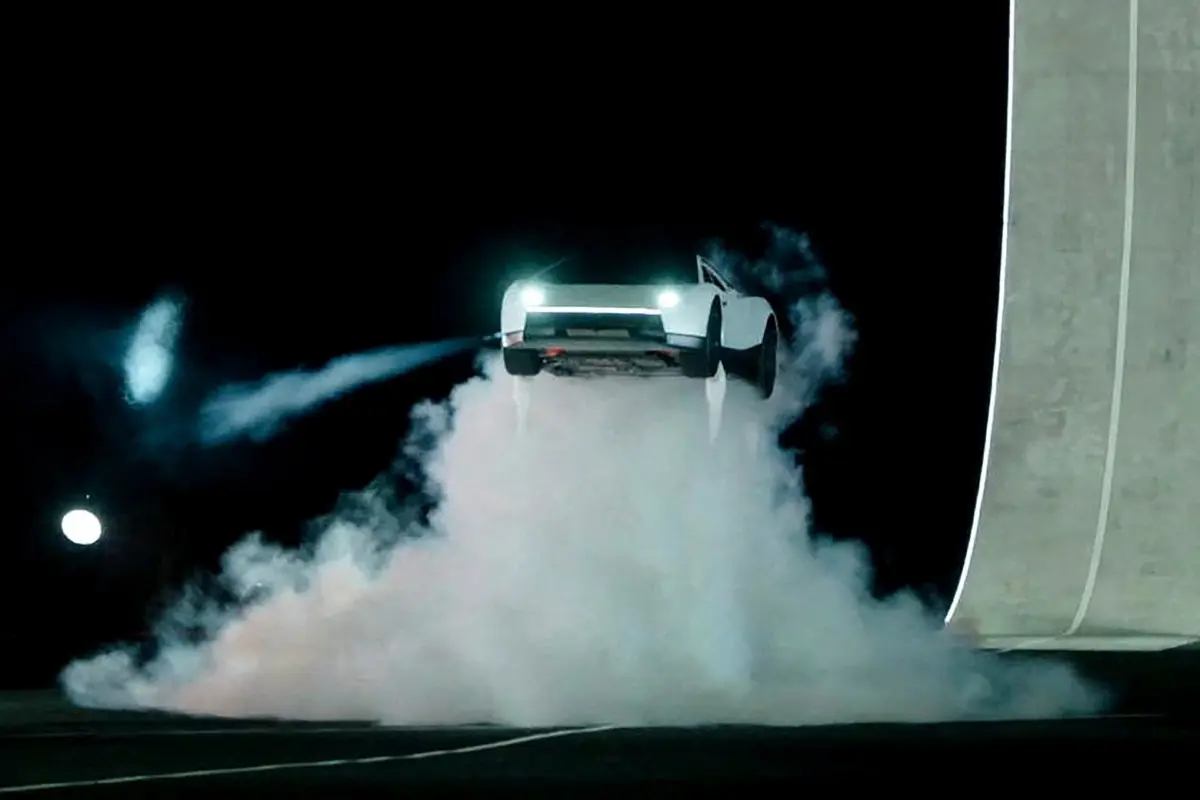
The livestreamed event in Texas was meticulously choreographed to evoke maximum disbelief. Tesla engineers constructed a colossal, C-shaped mechanical ramp designed to test the limits of aerodynamic downforce and propulsion. The new Roadster ascended the apex of the curve, utilizing an advanced downforce-generating fan system—reminiscent of legendary experimental race cars—to adhere upside-down to the track.
Upon release, the vehicle broke free, executed a controlled rotational flip in mid-air, and touched down safely amidst a dense plume of compressed air. To punctuate the demonstration, the car subsequently vaulted over a parked line of standard Tesla vehicles, adding another calculated roll to its aerial repertoire.
While visually arresting, the stunt was less about introducing a viable consumer product and more about establishing a conceptual bridge between Tesla’s automotive engineering and SpaceX’s aerospace capabilities. It directly recalled Musk’s 2018 masterclass in PR: the launching of his personal cherry-red first-generation Roadster into deep space atop a Falcon Heavy rocket—a vehicle that continues to orbit the sun, occasionally tracing paths near Mars.
The Shift Away from the Steering Wheel
During the Texas showcase, Musk casually dropped a revelation that sent ripples through the automotive sector: the new Roadster will officially be the last manually drivable vehicle Tesla ever brings to market.
This declaration serves as the definitive watershed moment for the company. The horizon no longer belongs to human drivers gripping leather-wrapped steering wheels; it belongs to the Cybercab—a dedicated robotaxi devoid of steering wheels and pedals, intended to ferry passengers in autonomous fleets. Alongside the Cybercab sits Optimus, Tesla’s humanoid robot project. Musk has repeatedly asserted that Optimus will eventually elevate Tesla’s market capitalization from its current $1.4 trillion plateau to an astronomical $25 trillion. Priced at a projected $30,000 per unit, these androids are designed to shoulder the burdens of global labor: assembling Cybercabs, tending bars, maintaining industrial facilities, caring for an aging populace, and assisting human pioneers in the eventual colonization of the moon and Mars.
The Mechanics of the Merger
Behind the pyrotechnics and futuristic promises lies a sobering financial reality. Tesla’s profit margins are under severe pressure, driven by massive capital expenditures channeled into artificial intelligence and neural network training clusters. The automaker is no longer expanding as the undisputed, high-margin EV juggernaut of the early 2020s.
By weaving SpaceX technology directly into a Tesla product launch, Musk is preparing public markets for a consolidation of resources. A merger between Tesla and SpaceX solves a fundamental balance sheet dilemma. It allows Musk to leverage SpaceX’s unparalleled capacity for raising public and private capital to rescue and reorient Tesla’s capital-intensive manufacturing apparatus, fusing two distinct corporate identities into a single, unstoppable market-dominating juggernaut.
Supporting Context & Metrics: The Pressures Behind the Pivot
To fully grasp why a Tesla-SpaceX merger has shifted from speculative internet chatter to a boardroom inevitability, one must examine the macroeconomic and competitive pressures eroding Tesla’s traditional business model.
The State of Tesla’s Core Business
On paper, Tesla remains a manufacturing titan. In the 2025 fiscal year, the company delivered more than 1.6 million manually drivable vehicles, generating approximately $95 billion in total revenue, primarily derived from its automotive division alongside burgeoning solar and energy storage sectors.
However, beneath these headline figures lies a deteriorating margin profile. Tesla has not introduced a genuinely new, non-flying consumer vehicle since the rollout of the polarizing Cybertruck in 2019. Compounding matters, the company has quietly phased out production of its high-priced luxury flagships—the Model S sedan and the Model X SUV—leaving the aging Model 3 sedan and Model Y crossover to shoulder the entirety of the company’s automotive revenue.
Headwinds from Global Competition and Policy
The competitive landscape has transformed dramatically over the past half-decade. Chinese EV manufacturers, backed by aggressive state subsidies and advanced supply chains, have saturated international markets, capturing significant European market share. In Europe, Musk’s increasingly polarizing political commentary and alignment with right-wing factions have created measurable consumer friction, directly impacting regional sales figures.
Domestically, regulatory conditions have turned increasingly hostile for legacy EV strategies. Federal regulatory credits—lucrative instruments that historically netted Tesla billions of dollars in pure-profit subsidies sold to non-compliant traditional automakers—have been systematically rolled back. Simultaneously, the broader U.S. consumer market for electric vehicles has cooled amid shifting federal tax credit policies and consumer hesitancy regarding charging infrastructure.
The Financial Architecture of the Merger
Wall Street has taken note of these structural headwinds. Notable analysts, including Barclays’ Dan Levy, have increasingly framed a Tesla-SpaceX merger not as a wild hypothetical, but as an operational necessity that could materialize sooner rather than later.
Under the most widely discussed structural models, SpaceX would act as the acquiring entity. Tesla public shareholders would execute a share-swap, exchanging their automotive equity for shares in the privately held aerospace giant. The resulting merged entity would command a valuation eclipsing $3.5 trillion.
More importantly, this transaction unlocks SpaceX’s formidable capital-raising apparatus. The combined financial muscle would be deployed to fund the multi-billion-dollar retooling of Tesla’s global factories from consumer EVs to autonomous Cybercabs and humanoid Optimus robots. Furthermore, it provides the immense computational capital required to compete head-to-head with artificial intelligence heavyweights like OpenAI and Anthropic in building next-generation data centers—including Musk’s rumored, highly ambitious initiatives to launch orbital data centers powered directly by unfiltered solar radiation.
Official Statements and Industry Reception
The public and analytical reaction to the Roadster unveiling and the anticipated merger has been sharply divided between fervent retail investors and cautious industry veterans.
The Consumer Promise and the Caveat
For consumers willing to put down capital, the new Roadster requires a familiar exercise in patience and financial risk. When the original Roadster concept was announced in 2017, dedicated brand loyalists rushed to secure reservation slots, laying down $50,000 deposits (or up to $250,000 for exclusive "Founder Series" allocations).
For the iteration unveiled in Texas, Tesla’s pricing structure mirrors its past ambition:
- The "Performance" Trim: Priced at $50,000 for standard upgrades.
- The "Thrust" Trim: Demanding a $250,000 commitment for enhanced acceleration packages.
- The "Rocket" Trim: The headline-grabbing, thruster-equipped variant capable of brief flight, available strictly on an invite-only, unpriced basis.
Despite official company projections indicating customer deliveries commencing by 2028, seasoned market watchers echo the timeless maxim: caveat emptor. Musk’s aggressive delivery timelines have historically served as aspirational targets rather than hard guarantees, a pattern well-understood by his investor base.
The Strategic Rationale from Leadership
While critics frequently decry Musk’s grand pronouncements as erratic distractions, supporters argue that the CEO operates on a multi-decade master plan. Selling millions of moderately priced, human-driven electric vehicles was never the ultimate destination; it was merely the funding mechanism.
The rationale posits that developing global manufacturing expertise, supply chain dominance, and mass-production efficiency with the Model 3 and Model Y was essential training for building a factory capable of outputting a Cybercab every ten seconds and marching millions of Optimus robots off assembly lines. From this perspective, shareholders who bankrolled the EV era are unwitting pioneers of a much broader technological revolution.
Future Outlook: The Weyland-Yutani Horizon
As the dust settles over the Texas test track, the automotive industry must confront an inescapable conclusion: the era of Tesla as a standalone car company is drawing to a close.
The theatrical debut of a rocket-propelled, quasi-flying Roadster was not a product launch; it was a conceptual bridge. It offered a nostalgic, guilty-pleasure throwback to the early days of Tesla’s showmanship, while simultaneously serving formal notice to global markets that the company’s destiny lies far beyond terrestrial roadways.
By absorbing Tesla into the ecosystem of SpaceX, Elon Musk is constructing a hyper-integrated technological empire. This galactic mega-entity—spanning orbital rocketry, satellite internet, artificial intelligence, autonomous transport, humanoid robotics, and space colonization—promises to reshape human civilization. Whether this unprecedented corporate consolidation will usher in a utopian era of post-labor abundance or simply outpace regulatory and financial gravity remains one of the defining questions of the 21st century. One thing is certain, however: as Tesla quietly fades into the architecture of Musk’s broader ambitions, the corporate landscape will never be the same.




