Executive Overview
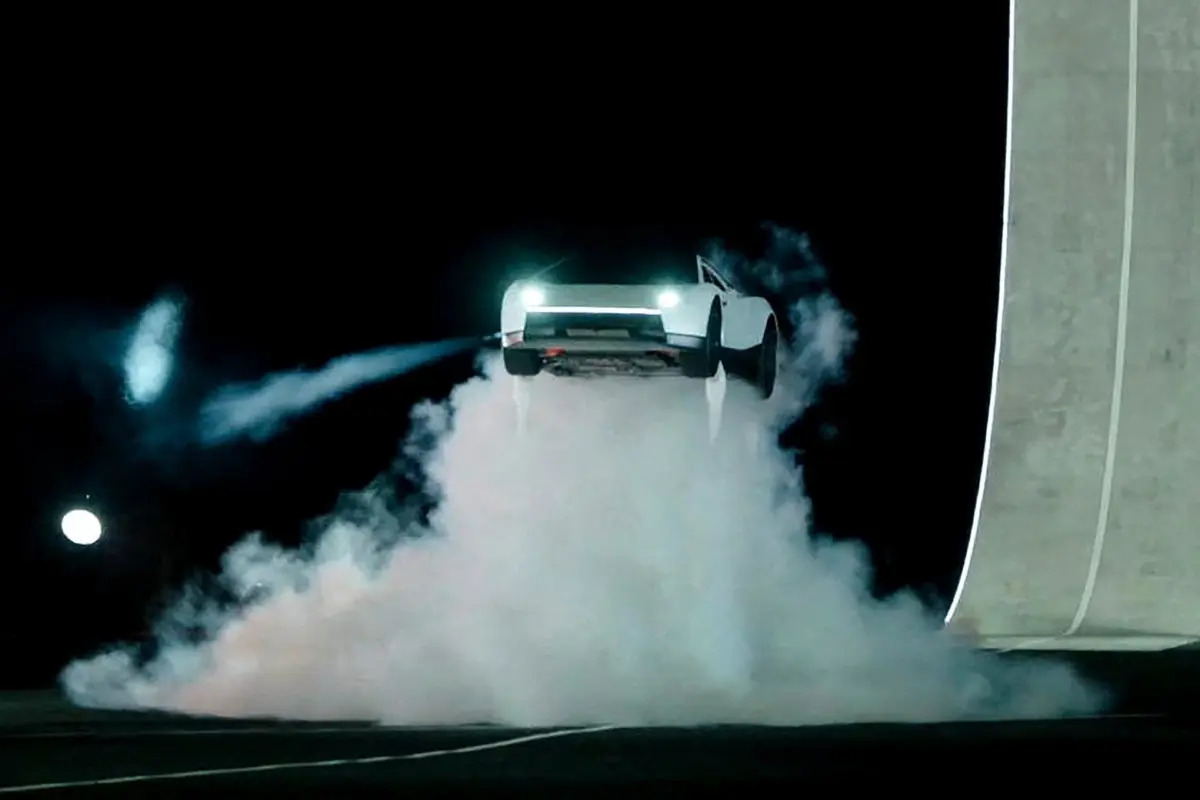
In the world of high-stakes corporate spectacle, Elon Musk has long mastered the art of the misdirection. When the Tesla CEO took the stage in Texas under the flashing lights of a high-octane livestream, the headlines were meant to focus on the impossible: a near-decade-overdue sports car that, powered by SpaceX-designed gas thrusters, could briefly defy gravity.
"What you see with your eyes, you will not believe!" Musk declared to a roaring crowd, pitching a vehicle that melds the aesthetic of a 1970s Lotus Esprit with the architectural lineage of an SR-71 Blackbird spy plane. Featuring a powertrain capable of rocketing from 0 to 60 mph in a blistering 0.8 seconds, the new Roadster was presented as the pinnacle of automotive engineering.
Yet, beneath the pyrotechnics, compressed-air clouds, and viral stunts lies a far more profound corporate reality. The new Roadster is not the dawn of a consumer-facing flying-car era; it is a meticulously crafted Trojan horse. Behind the gloss of the vehicle’s "Rocket" trim package lies a stark financial and strategic pivot: the quiet sunsetting of Tesla as an independent traditional automaker and the clearing of the runway for the mother of all corporate combinations—a megamerger with SpaceX.
As profit margins contract, competition from Chinese electric vehicle (EV) manufacturers intensifies, and regulatory tailwinds dissipate, Musk is laying the groundwork for a $3.5 trillion galactic enterprise. By weaving SpaceX technology directly into Tesla’s marquee events, the billionaire visionary is signaling that the era of selling manually driven family cars is giving way to an autonomous, AI-driven, and space-faring future.
Detailed Chronology: From the Texas Spectacle to the Vision of 2028
The Texas Reveal
The unfolding of the narrative began on a Thursday evening in Texas, engineered with the precision of a Hollywood blockbuster. Tesla constructed a colossal, C-shaped ramp designed to test the limits of aerodynamic downforce and vehicular audacity. The Roadster ascended the curve, anchored upside down by an aggressive downforce-generating fan system, before blasting free, executing a controlled roll—the much-hyped "flying" segment—and touching down smoothly amidst a plume of compressed air. To punctuate the demonstration, the vehicle vaulted over a neat lineup of parked Tesla sedans, executing yet another acrobatic roll.
While visually breathtaking, the stunt was less a technological breakthrough in mass transit and more a callback to Musk’s 2018 PR masterclass, when his personal red Roadster was launched into deep space atop a SpaceX Falcon Heavy rocket—where it continues to orbit the sun to this day.
The Pre-Order Gamble
True to form, the reveal was immediately tied to capital-raising mechanisms that recall previous iterations of Tesla’s product launches. When the initial generation of the Roadster was announced in 2017, early-adopter true believers plunked down $50,000 reservations, stretching up to $250,000 for the limited-run Founder Series.
With this latest iteration, the financial structure has become even more stratified. Tesla is soliciting:
- $50,000 for the "Performance" trim level.
- $250,000 for the "Thrust" version.
- An undisclosed, invite-only sum for the elite "Rocket" trim—the variant equipped with the SpaceX thruster technology capable of localized flight.
Despite these steep financial commitments, customers are being asked to exercise profound patience, with deliveries slated—optimistically—for 2028. In the ecosystem of Musk-led ventures, the ancient legal doctrine of caveat emptor remains the baseline rule of engagement.
The Death of the Manual Drive
Perhaps the most telling declarative statement made during the event was Musk’s confirmation that the Roadster will be the absolute last manually drivable vehicle Tesla ever designs and builds.
This pronouncement marks a sharp dividing line in corporate history. The future, according to Tesla’s roadmap, belongs entirely to autonomous systems:
- The Cybercab: A purpose-built, steering-wheel-less and pedal-less robotaxi designed for high-density urban transport fleets.
- Optimus Humanoid Robots: Bipedal general-purpose machines projected by Musk to scale up to a $30,000 price point, engineered to eradicate human drudgery by assembling vehicles, tending bars, mowing lawns, caring for the elderly, and assisting in extraterrestrial colonization efforts.
Supporting Context & Metrics: The Financial Pressures Behind the Pivot
To understand why Tesla is executing such a radical pivot away from core automotive manufacturing, one must examine the macroeconomic and competitive pressures straining the company’s balance sheet.
Production and Revenue Realities
On paper, Tesla remains a manufacturing titan. In 2025, the company delivered more than 1.6 million manually drivable vehicles, generating approximately $95 billion in revenue, supplemented by growing solar and energy storage sectors. For decades, Tesla shouldered the monumental burden of proving that electric vehicles were commercially viable, ultimately capturing a dominant slice of the global automotive market.
Margin Compression and Stagnant Lineups
However, the underlying economics of selling moderately priced EVs have deteriorated. Tesla’s profit margins are shrinking under the weight of massive capital expenditures directed toward artificial intelligence and autonomous infrastructure. Compounding this issue is a stale vehicle lineup:
- The company has not introduced an all-new, non-flying consumer vehicle since the rollout of the Cybertruck in 2019.
- Production of the high-priced Model S sedan and Model X SUV has been quietly terminated.
- The entire traditional automotive burden now rests squarely on the shoulders of the Model 3 sedan and the Model Y crossover.
External Headwinds
At the same time, the competitive landscape has undergone seismic shifts.
- Global Competition: Aggressive, lower-cost Chinese automakers have flooded international markets, capturing significant ground. In Europe, political friction—particularly backlash stemming from Musk’s alignment with right-wing political figures—has measurably depressed regional sales.
- Regulatory Subsidy Rollbacks: Governments worldwide have begun phasing out or outright eliminating the lucrative regulatory carbon credits that once padded Tesla’s net income to the tune of billions of dollars.
- U.S. Tax Credit Expirations: The erosion of federal EV tax incentives has softened consumer demand across the domestic market, making volume-based profitability an uphill battle.
Official Statements and Industry Analysis
The convergence of Tesla’s strategic drift and SpaceX’s engineering dominance has fueled intense speculation across Wall Street. Financial analysts increasingly view the integration of the two corporate entities not as a wild hypothetical, but as an operational inevitability.
The Barclays Perspective
Barclays analyst Dan Levy recently captured Wall Street’s consensus, suggesting that a Tesla-SpaceX consolidation is "almost a done deal." According to projected financial models, the transaction would likely take the form of an acquisition by SpaceX, wherein current Tesla investors would swap their equities for SpaceX stock. The resulting combined mega-entity would command a staggering market capitalization estimated around $3.5 trillion.
Funding the AI and Orbital Future
Such a merger serves a vital logistical purpose: it provides Musk with the unmatched capital-raising engine of SpaceX to underwrite the astronomical costs of transforming Tesla’s factories for Cybercab and Optimus production. Furthermore, the combined entity would possess the financial fortitude required to keep pace with deep-pocketed competitors like OpenAI and Anthropic in the grueling race for AI data-center infrastructure.
Most audaciously, the merger blueprint aligns with speculative plans for SpaceX to begin launching modular data centers directly into Earth orbit, harvesting uninterrupted, zero-gravity solar power to feed the computational hunger of artificial intelligence.
Future Outlook: The Galactic Mega-Entity
Elon Musk has frequently framed Tesla’s decades-long production of consumer electric vehicles as a calculated "means to an end." The ultimate objective was never merely to become the electric equivalent of Toyota or Ford; rather, it was to forge the global manufacturing capability, supply chains, and engineering expertise required to mass-produce a Cybercab every ten seconds and march millions of Optimus robots off automated assembly lines.
For early investors and everyday consumers who bankrolled the enterprise through its turbulent formative years, the transition represents a profound paradigm shift. The nostalgic, carnival-barker-style stagecraft of the Roadster event served as a fond farewell to an era of automotive pioneering.
As Tesla dissolves its identity into the orbit of SpaceX, the automotive industry must bid farewell to the company that forced a global transition to electrification. In its place rises a hyper-consolidated, interplanetary conglomerate—an entity poised to realize a technological empire that makes the dystopian corporations of science fiction look modest by comparison. The future of transportation is no longer grounded on asphalt; it is destined for the stars.