Executive Overview
Paris Fashion Week has long served as the ultimate crucible for the global luxury industry, a stage where heritage houses either cement their enduring relevance or fade into nostalgic obsolescence. Yet, the Spring/Summer 2027 season arrived with a palpable sense of restraint. In stark contrast to previous years—which were defined by a relentless musical chairs of creative directors, dramatic strategic pivots, and high-stakes artistic overhauls at nearly every major legacy house—this season offered a rare moment of industry-wide decompression.
Amidst a drastically slowed calendar featuring only two high-profile creative debuts across the entire schedule, all eyes converged on the historic Left Bank venue where French fashion house Courrèges prepared to unveil its new era.
Enter Drew Henry. The South African-born designer stepped onto the global fashion stage on the morning of September 30, assuming the mantle of creative director from his predecessor, Nicolas Di Felice. Henry’s appointment marks a pivotal crossroads for the brand founded in 1961 by André Courrèges. Known historically for pioneering space-age modernism, futuristic vinyl, architectural tailoring, and uncompromising youthfulness, the house required a visionary capable of honoring its radical past while translating its ethos for an ultra-sophisticated, hyper-contemporary demographic.
Henry’s debut collection for SS27 did precisely that, filtering the cerebral yet playful aesthetic of contemporary tastemakers through the lens of mid-century futurism. To borrow a modern cultural touchstone, if the archetypal, design-forward concept stores found in Hackney, Stoke Newington, or the Marais—purveyors of edible-looking artisanal soaps, extortionate wobbly candles, obscure interior design periodicals, and minimal luxury fashion arranged by strict color-block gradients—were manifested as a physical runway collection, it would be Courrèges SS27. It was simple, remarkably fresh, undeniably fun, and laced with just enough idiosyncratic, off-kilter charm to keep the fashion pack transfixed.
This in-depth investigative report explores the mechanics of Henry’s debut, examining the foundational heritage of Courrèges, tracing the precise chronology of a momentous morning in Paris, analyzing the broader market metrics shaping the luxury sector, and forecasting the trajectory of a brand poised to dominate the minimalist-chic zeitgeist.
Detailed Chronology: Inside the SS27 Courrèges Debut
The Prelude to the Presentation
The atmosphere outside the venue on the morning of September 30 was charged with an intensity disproportionate to the sparse debut schedule of the week. With only two major creative director introductions on the entire Paris calendar—comprising Courrèges this morning and Kai Nesselrath’s much-anticipated premiere for Carven later in the afternoon—the fashion press, international buyers, and celebrity delegations arrived early, acutely aware that they were witnessing one of the few transformative moments of the season.
The anticipation was compounded by the heavy legacy of Nicolas Di Felice’s tenure, which had successfully revived Courrèges by leaning into sleek, techno-fetishistic clubwear and stark, architectural silhouettes. When Di Felice stepped down, the house faced the perennial dilemma of luxury conglomerates: how to maintain momentum without slipping into repetitive self-parody.
Drew Henry, whose curriculum vitae includes prestigious stints at Céline, JW Anderson, Phoebe Philo’s studio, and Burberry, was quietly announced as the antidote to creative fatigue. Known behind the scenes as a designer’s designer—someone deeply steeped in the lineage of intellectual minimalism and structural purity—Henry approached the Courrèges archive not as a museum to be preserved under glass, but as a living, breathing laboratory.
The Runway Narrative: Act I – The Blank Canvas
As the house lights dimmed, the minimalist soundscape began to pulse through the venue. The first look of the collection emerged from the backstage area as a definitive statement of intent.
It arrived entirely in optic white, acting quite literally as a blank page. The look comprised a knee-length structural waistcoat with the top three buttons meticulously fastened, while the remaining fabric was left loose, fluid, and daringly open around the waist and legs. It was an immediate nod to André Courrèges’ obsession with architectural liberation—clothes that allowed the female body to move unencumbered by traditional sartorial constraints—reimagined through Henry’s penchant for fluid, deconstructed tailoring.
This opening look established the cadence for the first movement of the show: purity, precision, and an absence of noise. The immaculate whites quickly gave way to a carefully curated spectrum of block colors. Henry deployed shades of muted sage, chalky butter yellow, industrial grey, and rich, ink-black, proving his mastery over color theory. Every garment was arranged not just for visual impact on the runway, but with the modular, capsule-wardrobe sensibilities of the modern consumer in mind.
The Runway Narrative: Act II – Playful Subversion and Archival Revival
As the collection progressed, Henry injected the "quirky twist" that defines his design philosophy. The stark minimalism was expertly undercut by elements of tactile surrealism and audacious playfulness.
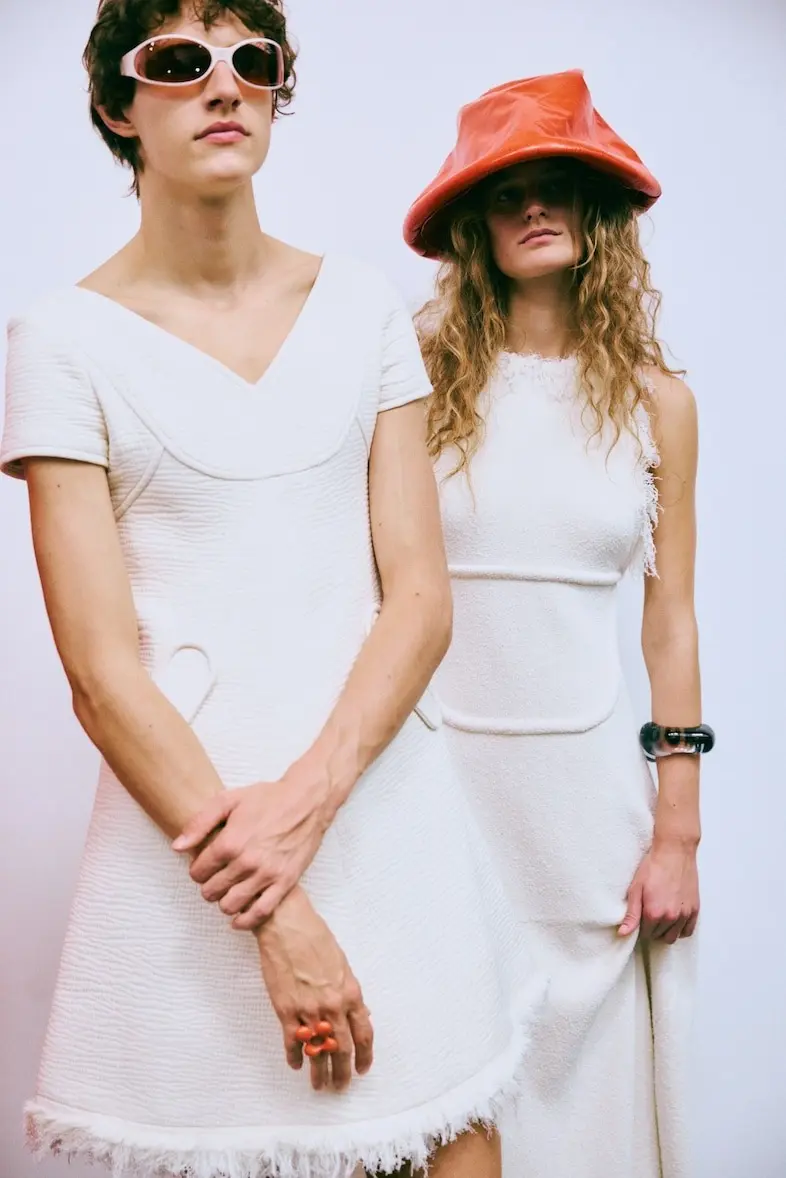
Among the standout accessories were furry stilettos that combined sleek, architectural heels with tactile, plush textures, creating a deliberate visual friction. But the true showstoppers were the ludicrous, oversized hats that commanded the runway with theatrical bravado. Far from being mere runway fantasies, these hats were pulled directly from the Courrèges archives, originally designed by master milliner Jean Barthet in the early 1960s. By resurrecting these forgotten relics of space-age couture, Henry bridged the gap between Courrèges’ historical origins and twenty-first-century street style.
Footwear history was also rewritten on the runway. The house’s iconic go-go boots—long synonymous with pristine, polished white vinyl—were reinterpreted to look deliberately, lovingly worn in. Scuffed, softened, and broken-in, these boots stripped away the intimidating perfection of traditional luxury, offering instead an approachable, lived-in luxury that resonated deeply with the younger buyers seated front row.
Further challenging traditional gender boundaries, Henry took the sweet, innocent silhouette of the babydoll dress and recontextualized it for a contemporary male audience. Rendered in unexpected proportions and styled on male models, these pieces underscored the gender-fluid reality of modern dressing, proving that Henry understands the shifting semiotics of contemporary menswear just as profoundly as womenswear.
Supporting Context & Metrics: The Business of Debuts and the Courrèges Revival
A Quiet Calendar in Paris
To fully understand the significance of Henry’s debut, one must examine the broader macro-environment of the Spring/Summer 2027 fashion calendar. Just twelve to eighteen months prior, the industry was reeling from a dizzying carousel of creative director appointments. Major heritage houses seemed to swap designers every fiscal quarter, resulting in market saturation, fatigue among consumers, and a noticeable dip in retail conversion rates as shoppers struggled to understand what individual brands stood for.
Recognizing this fatigue, luxury conglomerates and independent houses alike pumped the brakes for the SS27 season. With only two major debuts scheduled in Paris—Courrèges and Carven—the spotlight was blindingly intense. For Courrèges, owned by Artemis (the Pinault family’s holding company), this calculated scarcity worked to absolute perfection. Without competing noise from rival houses staging marquee debuts, Courrèges commanded the global fashion media cycle entirely for 48 hours.
Brand Equity and the Modern Luxury Consumer
To appreciate Henry’s trajectory, one must evaluate his pedigree. Having trained under the titans of modern intellectual fashion—working on the leather goods and ready-to-wear lines at Céline during its golden era under Phoebe Philo, refining proportions at JW Anderson, and navigating heritage reinvention at Burberry—Henry possesses a rare hybrid skill set. He understands the commercial imperatives of global luxury distribution while maintaining the uncompromising artistic vision required to captivate the fashion elite.
Market analysts note that Courrèges’ target demographic—the affluent, culturally literate urbanite who frequents design-forward concept stores across London, Paris, and Berlin—demands authenticity. They are increasingly immune to traditional logo-mania and heavy-handed advertising campaigns. Instead, they buy into a holistic aesthetic ecosystem: interior design, scent, music, and understated, impeccably cut clothing. Henry’s SS27 collection tapped directly into this psychographic profile. By blending accessible wearability (such as the distressed go-go boots and relaxed waistcoats) with avant-garde archival nods (the Barthet hats), he ensured that the collection is as commercially viable on e-commerce platforms as it is visually arresting on Instagram and TikTok.
Official Statements and Industry Reactions
Following the conclusion of the show, the backstage area transformed into a frenzied hub of industry heavyweights, buyers, and critics dissecting the morning’s proceedings.
Drew Henry, visibly reflective yet radiant, addressed the press regarding his vision for the house codes:
"Courrèges is a house built on the future, but the future of 1961 looks very different from the reality of today. My goal was not to replicate the past or to lean entirely into nostalgic pastiche. Instead, I wanted to ask: what does space-age optimism mean in our current cultural moment? For me, it means stripping away excess, honoring the purity of the line, and injecting a sense of humor and tactile humanity back into luxury."
Industry veterans were quick to praise the seamless transition of power. Sarah Mower, chief critic for international fashion publications, noted:
"Drew has pulled off a masterclass in editorial editing. In a season where many houses are shouting to be heard, Courrèges whispered with absolute clarity. The archival hats and the distressed boots show a designer who is confident enough to play with heritage without breaking it."
Top-tier retail buyers from global luxury department stores also expressed immediate enthusiasm. A senior buying director for a prominent Parisian retailer remarked:
"The commercial translation of this collection is exceptional. The white waistcoat that opened the show is going to be an immediate sell-out piece, and the gender-fluid babydoll dresses represent precisely where the contemporary market is moving. Henry has secured the core Courrèges customer while expanding the tent significantly."
Future Outlook: Where Does Courrèges Go From Here?
As the dust settles on Paris Fashion Week and the industry transitions into the production and delivery cycles for Spring/Summer 2027, the overarching question remains: Can Drew Henry sustain this momentum, and what does his appointment mean for the long-term trajectory of Courrèges?
1. Retail Expansion and Product Diversification
With Artemis backing the brand, Courrèges is uniquely positioned to scale its retail footprint globally. Henry’s background at Céline and Burberry suggests that accessories—specifically footwear and leather goods—will play an increasingly vital role in the brand’s revenue mix. The positive reception of the scuffed go-go boots and furry stilettos indicates a lucrative runway-to-retail pipeline for high-margin accessory categories. Furthermore, expansion into key Asian markets, where minimalist, design-driven European labels enjoy cult-like status, will likely be a primary strategic focus over the next twenty-four months.
2. Deepening the Brand Ecosystem
Given Henry’s affinity for spatial design and contemporary lifestyle curation, industry insiders anticipate that Courrèges may soon expand beyond ready-to-wear and accessories. Rumors are already swirling within Parisian circles regarding potential homeware capsules, fragrance collaborations, and immersive retail installations that mimic the sensory environment of the concept stores that inspired his debut collection. By positioning Courrèges not just as a clothing label, but as an all-encompassing lifestyle brand, Henry can capture the loyalty of the modern consumer on a deeper, experiential level.
3. The Evolution of the Henry Aesthetic
As Henry prepares his upcoming collections—culminating in the upcoming menswear and pre-collection presentations—the true test will be his ability to iterate on the vocabulary he established on September 30. While a debut collection often functions as an introductory manifesto, subsequent seasons require evolution without dilution. If Henry can continue to balance the austere, architectural purity of André Courrèges with his own signature wit and subversion, the French house is poised to transition from a critical darling into one of the defining commercial powerhouses of the decade.
Conclusion
Drew Henry’s debut for Courrèges SS27 will be remembered as a masterclass in tactical restraint and visionary clarity. By honoring the space-age heritage of the 1960s while grounding it in the tactile, intellectual realities of contemporary fashion, Henry has successfully rewritten the house codes for a new generation. In a quiet Paris Fashion Week devoid of crowded calendars and frantic label-swapping, Courrèges stood alone in the spotlight—and proved that the future of luxury belongs to those who dare to keep it simple, fresh, and profoundly fun.