Executive Overview
Forward-thinking fashion has historically occupied a precarious space in the industry—frequently celebrated on editorial pages while quietly being diluted on commercial racks. Yet, few houses have embraced the avant-garde with the same unyielding, skin-tight tenacity as Mugler. From its earliest iterations under the visionary guidance of the late French designer Thierry Mugler, the label operated as an incubator for a theatrical, unapologetically futuristic reality. Long before cyborg aesthetics, chrome bodices, and biomechanical tailoring became the baseline currency of modern runway shock-value, Mugler was shaping hyper-stylized human vessels.
"I dreamed of creating another world, to my scale. One that was my own," the late founder once famously reflected. That philosophy of insular, spectacular world-building has undergone a high-stakes renaissance over the past year. Since Portuguese creative director Miguel Castro Freitas stepped into the role of creative helmsman, the house has aggressively recaptured the cultural conversation. By mining—and fearlessly modernizing—Thierry Mugler’s most provocative, skin-baring designs, Castro Freitas has routinely set the internet ablaze, generating viral discourse that bridges the gap between historical fashion reverence and hyper-connected digital culture.
Nowhere has this tension between past and present been more palpable than in the final chapter of Castro Freitas’s runway arc. Concluding his ambitious three-part runway series titled A Trilogy of Glorified Clichés, the designer delivered a masterclass in provocation, nostalgia, and technical audacity. From dresses tethered precariously to nipple rings to cheeky reinterpretations of legendary ’90s cut-outs, the collection cemented Mugler’s status as fashion’s ultimate provocateur. Accompanied by surrealist digital backdrops, avant-garde styling, and an eerie, front-row stunt featuring hyper-realistic prosthesis artist Alexis Stone disguised as Thierry Mugler himself, the show was less a traditional presentation than an immersive piece of performance art. This analysis examines the technical execution, historical weight, and cultural ripples of Mugler’s latest epoch-defining moment.
Detailed Chronology: Unfolding A Trilogy of Glorified Clichés
The trajectory of Miguel Castro Freitas’s tenure at Mugler has been marked by a methodical dismantling of conventional runway boundaries. The narrative arc began in earnest during his Spring/Summer 2026 (SS26) debut, which served as the inaugural installment of A Trilogy of Glorified Clichés. Immediately, the designer signaled that he had no interest in resting on the house’s considerable archival laurels. Instead, he chose to weaponize them.
The SS26 presentation sent shockwaves through Paris Fashion Week when a model stepped onto the runway clad in a slinky, ethereal nude dress held up entirely by her own nipple rings—a biting, direct nod to a radical styling choice Thierry Mugler originally introduced in the late 1990s. The internet, predictably, fractured into polar camps of prudish critique and rapturous applause. It was a calculated risk that paid immediate dividends, proving that Castro Freitas understood the core ethos of the brand: fashion should elicit a physical, visceral reaction, whether through awe or discomfort.
Fast-forward to the culmination of the trilogy—the final chapter that brought the grand experiment to a fever pitch. Castro Freitas turned his attention to another legendary artifact from the Mugler vault: the infamous peek-a-boo dress from the Autumn/Winter 1995 (AW95) collection. This historical piece famously featured a dramatic, oval cut-out engineered to expose the model’s lower back and bum cheeks.
When the modern iteration hit the runway, digital fashion observers—most notably commentators like @fashionroadman—were quick to draw comparisons to Alexander McQueen’s equally historic "Bumster" trousers from the late ’90s. Yet, historical accuracy dictates that Mugler was plumbing the depths of cheeky, anatomy-worshipping tailoring right alongside his British contemporaries. Castro Freitas’s update maintained the gravity-defying, structural integrity of the original while streamlining the silhouette for a contemporary eye, proving that the house’s fascination with the architecture of the human form remains entirely uncompromised.
Supporting Context & Metrics: Pushing Futuristic Extremes
Beyond the viral silhouettes, the technical styling and environmental world-building of the collection underscored Freitas’s commitment to pushing fashion to technological and physiological extremes. The runway itself was an assault on the senses. As sprawling LED screens flashed kaleidoscopic footage of wild animals, untamed nature, and intimate close-ups of people kissing, the audience was enveloped in a sensory landscape that questioned the boundary between organic life and synthetic creation.
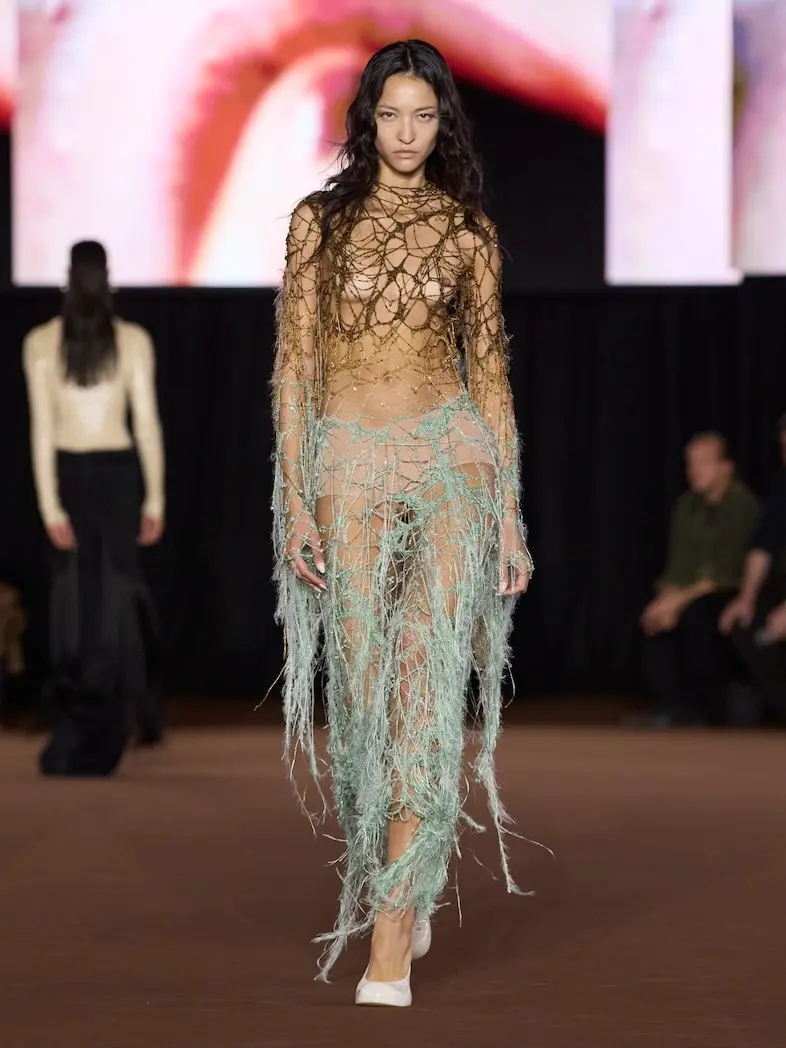
The garments matched this jarring dichotomy. Models navigated the runway in razor-sharp, monochromatic suits cut aggressively beneath the chest, exposing radical spans of under-boob—a silhouette that entirely reinterprets contemporary corporate or evening wear codes. Contrast was deployed as a weapon: shaggy, jet-black fur dresses were shockingly punctuated by hyper-vibrant neon shades, while loose, gossamer-thin netted gowns appeared to literally unravel on the body as the models walked, suggesting a garment in a state of rapid, graceful decay.
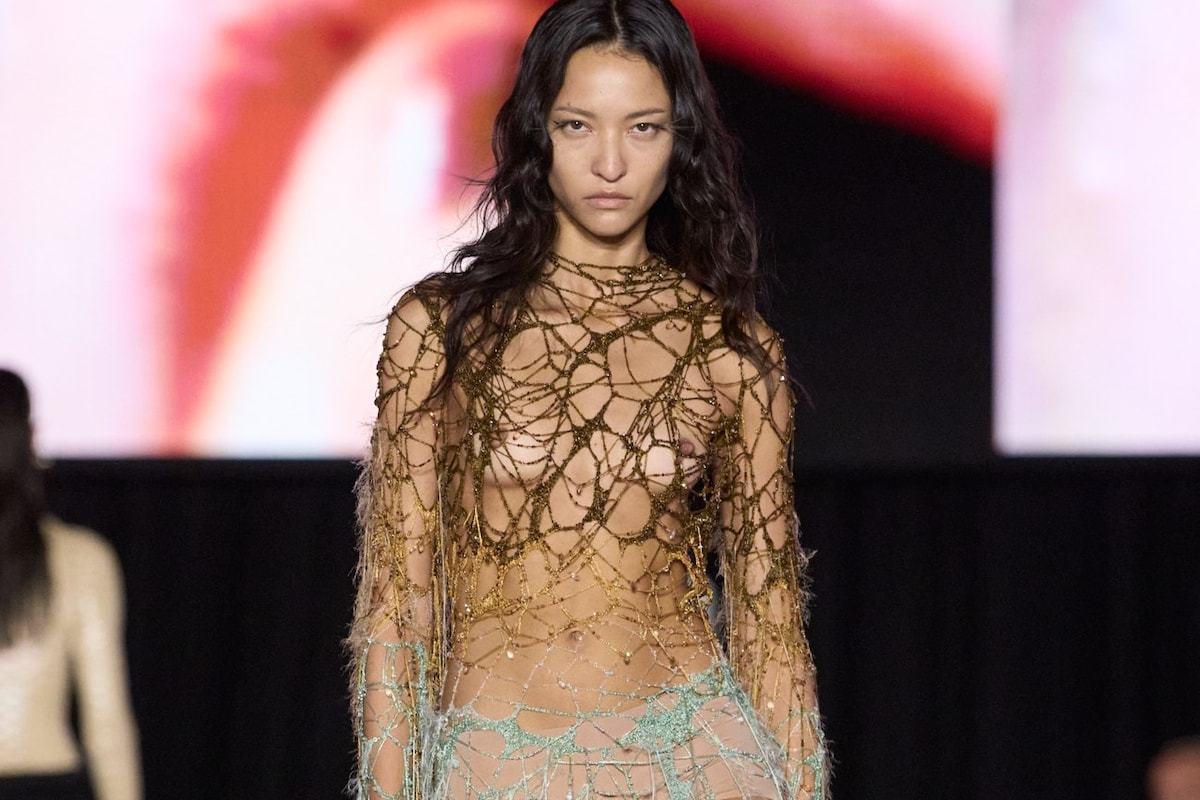
Every detail of the styling was weaponized to distort human proportions and challenge conventional beauty standards:
- The Silhouette: Hair was pulled into towering, impossibly slicked-back buns that dramatically elongated the models’ heads, creating an alien, elongated posture.
- The Footwear: Cartoonish, sculptural heels came saturated in high-octane bright shades, rooting the looks in a futuristic fantasy.
- The Accessories: Avant-garde headpieces completely shielded the eyes, rendering the models anonymous, robotic emissaries from an alternate dimension.
The apex of this surrealist fever dream, however, occurred off the runway. In a move that blurred the lines between homage and psychological thriller, renowned makeup artist and drag prosthetic illusionist Alexis Stone sat in the front row transformed into an uncannily accurate, aging clone of Thierry Mugler himself. Watching the show through prosthetics so flawless they induced vertigo, Stone embodied the ultimate thematic paradox: the past watching the future consume its legacy.
Official Statements & Industry Reception
The critical response to Mugler’s latest chapter has underscored a broader industry shift toward high-impact, conversation-starting garments over quiet luxury. While mainstream commercial buyers may find themselves hesitant to invest in nipple-ring suspensions and structural under-boob suiting, the cultural currency generated by these presentations is immeasurable.
In post-show interviews, insiders and critics alike praised Castro Freitas for avoiding the trap of pastiche. Rather than acting as a mere archivist dusting off old lookbooks, the Portuguese creative director has utilized Thierry Mugler’s provocative blueprints as a launching pad for a modern dialogue about body autonomy, gender expression, and digital virality.
"Mugler was never about polite fashion; it was about theatrical liberation," noted one prominent European fashion critic immediately following the show. "Castro Freitas understands that to honor Thierry, you cannot simply replicate him—you have to provoke the audience just as he did thirty years ago."
The integration of digital-native commentary—exemplified by the rapid dissemination of runway clips across TikTok and Instagram—highlights an acute awareness of how modern fashion is consumed. The brand is no longer just catering to the traditional front row; it is staging performances optimized for the infinite scroll, ensuring that a dress held together by body piercings becomes a global talking point within milliseconds of hitting the flashbulbs.
Future Outlook: The Next Era of Mugler
As A Trilogy of Glorified Clichés officially draws to its thunderous close, the fashion world is left to ponder what comes next for a brand that has staked its modern identity on relentless escalation. Having successfully navigated the perilous waters of succeeding a legendary founder and revitalizing a dormant house style, Miguel Castro Freitas has proven himself to be a master of theatrical timing.
The challenge ahead lies in translation—bridging the gap between the viral euphoria of the runway and the commercial realities of the global luxury market. While pieces like the oval-cut-out trousers and avant-garde suiting generate invaluable brand equity, the house must continue to expand its ready-to-wear offerings, accessories, and fragrance lines without losing the dangerous, electric edge that defines its current renaissance.
One thing remains unequivocally certain: as long as Miguel Castro Freitas holds the creative reins, Mugler will refuse to whisper when it can scream. In an era where much of contemporary design retreats into safe, algorithm-friendly minimalism, Mugler stands as a defiant monument to the power of fantasy, flesh, and unadulterated spectacle. The cyborgian gaze has not only returned—it is looking sharper, cheekier, and more vital than ever before.