Executive Overview
In the fast-paced ecosystem of modern video game hardware transitions, software longevity is typically measured in short, transactional life cycles. A console launches, a flagship sequel takes the baton, and the previous generation’s crown jewel is quietly relegated to the retro archives.
Yet, Nintendo—a company that has consistently defied conventional industry logic—has once again rewritten the rulebook.
More than nine years after its initial debut as a critically lauded yet commercially stifled title on the troubled Wii U, and nearly eight years after its blockbuster resurrection on the original Nintendo Switch, Mario Kart 8 Deluxe has received a major, completely unexpected feature update. Tailored specifically for the Nintendo Switch 2, this surprise patch breathes radical new life into an already legendary title, introducing capabilities that push the absolute limits of local multiplayer and hardware utilization.
At a time when the market’s collective gaze is fixed firmly on Mario Kart World—the definitive next-generation flagship racer released alongside the Switch 2 last year—Nintendo’s decision to heavily upgrade an aging precursor has sent shockwaves through the gaming community. This patch is far more than a routine stability update or a minor resolution bump. It introduces a jaw-dropping eight-player local split-screen mode, integrates CameraPlay functionality for real-time video reactions, drastically reduces loading times, and unlocks enhanced 4K visual fidelity for docked play.
This analytical report explores the technical achievements of this unexpected update, charts the chronological evolution of the Mario Kart 8 phenomenon, evaluates the strategic implications for Nintendo’s software ecosystem, and projects what this means for the future of the franchise on next-generation hardware.
Detailed Chronology: From Wii U Flop to Undisputed Sales Juggernaut
To truly understand the gravity of Nintendo’s latest software update, one must trace the improbable, nearly decade-long journey of Mario Kart 8.
1. The Genesis: Wii U (2014)
When Mario Kart 8 launched on the Wii U in May 2014, it was universally praised by critics for its gravity-defying anti-gravity mechanics, stunning high-definition asset design, and sublime orchestral soundtrack. However, it arrived tethered to a commercial dead end. The Wii U’s dismal hardware adoption rate meant that despite achieving a remarkably high attach rate among console owners, the game’s absolute sales figures were severely bottlenecked, topping out at roughly 8.46 million copies.
2. The Resurrection: Nintendo Switch (2017)
Recognizing that the game’s brilliance had been shielded from the mass market by hardware failure, Nintendo executed one of the most successful re-release strategies in video game history. In April 2017, Mario Kart 8 Deluxe arrived on the newly minted Nintendo Switch.
The "Deluxe" moniker wasn’t just marketing fluff; it rectified the original game’s most glaring omission by completely overhauling the lackluster Battle Mode, bundling all previously released downloadable content (DLC), and adding fan-favorite characters like the Inklings from Splatoon. The market response was immediate and historic. The game became a permanent fixture on global software charts, defying normal retail decay curves to sell tens of millions of copies year after year.
3. The Booster Course Pass Era (2022–2023)
By late 2021, Mario Kart 8 Deluxe had sold so well that a traditional sequel felt unnecessary, or perhaps commercially risky given how difficult it would be to capture lightning in a bottle a third time. Instead, Nintendo took the unprecedented step of launching the Booster Course Pass in 2022.
Over the course of six distinct waves, Nintendo doubled the size of the game, adding 48 remastered classic and retro tracks sourced from across the entire history of the franchise, alongside a rolling roster of legacy characters. By the time the pass concluded in late 2023, Mario Kart 8 Deluxe had transformed into a sprawling, definitive archive of the entire Mario Kart series, cementing its status as the best-selling game on the Nintendo Switch with over 60 million copies sold.
4. The Next-Gen Hand-Off: Switch 2 and Mario Kart World (Last Year)
When the Nintendo Switch 2 launched last year, it did so with a massive marquee title designed to showcase the new hardware’s technical horsepower: Mario Kart World. Brimming with advanced physics, sprawling open-world elements, and next-generation environmental rendering, Mario Kart World was positioned as the undisputed future of the franchise. It was widely assumed that Mario Kart 8 Deluxe would gracefully step aside, preserved as a beloved historical artifact of the previous generation.
5. The Unprecedented Switch 2 Patch (Present Day)
Completely defying industry expectations, Nintendo has deployed a robust, free update for Mario Kart 8 Deluxe designed exclusively to leverage the architecture of the Switch 2. Rather than leaving the past behind, Nintendo has built a bridge between generations, proving that for certain evergreen titles, the lifecycle never truly ends.
Technical Breakdown: What the Switch 2 Update Changes
The new patch for Mario Kart 8 Deluxe is not merely cosmetic; it fundamentally alters how the game can be played, utilizing the advanced computational power and input architecture of the Switch 2.
The Eight-Player Split-Screen Miracle
Historically, local split-screen in racing games has been capped at four players—a limitation dictated by the rendering overhead of drawing four distinct camera viewports simultaneously, coupled with the hardware constraints of legacy consoles.
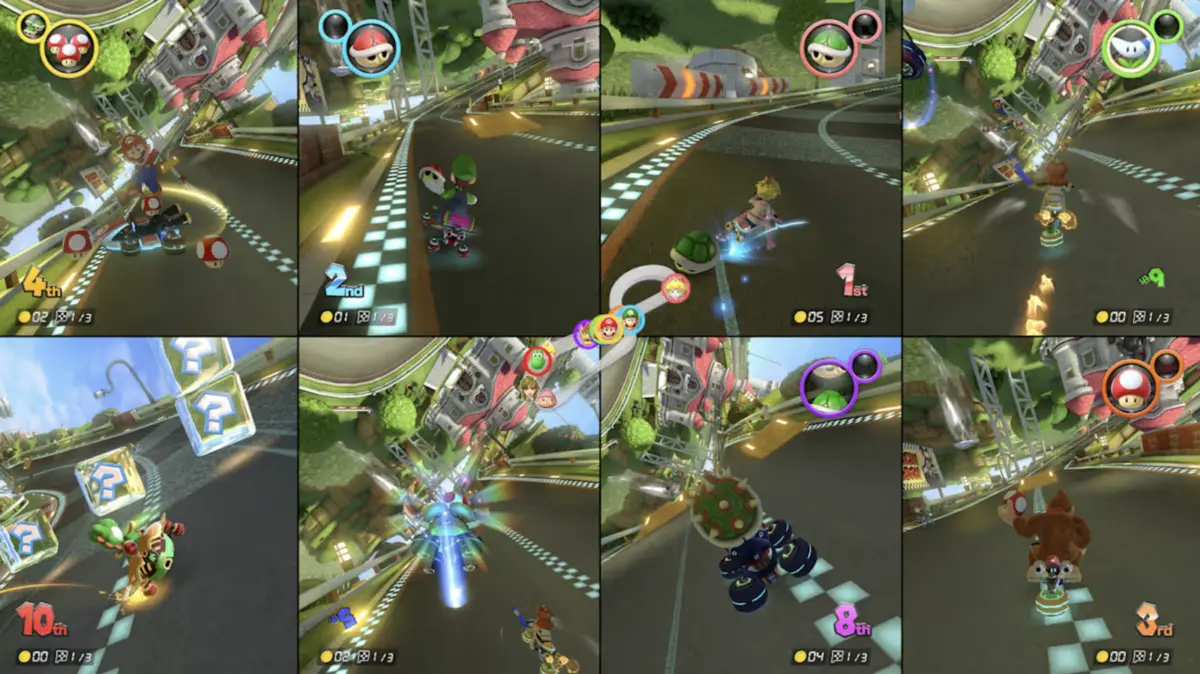
The Switch 2 patch shatters this ceiling by introducing eight-player local split-screen multiplayer.
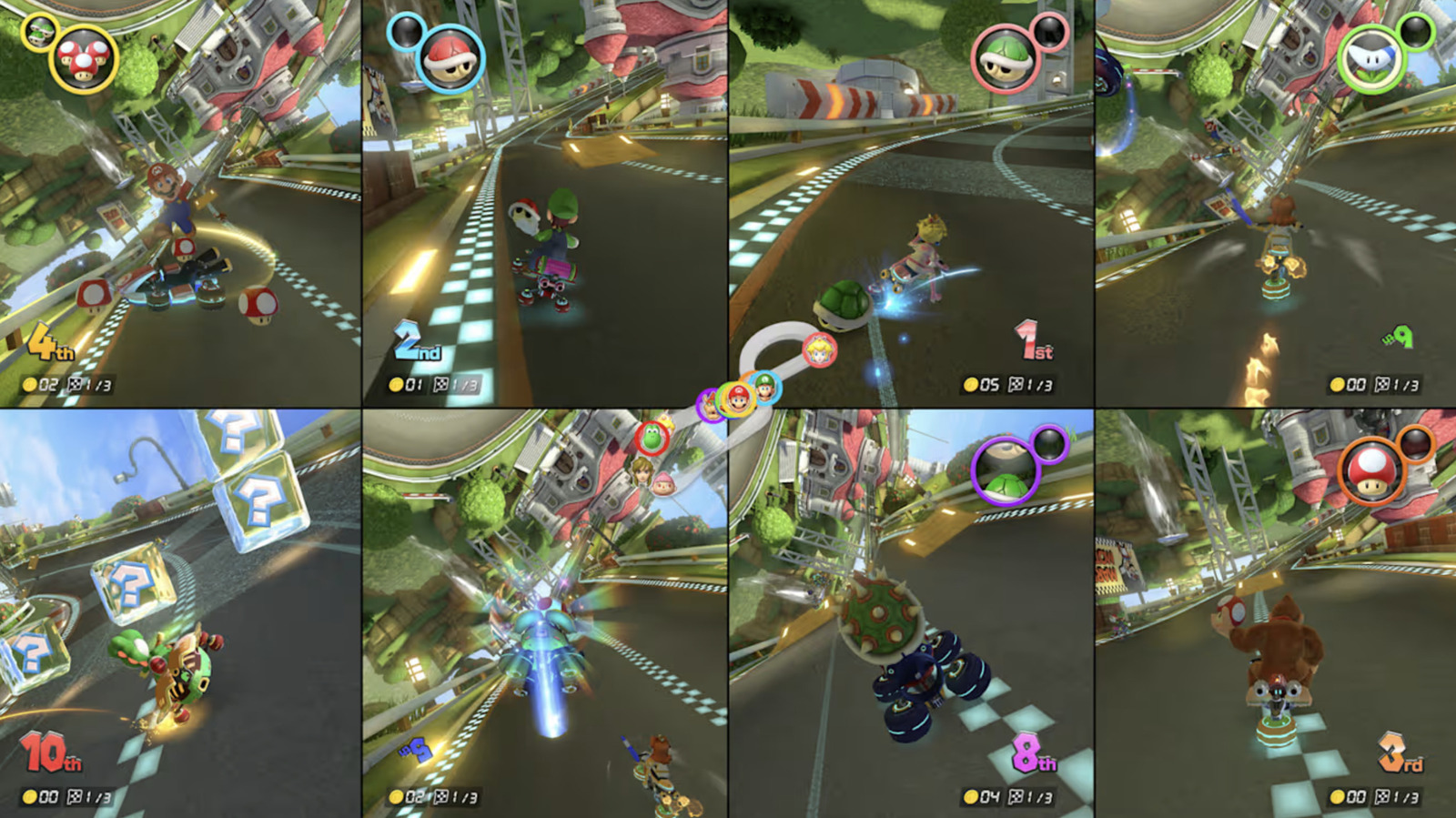
- Hardware Synergy: Utilizing the significantly expanded processing headroom and unified memory architecture of the Switch 2, the game can dynamically carve the display into eight distinct, fluid viewports without sacrificing the rock-solid 60 frames-per-second baseline that Mario Kart purists demand.
- Controller Compatibility: True to Nintendo’s philosophy of accessible hardware integration, the system supports a wide array of controllers. Players are not required to purchase eight brand-new next-gen gamepads; original Nintendo Switch Joy-Cons, Pro Controllers, and compatible third-party peripherals can be mixed and matched freely to fill out the lobby.
Integration of CameraPlay and GameChat
Taking a cue from its successor, Mario Kart 8 Deluxe now fully integrates CameraPlay support.
- Local Reactions: By connecting an official Switch 2 camera or a compatible standard USB-C camera to the console, players can display real-time video feeds of their opponents’ faces on-screen. This introduces a visceral, party-game dynamic—capturing the exact moment of triumphant elation or bitter betrayal (the classic "Luigi death stare") when a blue shell strikes at the finish line.
- Online Integration: CameraPlay is not restricted to local play. Through Nintendo’s upgraded online infrastructure and GameChat protocols, players competing globally can utilize camera feeds, matching the ecosystem features introduced in Mario Kart World.
Visual Enhancements and Performance Metrics
Running backward-compatible software on next-generation hardware often yields minor stability improvements, but Nintendo’s engineering team went significantly further with this patch:
- Native 4K Docked Performance: While previous iterations of the game utilized dynamic resolution scaling peaking at 1080p in docked mode on the original Switch, the Switch 2 patch enables native high-resolution output designed to shine on modern 4K displays.
- Handheld Mode Optimization: Building upon the ‘Handheld Mode Boost’ firmware update previously deployed on the Switch 2, the game now natively optimizes its portable asset streaming and texture filtering when played away from the dock.
- Substantially Reduced Load Times: Thanks to the high-speed NVMe-based storage architecture of the Switch 2, pre-race loading times have been slashed drastically, eliminating the brief wait periods between Grand Prix selections and getting players back onto the track faster than ever before.
Supporting Context & Metrics: The Evergreen Phenomenon
To appreciate why Nintendo is expending engineering resources on a nine-year-old game, one must examine the raw market metrics and consumer behavior data surrounding Mario Kart 8 Deluxe.
| Metric Category | Data Point / Milestone | Significance |
|---|---|---|
| Original Release Window | May 2014 (Wii U) | Survived the commercial failure of its parent platform. |
| Switch Port Release | April 2017 (Nintendo Switch) | Revitalized the title into a generational console seller. |
| Lifetime Sales Volume | Over 60 Million Units (Combined) | Ranks among the top-selling video games of all time. |
| Chart Longevity | ~7+ Years on US/Global Sales Charts | Maintained continuous retail presence without falling out of favor. |
| Expansion Scale | 48 DLC Tracks (Booster Course Pass) | Doubled the game’s core content post-launch. |
The Software Tail Strategy
In the video game industry, publishers typically rely on a high-velocity release cadence: launch a game, monetize it for 12 to 18 months via DLC, and then pivot the entire consumer base toward a sequel to capture another full-price ($60–$70) transaction.
Nintendo’s approach with Mario Kart 8 Deluxe defies this standard operating procedure. By treating the game not as a disposable product, but as an enduring platform—much like a digital theme park or a streaming service—Nintendo has captured multiple waves of hardware consumers. Parents who played the original Wii U version in their twenties are now buying Switch 2 consoles and introducing the game to their children.
By upgrading Mario Kart 8 Deluxe for the Switch 2, Nintendo accomplishes two strategic goals simultaneously:
- It adds immense value to the backward-compatible library, making the Switch 2 an even more attractive upgrade proposition for families and casual gamers.
- It maintains a vibrant, active multiplayer community across both titles, ensuring that the brand dominates engagement metrics regardless of which specific game a user fires up.
Official Statements & Industry Reception
The surprise deployment of the update sent ripples through social media and financial analyst circles alike. While Nintendo’s corporate communications department framed the update as a gesture of goodwill to the loyal player base, industry insiders have been quick to dissect the underlying strategy.
"Nintendo continues to view its intellectual property through a lens of timelessness rather than planned obsolescence," noted veteran gaming analyst Marcus Vance. "When you have a product that has achieved a 60-million-plus user base, abandoning it entirely on day one of a new hardware cycle leaves money and community goodwill on the table. By upgrading Mario Kart 8 Deluxe, Nintendo ensures that the transition friction for early Switch 2 adopters is practically zero."
Consumer reception on platforms like Reddit, ResetEra, and X (formerly Twitter) has been overwhelmingly euphoric, tempered only by mild bewilderment regarding the strategic interplay between the old title and the new hardware flagship, Mario Kart World.
Many fans have expressed surprise that Nintendo opted to invest developer hours into adding complex features like eight-player split-screen and CameraPlay to an older SKU, rather than channeling those specific engineering efforts exclusively into expanding the roadmap for Mario Kart World. However, the prevailing sentiment remains one of deep appreciation for a hardware manufacturer that continues to support its legacy software with features typically reserved for brand-new releases.
Future Outlook: What Lies Ahead for the Franchise?
As the dust settles on this unexpected software drop, industry observers are left pondering the long-term roadmap for Nintendo’s premier racing franchise.
1. Dual-Flagship Ecosystem Coexistence
For the foreseeable future, Nintendo appears content to operate a dual-flagship model for the Mario Kart franchise on the Switch 2. Mario Kart World serves as the bleeding-edge, next-generation showcase utilizing the console’s most advanced processing capabilities and innovative gameplay loops. Meanwhile, Mario Kart 8 Deluxe acts as the ultimate comfort food—a massive, feature-complete, highly accessible arcade racer that can accommodate up to eight local players on a single console.
2. The Question of Future DLC for Mario Kart World
One of the most persistent discussions among fans following this update is the status of Mario Kart World. While the game launched to critical acclaim, players who grew accustomed to the massive, multi-year stream of content updates provided by the Booster Course Pass in Mario Kart 8 Deluxe are eagerly awaiting announcements regarding future tracks, characters, and seasonal events for the Switch 2 exclusive.
If Nintendo’s ongoing stewardship of Mario Kart 8 Deluxe is any indication, the company views franchise longevity not as a finite sprint, but as a marathon. The meticulous care lavished upon an aging title suggests that Mario Kart World will likewise be supported for many years to come.
3. Setting a New Industry Standard for Backward Compatibility
Beyond the confines of the Mario Kart franchise, this update sets a fascinating precedent for the industry at large. As hardware manufacturers grapple with diminishing returns in generational leaps—where graphical improvements become harder for the average consumer to distinguish at a glance—adding bespoke, next-generation features to legacy software may become a vital tool in driving hardware adoption.
Nintendo has demonstrated that backward compatibility does not have to mean static preservation. By retrofitting yesterday’s masterpiece with tomorrow’s technology, Nintendo has once again proven why it remains a singular, peerless force in the interactive entertainment landscape. The nine-year-old game that keeps giving has just written a brilliant new chapter, ensuring its place on the starting grid for years to come.