Executive Overview
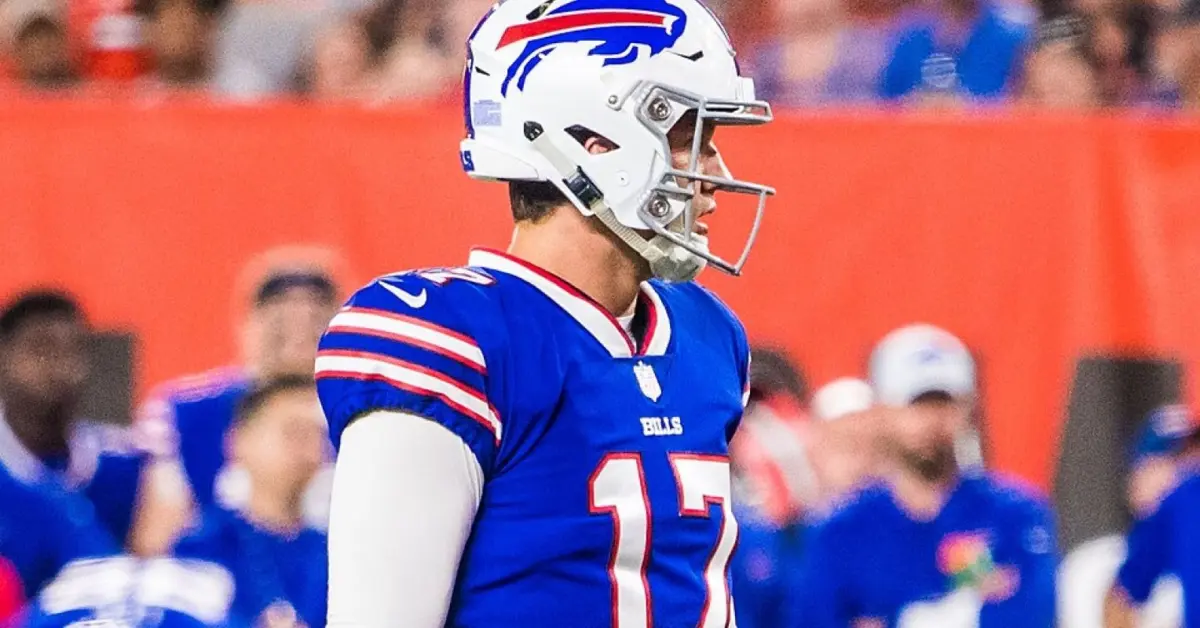
Step into any grocery store, corporate office on a casual Friday, or neighborhood block party across Western New York during the National Football League season, and you will encounter a singular, unifying aesthetic. It is a sea of blue jerseys emblazoned with the number 17. From pullovers and hoodies to coffee mugs and glowing, life-sized inflatable yard buffalos, fans are outwardly declaring their devotion to Buffalo Bills quarterback Josh Allen and his teammates.
Yet, while these garments are worn with the utmost sincerity, they mask a fascinating psychological paradox. The individuals sporting these jerseys will not take a single snap, absorb a bone-crunching linebacker blitz, or execute a game-changing pass breakup. They are spectators, safely insulated in the stands or on living room recliners. And yet, when the team triumphs, their collective language shifts immediately. Monday morning watercooler conversations are dominated by a specific, inclusive pronoun: "We."
"We looked phenomenal on offense yesterday."
"Our defense completely shut down their passing game."
This linguistic sleight of hand—the automatic adoption of success and the immediate distancing from failure—has fascinated behavioral scientists for half a century. Known formally as BIRGing (Basking in Reflective Glory) and its counterpart, CORFing (Cutting Off Reflective Failure), this phenomenon offers a profound window into human identity, community bonding, and the preservation of individual self-esteem through collective proxy.
As sports culture continues to intertwine with modern social psychology, examining why we obsess over teams to which we contribute no physical labor reveals deep truths about our need for belonging, our psychological resilience, and the fragile nature of fandom.
Detailed Chronology: Fifty Years of Studying the Fan Psyche
To understand why a middle-aged accountant in Buffalo or a college student in Ohio feels personal ownership over a multi-million-dollar professional sports franchise, we must look back to the mid-1970s.
The Cialdini Experiments (1973–1976)
Fifty years ago, a young social psychologist named Robert B. Cialdini and his research colleagues set out to quantify a phenomenon that had long been observed in stadiums but never rigorously tested: the emotional mechanics of sports fandom. Through a series of groundbreaking field experiments, Cialdini sought to uncover how people manage their public image and self-esteem through their affiliations with successful groups.
-
Study One: Apparel as Public Signaling
The researchers initially tracked the clothing habits of university students across several large campuses following major collegiate football games. The data revealed a stark and predictable pattern: students were exponentially more likely to wear university-branded sweatshirts, hats, and jackets on the Monday after a victory than they were following a defeat. The clothing functioned as an active, wearable shield and banner, designed to broadcast association with a winner. -
Study Two and Three: The Linguistic Shift ("We" vs. "They")
Subsequent experiments yielded subtler, more psychologically revealing insights. Researchers interviewed students directly about the outcomes of games. When describing a victory, students overwhelmingly used first-person plural pronouns: "We won," "We dominated," or "We played a smart game."
However, when their teams lost, the linguistic architecture collapsed. The pronouns shifted instantly. Students stopped saying "We lost" and pivoted entirely to third-person distancing: "They lost," "They played terribly," or "The coaches blew it."
Cialdini’s team concluded that these pronoun choices were not accidental grammar; they were calculated psychological maneuvers. By saying "we" after a win, individuals sought to enhance their public image by hitching their personal wagons to a triumphant engine. By saying "they" after a loss, they protected their egos from the collateral damage of failure.
Supporting Context & Metrics: The Mechanics of BIRGing and CORFing
To truly appreciate why sports fandom wields such profound psychological power, one must dissect the internal machinery of BIRGing and CORFing.
BIRGing: Basking in Reflective Glory
Basking in reflective glory operates much like standing in the sun. The process requires virtually no active physical labor on the part of the fan, yet it yields a warm, physiological payoff.
When fans sit in a stadium—often collectively known as the "12th" or "13th Man"—their physical environment triggers profound neurological responses. Neuroscientists point to mirror neurons, specialized brain cells that fire both when an individual performs an action and when they observe someone else performing it. When a receiver leaps for a spectacular one-handed touchdown catch, the fan on the couch or in the nosebleed section feels a microscopic, empathetic echo of that physical triumph.
This neural mirroring releases dopamine and other neurochemicals associated with reward and pleasure. When the play results in a score, the fan’s brain processes the external victory as a shared internal achievement. Monday mornings become visibly "bouncier." The collective endorphin hangover of a Sunday win translates into elevated workplace morale, enhanced optimism, and an inflated sense of personal capability.
Communitas: The Sociological Glue
Beyond individual psychology, sports fandom satisfies a profound sociological hunger. Noted sociologist and play theorist Thomas Henricks coined the term communitas to describe the profound feeling of equalizing togetherness that emerges when a group shares a central, burning passion.
In an increasingly fractured modern society—where political polarization, geographic isolation, and digital fragmentation pull communities apart—sports provide a rare, non-partisan circle of shared spirit. Families separated by thousands of miles tune into the same broadcast, coordinating FaceTime commentary at halftime.
Henricks argues that losing oneself in the collective energy of a game—a process of temporary de-individualization—actually helps individuals find themselves. By melting into the crowd, fans temporarily shed the isolating burdens of daily stress and bureaucratic alienation. They belong to something larger, enduring, and emotionally resonant.
CORFing: Cutting Off Reflective Failure
Yet, this paradise of belonging has an expiration date. What happens when the winning stops?
When a team enters a prolonged losing streak, the protective mechanisms of CORFing (Cutting Off Reflective Failure) activate with surgical precision. The inflatable glowing buffalos come down from the front lawn. The team jerseys are relegated to the bottom drawer, tucked away beside expired coupons and tangled charging cables.
More tellingly, the linguistic pivot occurs. The generous "we" vanishes, replaced by the accusatory "they":
- "They couldn’t convert on third down."
- "They botched the play-calling."
- "They folded under pressure."
Sports psychologists note that this is entirely driven by self-esteem preservation. For a dedicated fan, the opposite of pride is not simple humility; it is shame. When the psychological cost of association outweighs the joy of affiliation, fans instinctively sever the tie to protect their self-image.
Official Perspectives and Fan Case Studies
Fan loyalty exists on a vast spectrum. While some fanbases are notoriously fickle—fleeing at the first sign of a sub-.500 season in markets like Los Angeles, Miami, or Phoenix—others exhibit generational, unbreakable devotion.
The Extremes of Loyalty: Cleveland and Buffalo
Consider two legendary case studies in American professional sports loyalty:
- The Cleveland Browns and the "Dog Pound": For decades, through coaching carousels, front-office upheavals, and historic losing seasons, fans packed the stadium bleachers with painted faces, proudly embracing an identity rooted in gritty resilience.
- The Buffalo Bills: Long before the current era of Josh Allen dominance, the franchise endured heartbreak—most notably losing four consecutive Super Bowl appearances in the early 1990s—followed by a staggering 17-year playoff drought. Yet, throughout those nearly two decades of football wilderness, Bills Mafia remained steadfast. Tailgates raged through lake-effect snowstorms; season tickets remained sold out.
Sociologists analyzing these fanbases suggest that enduring collective trauma actually deepens communitas. When fans weather lake-effect whiteouts and crushing losses together, shouting "Go Bills!" ceases to be merely a prediction of an athletic outcome. It becomes a existential mantra: "We are hanging in there, and we will endure."
Future Outlook: The Evolution of Fan Identity in the Digital Age
As we look toward the future of sports culture, the intersection of psychology, technology, and community engagement is shifting rapidly.
-
Hyper-Personalized Digital Communities:
The traditional Sunday afternoon television broadcast is no longer the sole anchor of fandom. Global fan communities now congregate 24/7 on platforms like Reddit, Discord, and specialized sports apps. This digital connectivity allows BIRGing and CORFing to happen in real-time, at scale. Fans can instantly share memes celebrating a victory or collectively mourn a botched referee call with millions of peers across continents. -
The Gamification of Fandom:
With the explosion of legalized sports betting and fantasy football, the boundary between "spectator" and "participant" has blurred further. Fans no longer just bask in the reflective glory of their favorite team; they have direct financial and competitive stakes in individual player performances. This evolution may intensify both the euphoric highs of BIRGing and the defensive psychological retreats of CORFing in the decades to come. -
Mental Health and Sports:
As sports psychology increasingly enters mainstream conversations around wellness, researchers are beginning to examine the genuine emotional toll that chronic sports fandom takes on individuals. While the communal benefits of communitas are undeniable, learning to balance investment in external outcomes with internal mental well-being remains a critical challenge for passionate supporters.
Conclusion
At a wedding or a funeral in small-town America, you will not find people wearing a blue jersey with the number 17. There is a time and a place for solemnity, formality, and individual identity.
But when the weekend arrives and the stadium lights ignite, millions of people willingly step outside of themselves. They slip on the fabric of a collective dream. Whether they are basking in the radiant glory of a championship run or weathering the bitter chill of a rebuilding year, they are doing something deeply human: searching for connection, clinging to shared hope, and proving that even from the safety of a living room couch, we all want to feel like we are part of something greater than ourselves.