Executive Overview
In the upper echelons of B2B executive talent, a quiet and pragmatic career migration is underway. For the better part of the past decade and a half, the gold standard for ambitious Chief Revenue Officers (CROs), Chief Marketing Officers (CMOs), VPs of Customer Success, and Heads of Product has been unambiguous: join a high-octane, venture-backed startup, chase triple-digit growth, and surf the chaotic wave toward a hyper-scaled valuation.
However, as the tech landscape matures under the weight of market corrections and the seismic disruptions of the AI age, a counter-intuitive career option is gaining serious traction. Seasoned executives are increasingly turning their backs on the 996 (9 AM to 9 PM, 6 days a week) startup grind to join companies growing at a modest 0% to 10%.
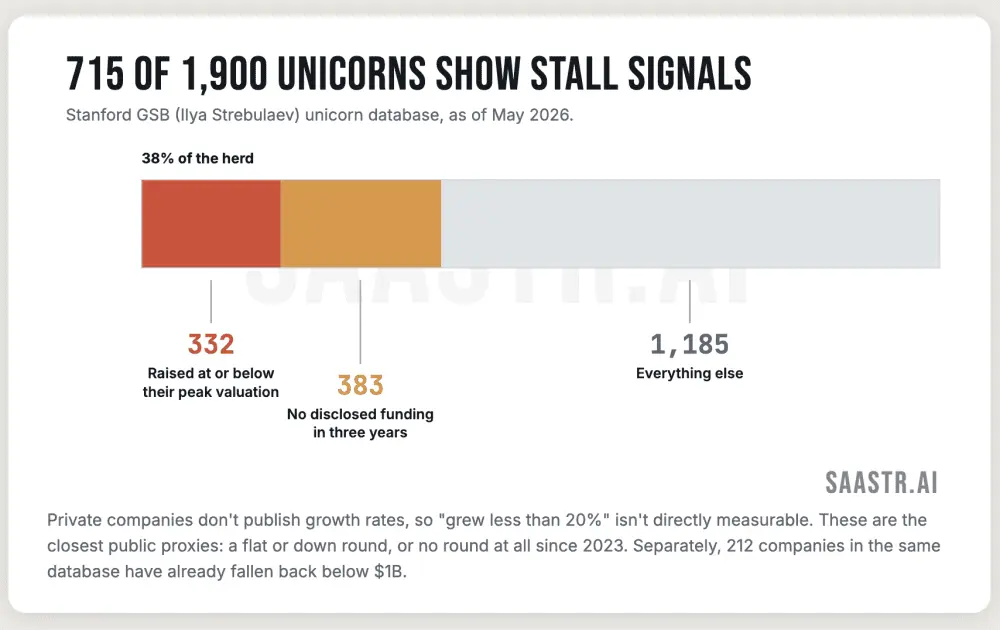
While describing a zero-to-ten-percent growth company as a "growth opportunity" might sound like a paradox or a career plateau, the data tells a different story. According to recent market indices from firms like Hurun, CB Insights, and Eqvista, there are currently between 1,400 and 1,700 unicorns globally. A massive share of these companies was minted during the venture capital frenzy of 2021 and 2022. Today, many of those former high-flyers are no longer scaling exponentially.
Crucially, they aren’t shrinking, either. Many are cash-flow positive, boasting established brands, robust balance sheets, and deep customer lists. But keeping a multi-million-dollar enterprise stable at 0% to 3% growth is no passive exercise—it is a rigorous, highly skilled discipline. For veteran executives seeking competitive cash compensation, stability, and the chance to apply battle-tested playbooks without the existential dread of weekly pivots, these flat-to-slow-growth giants have become the ultimate destination.
Detailed Chronology: The Evolution of the Unicorn Lifecycle and Executive Burnout
To understand how the market arrived at this juncture, one must examine the shifting trajectory of venture-backed technology companies over the last fifteen years.
Phase 1: The Zero-Interest-Rate Era (2012–2022)
During this golden decade, the SaaS playbook was written, rewritten, and scaled. Capital was abundant and cheap. Growth at all costs was the supreme mandate. Companies measured success not by profitability, but by Annual Recurring Revenue (ARR) velocity, net revenue retention (NRR), and top-of-funnel logo acquisition. Executives who mastered this hyper-growth environment were richly rewarded with outsized equity packages and immense prestige.
Phase 2: The Macroeconomic Reversal (2022–2024)
As inflation spiked and central banks raised interest rates, the cheap capital faucet was abruptly turned off. Thousands of unicorns minted in the 2021 bubble suddenly found themselves unable to justify their sky-high valuations through continuous 100%+ year-over-year growth. Boards pivoted overnight from a growth-at-all-costs mentality to a laser focus on efficiency, path-to-profitability, and cash-flow breakeven.
Phase 3: The AI Disruption and Executive Fatigue (2024–Present)
Entering the mid-2020s, the mass adoption of generative AI introduced a new layer of turbulence. AI-native startups began rewriting the rules of go-to-market (GTM) strategies. For traditional executives, the pressure became unrelenting. Every strategy forged over the previous ten years—from SDR outbound models to human-led demos and traditional pricing units—faced daily interrogation.
For many veteran leaders, the psychological and physical toll of continuous reinvention reached a breaking point. Simultaneously, a vast cohort of mature unicorns settled into a steady, cash-flow-positive holding pattern. These companies realized they did not need a radical AI overhaul to survive; they needed experienced hands to keep the ship steady, manage churn, and squeeze out incremental efficiency. Thus, a new executive employment category was born: the stability-first, slow-growth scale-up.
Supporting Context & Metrics: The Hard Math of "0% Growth"
To the uninitiated, managing a company with 0% growth sounds effortless—akin to coasting on a bicycle down a gentle slope. In reality, in the context of enterprise B2B software, maintaining a flat revenue line requires sprinting just to stay in place.
Consider a mid-sized B2B enterprise generating $150 million in ARR with a Gross Revenue Retention (GRR) rate of 88%. That metric sounds relatively healthy on paper, but the math reveals a stark reality: $18 million of ARR walks out the door every single year.
This leakage happens through a combination of:
- Customer churn (companies going out of business or switching vendors)
- Account downgrades and seat contraction
- Corporate M&A activity resulting in platform consolidation
- The departure of internal executive "champions" who originally bought the product
To achieve a net growth rate of 0%, that exact same company must successfully close $18 million in brand-new and expansion ARR annually to offset the losses.
The Operational Footprint
If that same $150M ARR company operates with an average deal size of $150,000, hitting flat growth requires closing roughly 120 new logos per year, alongside a robust expansion motion. Achieving this demands:

- A fully functioning sales organization of 30 to 50 quota-carrying reps.
- A sophisticated marketing funnel generating qualified pipeline.
- A dedicated Solutions Engineering (SE) team.
- A Customer Success (CS) apparatus aggressively fighting for every renewal and upsell.
- A Product organization shipping updates fast enough to prevent renewal conversations from turning sour.
This is not a retirement home for lazy executives; it is a complex, high-stakes operational challenge that requires seasoned professionals who know how to pull the right levers.
The Pre-AI Toolkit Still Wins
At an AI-native startup growing 300% to 1,000%+ annually, every foundational assumption of the last decade is scrutinized weekly. Should you replace SDRs with autonomous agents? Should the entire GTM motion be product-led or agent-led?
Conversely, at a $150M ARR company growing at 3%, the path forward relies on the timeless, unglamorous blocking and tackling of enterprise software:
- Territory Design: Optimizing account coverage so reps aren’t stepping on each other’s toes.
- Pipeline Hygiene: Enforcing strict pipeline coverage ratios and conducting rigorous win/loss analyses.
- Enablement: Implementing systematic sales enablement to lift win rates by even a few percentage points.
- Pricing and Packaging: Introducing strategic add-ons or packaging shifts that yield an incremental 4 points of expansion.
- Customer Success Interventions: Fixing onboarding gaps that trigger month-11 churn.
- Ideal Customer Profile (ICP) Tightening: Training reps to stop chasing bad-fit accounts that inevitably churn.
An executive with 15 years of operational scars can execute these strategies effectively on day one, without needing to reinvent their professional identity.
Financial Realities: Cash vs. Speculative Equity
Beyond the day-to-day operational relief, the financial structure of mature, slow-growth companies offers a compelling value proposition that rivals—and often beats—early-stage venture-backed startups.
The Cash Flow Advantage
A 60-person AI startup generating $8 million in ARR while growing at 4x is typically burning cash at an alarming rate. Consequently, their executive compensation packages rely heavily on speculative equity coupled with modest, sometimes mediocre, cash salaries, all traded against the backdrop of 996 work schedules.
On the other side of the ledger, a $150M ARR company growing at 0% to 5% has substantial baseline revenue. Having weathered the post-bubble cost-cutting waves of recent years, many of these firms are at or near cash-flow breakeven. Because they cannot dangle the promise of a 100x equity payout, they must compete for talent using what they actually have: cold, hard cash.
For VP-level and C-suite hires, particularly in enterprises scaling past $500 million in ARR, cash compensation is frequently robust. Furthermore, these companies possess actual marketing budgets, recognizable brand equity, and a deep roster of referenceable customers. Incoming executives do not need to spend their first six months evangelizing an unknown product category; their mandate is precise: take the growth rate from 3% to 8%, optimize gross margins, and protect the bottom line.
Future Outlook: The Caveats and the Critical Need for Diligence
While joining a flat-to-slow-growth unicorn sounds like an idyllic alternative to startup chaos, industry experts offer a vital warning: Flat is often just one bad quarter away from down.
Navigating a "down" company—one experiencing consecutive quarters of revenue contraction—is a fundamentally different professional nightmare. A declining company often triggers painful restructuring, private equity interventions, aggressive layoffs, and an executive suite that spends more time managing insolvency processes in data rooms than engaging with customers.
Therefore, thorough due diligence before accepting a slow-growth executive role is paramount. Candidates must evaluate:
- The Runway and Burn Rate: Is the company genuinely cash-flow positive, or is it slowly bleeding out while masking top-line stagnation?
- The Compensation Structure: Is the base cash competitive enough to justify the move, and are the equity grants tied to realistic, achievable milestone metrics (such as accelerating growth from 2% to 10%)?
- Board Alignment: Do the founders, primary investors, and board members share a realistic view of the company’s market position, or are they clinging to delusional hockey-stick projections from bygone eras?
Conclusion: A Rational Choice for the Rational Executive
Ultimately, the choice to join a 0%-to-15% grower comes down to personal and professional alignment. Not every talented executive wants to spend their Sunday nights debating autonomous sales agents in a high-stress Slack channel. Many have built successful careers, raised families, and developed a preference for high-impact, high-competence work executed within reasonable professional boundaries.
For leaders who possess the mastery to optimize a mature revenue engine, a $150M to $1B ARR enterprise paying strong cash comp, backed by a stable team and a proven playbook, represents the highest and best use of their skills. It is not a step backward; it is a calculated, highly rational pivot toward sustainable executive longevity in a rapidly changing tech economy.