Executive Overview
In the rapidly accelerating landscape of artificial intelligence and decentralized technology, brand resurrections are rarely straightforward. Yet, few transformations match the narrative arc of LimeWire. Once synonymous with the wild-west peer-to-peer (P2P) file-sharing networks of the early 2000s—a cultural touchstone frequently embroiled in copyright legal battles—LimeWire has successfully reinvented itself. Today, it stands as a cutting-edge, AI-powered content publishing platform and Web3 creative studio.
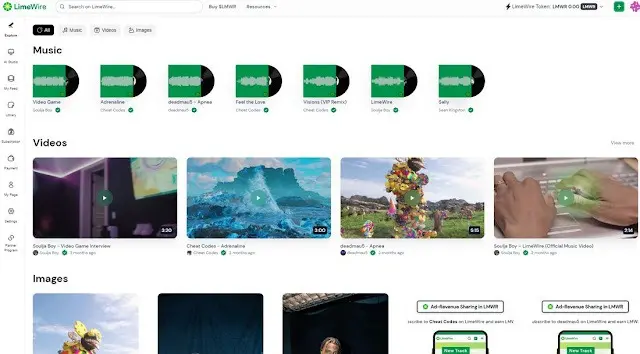
By merging generative artificial intelligence with blockchain-based monetization, LimeWire has carved out a distinct niche. It is no longer just a utility for digital discovery; it is an end-to-end ecosystem where creators, designers, musicians, and everyday enthusiasts can generate, publish, trade, and monetize digital assets. High-profile artists like Deadmau5, Soulja Boy, and Sean Kingston have already leveraged the platform to distribute NFT-backed music, videos, and visual art.
This deep-dive investigation explores LimeWire’s technological architecture, its innovative approach to content ownership, its Web3 revenue-sharing models, and its strategic roadmap as it scales to meet the demands of the modern creator economy.
Detailed Chronology: From Underground P2P to Regulated Web3 Creator Economy
To understand LimeWire’s current incarnation, one must examine its turbulent past and the strategic pivot that brought it into the Web3 era.
The 2000s: The P2P Era and Legal Twilight
Launched in 2000 by Mark Gorton, LimeWire became one of the most popular Java-based Gnutella clients. At its peak, millions of users worldwide used the software to share music, movies, and software. However, the platform became the epicentre of the digital music piracy debate. Following a protracted legal battle brought by the Recording Industry Association of America (RIAA) in Arista Records LLC v. Lime Group LLC, a federal judge ordered LimeWire to shut down its file-sharing operations in 2010. The brand went dormant, leaving behind a legacy as a cultural icon of early internet file-sharing.
2022–Present: The Strategic Acquisition and AI Pivot
In 2022, Austrian entrepreneurs Julian and Paul Zehetmayr acquired the intellectual property rights to LimeWire with a completely different vision. Recognizing the explosive growth of generative AI and blockchain technology, the new leadership team abandoned the original P2P utility model entirely.
Instead, they repurposed the trusted brand name to build a creator-focused Web3 platform. The relaunch focused initially on AI-generated images, utilizing state-of-the-art diffusion models. Shortly after, the platform introduced its native utility token, $LMWR, and integrated automated NFT minting on the Polygon and Algorand blockchains. By bridging the gap between accessible AI art generation and decentralized ownership, LimeWire positioned itself at the intersection of two of the decade’s most disruptive technological movements.
Supporting Context & Metrics: Inside the LimeWire AI Studio
LimeWire’s current operational framework centers heavily on its AI Studio—a suite of generative tools designed to lower the technical barriers to digital art creation while giving creators complete control over distribution and monetization.
Advanced AI Image Generation Tools
The core of the platform’s current utility lies in its robust image generation engine. LimeWire supports several industry-leading open-source and proprietary models, including:
- Stable Diffusion 2.1
- Stable Diffusion XL (SDXL)
- DALL-E 2
This multi-model integration allows users to experiment with various artistic frameworks. Creators can transition effortlessly between distinct aesthetic styles, including:
- Cinematic and hyper-realistic photography
- Digital art and concept design
- Pixel art and retro aesthetics
- Anime and stylized illustration
- Analog film and vintage textures
Customization and Granular Controls
Unlike rigid, consumer-facing AI filters, LimeWire provides advanced settings for seasoned digital artists. Users can employ specific samplers, adjust detail and quality levels through step counts, utilize prompt guidance scales, and fine-tune aspect ratios. Furthermore, the platform’s development team is actively engineering a proprietary AI model designed to deliver unique aesthetic outputs exclusive to the LimeWire ecosystem.
Automated NFT Minting and Blockchain Infrastructure
One of LimeWire’s most defining features is its seamless Web3 integration. Once a user generates and publishes an image, music track, or video, the platform automatically mints the creation as a Non-Fungible Token (NFT) on either the Polygon or Algorand blockchain.
This process eliminates the technical complexities traditionally associated with smart contracts, gas fees, and wallet configurations for novice users. The resulting NFT acts as an immutable digital signature, ensuring authenticated ownership within the decentralized web.
+-------------------------------------------------------------------+
                   LIMEWIRE CREATOR WORKFLOW
+-------------------------------------------------------------------+
  [ 1. Prompt Input ] --------> [ 2. Multi-Model AI Generation ]
                                           |
                                           v
  [ 4. Monetization ] <-------- [ 3. Automated NFT Minting ]
    - Ad Revenue Share            (Polygon / Algorand)
    - Direct Subscriptions
    - Secondary Trade Royalties
Official Statements and Monetization Models
LimeWire’s business model departs significantly from traditional SaaS (Software-as-a-Service) art platforms by placing financial agency directly into the hands of the creators.
The Revenue-Sharing Economy
In traditional social media and content platforms, ad revenue is rarely distributed equitably among base-tier users. LimeWire upends this dynamic by offering a direct ad-revenue-sharing model:
- View-Based Earnings: Creators receive up to 70% of all ad revenue generated when other platform users view their published images, music, and video content.
- $LMWR Utility Token: All earnings are distributed monthly in $LMWR, LimeWire’s native cryptocurrency. Creators can trade $LMWR on major global exchanges—such as Kraken, ByBit, and Uniswap—or reinvest the tokens directly into the platform to purchase additional AI generation prompts.
Flexible Distribution: Public vs. Subscriber-Only
Creators maintain granular control over how their digital assets are consumed and traded:
- Public Release: Content is discoverable by the global LimeWire community. Anyone can view, collect, and trade the associated NFTs on secondary markets. Each time an NFT changes hands on the secondary market, the original creator earns an automated 2.5% royalty fee.
- Subscription Model: Creators can gate specialized or high-value content behind a paywall, offering exclusive access strictly to paying subscribers. This fosters intimate creator-fan ecosystems reminiscent of Patreon or OnlyFans, but with native blockchain ownership baked in.
Tiered Pricing Structure
To accommodate everyone from casual hobbyists to high-volume professional digital agencies, LimeWire offers a flexible freemium and subscription pricing matrix:
| Plan Tier | Monthly Price | Monthly Credits | Est. Image Generations | Ad Revenue Share | Key Perks |
|---|---|---|---|---|---|
| Free Tier | $0 | 10 credits | Up to 20 images/day | 50% | Basic AI tools, standard access |
| Basic | $9.99 | 1,000 | Up to 2,000 | 50% | Ad-free, creation history |
| Plus | $29.00 | 3,750 | Up to 7,500 | 60% | Pro badge, faster generation |
| Pro | $49.00 | 5,000 | Up to 10,000 | 70% | Priority processing, early model access |
| Advanced | $99.00 | 11,250 | Up to 22,500 | 70% | Maximum allocation, VIP support |
Note: All paid plans include a Pro profile badge, complete creation history access, expedited image rendering queues, and an ad-free user experience.
Future Outlook: Expanding Beyond Static Art
As generative AI technologies mature, LimeWire’s strategic roadmap points toward a multi-modal future that extends far beyond static visual art.
AI Music and Video Generation
While the platform’s current foundation rests heavily on image generation, executive leadership has announced aggressive plans to roll out dedicated AI music and video generation tools. Given the platform’s historical roots in the music industry—and its current roster of early adopters like Soulja Boy and Deadmau5—the introduction of text-to-audio and text-to-video tools could prove transformative.
These upcoming modules will allow musicians and independent filmmakers to generate sample libraries, background tracks, and video loops entirely through AI prompts, subsequently minting and monetizing them within the same unified ecosystem.
Decentralized Governance and Ecosystem Growth
As the circulation of $LMWR tokens scales alongside platform adoption, LimeWire is expected to lean further into decentralized autonomous organization (DAO) mechanics, giving token holders a voice in platform governance, feature rollouts, and treasury allocations.
Conclusion: A Democratized Creative Landscape
LimeWire’s evolution from a controversial P2P file-sharing protocol into an authorized, Web3-enabled generative AI studio is a testament to adaptive corporate strategy. By lowering the barriers to entry for artificial intelligence art generation while providing robust, blockchain-backed financial incentives, LimeWire has positioned itself as a formidable contender in the modern creator economy.
For digital artists, musicians, and developers looking to experiment with generative AI without sacrificing the rights to their intellectual property, LimeWire offers a compelling, comprehensive toolbox. As the platform prepares to launch its anticipated music and video generation suites, the digital art community watches closely to see how this resurrected icon will continue to reshape the boundaries of human and machine-assisted creativity.