Executive Overview
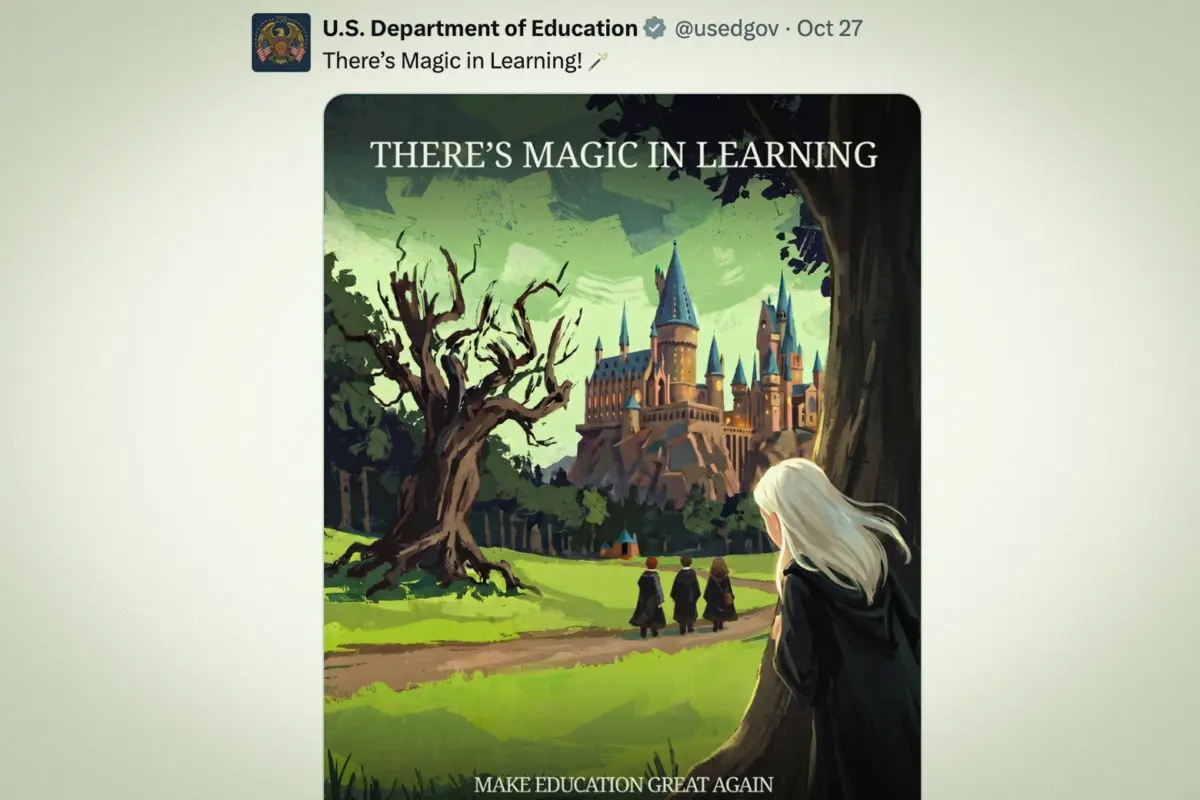
In the sprawling, hyper-connected landscape of modern internet culture, the boundaries between fringe digital subcultures and mainstream institutional communication have effectively dissolved. A striking case study in this phenomenon emerged when the official X (formerly Twitter) account of the United States Department of Education posted an AI-generated image captioned with the phrase, "There’s Magic in Learning—Make Education Great Again."
While the sentiment at first glance appeared to be a mundane, albeit slightly clunky, attempt at government-agency relatability, the visual asset accompanying the text revealed a deeply surreal reality. The image depicted a character instantly recognizable to chronically online audiences as "Draco Malfoid"—a gender-swapped, AI-generated iteration of the classic Harry Potter villain, birthed within the deepest, most misogynistic recesses of the manosphere.
This incident is more than just a viral misstep by a government social media manager; it represents a fascinating cultural convergence. For decades, the multi-million-word ecosystem of Harry Potter fan fiction was largely built, sustained, and consumed by young women, LGBTQ+ creators, and marginalized communities. Today, however, alt-right and "incel" (involuntary celibate) spaces have co-opted this very literary tradition. By swapping Draco Malfoy into a waifish, AI-rendered blonde archetype, right-wing internet denizens have embraced fan fiction en masse—provided it arrives packaged in synthetic, machine-generated "slop."
The fact that this meme successfully migrated from the toxic message boards of 4chan and the algorithmic feeds of TikTok straight to a federal agency’s public-facing timeline illustrates a profound shift in how internet vernacular moves through society. It highlights a dangerous new normal where institutional communications are increasingly shaped by meme literacy, algorithmic optimization, and the casual laundering of toxic subcultural jargon into official state channels.
Detailed Chronology: From Digital Ink to Federal "Slop"
To understand how a fictional wizard from J.K. Rowling’s universe became entangled with federal education policy, it is necessary to trace the rapid, chaotic trajectory of the meme itself.
The Genesis: @redteneri and "Dracaena"
The saga began modestly roughly a month prior to the Department of Education’s post. An independent digital artist operating under the handle @redteneri published an original hand-drawn illustration on X. The artwork re-imagined the character Draco Malfoy as a young woman boasting long, flowing blonde hair, prominent hoop earrings, and striking green eyes. In these early, human-crafted iterations, the character was dubbed "Dracaena Malfoy"—a creative flourish that nodded to the ancient Greek mythos of dragon-women while remaining safely within the traditional boundaries of fandom art.
The Algorithm Takes the Wheel
As the artwork circulated, it triggered an algorithmic tidal wave. Within days, human artistry was crowded out by an overwhelming influx of generative AI tools. Automated content generators flooded the internet with synthetic videos, hyper-real images, and deepfake-adjacent adaptations of the character.
Along with this synthetic saturation came a linguistic corruption. The fandom rechristened the character not as Dracaena, but as "Draco Malfoid." The suffix—foid—is a well-documented misogynistic portmanteau used within incel communities to dehumanize women by reducing them to "female androids" or subhuman humanoid organisms.
Despite, or perhaps because of, this hostile nomenclature, the character exploded in popularity. "Malfoid fans" swarmed the social media profiles of Harry Potter author J.K. Rowling. They populated TikTok with long-form, AI-generated video series chronicling an enemies-to-lovers romance arc between Malfoid and Harry Potter. Developers even launched a dark academia romance simulation game titled Pureblood & Prejudice on indie platforms like Itch.io.
The Institutional Crossroads
The cultural tipping point arrived when the U.S. Department of Education waded directly into the discourse. By posting an AI-generated graphic featuring the unmistakable aesthetic of the Malfoid meme alongside a political slogan echoing Trumpian campaign branding ("Make Education Great Again"), the federal government inadvertently validated a fringe internet meme born of misogynistic subculture.
Fan accounts erupted in sheer disbelief. "MALFOID OCCUPIED GOVERNMENT," posted one astounded user on X. The irony was palpable: the administrative apparatus of the United States federal government had become just another node in the sprawling, decentralized distribution network of contemporary internet shitposting.
Supporting Context & Metrics: Fandom, Demographics, and the "Manosphere"
To fully grasp the socio-cultural significance of the Draco Malfoid phenomenon, one must examine the historical demographics of fan fiction and the distinct linguistic evolution of the internet’s dark corners.
The Demographics of Fandom vs. The Incel Infiltration
Historically, online literary spaces have been overwhelmingly female-centric. Data from major platforms like Wattpad indicates that as of 2021, over 70 percent of its readership identified as women, with Gen Z and Millennials making up more than 80 percent of the user base. Archive of Our Own (AO3), the definitive repository for fan-generated fiction, hosts hundreds of thousands of stories exploring complex political landscapes ("Political Harry Potter") and foundational queer romantic pairings—affectionately dubbed "ships"—such as "Drarry" (Draco Malfoy and Harry Potter), "Destiel" (Dean Winchester and Castiel from Supernatural), and various prominent gaming creator pairings.
For years, these spaces were viewed with open disdain by male-dominated internet subcultures, who frequently dismissed fan fiction as "cringe," worthless, or overly emotional. The emergence of Draco Malfoid, however, marks a watershed moment: alt-right and military-bro spaces are now unironically consuming and producing Harry Potter fan fiction, provided the female characters have been stripped of their agency and rendered into passive, AI-generated "waif" archetypes.
Etymology of the "Foid"
The linguistic weaponization of the term foid provides critical context for the Malfoid phenomenon. Originating on extremist message boards such as 4chan—the ideological engine room of the modern manosphere—foid (or femoid) was engineered to strip women of their humanity.
In these ecosystems, the companion term foidslop is routinely deployed to devalue any media created by, for, or about women. A viral TikTok video of a woman demonstrating makeup techniques? Foidslop. Greta Gerwig’s cultural blockbuster Barbie? Foidslop. Stories centered on emotional vulnerability, queer romance, or interpersonal drama? Foidslop.
Yet, the irony of Malfoid is that these same alt-right spaces have embraced an AI-generated caricature that is, by definition, the ultimate manifestation of synthetic, low-effort media. They have rejected human-crafted, emotionally resonant fan fiction written by women over decades in favor of machine-generated "Malfoidslop."
Official Statements and Institutional Reactions
As the post gained traction across tech policy circles and cultural blogs, public scrutiny fell heavily upon the Department of Education’s digital communication strategy.
Independent digital forensics quickly stepped in to evaluate the provenance of the agency’s imagery. When run through advanced synthetic media detection utilities, such as SightEngine’s AI image analyzer, the graphic posted by the Department of Education returned a 99 percent probability of being entirely AI-generated.
Despite mounting inquiries from journalists, the Department of Education has declined to issue an official clarification regarding whether the image was produced via artificial intelligence, nor have they directly addressed the etymological origins of the character depicted. Government communications offices have historically maintained strict guidelines regarding brand safety and non-partisan neutrality; however, the increasing reliance on algorithmic content generation by federal social media staffers has created severe vulnerabilities.
Communication experts note that the incident exposes a growing institutional pressure to chase viral metrics. In an era where government agencies compete with independent creators for algorithmic reach, social media teams are frequently incentivized to adopt hyper-online idioms—sometimes without recognizing the toxic baggage attached to them.
Future Outlook: The Synthetic Erosion of Digital Culture
The journey of Draco Malfoid from a 4chan-adjacent incel meme to a U.S. government Twitter post serves as a cautionary tale for the future of digital discourse. Several long-term implications arise from this cultural convergence:
- The Normalization of Subcultural Jargon: Terms that once served as red flags for radicalization—such as "-pilled," "chud," and now "-foid"—continue to bleed seamlessly into mainstream lexicons. As institutions attempt to bridge the generational divide by speaking the "language of the internet," they inadvertently sanitize and legitimize terminology rooted in misogyny and extremism.
- The Death of Human Craftsmanship in Fandom: For over two decades, online fandoms were defined by labor-intensive, human-driven creativity. Authors spent countless hours meticulously crafting complex narratives, often appending humble disclaimers like "Sorry for the errors, my English isn’t too good." The rise of AI-generated characters like Malfoid threatens to replace this rich tapestry of human expression with algorithmic paste—recycling decades of unpaid, passionate labor by young women into hollow, machine-rendered content.
- Institutional Vulnerability to Algorithmic Drift: As federal and corporate communication strategies increasingly outsource visual creation to generative AI tools, incidents of accidental meme endorsement will likely multiply. Without rigorous oversight and deep digital literacy, public institutions risk becoming unwitting megaphones for the internet’s most nihilistic subcultures.
Ultimately, the Draco Malfoid saga is a darkly humorous yet deeply unsettling snapshot of our current cultural moment. It demonstrates that in the algorithmic age, even the apparatus of the United States government is not immune to being consumed by the recursive, self-parodying vortex of the internet—where human art is reduced to synthetic slop, and a misogynistic meme can quietly find a home in the halls of federal education policy.