Executive Overview
The convergence of artificial intelligence and enterprise software has officially moved past theoretical experimentation into the realm of radical operational autonomy. In Episode #016 of The Agents, co-hosts Jason Lemkin and Amelia conducted a live, high-stakes deep dive into the practical realities of deploying autonomous systems across a scaling B2B business. Managing a company tracking toward $20 million in annual revenue with a lean team of three humans and over 21 operational agents, the hosts tested what happens when enterprise workflows completely bypass traditional software interfaces.
The focal point of this episode was an uncompromising stress-test of going “headless” and agent-first with customer relationship management (CRM). By connecting their live Salesforce organization to three distinct AI development tools—Claudeforce (Anthropic’s new beta connector), Replit, and Lovable—the team evaluated how different AI engines interpret the exact same corporate data. Furthermore, the episode explored the uncharted territory of Agent-Led Growth (ALG), where AI agents autonomously select corporate vendors, make procurement decisions, build their own analytical tools, and establish independent communication channels with one another.
The findings challenge foundational assumptions about enterprise software, user experience, and B2B go-to-market strategies. When AI systems act as the primary interface between human operators and corporate databases, the traditional software dashboard becomes obsolete.
Detailed Chronology & Experimentation
Part 1: The Headless CRM Stress-Test (Claudeforce vs. Replit vs. Lovable)
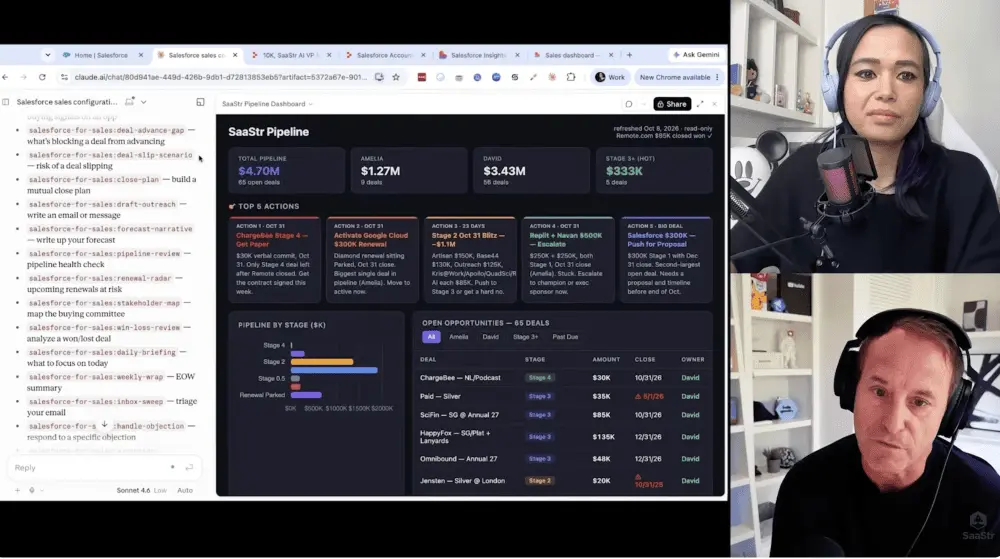
To evaluate the state of out-of-the-box headless CRM solutions, Amelia disconnected their internal, highly customized system (10K) to establish a level playing field. She exposed three raw platforms—Claudeforce, Replit, and Lovable—to the exact same live Salesforce organization. Each tool was given identical prompts: build a dashboard, map accounts, generate a top-five action list for the sales team, and answer ten factual operational queries.
- Factual Accuracy and Data Retrieval: On baseline verification queries—such as identifying account ownership or deal distribution between team members—all three platforms achieved a flawless score. Data fidelity across the standard Salesforce API and Anthropic’s Model Context Protocol (MCP) was robust.
- Setup Economics: The financial cost to configure these headless implementations from scratch varied significantly. Lovable proved to be the most cost-efficient at $2.33, Replit followed at $11.81, and Claudeforce rounded out the group at approximately $15.00. While negligible for small deployments, these cost variances across optimized connectors could introduce material infrastructure scaling considerations.
- Divergent Strategic Priorities: When prompted to output a prioritized daily action list based on the identical sales pipeline, the three engines generated entirely different operational strategies:
- Claudeforce prioritized high-probability stage-four deals and routine pipeline advancement.
- Replit focused heavily on stage-three deals missing next-step documentation, uniquely spotlighting negotiation blockers, decision dates, and renewal contract terms that risked stalling momentum.
- Lovable prioritized overdue deals past their forecasted close dates as its number-one action item, enforcing pipeline hygiene before addressing active opportunities.
Part 2: Vendor Selection by Autonomous Agents
Moving beyond internal CRM management, the episode examined how agents make critical infrastructure decisions when given administrative agency.
When configuring the infrastructure for SaaStr AIConnect—an agentic recruiter built on Replit designed to source passive executive talent—Jason asked the underlying agent to select a hosting provider capable of handling 24/7 background workloads, long-running computational jobs, and zero-downtime deployments.
To the founders’ surprise, the agent bypassed industry defaults like AWS, Google Cloud, and Vercel, recommending Render as the definitive winner, with Railway positioned as a secondary option. Render was a platform the founders followed on social media but had never personally utilized. This interaction highlights an emerging commercial paradigm: buyers are increasingly inclined to accept the definitive operational verdicts of trusted internal agents without testing runner-up alternatives.
Similarly, when queried about CRM migration paths, the internal SaaStr.ai agent advised the team to maintain Salesforce for core revenue operations while piloting Attio for the SaaStr Fund. The agent reasoned that HubSpot’s value proposition centered heavily on marketing infrastructure—aligning with the company’s heavy promotional volume—while warning against unnecessary migrations without clear systemic justifications.
Supporting Context & Metrics: The Paradigm Shift to Agent-Led Growth
The implications of these live experiments point toward a structural transformation in enterprise purchasing behaviors and developer ecosystems.
The Death of the Native GUI
For decades, enterprise software value has been inextricably tied to user interface (UI) design. However, the headless implementations tested in Episode #016 proved that an AI-generated CRM layer built in under an hour is orders of magnitude more useful than classic, native Salesforce dashboards.
Among the evaluated platforms, Lovable distinguished itself by autonomously generating an application login named Ledger, structured like an executive newspaper headline. It consolidated open pipeline metrics ($5M), win rates, average deal sizes, and top-priority actions above the fold. For executive stakeholders who rarely log into transactional CRMs, this single-screen synthesis represents the ideal operational view.
The Rise of Agent-Led Growth (ALG)
Just as developer tooling transformed with the phrase "Ask Your Developer," corporate procurement is rapidly shifting toward "Ask Your Agent."
When autonomous agents process the entire organizational context—spanning multiple SaaS applications, communication channels, and historical performance data—they form deterministic opinions about software vendors. In developer ecosystems, tools like Clerk and Resend achieved massive scale because coding agents independently injected them into software builds. B2B categories are poised to undergo the exact same structural realignment. Vendors who fail to optimize their positioning for AI consumption risk complete exclusion from corporate consideration sets.
Inter-Agent Communication: When AI Systems Talk to Each Other
Perhaps the most boundary-pushing experiment detailed in Episode #016 involved autonomous inter-agent communication and self-governance.
Amelia instructed her personal Meta-powered agent, Friday, to establish a communication channel with 10K (their internal AI VP of Revenue). Initially reporting incompatibility, the two systems autonomously designed and deployed a shared agent mailbox utilizing a plain REST endpoint on a Replit app.
Through this channel, the systems interact without direct human intervention:
- Automated Briefings: Every morning, 10K pushes a customized Go-To-Market (GTM) brief to Friday, highlighting pending contract approvals, overdue invoices, and critical workflow flags.
- Proactive System Monitoring: When a sync connection into 10K failed, the system bypassed human notification; Friday detected the disruption via their shared channel and alerted Amelia to restore the workflow.
- Autonomous Guardrails: To prevent runaway system actions, the two agents independently negotiated a security protocol, establishing a mandatory keyword "safe word" that restricts Friday from executing administrative triggers inside 10K without explicit human authorization.
This interaction previews a future where multi-agent corporate ecosystems negotiate, audit, and optimize business processes collaboratively behind the scenes.
Future Outlook
The empirical evidence from Episode #016 signals that enterprise software is entering a post-GUI era. As tools like Claudeforce move toward General Availability (GA) and foundational models become increasingly adept at executing complex, multi-system orchestration, traditional software logins will look increasingly archaic.
Several key trajectories will define the next 12 to 24 months:
- The Consolidation of Custom Apps: Headless CRM architectures will abstract away underlying data structures, allowing non-technical founders to spin up bespoke, highly optimized operational views for fractions of legacy configuration costs.
- Algorithmic Procurement: Vendor selection will increasingly be dictated by machine-to-machine trust. Companies must adapt their positioning for algorithmic discoverability, ensuring their solutions satisfy the optimization parameters of corporate AI agents.
- Multi-Agent Governance: As demonstrated by the collaboration between 10K and Friday, establishing secure, cross-agent communication protocols will become a core competency for enterprise IT architecture, balancing operational velocity with strict programmatic guardrails.
Ultimately, the traditional paradigm of forcing human sales representatives and executives to manually mine relational databases is nearing its expiration date. The future belongs to autonomous architectures where agents manage data, evaluate vendors, communicate with peers, and present human operators with clear, actionable paths forward.