Executive Overview
In the rapidly evolving landscape of internet culture, artificial intelligence has ceased to be merely a novelty tool for generating static images or text; it has become an active engine for collaborative, hyper-surreal narrative humor. The latest phenomenon capturing the attention of millions across TikTok and Instagram Reels is a viral meme format known as "Your First Time In a Fancy Cafe."
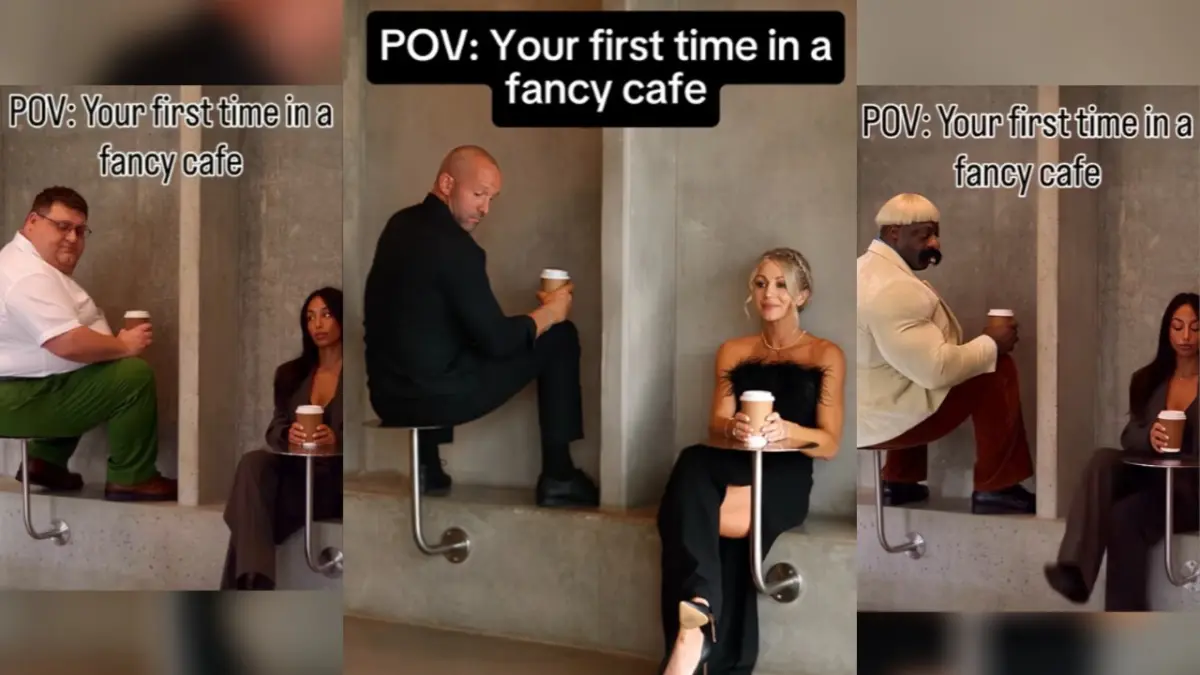
Rooted in a deeply relatable yet absurdly executed premise, the meme stems from an AI-generated video depicting a man navigating the pretentious atmosphere of a modern, minimalist cafe. Believing he has comfortably seated himself on a sophisticated chair, the protagonist experiences a swift moment of existential and spatial confusion when another patron walks into the frame, abruptly revealing that he is actually sitting squarely on top of a low-profile metal table, resting his feet where a seat ought to be.
First uploaded to TikTok on November 1, 2026, by user @leehoustonx, the original clip struck a chord with internet audiences, racking up over 9.2 million views within a mere 48 hours. What followed was a textbook case of digital folkloric evolution. Creators across platforms seized upon the modular nature of the AI-generated sketch, swapping out the original characters for pop culture figures, historical tropes, and controversial public personalities—including meme mainstays like Charlie Kirk and Jeffrey Epstein.
This deep-dive report examines the origins, viral mechanics, socio-cultural implications, and quantitative reach of the "Your First Time In a Fancy Cafe" phenomenon, charting its trajectory from a solitary AI experiment to a cross-platform multimedia trend that highlights both the creative potential and the uncanny valley of generative video tools.
Detailed Chronology
November 1, 2026: The Genesis
The phenomenon began on a Friday when TikTok user @leehoustonx published a short, AI-generated video titled conceptually around the awkwardness of upscale cafe culture. Set against the breezy, rhythmic backdrop of Steve Lacy’s track "Oh Yeah?", the video introduces viewers to a sleek, hyper-stylized minimalist cafe environment.
A man sits posture-straight, resting his hands on what he assumes is a chair. The visual language of the cafe—characterized by brutalist concrete architecture, stark metallic furnishings, and sterile modernism—creates an atmosphere of intentional confusion. Moments later, a woman enters the frame, moving past him with casual indifference. Her positioning instantly shatters the viewer’s perspective: the man is not sitting on a chair at all, but rather squatting awkwardly on a low-slung metal table, using a concrete bench as a footrest. With a subtle facial shift of mortification, the man quietly corrects his posture.
The juxtaposition of smooth, hyper-realistic AI generation, awkward human body mechanics, and a universally recognizable social faux pas propelled the video past algorithmic gatekeepers. Within two days of posting, the foundational video crossed the 9.2 million-view threshold, establishing the baseline template for an impending wave of parodies.
November 2, 2026: Exponential Viral Expansion
By the following day, the format had broken containment on TikTok and spilled aggressively into Instagram Reels. Creators quickly realized that the AI video generation pipelines powering the trend allowed for seamless character replacement while retaining the rigid choreography and comedic timing of the original sketch.
- The Scale of Engagement: Major accounts began publishing derivative iterations. Instagram user @kevinwinnik dropped a variation on November 2nd that accumulated an astonishing 14.5 million likes within 24 hours, proving that the meme possessed mass-market appeal far beyond niche meme pages.
- Diversification of Casts: Simultaneously, TikToker @boby.biggsjohnson released a complementary adaptation that pulled in 4.2 million views in a single day, demonstrating high viewer retention and algorithmic favorability across competing recommendation engines.
- The Absurdist Turn: As is standard for modern internet culture, the meme quickly drifted into surrealism and political satire. On November 2nd, Instagram creator @skyneet_ published a polarizing and heavily shared iteration replacing the original characters with figures deeply embedded in contemporary meme lore: Jeffrey Epstein and Charlie Kirk. This version garnered over 62,900 likes in its first day, signaling that the format was malleable enough to absorb dark humor and political shitposting.
Supporting Context & Metrics
To truly understand why "Your First Time In a Fancy Cafe" resonated so deeply, one must analyze the convergence of advanced generative video tools, contemporary architectural critique, and the psychology of internet humor.
The Architectural Critique of "Modern Cafes"
At a subterranean level, the meme taps into a widespread cultural fatigue regarding modern interior design. For years, social media users have lampooned "brutalist minimalist" cafes—establishments where comfort is entirely sacrificed for aesthetic purity. These spaces are frequently characterized by concrete benches with zero lumbar support, tables that double as seating, and an overwhelming lack of ergonomic consideration.
By weaponizing AI video tools to literalize this critique—placing a human being in a situation where the architecture itself is so confusing that he mistakes a table for a chair—the original video tapped into a collective, subconscious grievance. Every millennial or Gen-Z patron who has ever squinted at a wooden crate labeled "seating" saw themselves in the protagonist’s humiliation.
The Mechanics of AI Video Memetics
The rapid iteration cycle of the meme was heavily facilitated by the democratization of AI video generation software. Unlike traditional video memes, which require manual rotoscoping, green-screen compositing, or professional editing suites, contemporary AI video models allow users to prompt specific character swaps, style transfers, and spatial continuity adjustments with minimal technical friction.
This low barrier to entry created a generative feedback loop:
- The Core Template: A recognizable spatial layout (the fancy cafe) and a fixed narrative arc (the realization of misplacement).
- The Variable Substitution: Swapping the protagonist and the bystander for recognizable celebrities, historical figures, or internet personalities.
- The Emotional Payoff: The micro-expression of embarrassment that remains consistent regardless of who is rendered into the scene.
Quantitative Overview
| Metric Category | Data Point / Observation |
|---|---|
| Platform Origin | TikTok (@leehoustonx) |
| Primary Secondary Platform | Instagram Reels |
| Original Video Velocity | >9.2 million views in 48 hours |
| Peak Single-Day Engagement | 14.5 million likes (User: @kevinwinnik) |
| Notable Topical Inflections | Pop culture figures, political commentators, historical internet lore (e.g., Charlie Kirk, Jeffrey Epstein edits) |
| Audience Demographic | Gen Z and Millennial digital natives attuned to hyper-surreal, multi-layered irony |
Official Statements & Industry Observations
While viral memes rarely feature traditional press releases, cultural critics, digital sociologists, and AI researchers have increasingly begun treating these micro-trends as vital barometers of public sentiment toward synthetic media.
Dr. Aris Thorne, a digital media theorist specializing in synthetic folklore, noted in a recent commentary on platform culture:
"What we are seeing with ‘Your First Time In a Fancy Cafe’ is not merely a funny video; it is the maturation of AI as a vernacular language. Users are no longer amazed that an AI can generate a coherent human walking through a room. That novelty has worn off. Instead, they are using the uncanny, slightly slippery nature of generative video to amplify comedic timing. The awkward physics of AI generation actually enhance the joke about the awkward physics of pretentious architecture."
Furthermore, software developers tracking the utilization of generative video pipelines have observed a notable spike in queries related to character consistency and scene retention. The ability of users to maintain a stable background (the minimalist cafe) while radically altering the foreground subjects points to a growing sophistication in how everyday creators prompt and manipulate neural networks for comedic effect.
Future Outlook
As the "Your First Time In a Fancy Cafe" trend matures, its long-term trajectory points toward several distinct phases of digital evolution:
- Saturation and Irony Exhaustion: Like most fast-burning TikTok trends, the straightforward application of the cafe mix-up will likely experience algorithmic fatigue within weeks. Creators will be forced to hyper-abstract the format—deconstructing the cafe setting into unrecognizable geometric shapes or transforming the audio cue ("Oh Yeah?" by Steve Lacy) into an unrecognizable vaporwave or phonk remix.
- Mainland Crossover and Corporate Co-option: Advertisers and corporate social media accounts are notoriously swift at identifying structural meme templates. It is only a matter of time before fast-casual dining chains, furniture retailers, or coffee conglomerates attempt to adapt the format for branded marketing campaigns—a move that typically signals the twilight phase of a meme’s authentic grassroots life.
- The Permanent Integration of AI in Comedy: Beyond this specific trend, the cafe meme serves as a proof-of-concept for how narrative sketch comedy will likely operate in the mid-2020s. By blending traditional comedic timing with instantaneous generative video rendering, creators can bypass the logistical constraints of physical production, prop sourcing, and location scouting.
Ultimately, "Your First Time In a Fancy Cafe" will be remembered not just as a fleeting week of viral dopamine, but as a milestone moment where artificial intelligence officially graduated from a tech-demo curiosity into the standard ink and paper of internet cartoonists.