Executive Overview
As the dust settles over the fiery slopes of Orodruin and the fragile geopolitics of Middle-earth fracture further, Amazon Prime Video’s massive fantasy epic The Lord of the Rings: The Rings of Power has officially closed the book on its third season. Entitled “The Doom of Men,” the double-episode finale (Episodes 7 and 8) encapsulates both the soaring ambitions and the persistent narrative stumbles that have defined the series thus far.
Earning a respectable 7 out of 10 (“Good”) in critical reception, Season 3 successfully revitalized a sprawling narrative that had occasionally threatened to buckle under its own weight in previous outings. By steering the plot closer to the Second Age chronology laid out in J.R.R. Tolkien’s appendices, the creative team injected a renewed sense of urgency into the proceedings. Yet, for all its pyrotechnics, strategic betrayals, and lore-heavy reveals, the finale functioned primarily as a high-stakes chess match—setting the board for the recently announced Season 4 rather than delivering an emotionally cohesive resolution.
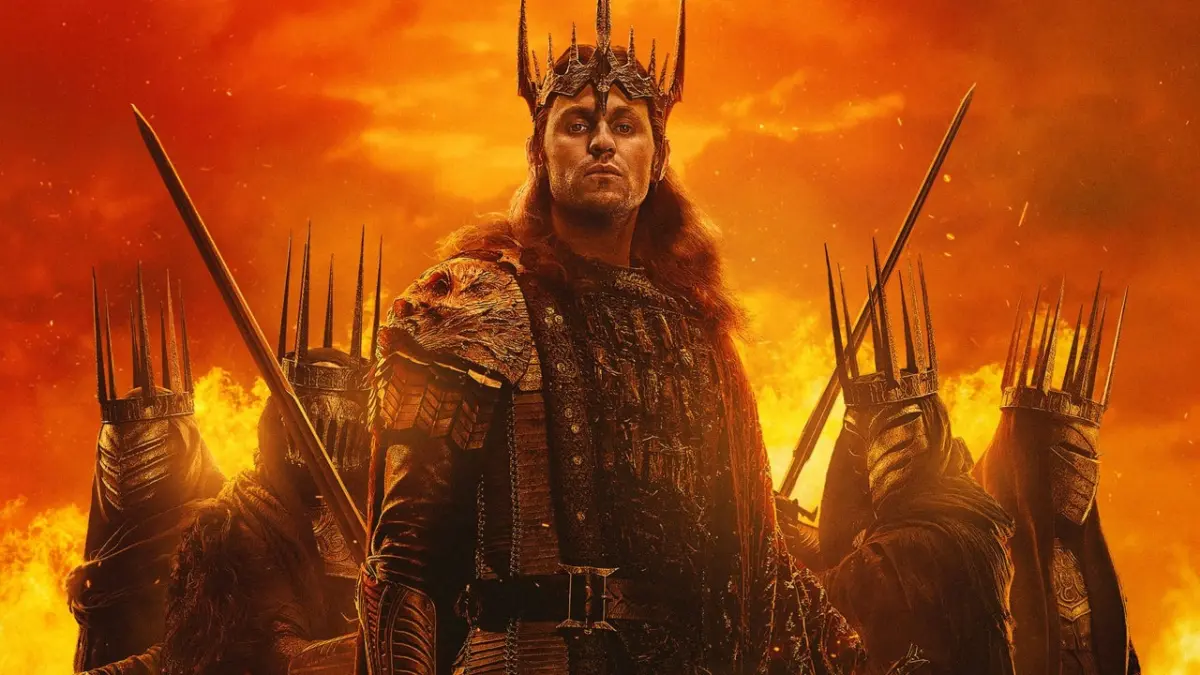
At the heart of the finale lies a sobering truth: while blades and armies clash, Sauron’s most formidable weapon remains his insidious guile. As the Dark Lord prepares his next major offensive, the kingdoms of Men and Elves stand precariously on the precipice of total annihilation.
Detailed Chronology: Breaking Down "The Doom of Men"
The Forging of the One and the Pact of Fire
The narrative runway leading into the finale was dominated by Episode 7, “Orodruin,” which featured the long-awaited and dreaded crafting of the One Ring. In a darkly Faustian sequence, Sauron successfully forged the master ring with the unexpected assistance of a Balrog (voiced with gravelly menace, albeit heavily modulated, by Simon Pegg).
While the concept of Middle-earth’s ultimate dark force striking a bargain with a primordial demon is conceptually thrilling, the execution left some critics wanting. Pegg’s vocal performance was distorted to the point of anonymity, rendering the casting choice nearly invisible beneath layers of audio processing. Nevertheless, the narrative consequence is absolute: the One Ring exists, and Sauron’s dominion takes a terrifying leap forward.
Númenor’s Political Suicide
Simultaneously, the political landscape of Númenor suffered a catastrophic shift. Queen Míriel, bowing to the crushing weight of destiny and political expediency, ultimately turned her back on Elendil. She proceeded with her marriage to Ar-Pharazôn, consolidating power and effectively uniting the Númenórean factions under a banner of escalating hubris.
Despite Elrond’s desperate attempts to instill hope in the hearts of the doomed Númenórean soldiers—even going so far as to evoke the memory of his brother, Elros—Pharazôn’s unchecked ambition blinds him to the gathering storm. The Elves, gifted with foresight, already perceive the looming "Doom of Men." With Sauron deliberately orchestrating a calculated surrender, the stage is undeniably set for the catastrophic Fall of Númenor in the upcoming fourth season.

Khazad-dûm’s Quiet Exile
Meanwhile, the subterranean depths of Khazad-dûm saw Prince Durin and his family cast out into the cold following their banishment. Making a desperate play for survival, they absconded with one of the rings originally intended for the Dwarf-lords. Notably, the Dwarven storyline sat out the finale entirely, leaving their fate hanging in the balance as an unresolved thread to be unspooled when the series returns.
The Wizards, the Ring, and Pallando’s Redemption
One of the season’s most enduring mysteries—the identity and alignment of the Dark Wizard played by Ciarán Hinds—finally reached a climax in the finale. The storyline coalesced around the sacrifice of the Blue Wizard, Pallando.
In a classic narrative arc featuring a Heel-Face Turn followed swiftly by a redemptive death, Pallando managed to free himself from the corrupting influence of a ring. Having worn the artifact for a fleeting window of time, his brief obsession offered a meta-textual nod to Gollum’s iconic "my precious" mantra. Though the subsequent wizards-versus-Nazgûl battle suffered from visibly awkward wire-work and choreography, it provided a poignant moment of unity as Gandalf and Pallando fought side-by-side.
While some critics questioned whether the multi-season build-up surrounding Pallando justified such a brisk and final payoff, his sacrifice carried undeniable strategic weight: the liberation of his followers robbed Sauron’s growing army of a critical vanguard.
The Temptation of the Istari
Perhaps the psychological high-water mark of the finale was Sauron’s direct confrontation with Gandalf. Employing a tactic reminiscent of The Last Temptation of Christ, Sauron tested the Maia’s incorruptibility, offering him dominion over Middle-earth in exchange for submission.
Sauron even went so far as to conjure a cruel mirage of Nori Brandyfoot (featuring a welcome cameo by Markella Kavenagh) to emotionally compromise Gandalf. While viewers familiar with the show’s structural beats likely never believed Nori was genuinely returning in a permanent capacity, the psychological warfare displayed highlights Sauron’s mastery over the minds and hearts of his foes.
Supporting Context & Metrics: Evaluating Season 3
To fully contextualize the reception of The Rings of Power Season 3, it is vital to examine how the production measures up against modern prestige television benchmarks:

- Budget and Scale: Retaining its title as one of the most expensive television productions in history, Season 3 maintained an estimated per-episode budget exceeding $50 million, visible in its expansive CGI vistas, intricate costume design, and sweeping battle sequences.
- Audience Retention: Following a mixed reaction to the pacing of Season 2, Amazon reported a stabilization in viewer retention for Season 3, largely credited to tighter plotting centered around the forging of the rings and the acceleration toward Second Age tentpole events.
- Critical Consensus: Review aggregates place Season 3 comfortably above its sophomore outing, praising its narrative focus while occasionally faulting it for relying too heavily on "table-setting" for future seasons rather than delivering standalone narrative satisfaction.
Official Statements and Industry Reactions
Following the conclusion of the double-episode finale, showrunners J.D. Payne and Patrick McKay, alongside key members of the cast and Amazon Studios executives, offered insights into the trajectory of the series.
"We always envisioned the journey of the Rings as a slow-burning fuse that eventually detonates the entire geopolitical structure of Middle-earth," said showrunner J.D. Payne in a recent post-finale roundtable. "Season 3 was about lighting that fuse. As we move into Season 4, there is nowhere left to hide. The consequences of hubris, of forged rings, and of blind ambition will come due in ways the characters—and the audience—are not fully prepared for."
Amazon Studios head of television Jennifer Salke also emphasized the studio’s long-term commitment to J.R.R. Tolkien’s legendarium, confirming that the early renewal for Season 4 underscores their absolute confidence in the creative team’s multi-season roadmap.
Future Outlook: What Lies Ahead in Season 4
As Amazon officially greenlights Season 4, the narrative architecture of The Rings of Power is shifting from political machination to all-out apocalyptic warfare.
- The Fall of Númenor: With Ar-Pharazôn’s hubris reaching its zenith and Sauron orchestrating his own capture to corrupt the island kingdom from within, Season 4 is widely expected to depict one of the most cataclysmic events in Tolkien’s mythology: the drowning of Númenor.
- The Dwarven Reckoning: Prince Durin’s exile and the possession of the Dwarven ring ensure that Khazad-dûm will face internal and external pressures, particularly as the influence of the rings begins to warp the minds of the Dwarf-lords.
- The Resistance Unites: With Gandalf stepping fully into his role as a protector of Middle-earth and the Elves recognizing the true scope of the coming darkness, surviving factions will be forced to form unprecedented alliances—or fall individually beneath the shadow of Mordor.
Ultimately, The Rings of Power Season 3 finale proved that while the journey through Tolkien’s Second Age can occasionally feel bogged down by exposition and setup, the destination is shaping up to be an unmissable, fiery spectacle. Doomsday is indeed coming to Middle-earth, and the countdown has officially begun.