Executive Overview
For years, the software-as-a-service (SaaS) industry debated the theoretical threat of artificial intelligence. Would autonomous agents replace human workers entirely, or would they remain glorified autocomplete tools confined to sidebars and chat boxes?
In late 2026, the data arrived to answer that question, and the reality is far more radical than most enterprise roadmaps anticipated. AI agents have not merely arrived; they have quietly commandeered the core machinery of software development.
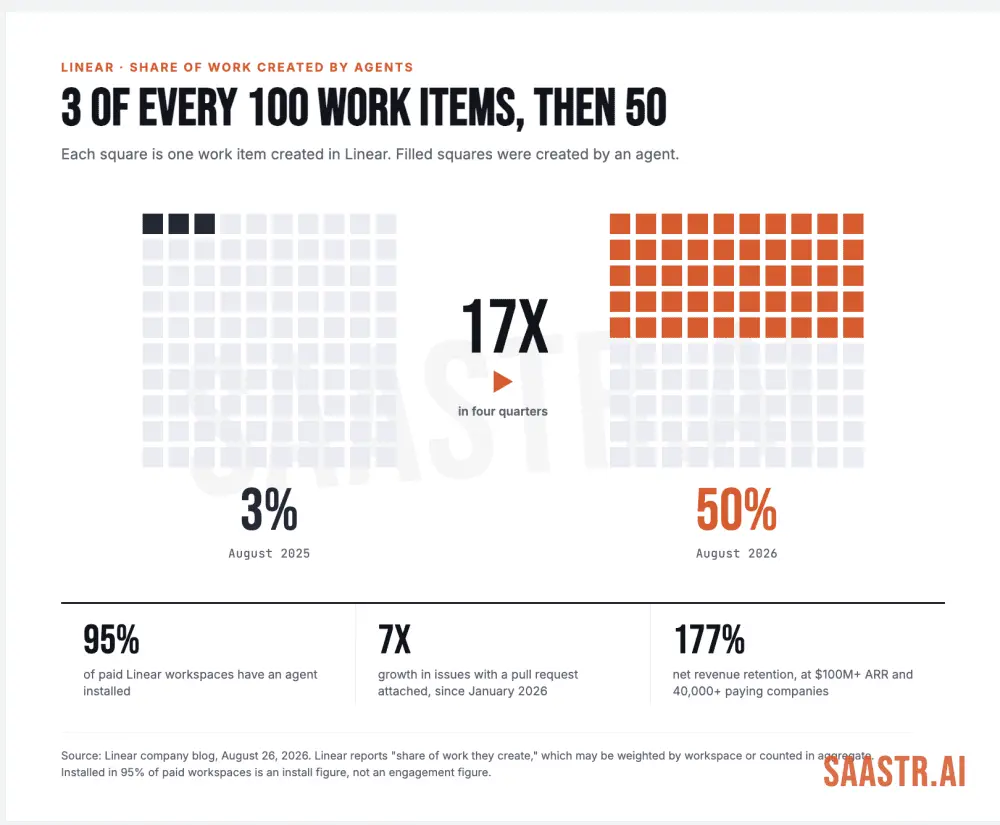
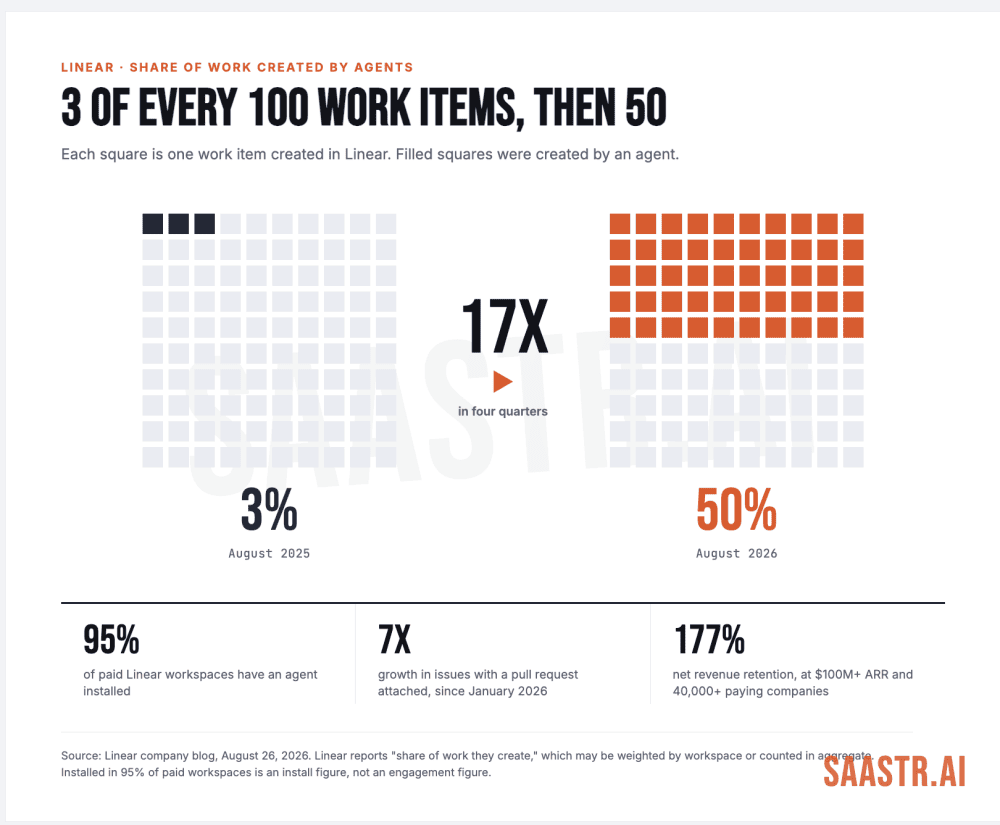
According to recent milestone metrics published by issue-tracking pioneer Linear alongside financial disclosures from industry titan Atlassian, AI agents are no longer just consuming enterprise software—they are actively writing it. Linear revealed that autonomous agents are now installed in 95% of paid workspaces, with the share of work items created by machines skyrocketing from a mere 3% to 50% over the course of just twelve months. Concurrently, issues linked directly to human-approved code pull requests (PRs) have grown sevenfold.
Far from hollowing out the software ecosystem or rendering systems of record obsolete, this seismic automation wave is supercharging customer expansion. Linear maintained an astonishing 177% Net Revenue Retention (NRR) at scale, while Atlassian reported that its Model Context Protocol (MCP) adopters expand paid seats faster and grow annual recurring revenue (ARR) at twice the rate of non-adopters.
Rather than signaling the death of traditional enterprise tools, the agentic revolution is proving that when machines handle the grunt work of generating inputs, human-machine collaboration accelerates velocity, alters monetization models, and divides the software market cleanly between resilient market leaders and vulnerable mid-market competitors.
Detailed Chronology: From Novelty to Core Infrastructure
To understand how software workflows transitioned from human-centric to machine-driven in a single year, one must examine the timeline of execution across the industry’s leading engineering teams.
The 2025 Foundation: Setting the Stage
Throughout 2025, the industry was flooded with "AI wrapper" applications. Startups and enterprise tools alike rushed to bolt generative chat interfaces onto existing products. However, these tools suffered from high friction: they required users to copy and paste text, switch contexts, and manually verify outputs. They were treated as novelty features rather than foundational infrastructure.
By late 2025, advanced agentic platforms began appearing natively within developer toolchains. Coding assistants evolved from suggesting lines of code to executing multi-step workflows. Companies like Cognition, Cursor, and OpenAI began building their internal product development pipelines directly on top of flexible issue trackers like Linear, serving as the proving grounds for autonomous agent deployment.
The 2026 Inflection Point: The 50% Crossing
By the first half of 2026, the paradigm shifted from human-triggered prompts to autonomous execution loops. Linear’s tender offer announcement in August 2026 exposed a staggering reality check for the B2B SaaS sector:
- January 2025: Agents accounted for roughly 3% of the work items generated inside Linear workspaces.
- August 2026: Agents accounted for 50% of all created work items across its paid ecosystem.
This twelve-month acceleration represents an adoption curve virtually unprecedented in enterprise software history. Standard feature adoption cycles typically crawl from 3% to 8% to 15% over a three-year period. Linear’s metric, conversely, tracked the fundamental composition of database records entering its system—proving that machines were no longer just logging in; they were defining the very tasks that engineering, product, and design teams executed.
Supporting Context & Metrics: Decoding the Data
A critical trap in enterprise software analytics is confusing volume with productivity. An autonomous agent configured incorrectly can easily spam an issue tracker with hundreds of useless tickets per day, inflating usage metrics while destroying actual developer velocity.
Quality Over Volume: The Sevenfold PR Growth Metric
To validate that the 50% creation rate represented meaningful engineering output, analysts examined a second crucial metric: completion loops.
Since January 2026, Linear tracked a sevenfold increase in issues accompanied by a pull request (PR) attached by an engineer, designer, or product manager. This proves that the work generated by agents is not lingering as digital clutter; it is flowing through the pipeline, being matched with concrete code, and reaching the review stage.
The Atlassian Paradigm: MCP Growth and the Unified UI
Corroborating Linear’s findings, Atlassian’s Q4 FY26 earnings release provided a broader look at enterprise workflows across millions of users.
- Jira work items and Confluence pages generated via Atlassian’s Model Context Protocol (MCP) server surged nearly 4x quarter-over-quarter.
- Monthly active users of the MCP server and Teamwork Graph CLI doubled, surpassing 1 million, with total MCP calls up over 400%.
Crucially, Atlassian’s data dismantled fears that agents would completely bypass user interfaces and destroy seat-based licensing models. 98% of Atlassian’s MCP users were also active in the Jira UI during the same month. Humans and machines are operating simultaneously within the exact same records, with agents acting as active contributors to the enterprise "Teamwork Graph" rather than mere API consumers.
Financial Resiliency: NRR and Commercial Performance
The macroeconomic impact of this shift is starkly visible in financial retention metrics:
- Linear: Maintained an elite 177% Net Revenue Retention (NRR) while operating at scale past $100M+ ARR.
- Atlassian: Closed FY26 with revenue up 28% to $1.77 billion, cloud revenue accelerating to 31%, and subscription ARR reaching $6.6 billion (up 23%). Atlassian explicitly noted that MCP and Rovo adopters grow ARR at more than twice the rate of non-adopters.
- Mid-Market Competitors: Companies sitting squarely in the horizontal mid-market faced severe headwinds. While monday.com and Asana navigate single-digit to mid-teens growth adjustments and workforce reductions, agent-native and deeply integrated incumbents are capturing the financial upside of increased digital consumption.
Official Statements and Industry Perspectives
The rapid pivot toward agentic workflows has forced executive leadership teams to rethink product architecture, pricing models, and corporate financing strategies.
Karri Saarinen and Linear’s Capital Strategy
Linear’s recent corporate maneuvers—featuring a $99 million secondary tender offer at a $2.5 billion valuation without raising primary capital—underscored a broader philosophy shift among cash-flow positive, capital-efficient tech companies. By allowing employees to realize liquidity without diluting existing shareholders or adding unnecessary primary capital to a balance sheet that already boasts more cash than the company has ever raised, Linear set a new playbook for generational tech startups.
More importantly, Linear’s leadership highlighted that modern B2B software must adapt to three non-negotiable realities:
- Agent-Created Data Share: Systems must track what percentage of database objects are generated by machines versus humans.
- First-Class Agent Identities: Agents require dedicated identities, permissions, and audit trails rather than sharing generic bot credentials.
- Value-Aligned Pricing: If customer work volume triples via automation while human headcount remains flat, legacy per-seat pricing models will fail to capture the underlying economic value generated.
Atlassian Leadership on the "Teamwork Graph"
Atlassian Co-Founder and CEO Mike Cannon-Brookes emphasized that agents have fundamentally transformed into teammates within the enterprise software stack. By grounding agents in over 200 billion objects within Atlassian’s Teamwork Graph, the company reported up to 44% more accurate answers utilizing 48% fewer tokens.
Furthermore, industry studies—such as Microsoft’s July 2026 evaluation of Claude Code and Copilot CLI rollouts—confirm that while agentic tools deliver a very real, tangible lift (roughly 24% more merged pull requests among adopters), they act as productivity multipliers rather than magical 10x silver bullets. The human element remains essential for validation, architecture, and final sign-off.
Future Outlook: The Road Ahead for Enterprise Software
As the dust settles on a transformative year of AI integration, the software industry faces a clear bifurcation.
1. The Death of Per-Seat Inflexibility
Software vendors clinging exclusively to traditional per-seat pricing are facing an existential crisis. When three human engineers aided by twenty autonomous agents produce the workload of a fifty-person department, seat-based metrics detach completely from business value. Forward-thinking companies are rapidly transitioning toward consumption-based models or value-metric pricing that captures API calls, storage, compute, and agentic task volume.
2. Context Quality as the Ultimate Differentiator
The core technical challenge of agentic software has shifted from generating code or text to providing precise context. The tools that win over the next five years will not be those with the flashiest chat interfaces, but those that possess the richest institutional context—graphs, historical comments, audit trails, and deep integrations—ensuring that autonomous agents operate with maximum accuracy and minimal hallucination.
3. The Review Surface Becomes the Product
As agents increasingly handle the initial generation of work items, code, and documentation, the value of enterprise software migrates to its review interface. The battleground is no longer about who can make it easiest to type a ticket or write a draft; it is about who builds the most frictionless, transparent surface for humans to inspect, approve, and ship machine-generated output.
Conclusion
The narrative that AI agents would hollow out enterprise software and destroy SaaS business models has been decisively upended. Instead, agents have become the primary drivers of digital creation—generating half of all workflows in industry-leading environments while simultaneously driving record-breaking net revenue retention and account expansion. For B2B founders and product leaders, the message is unequivocal: the shift from human-entered data to machine-generated execution is already complete. The only remaining question is whether your product architecture was built to measure, price, and govern it.