
Executive Overview
As the gaming industry braces for what is unarguably the most anticipated entertainment release in history, Rockstar Games has offered a staggering glimpse into the sprawling, neon-soaked underworld of Grand Theft Auto VI. Following an exclusive, fleeting window on Netflix, a comprehensive 26-minute extended look has made its way to public platforms, setting the stage for the game’s official launch on November 19.
Set primarily within the sun-drenched neon streets of Vice City and the treacherous, untamed bayous and forests of the fictional state of Leonida, GTA VI aims to redefine the open-source action-adventure genre. Promising campaigns that could easily surpass 80 hours of total playtime, Rockstar North has meticulously engineered a next-generation ecosystem. The latest deep-dive footage reveals a monumental evolution in systemic game design, introducing vastly overhauled gunplay, intricate carjacking mechanics, a sophisticated moral and criminal profiling framework, and a modernized Wanted system that resurrects a fan-favorite challenge.
This report synthesizes every major technical upgrade, gameplay addition, and thematic Easter egg unearthed from the extended trailer, providing a definitive preview of how GTA VI is poised to shatter industry sales and structural benchmarks.

Detailed Chronology: Deconstructing the 26-Minute Gameplay Showcase
The extended gameplay presentation provided a granular view of GTA VI‘s structural mechanics, shedding light on mission pacing, world interaction, and the dynamic interplay between the game’s two central protagonists, Lucia Caminos and Jason Duval.
Character Dynamics and Narrative Agency
Rockstar’s modern take on a contemporary Bonnie and Clyde manifests fluidly through dual-protagonist mechanics reminiscent of Grand Theft Auto V, yet with deeper narrative integration. Around the 18:41 mark of the presentation, the action dynamically shifts from Jason to Lucia mid-chase, as both criminals attempt to survive a high-octane vehicular escape in a red convertible.
However, the trailer also highlights moments of player choice that dictate campaign progression. At roughly the 10:50 mark, Lucia and Jason patronize the Effluvia—a glitzy rooftop lounge in downtown Vice City—where they are propositioned for a criminal enterprise by their associate, Brian Heder. Rather than enforcing a rigid narrative path, a brief dialogue exchange leads to Lucia standing up and leaving Jason to take the job, washing it down with a trademark bottle of Pißwasser. This choice-driven structure hints at branching mission paths and individual character arcs that will profoundly influence the overarching 80-hour narrative.

The Evolution of Open-World Mechanics
GTA VI introduces unprecedented interactivity to the open-world formula, heavily inspired by Rockstar’s masterclass in environmental storytelling, Red Dead Redemption 2.
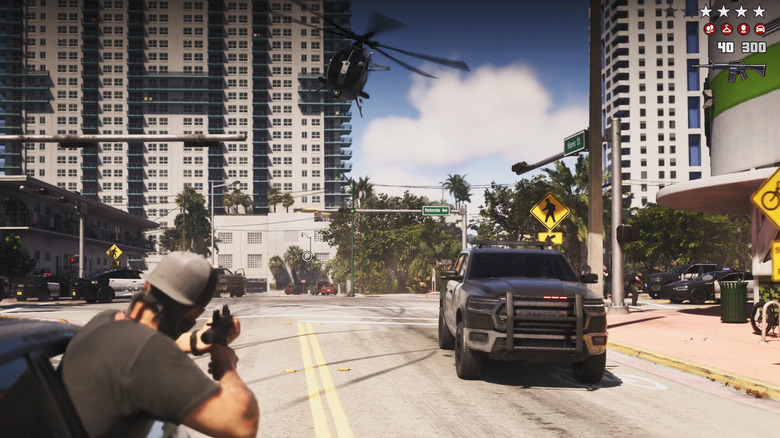
- The Return of the Six-Star Wanted Level: Spotted briefly at the 14-minute mark during a frantic backseat firefight with an automatic rifle, the iconic six-star Wanted level makes a triumphant return after being capped at five in GTA V. This tier promises a relentless, military-grade response that evokes memories of the formidable NOOSE forces from GTA IV.
- The Criminal Profile and De-escalation Systems: Rejecting a black-and-white morality meter, GTA VI tracks player actions through a nuanced Criminal Profile. Hitting back at an aggressive non-player character (NPC) carries a vastly different weight than executing an unprovoked civilian. Furthermore, players can frequently bypass violent altercations entirely using contextual dialogue options to taunt or de-escalate situations. According to studio co-head Rob Nelson, micro-interactions—such as depositing trash in receptacles or feeding local Leonida wildlife—gradually alter how the game world and its inhabitants react to the protagonists.
- Immersive Side Activities: The presentation showcased a dizzying array of minigames and leisure pursuits. Alongside traditional pastimes like scuba diving, basketball, and dirt bike races, players can partake in timed target-practice challenges, stock car racing, kayaking, and even backyard wrestling complete with signature WWE-style finishing maneuvers.
Supporting Context & Metrics: Technical Overhauls and Combat Refinements
Beyond narrative framing, GTA VI introduces significant mechanical overhauls designed to modernize Rockstar’s combat and exploration loops for contemporary hardware.
Tactical Combat and Weapon Handling
Gunplay and close-quarters combat have undergone a rigorous modernization process, prioritizing tactical flow and physical realism:

- Dynamic Weapon Swapping: Players are no longer forced to pause the action within a traditional radial weapon wheel during high-stress scenarios. As demonstrated during Lucia’s target-range sequence at the 18:31 mark, characters can seamlessly toggle between a primary rifle and a sidearm on the fly.
- Environmental Weapon Acquisition: Picking up fallen enemy weapons is now faster and more fluid. Toward the end of the trailer, Jason effortlessly strips a Duke 556 assault rifle from a fallen adversary mid-firefight.
- One-Handed Wielding: Lucia is shown dispatching enemies with a shotgun held in one hand while simultaneously hauling a heavy sack of contraband with the other.
- Targeting and Precision: Returning mechanics from Max Payne 3 and Grand Theft Auto V—such as Michael De Santa’s iconic slow-motion shooting—reappear through Jason. Furthermore, a brand-new vitals targeting system utilizes color-coded markers: red highlights indicate lethal impact zones, while yellow markers targeted at joints suggest non-lethal disarming capabilities, reminiscent of GTA IV.
Vehicular Mechanics and Navigation
Carjacking has been elevated from a simple button-press to an intricate mechanical puzzle. At the 6:07 mark, Jason utilizes a "Slim Jim" tool, requiring the player to time a meter via the right analog stick to breach a vehicle. High-end, electronically locked vehicles require specialized key cloners, explicitly confirming that players will no longer be able to hot-wire every single automobile encountered on the streets of Leonida.
Navigation has also received a quality-of-life upgrade: the in-game map HUD has been redesigned to render buildings in fully realized 3D, drastically easing transit through dense urban sprawls.
Official Statements & Industry Impact
Rockstar North co-studio head Rob Nelson has been vocal about the studio’s design philosophy for Grand Theft Auto VI, emphasizing systemic depth and reactive world-building over mere scale. In recent pre-release briefings, Nelson highlighted that "consistent actions may have an impact in terms of how the world reacts to you and how the narrative plays out," framing the Criminal Profile system as the heartbeat of the game’s immersive simulation.
Industry analysts project that GTA VI will comfortably shatter historical entertainment launch records, potentially generating billions of dollars within its first weekend. By marrying the satirical, sun-bleached consumerist excess of Vice City with the hyper-realistic ecosystem mechanics pioneered in Red Dead Redemption 2, Rockstar is positioning the title not merely as a video game, but as a definitive cultural milestone for the 2020s.
Future Outlook
As the November 19 release date rapidly approaches, speculation remains rampant regarding the full breadth of Leonida’s map and the mysterious contours of online integration ("GTA Online II"). What the extended look unequivocally proves, however, is that Rockstar Games is leaving nothing to chance.
By refining player agency, expanding environmental interactivity, and honoring the legacy of its past masterpieces through clever design nods and structural callbacks, Grand Theft Auto VI is shaping up to be a towering achievement in interactive media. When players finally step foot into Vice City later this year, they will find a living, breathing world that watches, remembers, and reacts to every single bullet fired and trash can used.