Executive Overview
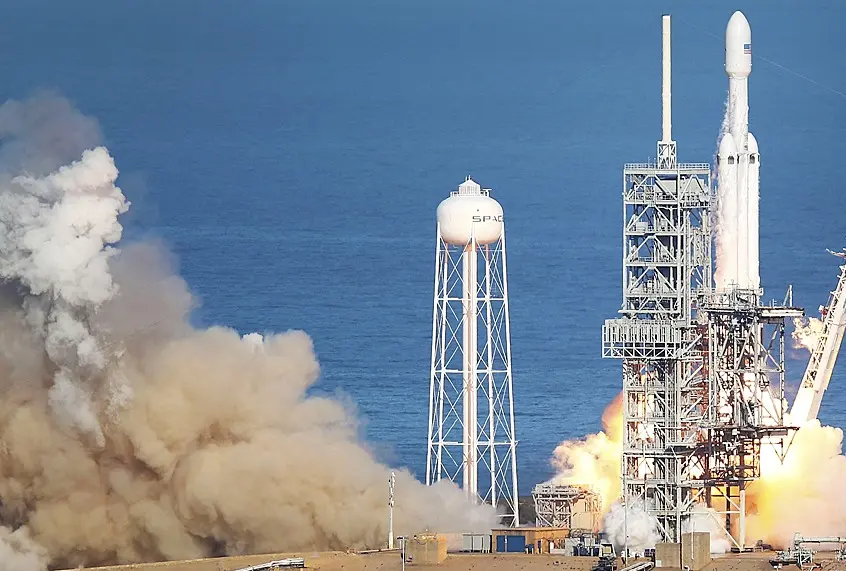
On February 6, 2018, the aerospace industry crossed a monumental threshold. From historic Launch Pad 39A at the Kennedy Space Center in Florida—the very site from which humanity once departed for the Moon—Elon Musk’s private spaceflight enterprise, SpaceX, successfully executed the maiden flight of the Falcon Heavy. Billed as the most powerful operational rocket in the world by a factor of two, the vehicle successfully cleared the tower, pierced the stratosphere, and placed a cherry-red Tesla Roadster into heliocentric orbit, complete with a spacesuited dummy affectionately dubbed "Starman" behind the wheel.
Beyond the undeniable engineering triumphs—which included the synchronized, jaw-dropping vertical landings of two of the rocket’s three reusable first-stage boosters back at Cape Canaveral—the launch provided a secondary, cultural spectacle. Streaming live across numerous video and social media platforms, the onboard cameras captured stunning, crystal-clear, high-definition footage of the Earth’s distinct, undeniable curvature set against the infinite black of deep space.
For the global scientific and astronomical communities, it was yet another breathtaking visual confirmation of our planet’s oblate spheroid geometry. For the internet at large, however, it immediately sparked a viral, tongue-in-cheek debate: Will this finally put an end to the resurgent, highly vocal flat-Earth movement?
This comprehensive report examines the technical achievements of the Falcon Heavy launch, the reactions of the global digital populace, the core tenets of flat-Earth pseudoscience, and why, despite overwhelming, high-altitude empirical proof, psychological frameworks ensure that conspiracy theories will stubbornly persist in the face of absolute truth.
Detailed Chronology: A Day That Altered Aerospace History
Pre-Launch Anticipation and Technical Stakes
The stakes heading into February 6, 2018, could not have been higher. For years, skeptics within the traditional aerospace sector and broader public alike doubted whether SpaceX could successfully strap three Falcon 9 core boosters together to generate the staggering 5 million pounds of thrust required to lift heavy payloads beyond low-Earth orbit. Elon Musk himself repeatedly tempered expectations prior to the launch, famously assigning only a 50-50 chance of success for the maiden voyage and warning spectators that a catastrophic explosion right on the pad remained a very real possibility.
Liftoff at Pad 39A
At 3:45 PM EST, the countdown reached zero. The Falcon Heavy ignited its 27 Merlin engines simultaneously, unleashing a deafening roar that shook the Florida coastline and drew hundreds of thousands of ecstatic onlookers to nearby beaches and viewing areas.
As the colossal rocket clawed its way through the troposphere, telemetry data streamed smoothly to SpaceX mission control in Hawthorne, California. Within minutes, the rocket successfully passed through Max-Q (maximum aerodynamic pressure), the most physically punishing phase of the ascent.
The Booster Landings
Perhaps the most visually arresting moment of the early flight sequence occurred minutes after separation. While the central core booster ultimately missed its target drone ship in the Atlantic Ocean due to ignition fluid shortages, the two side boosters executed a meticulously choreographed, synchronized return to Earth. Both boosters descended backward through the atmosphere, reignited their engines, and touched down on Landing Zones 1 and 2 at Cape Canaveral Air Force Station in near-perfect unison. The dual landing instantly became an iconic, cinematic touchstone in the history of modern industrial design.
Starman’s Journey into the Cosmos
Meanwhile, the upper stage of the Falcon Heavy continued its ascent, coasting out of Earth’s immediate gravitational pull and into an elliptical orbit around the sun that would stretch out toward the orbit of Mars. Released from its protective fairing, the secondary payload—a personal Tesla Roadster playing David Bowie’s "Space Oddity" on an infinite loop—floated silently against the backdrop of our home planet. The live-streamed camera feeds captured a panoramic view of the globe, offering a vantage point previously reserved for professional astronauts aboard the International Space Station.
Supporting Context & Metrics: The Scale of the Achievement
To truly understand why the Falcon Heavy launch resonated so profoundly across cultural and scientific spheres, one must examine the raw engineering metrics and the economic disruption SpaceX introduced to the global launch market.
| Metric / Parameter | Specification | Significance |
|---|---|---|
| Total Thrust at Liftoff | ~5 million pounds (approx. 22.7 meganewtons) | Equivalent to roughly eighteen 747 aircraft operating at full power. |
| Payload Capacity to LEO | 63,800 kilograms (140,660 lbs) | Makes it the most capable operational rocket in the world in 2018. |
| Payload Capacity to Mars | 16,800 kilograms (37,000 lbs) | Opens deep-space exploration pathways for private enterprise. |
| First-Stage Engines | 27 Merlin 1D engines (clustered cores) | Demands advanced computerized thrust vectoring and load balancing. |
| Reusability Factor | Dual side boosters recovered intact | Drastically slashes per-launch capital expenditure compared to expendable systems. |
By demonstrating that heavy-lift rocketry could be combined with rapid, cost-effective booster recovery, SpaceX fundamentally altered the economics of space exploration. Governments and private enterprises alike were put on notice: the era of disposable space hardware was drawing to a close.
Official Statements and Global Reactions
The immediate aftermath of the launch saw an outpouring of commentary from aerospace leaders, cultural figures, and everyday internet users.
Elon Musk, speaking at a post-launch press conference, captured the emotional resonance of the event:
"Life cannot just be about solving one miserable problem after another. There need to be things that inspire you, that make you glad to wake up in the morning and be part of humanity. That is why we did this. That is why you should care."
Social media platforms, particularly Twitter and Reddit, exploded with memes, screenshots, and live reactions. A prevailing theme among online commentators was the juxtaposition between the high-definition proof of Earth’s sphericity and the stubborn resilience of internet conspiracy theorists.
Popular tech and internet personalities chimed in immediately following the broadcast:
- Dave Days (@davedays): "Flat earth conspiracy officially debunked… with style @SpaceX #FlatEarth"
- Skyler (@thatguysky13): "Look you can see the curvature of the Earth, I bet the flat Earthers are pissssed"
- State of Mind (@StateofMindNZ): "Tough day at the office for flat earthers…"
Yet, while mainstream observers viewed the crisp, unedited camera feeds of the horizon as the final nail in the coffin for pseudoscientific geography, sociologists and psychologists studying online behavior understood a deeper, more troubling reality: physical evidence rarely penetrates closed ideological systems.
The Flat-Earth Phenomenon: Anatomy of a Modern Conspiracy
To appreciate why high-altitude rocket footage fails to convince flat-Earth adherents, one must examine the core structure of the belief system itself.
Core Beliefs vs. Empirical Reality
Proponents of the flat-Earth theory reject centuries of established physics, astronomy, and navigation. Instead, they maintain that:
- The Disk Model: The Earth is not an oblate spheroid, but rather a flat disk centered roughly around the North Pole.
- The Antarctic Ice Wall: Antarctica is not a continent at the bottom of a globe, but a massive wall of ice—hundreds of feet high—that rings the perimeter of the disk to hold in the oceans.
- The Denier Cabal: All government space agencies (NASA, ESA, Roscosmos), private aerospace firms, commercial airline pilots, and independent scientists are part of a massive, coordinated global conspiracy to hide the "true" nature of creation from the general public.
The Psychology of Denial: Why Visual Evidence Fails
When confronted with live-streamed, unedited video footage from the Falcon Heavy showing a clear, convex curvature, flat-Earth truthers do not experience a paradigm shift. Instead, they deploy psychological defense mechanisms common to all hardline conspiracy theories:
- Fish-Eye Lens Accusations: A primary counter-argument is that onboard cameras utilize wide-angle lenses (such as GoPro or custom fish-eye rigs) designed to intentionally distort straight lines into curved horizons.
- CGI and Fabrication Claims: Any video output originating from outer space is automatically categorized as computer-generated imagery (CGI) produced in terrestrial studios (often invoking comparisons to Hollywood productions).
- The "Dome" Hypothesis: Some sub-sects of the movement argue that humanity lives underneath a solid firmament or dome, and that optical refractions within this glass-like barrier create the illusion of a curved horizon from high altitudes.
Psychologists note that belief in flat-Earth theories is rarely about geography; it is about identity, community, and distrust of institutional authority. For an individual embedded in this subculture, admitting the Earth is round means alienating their social circle, admitting they were duped, and submitting to mainstream scientific consensus—a psychological cost far higher than simply denying what their own eyes see on a screen.
Future Outlook: Science, Truth, and the Information Age
The successful flight of the SpaceX Falcon Heavy in February 2018 will forever be remembered as a technical tour de force that unlocked the solar system for commercial innovation. It proved that private enterprise could build, launch, and recover heavy-lift orbital architecture with unprecedented precision.
However, the cultural discourse surrounding the launch serves as a sobering reminder of a modern paradox: we live in an era of unprecedented access to scientific data and empirical visualization, yet public skepticism of established facts remains at an all-time high.
As humanity pushes further into the cosmos—with ambitions set on lunar outposts, Martian colonization, and deep-space mining—the gap between empirical reality and populist skepticism is likely to widen rather than close. High-definition cameras, live telemetry feeds, and interplanetary travel will continue to accumulate mountains of undeniable proof that our world is a fragile, beautiful blue marble spinning in a vast universe. But for those committed to living on a flat disk of their own imagination, no amount of rocket fuel, satellite imagery, or stellar exploration will ever be enough to alter their horizon.