Executive Overview
Video game music has long since transcended the realm of background noise, evolving into a critical pillar of interactive storytelling and emotional resonance. Yet, few composers have managed to carve out a distinct, universally recognizable sonic identity quite like Darren Korb, the audio director and resident composer for Supergiant Games. Following the monumental success of the original Hades, Korb returned to the mythological pantheon for Hades 2, delivering a musical landscape that is at once a natural evolution of its predecessor and a monumental leap forward in ambition, texture, and scope.
Even for players who have long since exhausted the roguelike’s subterranean and celestial depths—clocking dozens of hours, conquering the core narrative, and moving on to other interactive experiences—the audio footprint of Hades 2 lingers. The soundtrack does not merely accompany the action; it acts as a kinetic, breathing entity that dictates the pulse of the combat, highlights the tragedy of ancient myths, and leverages unexpected guest instrumentation to redefine what indie game audio can achieve. This comprehensive analysis explores the anatomy of the Hades 2 score, examining its genre-bending boss themes, its textural ambient world-building, and its position as the zenith of Korb’s illustrious career thus far.
Detailed Chronology of the Audio Journey
To understand the impact of the Hades 2 soundtrack, one must trace the player’s auditory journey from the quiet, haunting reaches of Erebus to the blazing heights of Olympus. Korb structures the game’s audio architecture around distinct phases of progression, matching the psychological and mechanical toll of the roguelike loop.
The Ambient Foundation: Setting the Stage in Erebus
Long before a player encounters the high-octane adrenaline of a climactic boss battle, Hades 2 establishes its mood through atmospheric restraint. Tracks such as "Edge of Erebus," "Spider Silk," and "The Song of Sirens" ground the player in the damp, shadowy margins of the Underworld.

In "The Song of Sirens," Korb pays homage to the mythological creatures famed for luring sailors to their doom. Instead of immediately leaning into aggressive rock, he crafts an ethereal, mesmerizing siren call that genuinely feels faithful to its mythological namesake—right before dropping the hammer with a full-throttle rock band arrangement. This deliberate pacing ensures that when the score eventually explodes into heavy percussion and searing electric guitars, the shift feels earned and intensely jarring in the best possible way.
The Showstoppers: Boss Themes as Narrative Beats
The true masterstrokes of the Hades 2 soundtrack lie within its encounter themes. These are not merely functional loops designed to keep players focused; they are narrative events. Korb frequently incorporates elite guest musicians to inject distinct stylistic flavours into these encounters, transforming every major boss fight into a cultural collision of classical mythology and contemporary alternative music.
Scylla and the Sirens’ Discography
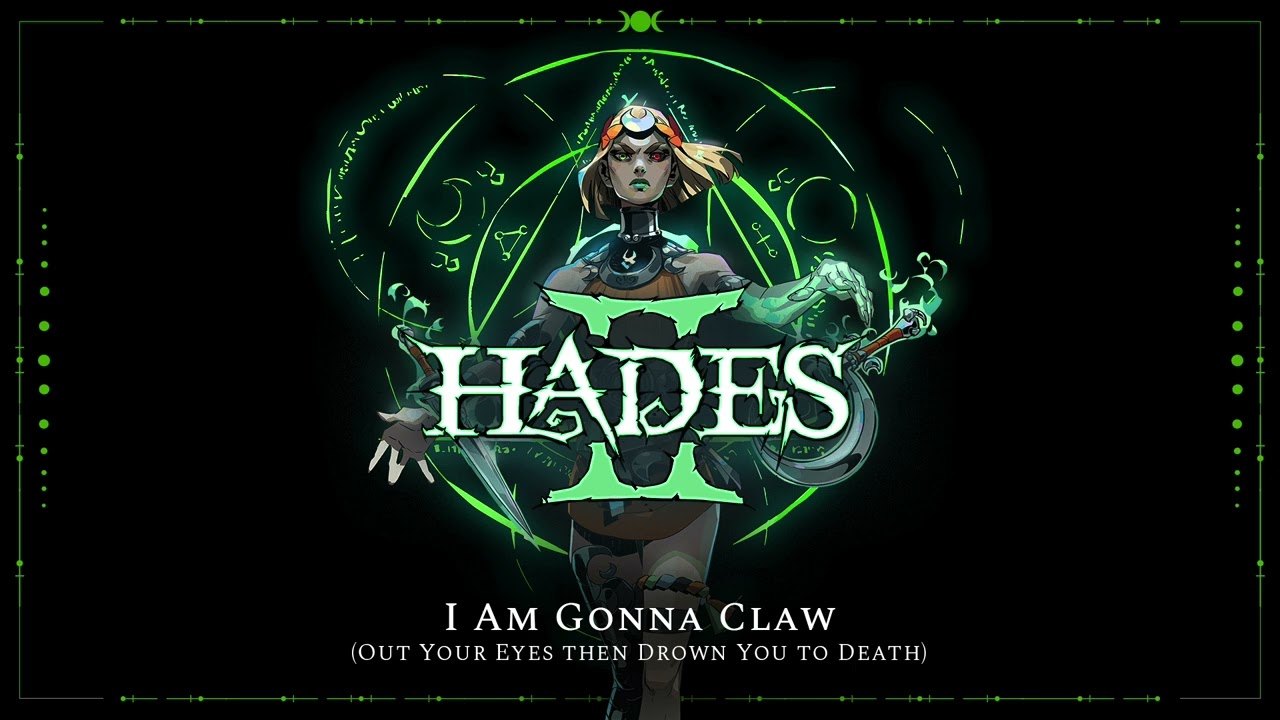
Few sequences in modern gaming match the sheer theatricality of battling Scylla and the Sirens. Comprising tracks like "Coral Crown," "I Am Gonna Claw (Out Your Eyes then Drown You to Death)," "Rock and a Hard Place (feat. Charybdis)," and "Bewitching Eyes," this fictional band functions both as a brilliant recurring gag and a masterclass in musical earworms.
The concept of Scylla serving as the player’s musical antagonist—writing bespoke diss tracks after suffering repeated defeats—is elevated by Erin Yvette’s powerhouse vocal performance. When the monstrous Charybdis joins the fray, contributing brutal death metal growls to the mix, the track transcends standard video game fare, delivering a genre-hybrid track that refuses to leave the listener’s consciousness.

The Titan of Time: Chronos and Louis Cole
Chronos, the overarching antagonist of Hades 2, is anchored by a thematic identity rooted in the relentless march of time. "The Titan of Time" utilizes a ticking clock as its signature percussion element—an obvious choice, perhaps, but executed with such rhythmic precision and complex time signatures that it elevates mechanical tension.
However, the true revelation arrives with "The End of Time," unlocked via the "Dissolution of Time" incantation. Featuring guest percussionist and multi-instrumentalist Louis Cole, the track unleashes an absolute barrage of frantic, ferocious drumming. Cole plays with the intensity of a predator tearing into a meal, making the drums the undisputed leading voice of the composition. It is a masterclass in rhythmic escalation that perfectly mirrors the desperation of battling the personification of time itself.
The Sightless Shepherd
Even minor regional bosses receive top-tier musical treatment. "The Sightless Shepherd" accompanies the encounter with Polyphemus, the infamous cyclops blinded by Odysseus in Greek mythology. Despite being merely the introductory boss of the surface biomes, Korb drafts jazz innovator Sam Gendel to deliver a blistering, hypnotic saxophone solo. The resulting fusion of classical Greek tragedy and avant-garde jazz textures creates an unforgettable auditory signature for an otherwise brutal early-game hurdle.
Olympus Aflame
Representing the literal and figurative height of conflict, "Olympus Aflame" plays during the grueling Vow of Rivals encounter against both Heracles and Prometheus. While it leans into a more traditional fantasy orchestral palette, it serves a vital structural purpose. The soaring, frantic crescendo of the orchestral brass captures the apocalyptic panic of Mount Olympus crumbling under siege, acting as proof of Korb’s mastery over classical composition before he deconstructs it with modern instrumentation elsewhere in the game.

Supporting Context & Metrics: The Supergiant Legacy
To fully appreciate the magnitude of Hades 2, one must view it within the lineage of Supergiant Games’ catalog. From the rustic, acoustic americana of Bastion to the neon-soaked cyberpunk synth-pop of Transistor, and the rhythmic, vocal-heavy choral arrangements of Pyre, Korb has continually reinvented his sonic palette.
| Game Title | Primary Musical Style / Genre | Notable Audio Characteristics |
|---|---|---|
| Bastion | Acoustic "Acoustic-Frontier" / Americana | Slide guitar, soulful vocals, organic textures |
| Transistor | Electronic / Synth-pop / Noir Jazz | Melancholic female vocals, electronic soundscapes |
| Pyre | Progressive Choral / World Folk | Multi-layered vocal harmonies, complex rhythmic structures |
| Hades | Hellenic Heavy Metal / Dark Ambient | Bouzouki, heavy distortion, driving rock beats |
| Hades 2 | Avant-Garde Fusion / Symphonic Metal / Jazz | Complex time signatures, guest instrumentation (sax, extreme metal vocals) |
While players and critics alike have long praised the original Hades soundtrack—which similarly relied on heavy guitar riffs and traditional Greek instruments like the bouzouki—Hades 2 represents the epoch of Korb’s career. By expanding the canvas to include jazz fusion, death metal harsh vocals, and complex polyrhythms, the game features a discography dense enough to nearly eclipse the rest of his celebrated body of work.
Official Statements and Creative Philosophy
Darren Korb’s approach to video game composition has always prioritized narrative integration over passive listening. In past interviews and developer breakdowns, Supergiant Games has consistently emphasized that music is written concurrently with the development of characters and encounters, rather than being slapped on as an afterthought.
The decision to feature prominent guest artists—such as Louis Cole on drums and Sam Gendel on the saxophone—reflects a deliberate strategy to push the boundaries of what an in-house indie game composer is expected to do. By collaborating with musicians outside the traditional video game audio sphere, Korb infuses Hades 2 with authentic jazz and metal credibility, ensuring that tracks like "The End of Time" and "The Sightless Shepherd" carry the technical chops and improvisational flair of a live studio session.
Furthermore, the integration of character-driven lyrics—particularly through Scylla and the Sirens—reinforces the game’s overarching theme of interpersonal rivalry and theatrical performance. The music does not just react to the player; the characters within the game world are actively performing it as an extension of their personalities.
Future Outlook: The Enduring Echo of the Underworld
As Supergiant Games continues to refine its craft and the gaming industry at large shifts toward increasingly sophisticated audio design, the benchmark set by Hades 2 will be difficult to surpass. Korb has demonstrated that even within a familiar genre framework, absolute creative freedom and a willingness to embrace unconventional musical collaborations can yield timeless results.
While players may eventually step away from the interactive loops of Hades 2, hanging up Melinoë’s witch-crafting tools for good, the soundtrack has successfully secured permanent residence in gym playlists, tabletop RPG sessions, and everyday listening rotations. It proves that great video game music does not merely stay in the game; it follows you out into the waking world, demanding to be heard, analyzed, and celebrated long after the credits roll.