Executive Overview
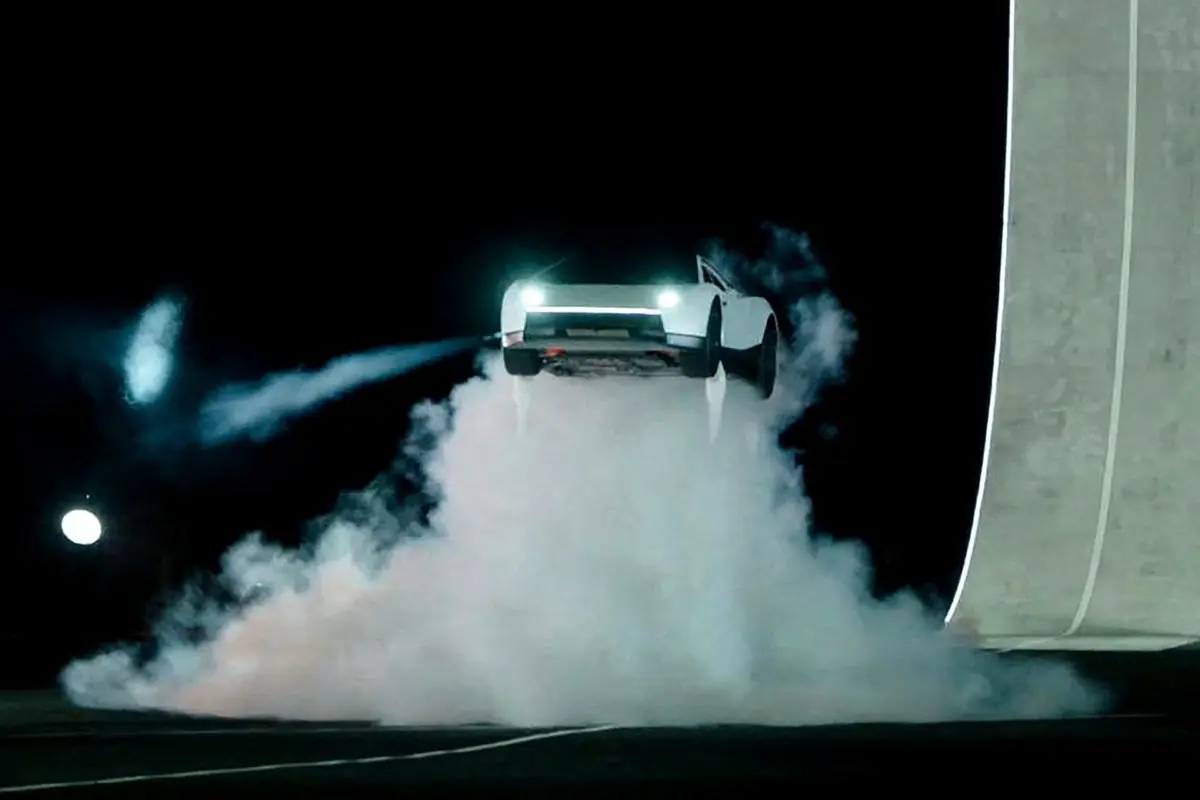
For years, Elon Musk has mastered the art of the tech-world sleight-of-hand, but his recent theatrical staging in Texas unveiled a spectacle that was less about automotive evolution and more about corporate metamorphosis. During a live-streamed event that defied traditional auto-industry logic, Musk showcased the long-delayed Tesla Roadster—complete with SpaceX-engineered gas thrusters capable of producing brief, terrifying moments of actual flight.
While the internet buzzed with memes of a flying sports car, industry insiders recognized the performance for what it truly was: a dazzling diversion. The event served as a subtle funeral for Tesla as a conventional electric vehicle (EV) manufacturer and the starting gun for the most ambitious corporate consolidation in modern history: the merger of Tesla and SpaceX.
As shrinking profit margins, aggressive Chinese competition, and the shifting political and regulatory landscapes strain Tesla’s balance sheet, Musk is pivoting toward a future dominated by autonomous Cybercabs and humanoid Optimus robots. To fund this high-stakes gamble in artificial intelligence and robotics, traditional car manufacturing must take a back seat. By embedding SpaceX technology directly into the new Roadster, Musk has signaled the dawn of a galactic mega-entity—a $3.5 trillion colossus that promises to forever redefine the boundary between earthly transportation and interplanetary ambition.
Detailed Chronology: From the Lotus Esprit to Rocket Thrusters
The journey of the Tesla Roadster reads like a sci-fi epic, characterized by astronomical ambitions, repeated delays, and signature Musk showmanship.
The 2017 Unveiling and the Great Wait
When the second-generation Roadster was first teased back in November 2017, Musk promised staggering performance metrics: 0 to 60 mph in 1.9 seconds, a top speed exceeding 250 mph, and a 620-mile range. True believers and early adopters eagerly handed over $50,000 reservation fees, with "Founder Series" slots commanding a cool $250,000 upfront. Years slipped by as Tesla poured its engineering bandwidth into scaling the Model 3 and Model Y, leaving Roadster reservation holders in a state of perpetual limbo.
The Texas Spectacle
Fast-forward to Thursday evening in Texas, where Musk took the stage with a proclamation ripped straight from a Hollywood blockbuster: "What you see with your eyes, you will not believe!"
The vehicle on display was a stylistic hybrid of a 1970s Lotus Esprit and the legendary SR-71 Blackbird spy plane. With an electric drivetrain boasting a mind-bending 0-to-60 mph time of 0.8 seconds, the car’s true party piece was hidden in plain sight: cold-gas thrusters derived directly from SpaceX rocket technology.
During the live demonstration, Tesla utilized a gigantic C-shaped ramp. The Roadster ascended the curve, used a downforce-generating fan system to defy gravity while inverted, and then blasted free. It executed a controlled roll—the "flying" portion of the show—before touching down amidst a plume of compressed air, subsequently jumping over a line of parked Teslas with another acrobatic rotation.
Pricing Tiers and the 2028 Horizon
True to form, the pricing structure for this mythical machine has grown increasingly baroque. Tesla is now demanding $50,000 for the "Performance" trim, $250,000 for the "Thrust" variant, and an unpublicated, invite-only sum for the ultimate "Rocket" trim—the iteration equipped for flight. Delivery dates have been pushed out to 2028, testing the patience of even the most dedicated shareholders. Yet, as history dictates when dealing with Musk’s timelines, caveat emptor remains the baseline rule of engagement.
Supporting Context & Metrics: The Financial Pressures Driving the Pivot
To understand why Musk is pushing the envelope toward flying sports cars and humanoid robots, one must examine the cold, hard metrics of Tesla’s current automotive operations.
The Numbers Behind the Machine
In 2025, Tesla proved it could still move metal on a massive scale, delivering over 1.6 million manually drivable vehicles and generating roughly $95 billion in revenue, primarily from its core automotive segment alongside energy storage and solar initiatives.
However, beneath the headline revenue figures lie systemic vulnerabilities:
- Shrinking Margins: The profitability of selling moderately priced EVs has plummeted.
- Stagnant Lineup: Tesla has not introduced an all-new, non-flying consumer vehicle since the Cybertruck debuted in 2019. Furthermore, the company quietly sunset its high-priced luxury stalwarts—the Model S sedan and Model X SUV—leaving the Model 3 and Model Y to shoulder the entire revenue burden.
- Geopolitical Headwinds: Intense competition from Chinese automakers has eroded European market share, a decline exacerbated by political backlash against Musk’s outspoken support for right-wing political factions.
- Regulatory and Tax Shifts: Governments are rolling back the lucrative regulatory credits that once padded Tesla’s bottom line to the tune of billions, while the elimination of federal consumer EV tax credits has softened overall domestic demand.
The Pivot to Autonomy and Artificial Intelligence
Faced with these macroeconomic headwinds, Musk has executed a ruthless strategic pivot. Tesla is no longer content being an "electric Toyota." Instead, capital is being aggressively reallocated toward A.I. and autonomous infrastructure.
The crown jewels of this new era are:
- The Cybercab: A dedicated, steering-wheel-free, and pedal-free robotaxi designed to operate in high-density urban transport fleets.
- Optimus Humanoid Robots: Priced at an estimated $30,000 per unit, Musk has claimed these androids will eventually push Tesla’s market capitalization from its current $1.4 trillion to an astronomical $25 trillion. Designed to eliminate human drudgery, Optimus units are slated to build Cybercabs, mow lawns, tend bars, care for the elderly, and assist in the eventual colonization of the Moon and Mars.
Official Statements and Industry Analysis
The convergence of Tesla and SpaceX has long been a subject of Wall Street whispers, but industry experts suggest the timeline is accelerating rapidly.
Barclays analyst Dan Levy recently captured market sentiment by suggesting that a Tesla-SpaceX merger is "almost a done deal." Under the prevailing financial models, the consolidation would likely see SpaceX act as the acquiring entity, allowing Tesla investors to seamlessly swap their shares for SpaceX stock. The resulting enterprise would command an unprecedented valuation hovering near $3.5 trillion.
Industry analysts point out the sheer necessity of this maneuver. Converting Tesla’s massive manufacturing footprint to output automated Cybercabs and armies of Optimus robots requires capital expenditures that dwarf standard automotive budgets. Furthermore, Tesla must compete toe-to-toe with tech titans like OpenAI and Anthropic in building out multi-billion-dollar artificial intelligence data centers.
By merging with SpaceX, Musk unlocks a corporate engine uniquely capable of raising staggering sums of capital from public and private markets alike. Moreover, rumors continue to swirl around wild, forward-looking concepts—such as SpaceX deploying orbital data centers powered by unfiltered solar energy—that fit comfortably within the merged company’s sci-fi roadmap.
Future Outlook: The Birth of a Galactic Mega-Entity
As the dust settles on the Texas Roadster demonstration, the overarching narrative is clear. The internal combustion engine era is a distant memory, and the golden age of mass-market, human-driven electric vehicles is rapidly drawing to a close.
Musk’s deployment of SpaceX rocketry in a Tesla showcase was not a random flourish; it was the ultimate foreshadowing. The EVs that captured global imagination over the past two decades were merely the trojan horse—a brilliant mechanism to build global manufacturing expertise, secure supply chains, and generate the foundational capital required to birth a new technological paradigm.
For investors, customers, and industry watchers, the message is unequivocal: say goodbye to Tesla as you know it. The company is poised to dissolve into SpaceX, forging a unified, multi-planetary corporate titan that will dwarf traditional industrial conglomerates. While skeptics will continue to question timelines and feasibility, one thing is certain—Elon Musk is no longer building cars for Earth; he is engineering the infrastructure for the cosmos.