Executive Overview
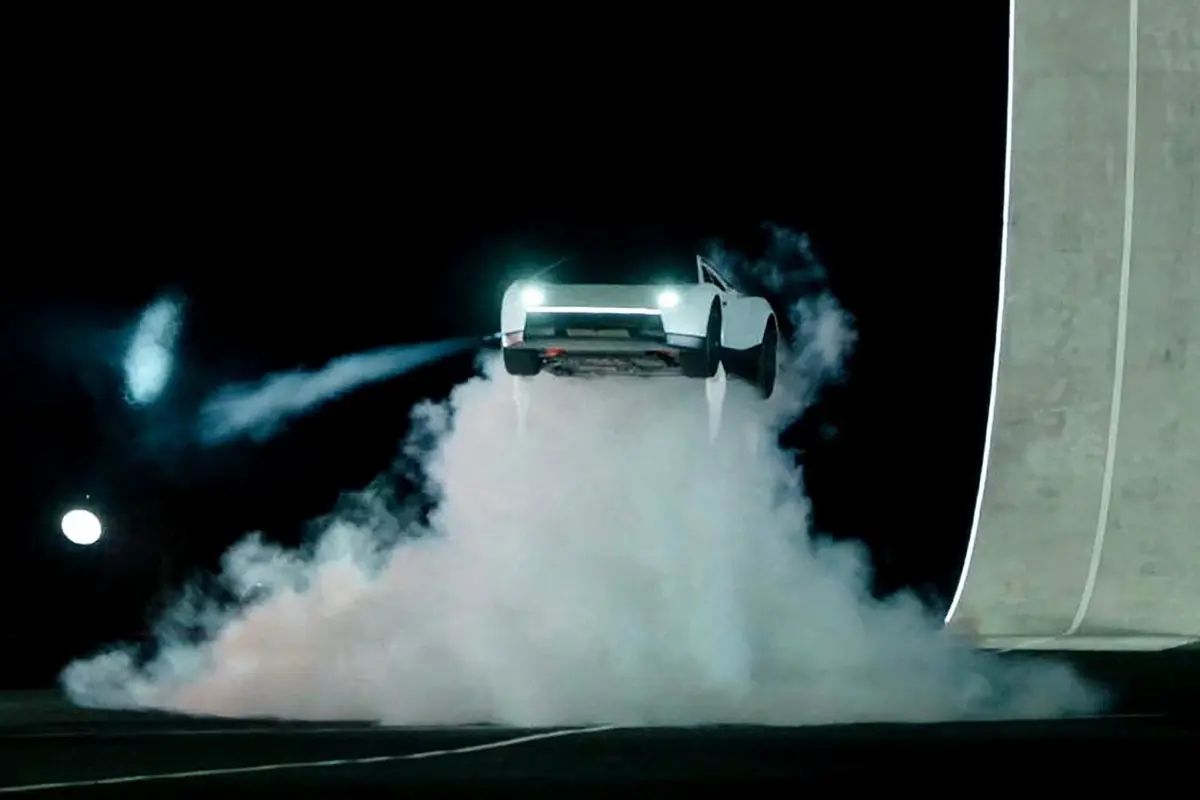
In the theater of modern corporate technocracy, few acts rival Elon Musk’s high-stakes spectacles. On a brisk Thursday evening in Texas, beneath the glare of theatrical lighting and before an ecstatic crowd of true believers and tech journalists, Musk unveiled what was ostensibly the long-delayed, highly anticipated new Tesla Roadster. Posing the classic carnival-barker query—"What you see with your eyes, you will not believe!"—he demonstrated a vehicle that didn’t merely drive; it allegedly flew, propelled by SpaceX-designed gas thrusters.
Yet, beneath the veneer of consumer vaporware and sci-fi theatrics lies a far more profound corporate reality. The debut of a "flying" Roadster was never genuinely about establishing Tesla as a dominant player in an airborne automotive market. Instead, the gravity-defying stunt served as a masterclass in misdirection, signaling the twilight of Tesla as a traditional automotive manufacturer.
Industry analysts, financial insiders, and close watchers of Musk’s sprawling corporate empire are increasingly arriving at a singular conclusion: we are bearing witness to the final chapter of Tesla’s independence, paving the way for the mother of all corporate combinations—a colossal, multi-trillion-dollar megamerger between Tesla and SpaceX.
By integrating SpaceX’s aerospace engineering, aggressive capital-raising prowess, and heavy-duty technological infrastructure with Tesla’s manufacturing base, Musk is positioning his enterprise for a pivot away from consumer passenger vehicles. The future, in Musk’s calculus, does not belong to manually driven electric sedans; it belongs to autonomous robotaxis, humanoid labor forces, orbital data centers, and interplanetary colonization.
Detailed Chronology: From the Texas Spectacle to the Horizon of 2028
To understand how the corporate ecosystem arrived at this inflection point, one must trace the timeline of promises, pivots, and paradigm shifts that culminated in the Texas showcase.
The Genesis of the Roadster Mythos
The Tesla Roadster has long occupied a mythical status within the company’s lore. The original red Roadster, launched into space atop a SpaceX Falcon Heavy rocket in 2018, set a precedent for blending automotive engineering with audacious aerospace PR stunts. When the second-generation Roadster was first teased in 2017, early adopters and loyalists eagerly plunked down $50,000 reservation fees—and up to $250,000 for the exclusive "Founder Series"—under the assumption that production was just around the corner.
Instead, the vehicle became a casualty of shifting corporate priorities, slipping years past its original deadlines as Tesla focused its capital on scaling the Model 3 and Model Y, and later, the polarizing Cybertruck.
The Texas Reveal: Engineering Illusion or Prophetic Signpost?
When the new Roadster finally took center stage in Texas, it was a mechanical Frankenstein’s monster: part 1970s Lotus Esprit, part SR-71 Blackbird spy plane. Featuring an electric drivetrain purportedly capable of going from 0 to 60 mph in a blistering 0.8 seconds, the vehicle’s true party trick was its SpaceX lineage.
Tesla constructed a massive C-shaped ramp. The Roadster ascended the curve, utilized a downforce-generating fan system to defy gravity while inverted, and then blasted free. It flipped—the literal "flying" component of the demonstration—before touching down amid a cloud of compressed air and leaping over a line of parked Tesla vehicles with another rolling maneuver.
Despite the cinematic flair, automotive engineers immediately pointed out the obvious: this was not a flying car. At best, it was a car capable of brief, highly controlled aerodynamic elevation—a stunt vehicle outfitted with rocket tech. Furthermore, Tesla’s newly announced pricing tiers—$50,000 for the "Performance" trim, $250,000 for the "Thrust" version, and an invite-only, undisclosed sum for the rocket-boosted "Flight" trim—come with a delivery target of 2028. For anyone familiar with Musk’s timelines, the phrase caveat emptor has never been more applicable.
The Sunset of the Manual Drive
During the event, Musk dropped a detail that fundamentally recontextualized Tesla’s trajectory: the new Roadster, he asserted, will be the last manually drivable vehicle the company ever builds.
This declaration marks a definitive break with the past. The company that spent two decades dragging the global automotive industry kicking and screaming into the electric age is quietly abandoning the very product category that made it a household name. In its place rises a trinity of futuristic bets:
- The Cybercab: A dedicated, steering-wheel-free, pedal-less autonomous robotaxi designed for high-density urban transport fleets.
- Optimus: A humanoid robot line priced at $30,000 per unit, which Musk claims will eventually scale to millions of units, handling everything from factory assembly to elder care and planetary colonization.
- Autonomous A.I. Infrastructure: Massive investments in artificial intelligence and neural networks designed to power both vehicular autonomy and general robotics.
Supporting Context & Metrics: Why Tesla’s Core Business Model is Under Siege
To comprehend the structural imperatives driving a potential Tesla-SpaceX merger, one must examine the macroeconomic and competitive pressures currently squeezing Tesla’s balance sheet.
Financial Realities of the EV Market
On paper, Tesla remains a corporate titan. In 2025, the company delivered more than 1.6 million manually drivable vehicles and generated roughly $95 billion in revenue, primarily from its automotive sector, alongside auxiliary revenue from solar and energy storage initiatives.
However, beneath the headline revenue figures lie deteriorating fundamentals:
- Shrinking Margins: Profit margins are compressing under the weight of massive, ongoing expenditures in artificial intelligence and autonomous driving research.
- Stagnant Product Lineup: Tesla has not introduced a high-volume, traditional non-flying passenger vehicle since the Cybertruck debuted in 2019. Concurrently, the company sunset production of its high-priced Model S sedan and Model X SUV, leaving the aging Model 3 sedan and Model Y crossover to shoulder the entirety of automotive revenues.
- Intense Global Competition: Aggressive, low-cost Chinese EV manufacturers have flooded international markets, capturing substantial European market share—a vulnerability exacerbated by Musk’s polarizing political alignment with right-wing European political factions, which alienated core demographics of EV buyers.
- Regulatory and Tax Headwinds: Governments worldwide have systematically rolled back or eliminated the lucrative regulatory carbon credits that once padded Tesla’s bottom line to the tune of billions of dollars. Additionally, the phase-out of federal consumer tax credits has cooled domestic demand across the U.S. EV sector.
The Mechanics of the Megamerger
Given these mounting headwinds, Wall Street analysts have increasingly turned their gaze toward structural consolidation. Barclays analyst Dan Levy recently captured industry consensus by suggesting that a merger between Tesla and SpaceX is not merely a wild hypothetical, but "almost a done deal," potentially materializing before the end of 2026.
The mechanics of such a transaction would likely see SpaceX act as the acquiring entity, allowing current Tesla investors to swap their equity for SpaceX stock. The resulting combined enterprise would instantly command a staggering valuation—projected near $3.5 trillion.
More importantly, the merger solves a critical operational bottleneck for Musk: capital. Converting Tesla’s vast manufacturing footprint from traditional EVs to Cybercabs and Optimus humanoid robots requires astronomical sums of liquid capital. SpaceX, with its unmatched ability to raise staggering amounts of public and private capital—bolstered by lucrative government defense contracts and the cash-generative Starlink satellite constellation—serves as the ultimate financial backstop.
Furthermore, the combined entity would possess the financial muscle required to keep pace with deep-pocketed competitors like OpenAI and Anthropic in the arms race for data-center construction. There are even whispered, brain-melting plans within Musk’s inner circle for SpaceX to eventually launch orbital data centers into space, harvesting unfiltered solar power to feed the unending energy demands of artificial intelligence models.
Official Statements & Industry Reactions
The audacity of the Texas showcase and the subsequent speculation surrounding a SpaceX-Tesla consolidation have drawn sharp reactions from across the financial, technological, and automotive sectors.
During the livestreamed event, Elon Musk framed the transition not as an abandonment of Tesla’s roots, but as the culmination of a master plan:
"What you see with your eyes, you will not believe! This is some crazy stuff… We are building the manufacturing capability and deep technological expertise required to crank out a Cybercab every 10 seconds and march armies of Optimus robots off the assembly lines. The vehicle journey was always a means to an end."
Financial analysts, however, view the pivot through a lens of pragmatic corporate survival. Speaking on condition of anonymity, a senior automotive sector strategist noted:
"Selling millions of moderately priced consumer EVs on thin margins was never Elon’s ultimate game. Traditional automakers figured this out decades ago. By rolling Tesla into SpaceX, Musk effectively transforms a stressed car manufacturer into a vertically integrated deep-tech, defense, and space infrastructure juggernaut, shielding himself from automotive commoditization."
Meanwhile, consumer advocates and safety regulators have expressed alarm over the rapid phasing out of manual driving controls in favor of unproven autonomous fleets and humanoid labor deployment, though market reaction to date has remained characteristically bullish, driven by retail investor enthusiasm for Musk’s grand visions.
Future Outlook: The Trillion-Dollar Corporate Borg
As the dust settles from the Texas Roadster spectacle, the writing is on the wall for anyone willing to read past the marketing hype.
The traditional era of Tesla as a standalone automobile manufacturer is drawing to a close. The company that proved electric vehicles could be stylish, scalable, and commercially viable is being dismantled from within, its infrastructure repurposed to feed a much larger, more ambitious apparatus.
Should the anticipated Tesla-SpaceX megamerger materialize, it will create an unprecedented corporate entity—a $3.5 trillion colossus that bridges terrestrial autonomy, artificial intelligence, aerospace defense, orbital communications, and humanoid robotics. Critics may decry the perpetual vaporware, the missed deadlines, and the theatrical misdirection of flying sports cars. Yet, history suggests that beneath Musk’s carnival-barker distractions lies a cold, calculated strategy of capital accumulation and structural transformation.
Tesla as we know it may soon disappear forever, swallowed whole by SpaceX and Musk’s sprawling dream of a galactic corporate empire. For better or worse, science fiction’s most dystopian mega-corporations—from cyberpunk conglomerates to the infamous Weyland-Yutani Corporation of the Alien franchise—have officially transitioned from Hollywood fantasy into corporate reality.