Executive Overview
To understand Elon Musk’s mindset, one must first look at the theater. On a warm Thursday evening in Texas, under the bright lights of a heavily orchestrated livestreamed spectacle, the billionaire entrepreneur looked out over a roaring crowd of die-hard fans and declared, "What you see with your eyes, you will not believe!"
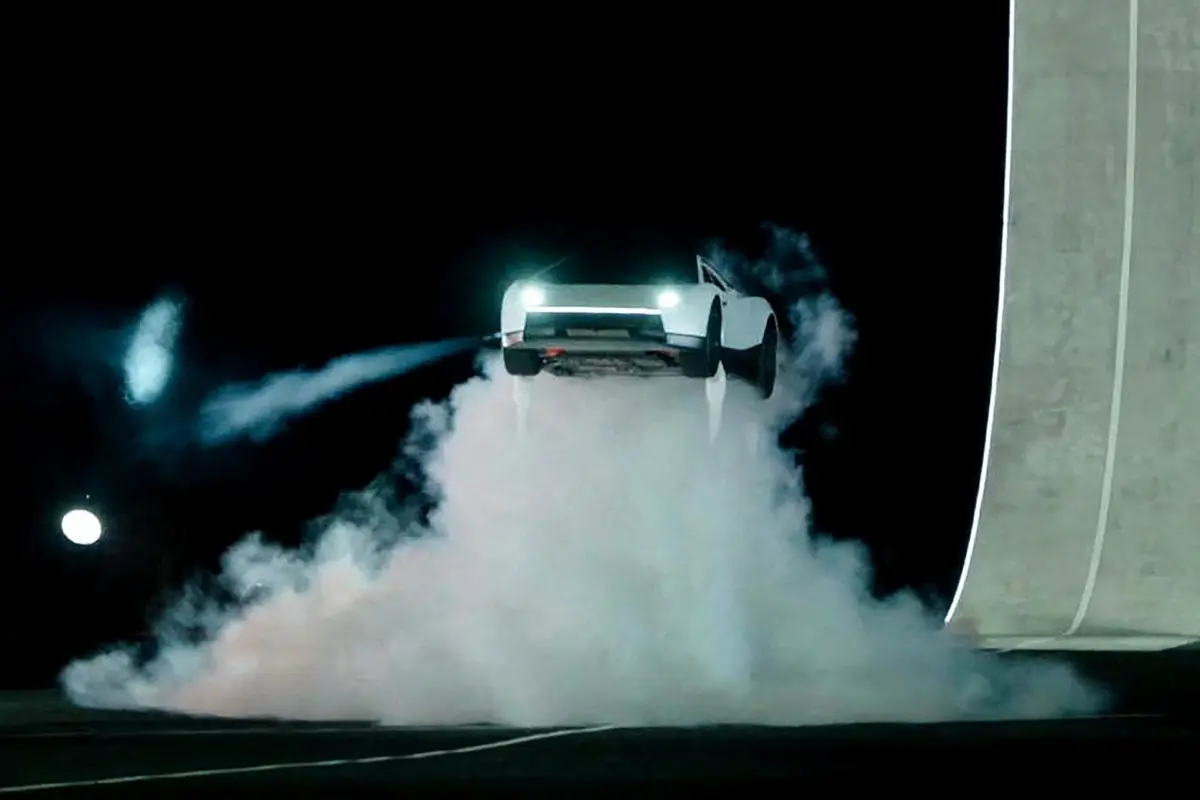
The occasion was the long-overdue unveiling of the next-generation Tesla Roadster. Nearly a decade late from its initial projected release, the vehicle was pitched not merely as a car, but as something bordering on science fiction: a high-performance EV capable of doing zero to 60 mph in an astonishing 0.8 seconds, styled as a hybrid of a 1970s-era Lotus Esprit and an SR-71 Blackbird spy plane. Most audaciously, Musk promised that the vehicle could be equipped with SpaceX-designed cold-gas thrusters—enabling the car to execute short, gravity-defying bursts of flight.
Yet, behind the viral stunts, the dramatic C-shaped launch ramps, and the cloud of compressed air, the grand presentation served a much deeper strategic purpose. We are not hurtling into a Jetsons-style future of ubiquitous flying cars; rather, we are witnessing the sunsetting of Tesla as we know it.
The Roadster reveal was a meticulously crafted signaling device, paving the way for what industry insiders and financial analysts believe could be the mother of all corporate mergers: the absorption of Tesla into SpaceX to form an unprecedented multi-trillion-dollar galactic conglomerate.
Detailed Chronology: From EV Pioneer to Rocket-Powered Theater
To trace the arc of Tesla’s evolution is to watch a masterclass in long-term strategic misdirection. To the casual observer, the Texas event was a triumphant showcase of automotive engineering. In reality, it was a funeral for the traditional automaker.
The Spectacle in Texas
Tesla spared no expense for the reveal. The centerpiece of the night was a gigantic C-shaped ramp. The new Roadster ascended to the curve’s peak, adhered itself upside down using a downforce-generating fan system, and then blasted free—flipping in mid-air before touching down safely amid a cloud of compressed air. To cap it off, it bounded over a lineup of parked Tesla vehicles with another airborne roll.
While visually stunning, it paled in comparison to Musk’s 2018 PR tour de force, when his personal red Roadster was launched into deep space atop a SpaceX Falcon Heavy rocket—where it remains today in a solar orbit, occasionally looping near Mars.
The Death of the Manual Drive
During the presentation, Musk casually dropped a detail that fundamentally redefines Tesla’s corporate trajectory: the new Roadster, he stated, will be the last manually drivable car the company ever builds.
This single declaration exposes the complete shift in Tesla’s corporate identity. The future of the company is no longer anchored in personal vehicle ownership or human drivers. Instead, it rests entirely on two pillars:
- The Cybercab: An autonomous, steering-wheel-free and pedal-free robotaxi fleet designed to ferry passengers on demand.
- Optimus Humanoid Robots: General-purpose bipedal androids that Musk claims will push Tesla’s market capitalization from its current $1.4 trillion to an astronomical $25 trillion. Priced at around $30,000 apiece, these robots are envisioned to relieve humanity of domestic and industrial drudgery, assembling Cybercabs, mowing lawns, tending bars, caring for the elderly, and ultimately assisting in the off-world colonization of the moon and Mars.
Supporting Context & Metrics: The Financial Pressures Fueling the Merger
Why would Musk willingly pivot away from an automotive empire that took two decades to build? The answer lies in the harsh, unvarnished realities of Tesla’s balance sheet and the shifting global automotive landscape.
Shrinking Margins and Stagnant Lineups
For all its cultural cachet, Tesla’s traditional automotive business is facing severe structural headwinds. In 2025, the company delivered more than 1.6 million manually drivable vehicles, generating roughly $95 billion in revenue. However, profit margins are rapidly compressing.
Tesla has not introduced a truly new, non-flying consumer vehicle since the Cybertruck debuted in 2019. Furthermore, the company has quietly ended production of its high-priced luxury stalwarts—the Model S sedan and Model X SUV—leaving the aging Model 3 sedan and Model Y crossover to shoulder the entirety of the car business.
Macroeconomic and Geopolitical Headwinds
Tesla’s dominance is under siege from multiple fronts:
- International Competition: A massive wave of low-cost, high-quality electric vehicles from Chinese automakers has flooded global markets, particularly in Europe, where Musk’s polarizing political alignments have actively damaged brand loyalty and sales.
- Regulatory Credit Deficits: For years, Tesla survived and thrived financially by selling regulatory zero-emission credits to legacy automakers—a multi-billion-dollar revenue stream that has largely evaporated as traditional competitors ramp up their own EV production.
- Shifting U.S. Policy: The rollback of federal EV tax credits has weakened overall consumer demand for electric passenger cars in the United States.
The Case for a SpaceX-Tesla Merger
Faced with the realization that mass-producing moderately priced passenger EVs is a low-margin, high-stress endeavor, Musk needs a financial rescue hatch.
Barclays analyst Dan Levy and other prominent Wall Street figures have increasingly pointed toward a looming corporate consolidation: a SpaceX acquisition of Tesla. Under this proposed structure, Tesla investors would swap their shares for SpaceX stock, creating a combined corporate entity with a projected valuation north of $3.5 trillion.
Such a merger would instantly solve Tesla’s capital allocation problems. SpaceX possesses an extraordinary capacity to raise astronomical sums of money from public and private markets. This war chest could then be funneled directly into funding the massive capital expenditure required to transition Tesla’s factories into Cybercab and Optimus production lines, while simultaneously keeping pace with AI behemoths like OpenAI and Anthropic in the ferocious data-center construction race.
Adding to the sci-fi ambition is a plan for SpaceX to eventually launch data centers directly into orbit, harvesting uninterrupted, zero-gravity solar power.
Official Statements and Industry Reactions
The market’s reception to Musk’s dual-pronged vision of autonomous robots and rocket-powered cars has been a mix of awe, skepticism, and financial opportunism.
Wall Street analysts have noted that the integration of SpaceX technology—such as cold-gas thrusters derived from rocket engineering—into a consumer automobile is unprecedented. However, skepticism remains regarding delivery timelines. When the original Roadster was announced in 2017, true believers flooded Tesla with $50,000 reservations ($250,000 for the limited Founder Series). Years later, those customers are still waiting.
With the new-new Roadster, history appears to be repeating itself. Tesla has structured a tiered reservation system:
- Performance Trim: $50,000
- Thrust Version: $250,000
- Rocket Trim (the "flying" model): An undisclosed, invite-only sum.
Tesla has informed reservation holders that deliveries will not commence until 2028. Industry veterans and consumer advocates alike have issued a familiar warning: caveat emptor—let the buyer beware—when dealing with Elon Musk’s timelines.
Despite the delays, defenders of the strategy argue that the traditional EV business was never the ultimate destination; it was merely the scaffolding. Musk’s underlying thesis has always been that building a global manufacturing footprint for electric cars was the necessary training wheels required to eventually mass-produce a Cybercab every 10 seconds and march legions of Optimus robots off assembly lines.
Future Outlook: The Rise of the Galactic Mega-Entity
As the dust settles on the Texas event, the true meaning of the spectacle becomes clear. The Roadster reveal was not an introduction to the future of automotive transit; it was a nostalgic, high-octane carnival act designed to distract the public while the foundational architecture of the modern economy is re-engineered.
Tesla as an independent electric vehicle manufacturer is quietly being sunsetted. In its place, a much larger, more ambitious entity is taking shape. By fusing Tesla’s consumer-facing robotics and autonomous fleets with SpaceX’s aerospace engineering, heavy-lift rocket infrastructure, and capital-raising dominance, Elon Musk is building a vertically integrated empire that spans from subterranean tunnels to deep space orbit.
For investors, customers, and observers, the message is unequivocal: get ready for the ultimate megamerger. The corporate entity that emerges from the union of Tesla and SpaceX will make traditional industrial giants look quaint—and will likely put fictional conglomerates like Alien‘s Weyland-Yutani Corporation to shame.