Executive Overview
The intersection of generative artificial intelligence and intellectual property law has reached a dramatic flashpoint. ZeniMax Media, the parent company of Bethesda Softworks, recently issued a swift and uncompromising cease-and-desist order against independent developer Chris First. The target of their legal action? Fallout: New York, a browser-based, AI-generated role-playing game that attempted to replicate Bethesda’s critically acclaimed post-apocalyptic universe entirely through code, artificial intelligence prompts, and synthetic text generation.
While the modding community has traditionally thrived as a bastion of grassroots creativity—producing monumental, multi-year volunteer projects like Fallout: London and Skyblivion—this incident represents a distinctly modern phenomenon: the rise of "zero-effort" AI prompt-engineered media. Built using Anthropic’s Claude Opus 5.5 and a suite of auxiliary AI agents, Fallout: New York featured working Pip-Boys, dynamic dialogue trees, and rudimentary quests without relying on traditional human-crafted texture packs or sound files.
However, the project’s blatant co-opting of the Fallout IP, combined with the registration of the domain name fallout.nyc, crossed a definitive line for corporate legal teams. This case study explores the broader implications of AI-generated content in gaming, the stark contrast between automated slop and authentic community craftsmanship, and the growing friction between eager fans desperate for a new entry in the franchise and the corporate stewards protecting multi-billion-dollar assets.
Detailed Chronology: From Prompt to Cease-and-Desist
The saga of Fallout: New York began as an experimental showcase of rapid application development through large language models. Rather than utilizing game engines like the Creation Engine or Unity alongside traditional asset pipelines, creator Chris First took a radically different computational shortcut.
The Genesis of the AI Project
In late September 2026, First took to social media platform X (formerly Twitter) to boast about his latest technical undertaking. He claimed to have built a functional, full-scale Fallout experience playable directly within standard web browsers. According to his posts, the game was conceptualized, structured, and executed by directing Claude Opus 5.5 and a coordinated studio of generative AI agents.
First’s directives to the AI were remarkably direct: he explicitly instructed the model to produce a game that was not merely "inspired by" the iconic post-apocalyptic franchise, but one that was "exactly like Fallout."
The resulting technical framework raised eyebrows across the developer community. The browser game reportedly operated with:
- Zero texture files: Environments and surfaces were rendered via procedural code.
- Zero sound files: Audio effects and soundscapes were synthetically generated on the fly.
- Integrated Mechanics: Functional V.A.T.S. (Vault-Tec Assisted Targeting System), interactive dialogue trees, quest mechanics, and a working Pip-Boy interface were all conjured through code prompts.
The Immediate Social Media Backlash
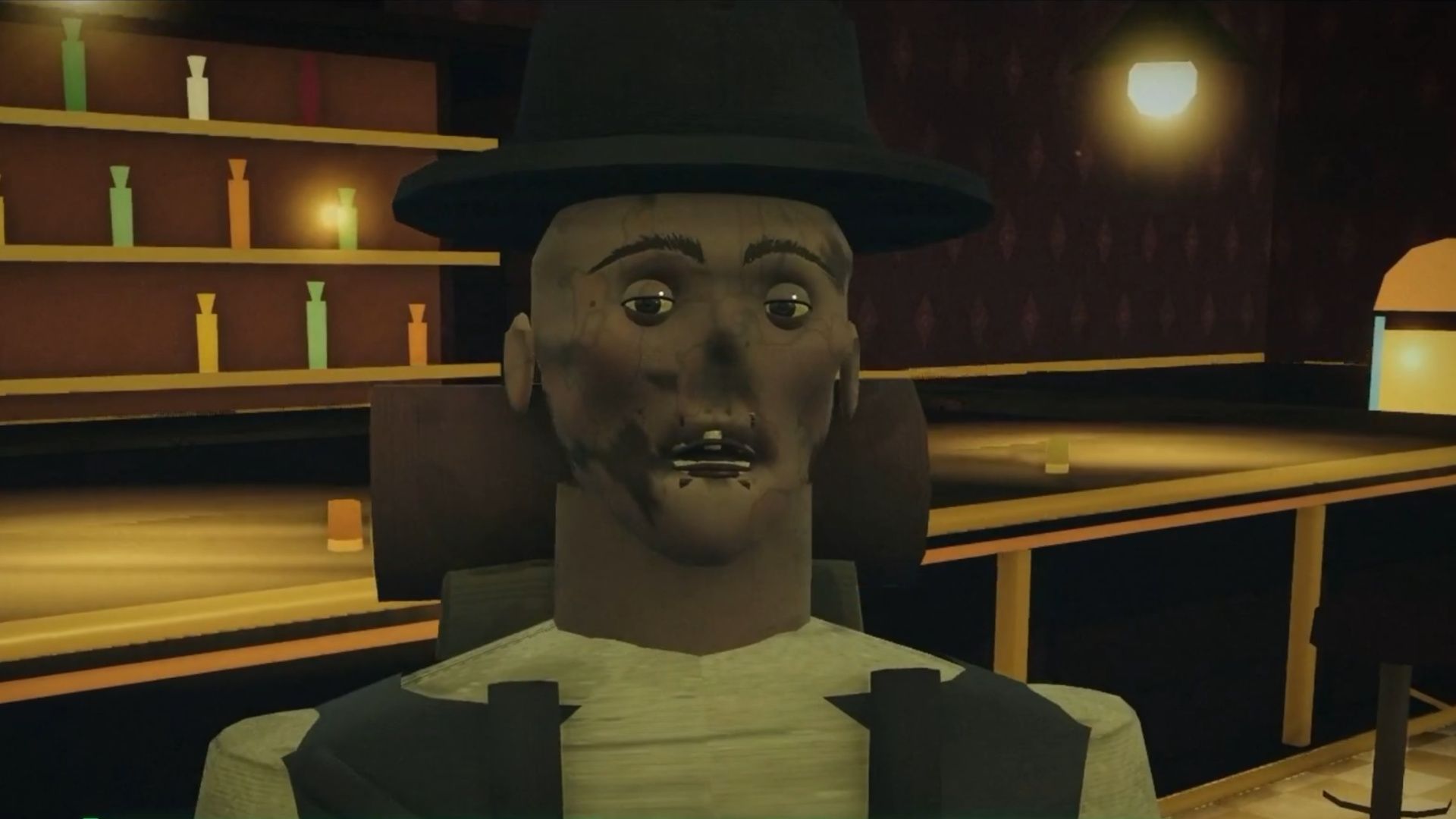
Upon its release, the project immediately drew widespread attention—though not entirely of the positive variety. While tech enthusiasts marveled at the speed with which a rudimentary game could be spawned from text prompts, gamers and digital artists were quick to point out the deeply unsettling, uncanny-valley nature of the output. The visual assets were widely criticized as "cursed faces" and low-poly garbage, lacking any of the meticulously crafted environmental storytelling and artistic direction that define Bethesda’s signature style.
The Corporate Intervention
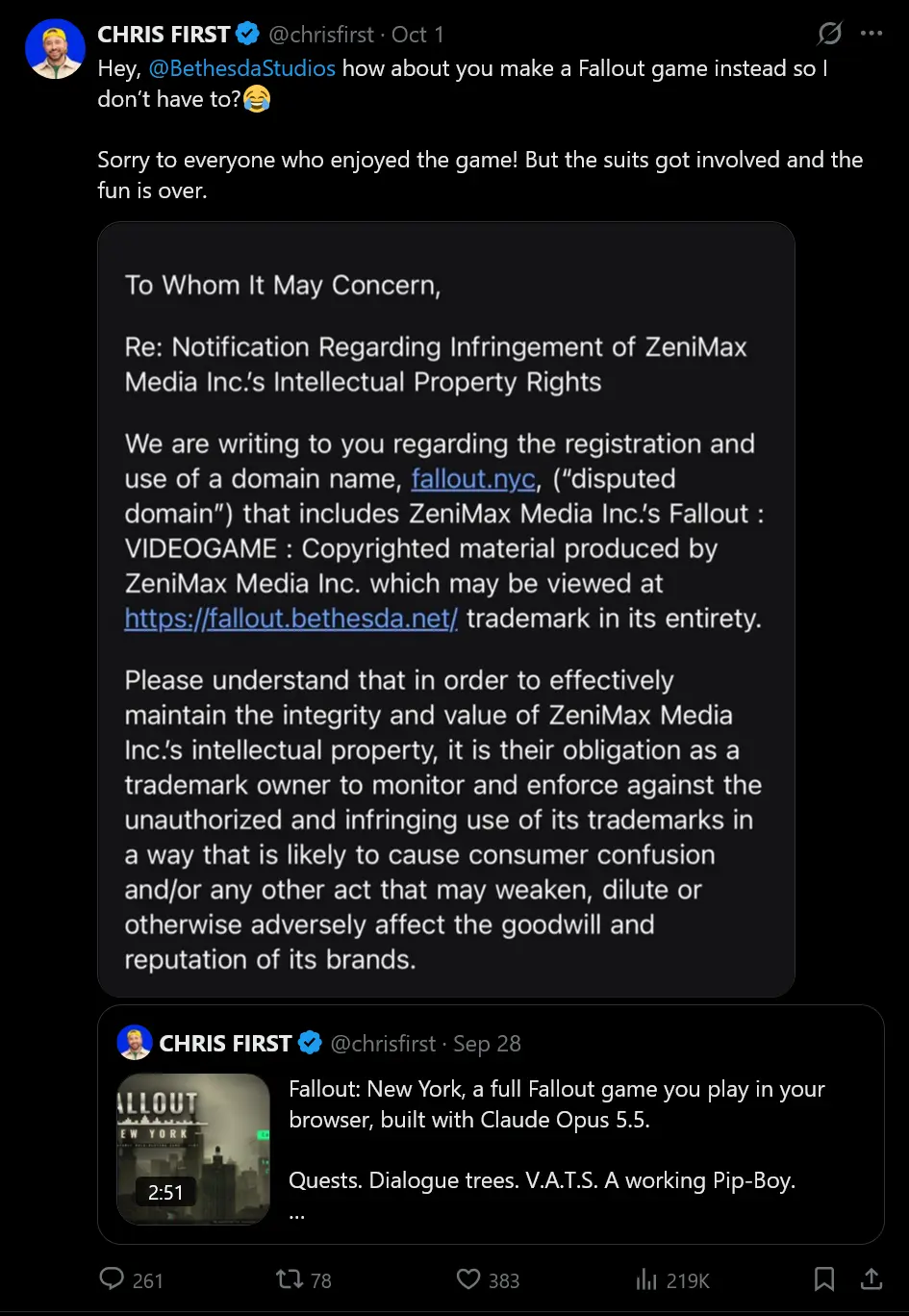
The novelty of browser-based AI experimentation quickly ran aground against corporate reality. Just days after the project gained viral traction, ZeniMax Media’s legal department stepped in. First revealed that he received formal notification demanding an immediate halt to the project.
The primary catalyst for the cease-and-desist letter was the domain name fallout.nyc, which ZeniMax argued directly infringed upon its federally protected intellectual property rights and created clear consumer confusion regarding official association. Facing the weight of a corporate legal team, First shuttered the domain, lamented the decision publicly, and effectively ended the brief, chaotic lifespan of Fallout: New York.
Supporting Context & Metrics: Authentic Craftsmanship vs. Generative Slop
To fully understand why the gaming community largely sided with Bethesda rather than the independent AI prompter, one must examine the stark philosophical divide separating AI-generated experiments from traditional modding culture.
The Golden Standard of Modding
For decades, the Bethesda ecosystem has sustained one of the most vibrant, passionate, and dedicated modding communities in video game history. Projects like Fallout: London—a massive, DLC-sized total conversion mod that transported the post-nuclear setting across the Atlantic—represent thousands of hours of painstaking, human-led labor.
Similarly, massive undertakings like Skyblivion (rebuilding The Elder Scrolls IV: Oblivion within the modern Skyrim engine) require:
- Hundreds of volunteer developers, voice actors, and level designers.
- Years of dedicated, uncompensated project management.
- Deep artistic intent, custom-authored lore, handcrafted assets, and rigorous quality assurance.
These initiatives are celebrated because they reflect genuine human sweat, emotion, and creative expression. They enhance the value of the underlying IP and are generally tolerated or even embraced by Bethesda as long as they remain non-commercial and respect copyright boundaries.
The Problem with Prompt Culture
In stark contrast, projects like Fallout: New York rely on generative algorithms trained on vast corpuses of data, often bypassing ethical considerations regarding artist consent and intellectual property protection. Critics argue that prompt engineering requires none of the technical mastery, artistic vision, or emotional resonance inherent in traditional game development.
Furthermore, the technical achievement of running a game in a browser is hardly groundbreaking in its own right. Industry observers were quick to point out that enthusiasts have previously ported fully realized, atmospheric masterpieces like Morrowind into web browsers. Crucially, running Morrowind in a browser actually looks, feels, and plays like Morrowind, maintaining the integrity of the original artistic vision.
By comparison, the low-poly, distorted aesthetic of the AI-generated New York wasteland offered little substance beyond a novelty gimmick. As critics noted on social media, players seeking an affordable, authentic post-apocalyptic fix could easily purchase Fallout 3 or Fallout: New Vegas for the price of a cup of coffee during digital storefront sales.
Official Statements and Community Reaction
The fallout from the cease-and-desist order elicited a fascinating spectrum of responses across social media, pitting the creator’s defiant attitude against a wall of community skepticism.
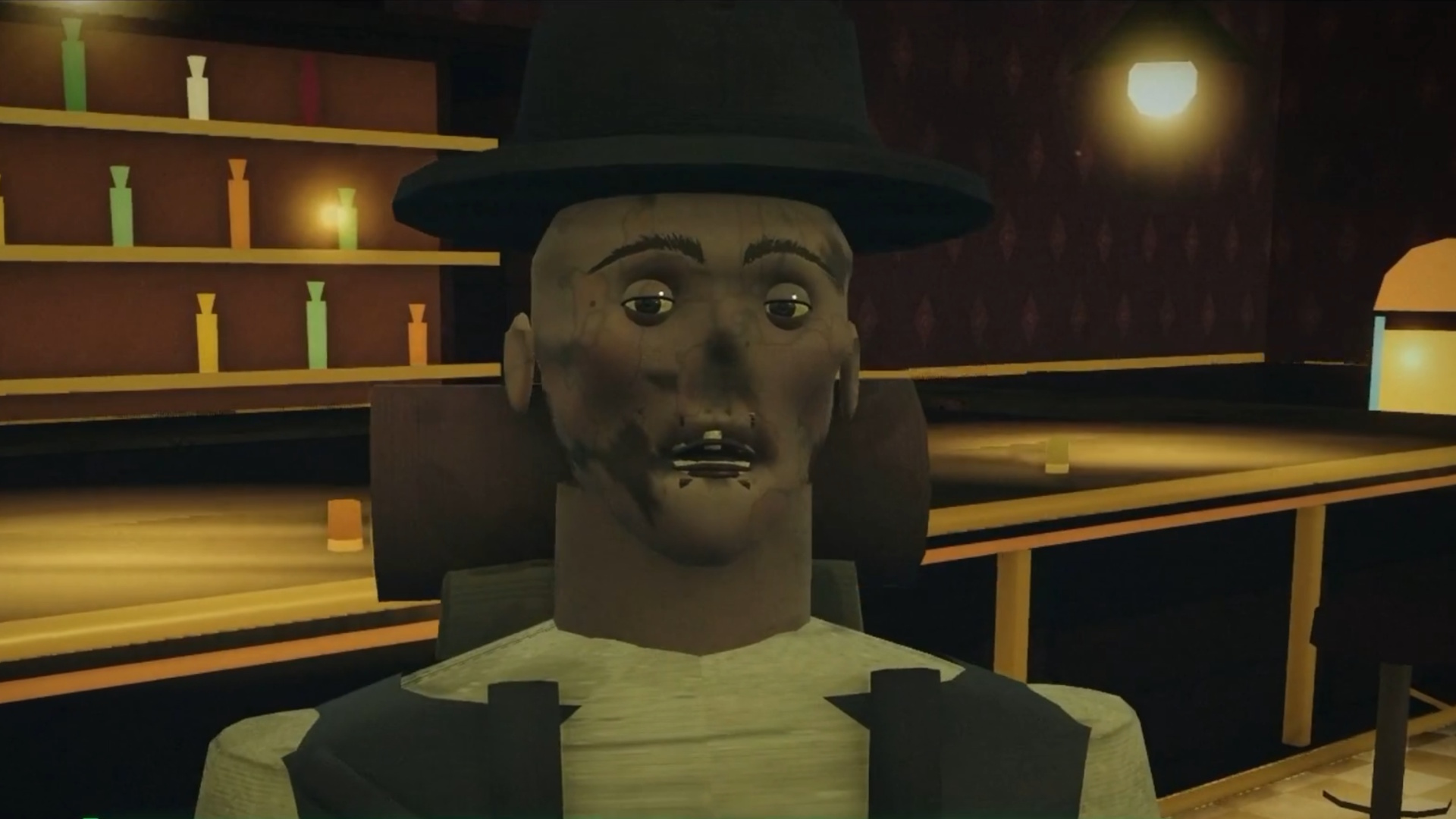
The Creator’s Stance
Chris First expressed visible frustration toward the corporate crackdown, framing it as heavy-handed interference against harmless creative experimentation. In a post accompanying a screenshot of the legal communication, First quipped:
"Hey, @BethesdaStudios how about you make a Fallout game instead so I don’t have to? 😂 Sorry to everyone who enjoyed the game! But the suits got involved and the fun is over."
Despite suggestions from optimistic followers that he could simply rebrand the project and strip away the copyrighted terminology, First showed little appetite for attempting a whitewashed version of the game, acknowledging that the underlying concept and execution were fundamentally tied to the infringed IP.
Community Consensus
Public reaction was overwhelmingly unsympathetic to First’s plight. Common themes running through the discourse included:
- Inevitable Consequence: Commenters pointed out that explicitly naming an unauthorized commercial or public-facing project "Fallout" and registering a matching domain name was an open invitation for corporate legal action.
- Rejection of AI Slop: A significant portion of the gaming community expressed deep fatigue over the saturation of low-effort generative AI projects flooding digital spaces, arguing that such experiments devalue authentic human artistry.
- Corporate Justification: Even critics of large game publishers acknowledged that ZeniMax had both the legal right and the obligation to protect its trademarks from brand dilution and consumer confusion.
Future Outlook: The Horizon of the Fallout Franchise and AI in Development
The clash over Fallout: New York highlights larger anxieties and trends facing the gaming industry as it navigates the 2030s.
The Waiting Game for Fans
At the heart of First’s experiment lay a relatable frustration: the agonizingly long gaps between mainline franchise entries. With over a decade having passed since the release of Fallout 4—and with Bethesda’s development bandwidth currently consumed by The Elder Scrolls VI and ongoing support for Starfield—fans recognize that an official new single-player Fallout game is unlikely to materialize until well into the 2030s.
This prolonged content drought creates a vacuum. Desperate for new stories in beloved settings, some fans turn to transmedia expansions like Amazon’s critically acclaimed Fallout television series, while others turn to community-driven mega-mods. Increasingly, however, tech-savvy experimenters are attempting to bridge the gap using generative AI tools.
The Legal and Ethical Precedent
ZeniMax’s decisive action serves as a clear warning shot to developers experimenting with generative AI models trained on or explicitly imitating proprietary franchises. As AI-assisted development tools become more sophisticated, major publishers will undoubtedly tighten their legal frameworks to prevent unauthorized procedural spin-offs from diluting their brand identity.
Ultimately, while the desire for a post-apocalyptic journey through the ruins of New York City remains high among the fanbase, Fallout: New York will be remembered not as a triumph of modern engineering, but as a cautionary tale about the limits of prompt-engineered shortcuts in a creative medium built on human passion.