Executive Overview
Two decades ago, a single blog post penned by Jeff Barr quietly altered the trajectory of the technology industry. On that day, Amazon Web Services (AWS) launched the Amazon Elastic Compute Cloud (EC2) Beta, introducing a concept that sounds almost pedestrian by today’s standards yet was revolutionary at the time: resizable, pay-as-you-go Linux virtual servers hosted in the cloud, billed strictly by the hour, originating from a single region (US East) with just one instance type (m1.small).
What began as a minimal-yet-functional experiment has since grown into the undisputed backbone of the modern internet. Over the past twenty years, Amazon EC2 has evolved from a single-region virtual machine offering into a sprawling, hyper-scale global infrastructure. Today, it encompasses more than 1,200 distinct instance types spanning 39 geographic regions, powering everything from scrappy bootstrapping startups to massive, trillion-parameter artificial intelligence training clusters.
This comprehensive retrospective examines the two-decade evolution of Amazon EC2. We will trace its critical milestones, analyze the architectural breakthroughs that enabled its meteoric scale, and explore how a service designed to rent basic CPU cycles laid the foundational bedrock for today’s cloud-native economy and the generative AI revolution.
Detailed Chronology: Twenty Years of Infrastructure Innovation
To understand the scale of Amazon EC2 today, one must retrace the stepping stones of its development. The platform’s journey is a masterclass in iterative engineering, where each foundational block unlocked entirely new paradigms of software architecture.
The Genesis: 2006
The launch of the EC2 Beta in 2006 solved a notoriously expensive and slow enterprise problem: hardware provisioning. Historically, running a web application required purchasing physical servers, racking them in a data center, configuring networking, and waiting weeks or months for delivery. EC2 reduced this timeline to minutes. Developers could spin up an m1.small instance via an API call, use it for as long as necessary, and terminate it without capital expenditure.
The Storage and Scaling Era: 2008–2009
In its earliest days, EC2 instances relied on ephemeral storage, meaning data stored on the local instance store was lost if the virtual machine stopped. That changed fundamentally in 2008 with the introduction of Amazon Elastic Block Store (EBS), which provided persistent, highly available block-level storage volumes that could be attached to running instances.
By 2009, AWS recognized that compute and storage alone were not enough to build resilient architectures. This realization triggered a flurry of foundational service releases:
- Elastic Load Balancing (ELB): Automatically distributed incoming application traffic across multiple EC2 instances.
- Auto Scaling: Enabled applications to dynamically scale compute capacity up or down based on real-time traffic demands.
- Amazon CloudWatch: Provided real-time monitoring of resource utilization and operational health.
- Amazon Virtual Private Cloud (VPC): Gave enterprises the ability to provision a logically isolated, customer-defined virtual network, bridging the gap between corporate data centers and the public cloud.
The Hardware & Processor Revolution: 2017–2018
As customer demands grew more complex, virtualization overhead became a bottleneck for traditional hypervisors. In 2017, AWS introduced the AWS Nitro System, a revolutionary combination of dedicated hardware and lightweight hypervisor software. By offloading virtualization functions—such as networking, storage, and security—from the host CPU to specialized Nitro cards, AWS reclaimed nearly 100% of host compute and memory resources for customer workloads while vastly improving security and performance.
Building on this hardware mastery, AWS shattered the Wintel/x86 duopoly in the cloud in 2018 with the launch of AWS Graviton processors. Designed internally by AWS using ARM architecture, Graviton chips were engineered specifically for cost-sensitive, scale-out workloads, offering superior price-performance ratios compared to traditional x86 alternatives.
Edge Expansion: 2018–2019
Realizing that the cloud needed to meet applications where they lived, AWS began pushing EC2 far beyond traditional centralized availability zones:
- AWS Outposts (2018): Brought native AWS infrastructure and operating models directly to on-premises data centers.
- AWS Local Zones (2019): Placed compute and storage capacity closer to end-users in major metropolitan areas to minimize latency.
- AWS Wavelength (2019): Embedded EC2 compute directly inside 5G telecommunications carrier networks, enabling ultra-low-latency mobile and edge computing applications.
Supporting Context & Metrics: The Scale of Modern EC2
The numerical growth of Amazon EC2 over the past twenty years defies traditional enterprise hardware metrics. What started as a single instance type in a solitary US data center has exploded into an ecosystem of staggering proportions.
Instance Diversification
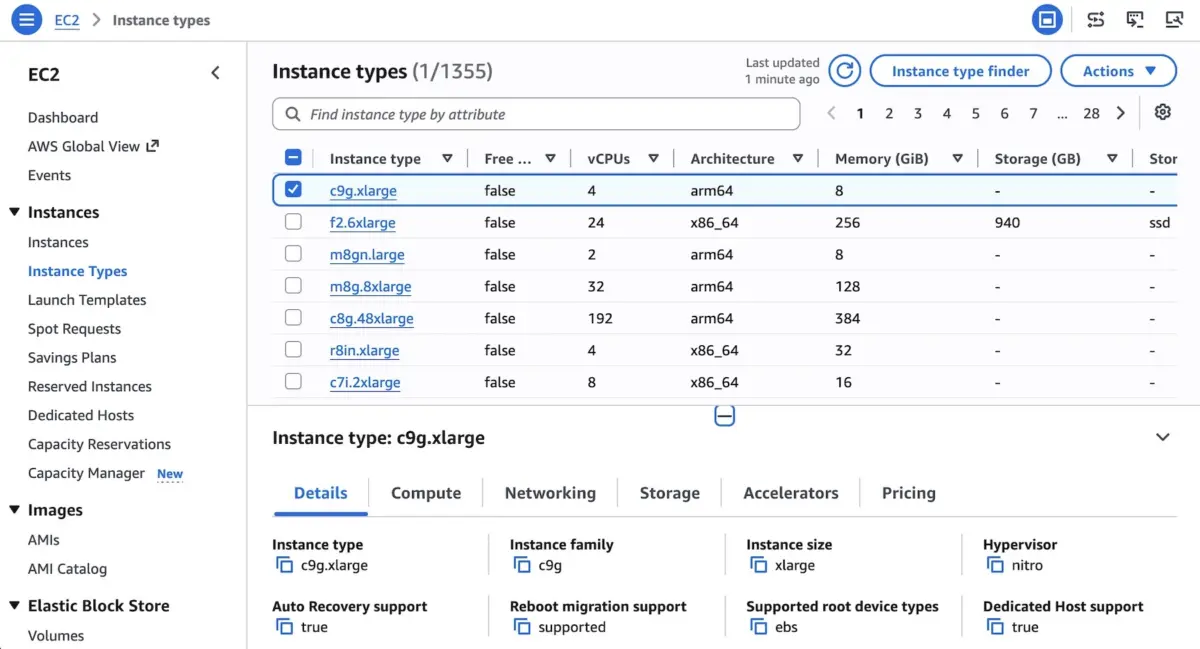
Today, EC2 offers a staggering 1,200+ distinct instance types. This vast catalog is meticulously segmented to match the precise economic and computational needs of modern workloads:

- General Purpose: Balanced compute, memory, and networking (e.g., M-series).
- Compute-Optimized: High-performance processors ideal for batch processing, scientific modeling, and gaming servers (e.g., C-series).
- Memory-Optimized: Designed for fast performance when processing large datasets in memory, such as relational databases and in-memory caches (e.g., R- and X-series).
- Storage-Optimized: High sequential read-and-write performance for workloads like distributed file systems and data warehouses (e.g., I- and D-series).
- Accelerated Computing: Equipped with GPUs and specialized accelerators (such as AWS Trainium and Inferentia) designed to handle machine learning inference, graphics rendering, and heavy computational tasks.
Global Footprint
From its single-region launch in 2006, EC2 now operates across 39 geographic regions worldwide, connected by high-speed, low-latency private global networks. This massive footprint enables organizations to deploy globally redundant applications in minutes, satisfying strict data residency regulations and disaster recovery mandates effortlessly.
Official Statements: The Philosophy Behind the Code
Reflecting on the milestone, key architects and evangelists within AWS have emphasized that the secret to EC2’s enduring success lies in strict adherence to foundational design principles.
In retrospectives spanning the 15th and 20th anniversaries, AWS leadership noted that the core value proposition of EC2 has remarkably remained unchanged: secure, resizable compute capacity delivered in minutes, billed strictly on consumption, with zero long-term commitments.
Channy Yun, principal developer advocate at AWS, encapsulated the development philosophy driving the platform:
"We made strong foundational decisions in 2006, and we left room for the service to grow. Twenty years later, that strategy of creating services that are minimal-yet-useful, launching quickly, and iterating rapidly in response to your feedback continues to guide how we build. The next twenty years of cloud computing will demand capabilities we have not yet imagined. Amazon EC2 will continue to be the foundation where your workloads run."
This ethos of "minimal-yet-useful" allowed early developers to experiment without friction, laying a feedback-driven pipeline that directly influenced subsequent service rollouts like EBS, VPC, and Nitro.
The Undisputed Bedrock of Modern Tech Stack
While end-users often interact with higher-level AWS abstractions, Amazon EC2 remains the invisible engine driving nearly the entire AWS ecosystem.
Consider the modern cloud architecture stack:
- Container orchestration platforms like Amazon ECS and Amazon EKS rely on underlying EC2 instances (or AWS Fargate, which itself abstracts EC2 capacity).
- Serverless functions executed via AWS Lambda ultimately execute on secure, pre-warmed EC2 virtualization runners managed by AWS.
- Managed big data frameworks such as Amazon EMR and AWS Batch spin up massive fleets of EC2 nodes to crunch petabytes of data.
- Cutting-edge artificial intelligence platforms, including Amazon SageMaker AI and Amazon Bedrock, depend fundamentally on high-performance accelerated EC2 instances packed with specialized GPUs and custom silicon to train massive foundation models.
Every architectural pattern engineered over the last twenty years—from a monolithic web server hosting a local blog to distributed clusters training trillion-parameter generative AI models—ultimately begins with a foundational API call to launch an EC2 instance.
Future Outlook: The Next Two Decades of Compute
As Amazon EC2 enters its third decade, the computing landscape is shifting once again. The primary driver is no longer just web and mobile applications, but the insatiable computational appetite of Artificial Intelligence and Machine Learning.
The challenges of the next twenty years will revolve around power efficiency, silicon innovation, and hyper-distributed edge computing. With custom-built silicon like AWS Graviton for general workloads, alongside Trainium and Inferentia for AI, AWS is proactively designing the hardware layers required to sustain the next generation of technological breakthroughs.
Yet, despite the complex machine learning models, quantum computing horizons, and edge-native architectures looming on the horizon, the core promise of Amazon EC2 remains the same as it was on that August day in 2006: to give builders instant access to virtually infinite computing power, freeing human ingenuity from the physical constraints of hardware.