Executive Overview
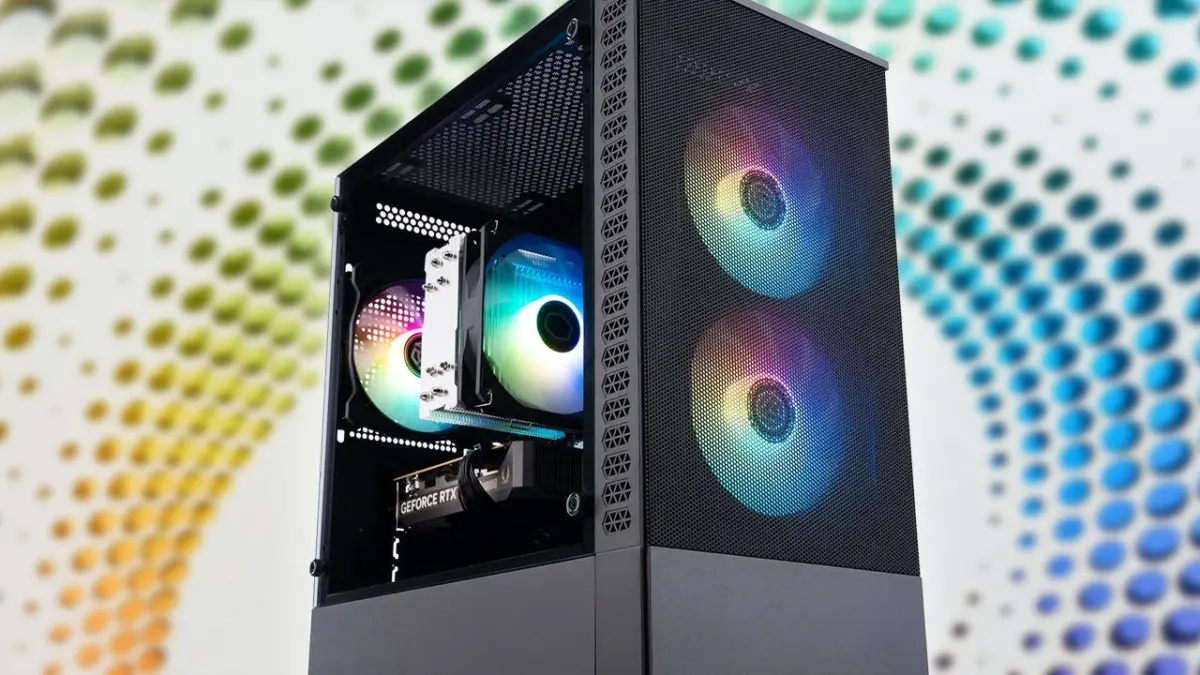
The budget-conscious PC gaming market has long been a battleground of compromises, where consumers hunting for systems under the $1,000 threshold are frequently forced to settle for outdated hardware, lacklustre GPUs, or single-digit performance gains over previous-generation consoles. However, a major market shift is underway. For a limited time, retail giant Walmart has introduced a compelling promotion featuring the ABS Cyclone Aqua Gaming PC equipped with an NVIDIA GeForce RTX 5060 graphics card, priced aggressively at just $849 with shipping included.
This offering arrives at a critical juncture for PC enthusiasts. As modern game development pushes hardware to its absolute limits through ray tracing, path tracing, and demanding visual fidelity targets, entry-level gamers need systems that can deliver a reliable, stutter-free experience without breaking the bank. The ABS Cyclone Aqua challenges the conventional wisdom that high-performance gaming requires a four-figure investment.
More importantly, a comparative analysis against contemporary pre-built alternatives—such as the newly released, higher-priced Steam Machine—reveals that the ABS Cyclone Aqua is not merely a cheaper alternative; it is a demonstrably more powerful machine. Boasting a next-generation NVIDIA Ada Lovelace-successor (or equivalent next-gen architecture) GPU that outclasses legacy mid-range tiers, ample storage, and balanced processing power, this system redefines the baseline for 1080p gaming efficiency.
This deep-dive report examines the structural anatomy of the ABS Cyclone Aqua, evaluates its component selection, analyzes performance benchmarks against competing hardware ecosystem entries, and weighs the long-term upgradability of a sub-$900 pre-built system in today’s volatile tech market.
Detailed Chronology of the Deal and Market Positioning
To understand the significance of the $849 price point for the ABS Cyclone Aqua, one must examine the trajectory of the sub-$1,000 pre-built gaming PC market over the past several hardware generations. Historically, sub-$1,000 desktops routinely compromised on core components—often pairing a capable entry-level GPU with an anaemic power supply, sluggish hard drives, or obsolete motherboards.
The Evolution of Budget Pre-Builts
- Early to Mid-2020s: The lingering effects of supply chain constraints, component shortages, and inflated silicon pricing meant that finding a pre-built PC with a current-generation mid-range graphics card under $1,000 was nearly impossible. Consumers were routinely steered toward systems utilizing previous-generation or heavily discounted entry-level cards (such as the GTX 1650 or RTX 3050), resulting in sub-optimal longevity.
- The RTX 40-Series Transition: As the market normalized, the introduction of the RTX 4060 brought ray tracing and DLSS 3 down to more affordable tiers. Yet, pre-built manufacturers still struggled to price these units competitively while maintaining healthy profit margins, often keeping entry-level configurations hovering around $900 to $1,100.
- The Current Shift: The debut of the RTX 5060 series has fundamentally altered the calculus. By offering substantial generation-over-generation performance uplifts relative to power consumption, hardware integrators like ABS (Advanced Battlestations) have been able to bundle next-generation graphics cards into sub-$900 configurations. Walmart’s current promotional window brings the ABS Cyclone Aqua down to $849, undercutting custom-build costs for equivalent individual components and instantly capturing the attention of value-seeking gamers.
This retail strategy targets a vast demographic: high school and university students, casual gamers transitioning from older consoles, and professionals who require a dual-purpose productivity and gaming machine that does not necessitate a second mortgage. By slashing the price below the psychological $900 barrier, Walmart and ABS have effectively established a new benchmark for accessible, high-framerate PC gaming.
Technical Specifications: Anatomy of the ABS Cyclone Aqua
A pre-built PC’s external aesthetics and promotional price tags are secondary to the raw silicon residing inside the chassis. A transparent analysis of the ABS Cyclone Aqua reveals a carefully curated balance of performance-yielding components and strategic cost-saving measures.
Core Hardware Breakdown
- Processor (CPU): Intel Core 5 Processor 120 (6 cores, 12 threads, max boost clock up to 4.5GHz)
- Graphics Card (GPU): NVIDIA GeForce RTX 5060
- System Memory (RAM): 16GB DDR4 RAM
- Storage: 1TB NVMe M.2 Solid State Drive (SSD)
- Operating System / Ecosystem: Windows 11 Home pre-installed, optimized for direct DirectX 12 Ultimate and DLSS compatibility.
+-------------------------------------------------------------------+
|               ABS CYCLONE AQUA HARDWARE ARCHITECTURE              |
+--------------------------+----------------------------------------+
| Component                | Specification Details                  |
+--------------------------+----------------------------------------+
| CPU                      | Intel Core 5 Processor 120             |
|                          | (6 Cores / 12 Threads, up to 4.5GHz)   |
+--------------------------+----------------------------------------+
| GPU                      | NVIDIA GeForce RTX 5060                |
+--------------------------+----------------------------------------+
| Memory                   | 16GB DDR4                              |
+--------------------------+----------------------------------------+
| Storage                  | 1TB NVMe M.2 SSD                       |
+--------------------------+----------------------------------------+
| Price Point              | $849 (Shipped via Walmart)             |
+--------------------------+----------------------------------------+
The CPU and GPU Synergy
At the heart of the system is the Intel Core 5 Processor 120, featuring a 6-core, 12-thread architecture capable of boosting up to 4.5GHz. While enthusiast circles often gravitate toward high-end Core i7 or Core i9 processors, the Core 5 120 strikes an optimal balance for a mid-range gaming rig. It provides ample single-core throughput to prevent CPU bottlenecks in modern open-world titles, while maintaining thermal efficiency that keeps the system running cool and quiet inside the Cyclone’s ventilated chassis.
Paired with this processor is the NVIDIA GeForce RTX 5060. This GPU represents the primary value driver of the entire system. Delivering roughly a 20% to 30% raw performance increase over its predecessor (the RTX 4060), the RTX 5060 excels at native 1080p rendering. It easily clears the 60 frames-per-second (fps) hurdle across nearly all contemporary AAA titles running at high or ultra settings.
Memory and Storage Considerations: Understanding the DDR4 Trade-Off
Transparency requires addressing the system’s memory configuration. The ABS Cyclone Aqua utilizes 16GB of DDR4 RAM rather than the newer DDR5 standard.
From a practical gaming standpoint, the real-world performance delta between DDR4 and DDR5 memory at a 1080p resolution is negligible for the vast majority of titles. Frame pacing, loading times, and minimum framerates remain exceptionally stable with a properly configured 16GB DDR4 kit.

However, prospective buyers must view this through a long-term upgrade lens. Because the motherboard and CPU architecture tied to this specific Intel Core 5 120 build are engineered around DDR4 memory slots, migrating to DDR5 RAM down the road cannot be accomplished via a simple memory stick swap. Should a user wish to upgrade to DDR5 in the future, they will need to replace both the motherboard and the processor concurrently. For casual users and budget-focused gamers who intend to use the system as-is for the next three to five years before a full platform replacement, this trade-off is entirely acceptable and directly enables the sub-$850 price tag.
Storage is handled gracefully by a 1TB NVMe M.2 SSD. In an era where modern blockbuster titles routinely demand anywhere from 80GB to 150GB of installation space, a 1TB drive provides a comfortable buffer for an operating system, utility software, and a robust library of four to six massive AAA games simultaneously. The high read/write speeds of the NVMe interface ensure virtually instantaneous boot times and rapid asset streaming in open-world games, eliminating the stuttering associated with legacy mechanical hard drives.
Supporting Context & Metrics: Performance Benchmarks and Competitive Analysis
To truly grasp the value proposition of the ABS Cyclone Aqua, it must be evaluated against real-world gaming workloads and compared directly against competing products in the current hardware ecosystem—most notably, the recently reviewed Steam Machine.
1080p Dominance and DLSS 4 Integration
The sweet spot for the RTX 5060 is unequivocally 1080p high-refresh-rate gaming. While enthusiast markets chase 1440p and 4K displays, the vast majority of global PC gamers—according to hardware surveys by platforms like Steam—continue to game primarily at 1080p.
- Native Performance: In standard rasterized titles (such as competitive shooters, sports titles, and standard action-adventure games), users can expect consistent, rock-solid framerates exceeding 60fps to 120fps+ on high and ultra graphics presets.
- Ray Tracing & DLSS 4: Where the RTX 5060 truly pulls ahead of older budget cards is its hardware architecture, which fully supports DLSS 4 with multi-frame generation. NVIDIA’s proprietary AI-driven upscaling technology allows the GPU to render frames at a lower internal resolution before intelligently upscaling them, generating intermediate frames using advanced neural networks. This technology allows budget systems to run demanding ray-traced titles smoothly, bypassing the severe performance penalties traditionally associated with real-time global illumination and reflections.
Note for Higher Resolutions: Consumers hunting for a machine natively optimized for 1440p or 4K ultra-settings should note that the RTX 5060, while capable in specific titles with DLSS enabled, will eventually bottleneck on VRAM and raw rasterization power at those elevated resolutions. For those workflows, stepping up to an RTX 5060 Ti (16GB) or an upper-tier enthusiast card is advised. For 1080p users, however, the RTX 5060 is an undisputed value champion.
Head-to-Head: ABS Cyclone Aqua vs. The Steam Machine
A compelling point of comparison in the current market is the $1,049 Steam Machine, a living-room-oriented system that has garnered significant industry attention. While compact form-factor PCs hold distinct appeal for couch gamers and living-room setups, a technical comparison reveals a stark performance disparity when factoring in cost.
+-------------------------------------------------------------------+
|               COMPARATIVE PERFORMANCE METRICS                     |
+--------------------------+-------------------+--------------------+
| Metric / Component       | ABS Cyclone Aqua  | Steam Machine      |
+--------------------------+-------------------+--------------------+
| Price                    | $849              | $1,049             |
| Price Difference         | Baseline          | +$200 Premium      |
| CPU Architecture         | Intel Core 5 120  | Low-wattage CPU    |
|                          | (6 Cores/12 Thrd) |                    |
| GPU Performance          | RTX 5060          | Custom GPU         |
|                          |                   | (RX 7600 / 4060 eq)|
| Relative GPU Output      | Baseline          | 20% - 30% Slower   |
+--------------------------+-------------------+--------------------+- Raw Processing Power: The Steam Machine features a notably low-wattage CPU designed primarily for thermal efficiency within a restricted chassis, whereas the ABS Cyclone Aqua utilizes a standard desktop-grade Intel Core 5 processor with higher sustained clock speeds and better multi-threaded throughput.
- Graphics Comparison: The Steam Machine’s custom GPU roughly matches the performance envelope of a Radeon RX 7600 or an RTX 4060. In contrast, the ABS Cyclone Aqua’s RTX 5060 delivers a 20% to 30% performance advantage across standard rendering workloads.
- The Financial Equation: When synthesizing these metrics, the consumer is left with a clear economic reality. The Steam Machine commands a $200 premium over the ABS Cyclone Aqua, yet delivers inferior processing power and graphics performance. For any buyer with even rudimentary PC literacy—capable of connecting standard peripherals and navigating a Windows environment—the ABS Cyclone Aqua represents a vastly superior financial investment.
Future Outlook: Longevity and Upgradability in the Sub-$900 Tier
Purchasing a pre-built gaming PC under $900 is rarely viewed as a lifetime investment; rather, it is evaluated as an entry ticket to the PC gaming ecosystem with a projected functional lifespan of three to five years before major component intervention becomes necessary.
What to Expect Over the Next 3–5 Years
- AAA Game Optimization: As developers transition fully to current-generation consoles (PS5 Pro and Xbox Series X/S successors) and lean heavily on software upscaling technologies like DLSS, the RTX 5060’s AI capabilities will serve as a strong protective buffer against obsolescence. Even as native game requirements climb, DLSS 4 multi-frame generation will allow the card to punch above its weight class well into the late 2020s.
- Component Maintenance: The inclusion of 16GB of DDR4 RAM means that while memory-heavy productivity tasks (such as 4K video editing, complex 3D rendering, or heavy multitasking while gaming) may eventually brush against memory limits, standard gaming workloads will remain well within the system’s comfort zone. Should a user find themselves constrained by the 16GB capacity, adding a matching 16GB DDR4 kit is a inexpensive and straightforward DIY upgrade.
- Power Supply and Thermal Headroom: ABS systems typically ship with standardized power supply units (PSUs) and adequate chassis cooling. While overclocking headroom is intentionally limited on entry-level budget configurations, the thermal profile of the Intel Core 5 120 and RTX 5060 combination ensures that components will operate well within safe thermal thresholds during extended gaming sessions, minimizing thermal throttling and hardware degradation.
Conclusion
The Walmart promotion featuring the ABS Cyclone Aqua Gaming PC for $849 shipped arrives as a timely corrective to an inflated hardware market. By pairing a robust Intel Core 5 processor with an NVIDIA GeForce RTX 5060 graphics card, 16GB of reliable DDR4 RAM, and a fast 1TB NVMe SSD, ABS and Walmart have crafted an entry-level desktop that punches well above its price class.
When contrasted against competing alternatives—such as the over-priced, under-powered $1,049 Steam Machine—the ABS Cyclone Aqua proves that consumers do not need to overspend to secure a high-performance 1080p gaming rig. Delivering consistent 60fps+ performance across modern titles, full support for DLSS 4 AI upscaling, and a price point that undercuts custom builds using equivalent components, this system stands out as one of the most intelligent value plays in the contemporary PC gaming landscape.
For budget-conscious gamers looking to dive into high-end graphics settings, ray tracing, and expansive digital libraries without compromising financial prudence, the ABS Cyclone Aqua sets a new standard for what a sub-$900 pre-built desktop can achieve.