Executive Overview
In a decisive escalation against the financial infrastructure underwriting the Kremlin’s wartime economy, the United Kingdom has levied sweeping economic sanctions against Cryptomus, a notoriously elusive cryptocurrency payment processor. For years, Cryptomus—alongside a web of aliases, shadow entities, and parallel services—has operated as a critical financial conduit. It has laundered billions of dollars derived from ransomware attacks, global narcotics syndicates, darknet marketplaces, and sophisticated cybercrime services, systematically helping Russian institutions and criminal syndicates circumvent international financial restrictions.
The U.K. government’s action, finalized on October 8, freezes any assets held by Cryptomus within British financial institutions and imposes a blanket prohibition preventing U.K. companies from engaging in any commercial or virtual interactions with the platform. Alongside Cryptomus, London targeted several sibling virtual payment platforms, including VexPay, TokenSpot, and the Tsunami Payments service.
While regulatory bodies in other jurisdictions have previously attempted to curb the platform’s activities—most notably through a record-breaking CAD $176 million fine issued by Canada in late 2025—industry experts have hailed the U.K. sanctions as a watershed moment. Unlike financial penalties, which sophisticated illicit operators routinely ignore or bypass, asset freezes and operational sanctions strike at the core of a payment processor’s utility.
This deep-dive investigation explores the anatomy of Cryptomus: its rapid evolution through multiple rebrandings, its staggering transaction volumes, its exploitation of jurisdictional blind spots involving phantom regulatory bodies in disputed African territories, and the collaborative blockchain analytics that finally brought its shadow infrastructure into the crosshairs of Western law enforcement.
Detailed Chronology: From Certa Payments to Heleket and British Sanctions
The trajectory of Cryptomus is a masterclass in corporate camouflage. To understand how the platform managed to evade international oversight for years, one must trace its deliberate metamorphosis through shifting names, corporate shells, and evasive maneuvers.
2022–2024: Emergence and the Certa Payments Era
Cryptomus first emerged on the digital landscape around 2022, initially incorporating under names such as Certa Payments and Xeltox Enterprises. Operating out of what appeared to be a modest office space in Vancouver—an address shared with dozens of other foreign currency dealers and money transfer businesses, none of which maintained a physical presence there—the platform quickly positioned itself as the go-to checkout gateway for Russian cryptocurrency exchanges and underground forums peddling cybercrime-as-a-service.
By late 2024, investigative reports, including a landmark investigation by Krebs on Security, exposed how Cryptomus was functioning as a primary mechanism for translating illicit cryptocurrency into clean cash within Russian banking networks. Despite these early exposures, the platform continued to process vast sums of capital, leveraging weak cross-border enforcement mechanisms to maintain operations.
2025: The Canadian Crackdown and the Birth of Heleket
The first major structural blow to the platform arrived in October 2025, when Canadian authorities levied a historic CAD $176 million fine against Cryptomus for severe anti-money laundering (AML) violations.
Faced with a regulatory reckoning, Cryptomus executed a classic chameleonic maneuver. Rather than complying with Canadian directives or paying the monumental fine, the platform appealed the penalty while simultaneously launching a parallel, no-KYC (Know Your Customer) service dubbed “Heleket.”
Blockchain intelligence and investigative tracking revealed that even as Cryptomus instituted superficial KYC measures—which caused its primary transaction volume to temporarily crater—its shadow twin, Heleket, seamlessly absorbed the overflow of illicit traffic, ensuring that ransomware operators, darknet vendors, and cybercriminals experienced zero downtime. Telegram support channels for Heleket brazenly denied any affiliation with Cryptomus, even as investigators mapped out identical backend infrastructure, wallet clusters, and administrative controls.

2026: The TRM Labs Disclosures and U.K. Sanctions
By April 2026, blockchain analysis firm TRM Labs published comprehensive intel revealing that Cryptomus had processed upwards of $7 billion in transactions since its inception in 2022. The data laid bare a grim reality: the platform’s volume was not merely driven by routine grey-market commerce, but was heavily saturated with funds linked to child sexual abuse material (CSAM) vendors, international terrorist financing networks, and human trafficking operations.
Recognizing that administrative fines were insufficient to curb a platform designed from the ground up for evasion, the United Kingdom stepped in on October 8, 2026. By officially sanctioning Cryptomus under Russian-related sanctions regimes, London effectively criminalized any interaction with the processor, dealing a fatal blow to its remaining Western touchpoints.
Immediate fallout from the U.K. action was visible in real-time. On the exact day the sanctions dropped, users attempting to route funds through Cryptomus encountered frozen interfaces. Telegram support bots for the platform abruptly began responding to customer inquiries by admitting that the service was suddenly and indefinitely unable to process transactions.
Supporting Context & Metrics: The Scale of the Illicit Hub
The sheer volume of capital flowing through Cryptomus and its derivatives places them in an elite tier of underground financial infrastructure. Far from operating on the fringes of the dark web, Cryptomus functioned as an industrial-scale processing engine.
Chainalysis and TRM Labs Data Breakdown
According to telemetry data published by Chainalysis following the U.K. sanctions announcement, Cryptomus and Heleket rapidly evolved into premier payment hubs for high-risk and illicit capital.
- Surpassing Mixers: Chainalysis noted that in terms of raw tracked categories, Cryptomus and its spin-offs received more illicit funds than traditional cryptocurrency mixers—platforms specifically designed to obfuscate transaction trails—within the analytics firm’s dataset.
- Explosive Counterparty Growth: The number of illicit counterparties interacting with the Cryptomus ecosystem surged dramatically, peaking at more than 900 unique illicit entities in a single month in late 2025.
- The $7 Billion Milestone: TRM Labs’ telemetry confirmed that cumulative transaction volumes cleared by the platform surpassed the $7 billion threshold by early 2026, cementing its status as a systemic risk to global financial integrity.
The Five Eyes Precedent
Beyond the financial metrics, the U.K. sanctions against Cryptomus mark a profound geopolitical milestone. Blockchain analyst and investigator Richard Sanders, who spent months mapping out Cryptomus’s intricate payment infrastructure, highlighted the unique nature of the action:
"Sanctions kill the operation. A fine doesn’t stop a cryptocurrency payment processor from processing payments," Sanders noted in a public analysis. "The distinction matters."
Furthermore, Sanders pointed out that this represents the first known instance of a "Five Eyes" nation (comprising Australia, Canada, New Zealand, the United Kingdom, and the United States) officially sanctioning a cryptocurrency operation that was originally incorporated within another Five Eyes jurisdiction (Canada). This unprecedented cross-border enforcement underscores the frustration shared by Western intelligence agencies regarding corporate registration loopholes exploited by cybercriminals.
The Phantom Regulator: Tracing the Roots to Western Sahara
How did a cryptocurrency processor operating out of North America and servicing Russian war-effort financiers maintain a veneer of legitimacy? The answer reads like a geopolitical thriller, involving fake financial institutions overseen by a phony regulatory body positioned within a disputed territory.
The 25-Year-Old Director and the Western Sahara Shell Game
Deep investigative work into Cryptomus’s corporate filings reveals a bizarre and elaborate regulatory fiction. When investigators traced the sole shareholder of Cryptomus’s parent company, Certa Payments, they uncovered a 25-year-old Ukrainian woman.

This individual did not merely front Cryptomus; she also headed several other corporate entities, most notably the WS Management and Advisory Corporation. This enterprise billed itself as an exclusive, authoritative regulatory body mandated to issue licenses for cryptocurrency businesses, foreign exchange brokers, and online gaming operations.
The catch? The jurisdiction granting this authority was the Western Sahara—a disputed region in northwest Africa not widely recognized as a sovereign nation, and certainly possessing no internationally recognized central banking or digital asset regulatory apparatus.
Digital Fingerprints: Crasadr.com and Rasd-State.ws
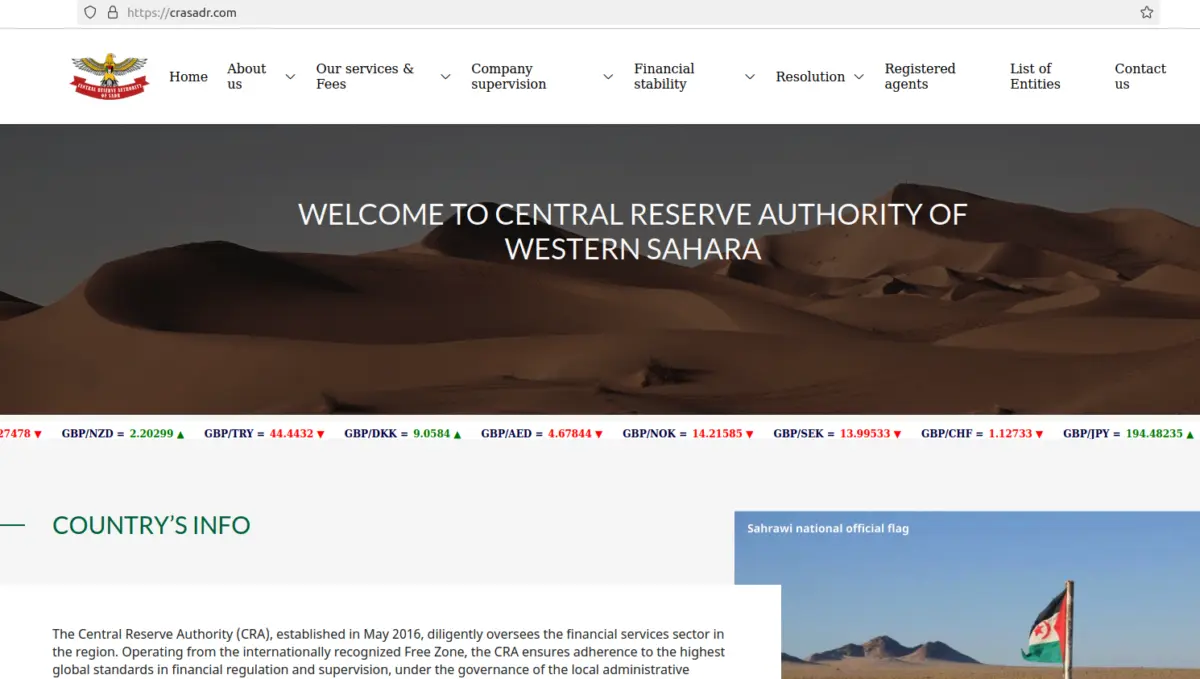
The web of deception extended directly into digital infrastructure. The regulatory body’s official web domain, crasadr.com, served as a registry purporting to list entities formally awarded licenses for cryptocurrencies, gaming, and foreign exchange services.
Further technical analysis conducted during investigative audits revealed that Certa Payments’ former corporate website (certa.website) shared a physical server with no fewer than 12 other domains. Among them was rasd-state.ws, a fabricated digital portal for the "Central Reserve Authority of the Western Sahara."
By fabricating a regulatory framework anchored in a lawless or unrecognized geopolitical zone, the architects of Cryptomus created a self-contained legal fiction. They could present "official" compliance credentials to partner banks and payment aggregators while operating entirely outside the reach of legitimate international financial watchdogs.
Official Statements & Industry Impact
The dismantling of Cryptomus’s operational network has triggered widespread commentary across the blockchain intelligence and cybersecurity sectors.
- Chainalysis Official Blog: In an October 8 statement reacting to the U.K. designations, Chainalysis emphasized that the sanctions target the broader, systemic infrastructure supporting Russia’s wartime economy. "Cryptomus and Heleket have emerged as major payment hubs for illicit activity," the firm stated, highlighting the necessity of targeting fiat-to-crypto gateways rather than focusing exclusively on decentralized mixing protocols.
- Investigative Consensus: Security analysts have universally praised the shift from monetary fines to asset freezes. Because corporate entities like Cryptomus can easily dissolve shell companies, abandon Canadian office spaces, or rebrand as Heleket, administrative fines are treated merely as a cost of doing business. Asset freezes, by contrast, sever access to global liquidity pools and force correspondent banks to terminate relationships instantly.
Future Outlook: The War on Shadow Payment Processors
The sanctioning of Cryptomus serves as both a major victory for international law enforcement and a stark warning regarding the adaptability of cybercriminal payment infrastructure.
As traditional mixing services face mounting algorithmic scrutiny from blockchain analytics firms, illicit actors have increasingly migrated toward "chameleonic" merchant of record platforms and pseudo-regulated payment gateways. These entities mimic legitimate e-commerce checkout solutions while deliberately turning a blind eye to high-risk verticals, ransomware extortion payouts, and state-sponsored sanctions evasion.
Moving forward, intelligence agencies and compliance officers face a two-fold challenge:
- Closing Cross-Border Shell Loopholes: The Cryptomus case starkly illustrates how fraudsters can exploit shell companies in friendly Western nations while weaponizing fake regulatory bodies in unrecognized territories to project false legitimacy. Stricter corporate registry verification across Five Eyes nations will be vital to preventing future iterations.
- Targeting Parallel Infrastructure: As demonstrated by the rapid launch of Heleket following Canada’s fine, shutting down a brand does not shut down an operation. Future enforcement actions must anticipate rapid re-branding and proactively blanket-sanction known operator clusters before they can successfully migrate their customer base.
For now, the U.K. government’s decisive action has dealt a crippling blow to one of the most prolific financial laundering pipelines operating between Western financial systems and the Russian cybercrime underground. Cryptomus—and its digital ghosts—may attempt to morph once more, but the net of international sanctions has officially tightened around their operations.