
Executive Overview
In the increasingly volatile landscape of modern cyber warfare, state-sponsored threat actors constantly search for structural weaknesses in the foundational architecture of the internet. A glaring vulnerability exposed how advanced persistent threat groups—specifically the Russian-linked cyber espionage outfit known as Fancy Bear (also tracked as APT28, Sofacy, or Strontium)—leveraged a design flaw in Google’s Accelerated Mobile Pages (AMP) framework. By exploiting how Google caches and renders mobile web content under its own trusted google.com domain, attackers were able to craft highly convincing, untraceable phishing vectors targeting high-profile investigative journalists, political dissidents, and researchers.
For years, cybersecurity professionals have drilled a simple golden rule into the minds of internet users: always check the URL in the address bar before entering credentials. However, Google AMP shattered this paradigm. By serving third-party content wrapped in an official google.com URL structure, the framework inadvertently provided malicious actors with an elite, institutional-grade cloak of legitimacy.
While Google repeatedly defended its architecture—dismissing early warnings from software engineers and web developers as alarmist—state-backed hackers quietly weaponized the flaw. The resulting campaign compromised prominent individuals, including veteran journalist David Satter, while narrowly missing others like Bellingcat researcher Aric Toler. This investigative report details the technical mechanics of the AMP vulnerability, the geopolitical dimensions of the attacks, the friction between external developers and Google’s engineering leadership, and the enduring implications for open-web standards.
Detailed Chronology: The Anatomy of an AMP Exploitation Campaign
The exploitation of Google AMP by Russian intelligence-linked hackers did not happen in a vacuum. It was the culmination of a multi-year campaign targeting individuals investigating Kremlin-backed activities, paired with a slow-moving internal debate within the tech community over the security risks of centralized web caching.
The Genesis of AMP and Early Warnings
Launched by Google in late 2015, Accelerated Mobile Pages was marketed as an open-source initiative designed to simplify web page architecture. By stripping down HTML and enforcing strict constraints on JavaScript, AMP enabled mobile browsers to load news articles and blog posts almost instantaneously, particularly on constrained mobile hardware or sluggish cellular connections.
To achieve this lightning-fast performance, Google introduced a pre-rendering mechanism. Search results featuring AMP-enabled content were pre-fetched and stored on Google’s own servers. When a user clicked an AMP link, the content was served instantly via a google.com URL wrapper.
While web publishers initially embraced the speed boost, independent developers raised immediate red flags. Critics pointed out that while the originating domain name appeared in small text within the body of the webpage, the web browser’s master address bar steadfastly displayed a pristine google.com URL. Worse yet, as users scrolled down the page, the subtle disclaimer revealing the true content source vanished entirely, leaving only the Google domain visible.
In late 2016, web programmer Ray Etornam filed a bug report on GitHub (amphtml/issues/6210), highlighting how bad actors and fake news publishers could exploit AMP caching to grant fraudulent sites unearned credibility. Developers like Christian Gloddy and John Pettitt echoed these concerns, warning that standard anti-phishing training—which instructs users to scrutinize the address bar—was completely neutralized by the google.com wrapper.
Despite these warnings, Malte Ubl, the tech lead for the Google AMP project, pushed back aggressively against the criticism. In public GitHub exchanges, Ubl maintained that the search viewer clearly attributed the original domain at the top, asserting that "an unsophisticated user could be fooled by this" was an unfounded concern.
Enter Fancy Bear: The Targeting of Aric Toler
While Google’s engineering team dismissed external warnings, Fancy Bear operatives were actively field-testing the exploit against high-value targets. Among them was Aric Toler, a lead researcher and writer for Bellingcat, an investigative collective renowned for uncovering state-sponsored covert operations, including tracking the Russian-backed rebels responsible for shooting down Malaysia Airlines Flight 17 (MH17) over Ukraine in 2014.
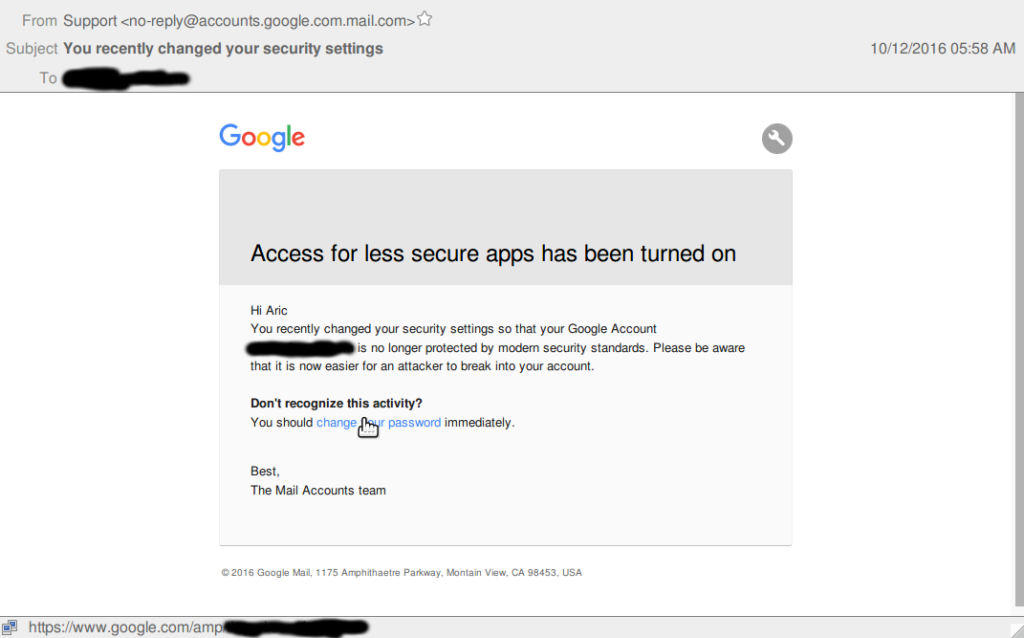
Toler’s brushes with state-sponsored phishing escalated throughout 2015 and 2016. Early attempts relied on amateurish tactics, such as basic URL shorteners (like Bitly) pointing to credential-harvesting pages—tactics easily spotted by a tech-savvy researcher. However, as the hackers grew more aggressive, their methodology evolved dramatically.

- October 12, 2016: Toler received an expertly crafted spear-phishing email masquerading as a security alert from Google. The message warned that older, insecure email applications had gained access to his account, dramatically increasing his vulnerability to intrusion. The alert invited him to click a password-reset link—routed through a Google AMP URL.
- October 13, 2016: Just one day later, following a public tweet by Toler acknowledging a legitimate Google warning about "government-backed attackers," the hackers deployed a second, tailored spear-phishing message. This email claimed that state-backed actors were actively trying to compromise his credentials and directed him to a malicious credential-harvesting site via another Google AMP link.
Although Toler recognized the threat and refused to click, forensic analysis by the cybersecurity firm ThreatConnect linked the infrastructure of these attacks directly to the email account [email protected]. This exact burner account had been utilized in prior operations attributed to APT28/Fancy Bear, confirming a targeted, state-sponsored cyber espionage campaign leveraging Google’s caching service.
The Breach of David Satter
While Bellingcat researchers successfully evaded the trap, other targets were less fortunate. David Satter, an American journalist and author who has written extensively and critically about the Russian government and Vladimir Putin, fell victim to an identical AMP-based phishing wave routed through the same [email protected] infrastructure.
Tricked by the authentic-looking google.com URL wrapper, Satter entered his Gmail credentials into the fraudulent landing page. Within moments, automated harvesting scripts breached his account, siphoning off his entire email archive.
The consequences were swift and damaging. Three weeks after the breach, a Canadian cybersecurity research group, Citizen Lab, discovered that the stolen trove of documents had been leaked online. Worse still, the hackers had selectively altered several documents before publication—a classic disinformation tactic designed to fabricate compromising narratives, discredit Putin’s political opponents, and sow confusion among international media outlets.
Supporting Context & Metrics: The Mechanics of Modern Phishing
To fully comprehend the danger posed by the AMP vulnerability, one must examine the psychological and technical pillars of modern phishing.
The Breakdown of Trust Indicators
Traditional cybersecurity awareness programs rely heavily on visual verification. Users are taught to look for specific markers before surrendering sensitive information:
- Domain Verification: Checking the top-level address bar for typosquatting (e.g.,
g00gle.cominstead ofgoogle.com). - Transport Layer Security (TLS): Ensuring the presence of a secure padlock icon and a valid SSL certificate.
Google AMP bypassed these hard-earned instincts. When an AMP page loaded, the browser’s address bar verified a legitimate, high-reputation TLS certificate issued to Google. For an average internet user—and even for experienced developers glancing quickly at a mobile screen—the presence of google.com acted as an absolute trust anchor.
The Infrastructure of APT28 (Fancy Bear)
Attributed by Western intelligence agencies and private cybersecurity firms to Russia’s military intelligence agency (the GRU), Fancy Bear is notorious for deploying zero-day exploits, spear-phishing campaigns, and malware frameworks like X-Agent and Sofacy.
Unlike financially motivated cybercriminal syndicates, Fancy Bear’s objectives are almost exclusively geopolitical: intelligence collection, intellectual property theft, and information operations designed to influence public discourse. By repurposing core architectural features of major Western tech platforms—such as Google AMP or Microsoft Exchange servers—Fancy Bear demonstrated a high degree of operational adaptability, turning commercial optimization tools into weapons of asymmetric warfare.
Official Statements and Corporate Friction
The intersection of state-backed espionage and commercial web optimization brought deep cultural friction between Google’s engineering leadership and the broader cybersecurity and publishing communities.
Google’s Defensive Stance and Eventual Patching
When confronted by software developers on GitHub and journalists during investigative inquiries, Google officials initially adopted a defensive posture. Malte Ubl and corporate spokespeople repeatedly insisted that the search viewer offered adequate contextual clues via the small-font origin domain displayed inside the page body.
However, as public scrutiny intensified and evidence mounted regarding the successful compromise of journalists like David Satter, Google quietly shifted its internal posture.
- The Safe Browsing Integration: Following the publication of initial reports, Google disclosed that it had quietly integrated its automated Safe Browsing security scanner into the AMP generation pipeline in early January 2017. Under this update, any AMP URL generated via search results was subjected to automated crawling and scanning to detect known malicious payloads before users could access them.
- Redirect Notices: For un-scanned or dynamic links, Google introduced interstitial "redirect notices." These warning pages informed users that they were navigating away from the Google ecosystem to an external domain, offering an exit hatch. However, critics noted that these notices were often dense with developer jargon, failing to clearly articulate the specific security risks of proceeding.
- Silencing Critics: As pressure mounted, project leads drew further criticism from the developer community by locking and restricting public comments on the original GitHub bug report (
#6210), drawing accusations of corporate opacity.
Industry Backlash: The Publisher Perspective
The controversy added fuel to an ongoing industry debate regarding the centralization of web traffic. Jason Kint, CEO of the digital publishing trade association Digital Content Next—representing major media organizations including The New York Times, The Washington Post, and major U.S. television networks—expressed deep concern over the incident.
"We’ve been supportive of AMP as much as it benefits competition and leverages the open web," Kint stated. "This report of an ongoing security issue is troubling and exactly why consolidation of power and closed standards are problematic. The sooner AMP migrates to the open web and becomes less tied to the interests of Google, in every way the better."
Industry leaders argued that by encouraging publishers to surrender control of their mobile traffic to a centralized tech giant’s proprietary caching ecosystem, Google had not only warped web economics but introduced systemic security vulnerabilities that individual publishers were powerless to mitigate.
Future Outlook: The Legacy of AMP and the Shifting Web Security Paradigm
The exploitation of Google AMP by Fancy Bear serves as a cautionary tale for the technology sector, offering critical lessons that continue to shape web standards, browser development, and threat intelligence today.
The Decline and Deprecation of AMP
The security vulnerabilities exposed in 2017 catalyzed a broader reckoning regarding centralized content distribution frameworks. Over the ensuing years, continuous pushback from developers, privacy advocates, and antitrust regulators forced a re-evaluation of AMP.
Google gradually decoupled its core search visibility requirements from AMP, acknowledging that modern mobile network improvements and responsive web design standards had largely eliminated the original performance justifications for the framework. By 2021 and 2022, Google officially phased out AMP as a mandatory prerequisite for Top Stories carousels in mobile search results, signaling the quiet retreat of one of the most controversial web standards of the 2010s.
Lessons for Modern Browser Architecture
The Fancy Bear AMP incident permanently altered how browser vendors and platform architects view URL bar design. Security researchers established a consensus that trust indicators must never be decoupled from the actual origin of the code executing in the viewport.
Modern web standards now place extreme emphasis on origin transparency. Browsers across desktop and mobile platforms have continuously refined address bar UI/UX to prevent URL spoofing, iframe obfuscation, and domain-masking techniques. Furthermore, major identity providers have accelerated the adoption of phishing-resistant authentication methods—such as FIDO2/WebAuthn hardware security keys and passkeys—which render credential-harvesting phishing pages completely ineffective, regardless of how convincing the URL wrapper might appear.
Conclusion
The campaign waged by Fancy Bear against journalists using Google’s Accelerated Mobile Pages demonstrates the high stakes of modern software engineering. When technology monoliths prioritize speed, caching optimization, and centralized control over transparent security architecture, they inadvertently construct high-value attack surfaces for state-sponsored threat actors.
For the cybersecurity community, the episode remains a stark reminder that the defense of a free press and open society requires constant vigilance not only against hostile foreign intelligence services, but also against the unintended systemic vulnerabilities built into the very infrastructure of the daily web.