Executive Overview
For over a decade, the playbook for early-stage B2B software funding was written in stone. Founders who marched into venture capital offices boasting $4 million in Annual Recurring Revenue (ARR), a tripled year-over-year growth rate, solid gross retention, and reasonable burn profiles could comfortably expect multiple term sheets within days.
Today, those same founders are walking out of top-tier fund meetings empty-handed, bewildered by sudden rejections. The reality is stark: the funding bar has shifted dramatically.
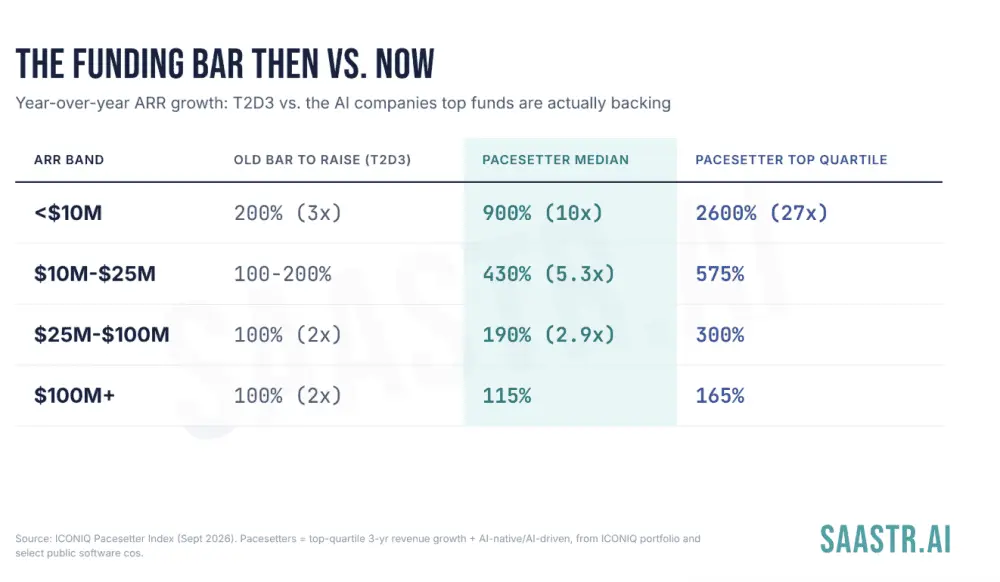
Propelled by the meteoric rise of AI-forward startups and data published by elite growth funds like ICONIQ Capital—specifically via its Pacesetter Index—the velocity expected by premier investors has accelerated to unprecedented levels. Under the $10 million ARR threshold, the median company securing top-tier capital today is growing at rates that dwarf the legendary T2D3 (triple, triple, double, double, double) benchmark of the past.
For the modern entrepreneur, understanding this paradigm shift is no longer optional. This article examines the mechanics of the new funding landscape, why traditional benchmarks are no longer sufficient for tier-one VCs, and how founders can successfully align their growth stories, retention metrics, and team sizing to secure capital in an AI-driven economy.
Detailed Chronology: The Evolution from T2D3 to the AI-Native Standard
The Golden Decade of T2D3 (2010–2020)
To appreciate how high the bar has moved, we must first look at the metric that defined a generation of enterprise software. For ten years, T2D3 was the gold standard. Popularized by prominent investors and successfully executed by category-defining cloud giants, T2D3 promised that a company tripling its revenue for two consecutive years, followed by three years of doubling, would effortlessly scale into a massive enterprise worth billions.
In this era, a startup scaling from $3 million to $9 million ARR was viewed as an institutional-grade rocket ship. Venture capitalists lined up to fund these trajectories, underwriting businesses that assumed traditional human-capital scaling, linear sales-capacity expansion, and standard seat-based pricing models.
The Seismic Shift of 2023–2026
The macroeconomic corrections of the early 2020s, paired with the sudden explosion of generative AI and agentic workflows, fundamentally altered venture capital deployment strategies. Top-tier growth funds stopped evaluating companies strictly against historical SaaS comps and began measuring them against a new class of hyper-efficient, AI-native category creators.
Data published in ICONIQ’s Pacesetter Index revealed an eye-opening divergence. While legacy software benchmarks remained relatively stable for late-stage companies (with businesses at $100M+ ARR still expected to double or grow around 100% to 115%), the chasm widened terrifyingly at the Seed, Series A, and Series B stages.
At the sub-$10 million ARR mark, the median Pacesetter company was found to be growing at rates up to 4.5x faster than the traditional T2D3 model dictates. A founder celebrating a 200% growth rate today is often benchmarked by elite funds against peers who are scaling at 500% to 900% in the exact same timeframe.
Supporting Context & Metrics: Inside the Pacesetter Index
To successfully navigate the modern fundraising ecosystem, founders must understand precisely what data points top-tier investors are evaluating behind closed doors. When a partner at an elite fund considers deploying a $50 million check, they are not evaluating a startup in a vacuum; they are weighing it against the fastest-growing anomalies in their portfolio and public software comps.
1. The Growth Rate Mismatch
Under $10 million ARR, the speed of capital acceleration has broken previous ceilings. While platforms like the SaaStr.ai Pitch Deck Analyzer previously flagged a company at $1.4M ARR growing at 200% as "Unlikely" to raise from premier growth funds, real-world data from Carta and ICONIQ showed top-quartile companies in the $2M–$10M band scaling at anywhere from 180% to over 500%. Today, the Pacesetter median for this segment sits near 900%.
2. Gross Margins and Net Revenue Retention (NRR) Under $10M
Interestingly, while growth expectations have scaled exponentially, tolerances on other foundational metrics have adjusted in surprising ways. Many founders waste valuable pitch time obsessively defending 55% gross margins or 105% NRR.
Data from the Pacesetter cohort proves that under $10 million ARR, companies frequently secure venture backing despite lower initial margins and moderate NRR. Why? Because top-tier investors recognize that gross margins naturally expand to the 75%–85% range as infrastructure stabilizes, and NRR peaks later (reaching 130%–140% in the $25M–$100M band). If a startup is failing to secure a term sheet, the culprit is almost invariably growth, not a temporary margin compression.
3. Headcount Efficiency and Revenue Per Employee
Perhaps the most dramatic shift in modern software underwriting is the intense focus on headcount efficiency. Historically, a well-run B2B software company at scale operated on roughly $200K to $250K of ARR per Full-Time Employee (FTE).
The new Pacesetter standard shatters this old math:
- At $100M+ ARR, the median Pacesetter company generates approximately $655,000 in revenue per employee.
- A company scaling to $150M ARR today achieves this milestone with roughly 230 employees—whereas under legacy operating models, that same milestone would have required 600 or more workers.
This operational leanness is mirrored in burn multiples, with medians hovering around 0.3x at scale and dropping to 0.1x for top-quartile performers. With the integration of AI agents and streamlined automation (such as organizations scaling toward $20M ARR with handfuls of human operators augmented by dozens of AI agents), the bloated hiring plans of the 2021 funding boom are now viewed by investors as glaring red flags during due diligence.
4. Deal Size and Budget Replacement (ACV)
Raw growth and lean operations are still insufficient if a product fails the budget-expansion test. Top-tier investors are increasingly asking whether a startup is merely capturing an existing software line item or unlocking entirely new budget pools.
Leading investors look for Annual Contract Values (ACVs) that are at least double those of pre-AI legacy competitors. Growing rapidly at an incumbent’s commoditized price point limits a startup’s ultimate total addressable market (TAM) ceiling in the eyes of growth equity partners.
Official Statements and Industry Insights
Venture capitalists and industry leaders have been vocal about the necessary alignment between founder expectations and market realities.
Industry veterans note that while T2D3 remains an exceptionally viable path to building a massive, highly successful $144 million ARR enterprise over five years, the psychological profile of the modern venture capitalist has shifted.
"Start at $2M ARR and run [T2D3]: $6M, $18M, $36M, $72M, $144M. That’s a $100M+ ARR company in five years, which would be a top-tier outcome in any decade. Most of the great B2B companies of the last cycle never hit it." — Industry Analysis
However, experts estimate that only about 10% of venture capital funds are actively seeking out and underwriting steady, compounding T2D3 growth models at the Series A and Series B stages. The remaining 90% are aggressively hunting for outlier curves reminiscent of category-defining AI infrastructure and application giants.
For the founder whose business model mirrors disciplined compounding rather than meteoric Pacesetter velocity, the strategy must pivot:
- Expand the Top of the Funnel: If only 1 in 10 funds is a cultural and structural fit for a 3x growth trajectory, a target list of 30 investors will only yield three genuine conversations—not nearly enough to cultivate a competitive, multi-offer funding round.
- Maintain Valuation Discipline: Pricing a round against hyper-inflated Pacesetter comparables when growing at traditional rates will almost certainly result in rejections. Aligning the valuation with compounding realities is critical to securing a reliable lead investor.
Future Outlook: How Founders Can Adapt and Win
The divergence between traditional SaaS benchmarks and elite Pacesetters does not spell doom for the standard entrepreneur. Rather, it demands strategic clarity and radical operational honesty. Founders navigating the market must implement specific countermeasures to secure funding:
1. Audit Your Metrics Against the Right Cohort
Before stepping into a pitch meeting, founders must brutally assess their four core metrics—Growth, Gross Retention, Gross Margins, and Headcount Efficiency—against both legacy benchmarks and modern Pacesetter medians. If your business matches or beats top-tier companies on retention, efficiency, and margins but lags slightly in raw growth, you can immediately filter your outreach toward the 10% of venture funds that specialize in underwriting steady compounding.
2. Re-evaluate Your Pricing and Packaging (ACV)
If your product is priced identically to legacy solutions, look for opportunities to shift your monetization model toward value-based pricing and packaging that reflects the actual labor displacement and productivity gains your software delivers. Doubling your ACV changes how growth equity partners perceive your market ceiling.
3. Design Your Hiring Plan for the AI Era
Throw out the traditional headcount expansion models of the past decade. Leverage AI tooling, automation, and lean operational structures to maximize revenue per employee. Demonstrating high capital efficiency protects your burn multiple and signals to institutional investors that your business is built for modern enterprise economics.
4. Know When to Wait
If your company is growing at a healthy 2.5x clip at $8 million ARR with a lean burn multiple, forcing a premature fundraising process against unrealistic comps may be counterproductive. Often, preserving equity and driving the business independently to $15 million ARR yields a significantly more advantageous fundraising environment than taking a flat round under duress.
Conclusion
The venture capital ecosystem has evolved past the blanket applicability of yesterday’s playbooks. While the bar set by ICONIQ’s Pacesetters and AI-forward disruptors is extraordinarily high, it is not the only path to success. By understanding where the market benchmark stands, acknowledging whether your business model targets compounding or hyper-growth, and tailoring your investor target list accordingly, founders can successfully cut through the noise, secure funding, and build enduring enterprise software companies in the new economic era.