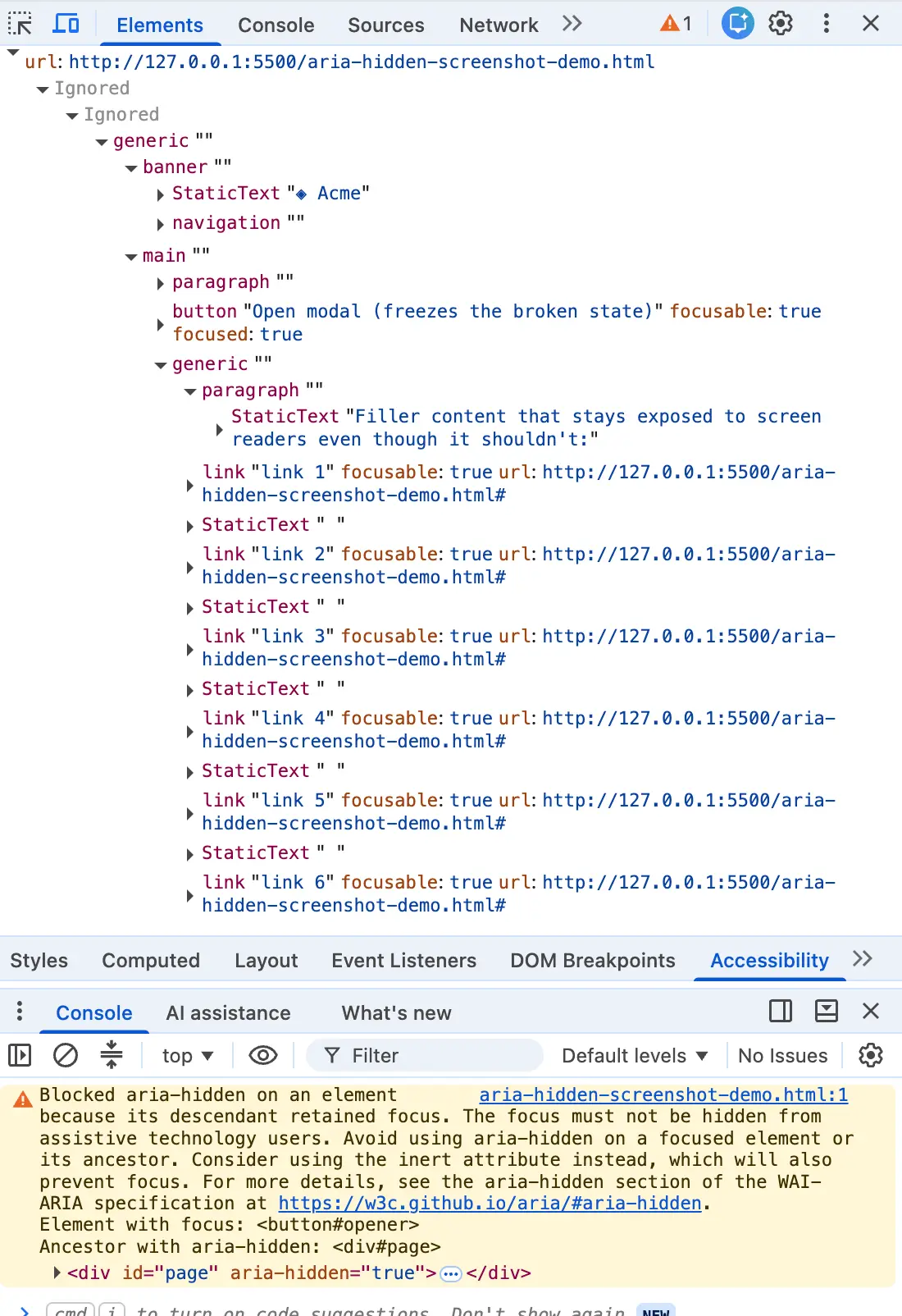
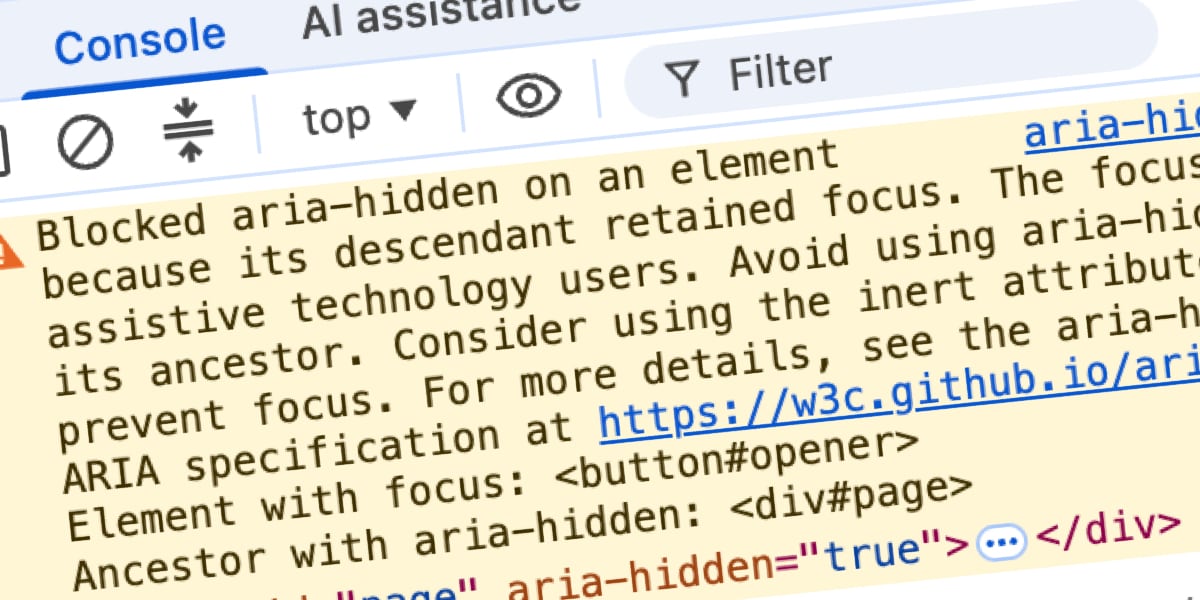
You closed a dialog, and the browser console erupted in a sharp, abrasive shade of mustard yellow. You highlighted the error message, dropped it into a search box, and landed here alongside half the front-end internet. Whether your application is built on Angular, Bootstrap, Ionic, or phpMyAdmin, this exact string turns up identically.
Here is the part the top-ranking search results bury: the warning is correct. There is a real person on the other side of that log—someone using a screen reader whose focus is about to drop straight into a structural hole in your page.
Every top-ranking fix online tells you to do the same thing under different names: deploy the blur() one-liner, wrap the close event in a setTimeout, or yank the aria-hidden attribute off the container entirely. Each of these hacks quiets the console while quietly harming the user the browser was trying to protect. If you have already shipped one of them, you are in enormous company. You were failed by your search results, not by your own carelessness. I know, because I shipped one too.
Executive Overview: The Invisible Accessibility Crisis
For years, front-end developers treated browser console warnings as advisory noise—yellow text to be ignored, deferred, or silenced so that Continuous Integration (CI) pipelines could pass. However, when Google’s Blink engine introduced accessibility tree validation warnings (surfacing heavily across Chrome versions 127 through 131), it wasn’t issuing a style-guide nicety. It was overruling developers.
The core issue stems from a foundational paradox baked into aria-hidden. While the attribute removes content from the accessibility tree, it leaves that content entirely untouched within the keyboard focus order. These two underlying systems operate independently, and there is nothing natively keeping them in sync.
When an element remains focused inside a subtree that has been marked as hidden, a dangerous phenomenon occurs: ghost focus. Screen readers fire events for nodes they have been explicitly told do not exist, resulting in absolute silence for the user. The browser’s console warnings are designed to catch this mismatch, but developers seeking a quick fix frequently apply band-aids that worsen the accessibility violation.
Resolving this requires discarding superficial console hacks and adopting a strict, sequential teardown contract: focus must leave a region before that region becomes hidden or inert.
Detailed Chronology: How the Warnings Emerged
While browsers had been quietly patching focusable aria-hidden nodes for years—dating back to Chromium discussions around early 2020 and the WAI-ARIA working groups—the friction didn’t reach mainstream developer consciousness until mid-to-late 2024.
The Open-Time Inversion (Summer 2024)
The first major wave of warnings appeared around Chrome 127 in July and August 2024. Bug reports flooded major UI library repositories, including MUI (#43106), Ant Design (#50170), and Flowbite (#943).
Developers encountered warnings regarding elements that "just received focus" the instant a modal or dropdown opened. The architectural flaw: the library marked the background aria-hidden="true" before moving focus away from the trigger button, stranding focus inside a newly hidden context.
The Close-Time Race (Late 2024)
Months later, around the release of Chrome 131 in late 2024, the "retained focus" warning variant arrived. Developers migrating through Bootstrap (#41005) and Angular Components (#30187) noticed the console flagging modals during their exit transitions.
Because component libraries traditionally executed their fade-out animations while keeping focus parked on the close button (only restoring focus to the trigger after the hidden event fired), every frame of the CSS transition featured a hidden modal housing a focused element.
The Modern Framework Collisions (2025–2026)
As component ecosystems matured, nested compositions—such as a native <select> or popover inside a modal <dialog>—turned these warnings into critical failures. Under React 19, unmount timing changes transformed what was once a minor console warning into full-scale focus freezes, documented in Radix UI (#3701) and Shadcn (#10074).
Supporting Context & Metrics: The Anatomy of "Ghost Focus"
To understand why browsers overrule developers, one must understand what happens on the assistive technology side of the screen.
When a user presses the Tab key, focus moves, a control highlights, and the screen reader processes the node. However, if that node sits within a container marked with aria-hidden="true", the screen reader’s accessibility API looks up the node, finds nothing it is permitted to describe, and outputs absolute silence.
[ User presses Tab ]
       │
       ▼
[ Focus lands on element inside aria-hidden subtree ]
       │
       ▼
[ Screen reader attempts lookup ──> Finds hidden/unmapped node ]
       │
       ▼
[ Result: Complete silence. User stranded with no audio feedback. ]
From the user’s perspective:
- They press a navigation key.
- The machine acknowledges nothing.
- They are left questioning whether the application broke, their screen reader crashed, or they made a mistake.
The browser’s console warning is not a nag; it is an alarm bell indicating that the DOM structure and the accessibility tree are actively contradicting one another.
Official Statements & Industry Standardizations
The tension between browser engine developers and UI library maintainers has sparked significant debate across web standards working groups.
Engineers from Chromium have maintained that exposing focusable, hidden nodes is a necessary safeguard against completely locked-out user sessions—a pattern that historically occurred when teams slapped aria-hidden across entire body wrappers during poorly implemented portal transitions.
Meanwhile, WAI-ARIA working groups (such as in GitHub discussion #2422, running through 2025 and early 2026) have grappled with standardizing these heuristic approaches to handling malformed ARIA attributes. The consensus moving forward is clear: browsers will continue to reject invalid accessibility trees, forcing component architectures to adapt.
Major libraries are already shifting. For instance, Bootstrap 6 abandoned its legacy 5.x architecture—which relied heavily on manual aria-hidden toggling—in favor of native HTML <dialog> elements utilizing the browser’s top layer. By relying on native implementations, the browser manages the focus dance automatically, rendering this entire class of bugs obsolete.
The Four Ways Developers Trigger the Warning
If you are seeing this warning, your implementation likely falls into one of four architectural traps:
- The Close-Time Race: The modal starts fading out, but focus remains on the close button inside the overlay while
aria-hiddenor hidden states commit. - The Open-Time Inversion: A modal opens, and the trigger button in the background retains focus for a brief beat before the focus trap activates.
- Nested Composition Turf Wars: Two independent primitives (such as a dropdown inside a dialog) both attempt to act as modal layers, fighting over background-hiding states.
- External Focus Departure: The user Alt-Tabs away from the browser window while an overlay is active, leaving focus bookkeeping desynchronized upon teardown.
The Four-Step Teardown Contract
If migrating immediately to native <dialog> elements is not feasible for your codebase this quarter, you must resolve the issue via a strict execution order.
The Golden Rule: Focus must leave a region before that region becomes hidden or inert.
Implementing this requires executing four distinct steps in precise order:
// CORRECT TEARDOWN PATTERN
function closeModal()
  // STEP 1: Un-inert the background FIRST so the trigger can receive focus
  background.removeAttribute('inert');

  // STEP 2: Move focus OUT to the trigger synchronously
  triggerButton.focus();

  // STEP 3: Make the closing shell inert (NOT aria-hidden) so it fades out safely
  overlay.setAttribute('inert', '');
  overlay.style.pointerEvents = 'none';
  overlay.classList.add('fade-out');

  // STEP 4: Clean up and unmount only after transitions settle
  overlay.addEventListener('transitionend', () => overlay.remove(),  once: false );
Why Common Fixes Fail
- The
blur()Hack: Callingdocument.activeElement.blur()drops focus straight to the<body>element. While the console warning clears because no element is technically focused inside the hidden subtree, keyboard users are stranded at the very top of the document, violating WCAG 2.4.3 (Focus Order). - Timing Shims (
setTimeout): Relying on timers to stagger execution bets that rendering completes before the focus call runs. Under heavy CPU load or concurrent rendering, this leads to intermittent, unreproducible failures. - Stripping
aria-hidden: Removing the attribute entirely silences the warning by making the background fully accessible while a modal is open, breaking the fundamental modal containment contract.
Future Outlook: The Path to Native Dialogs
The front-end ecosystem is slowly outgrowing the era of manual focus-trapping scripts and fragile aria-hidden wrappers.
As native HTML <dialog> elements gain universal adoption, and as CSS features like @starting-style and transition-behavior: allow-discrete make animating native dialogs seamless, the custom modal architecture that spawned these console warnings will fade into legacy status.
Until then, treat the browser console warning not as an annoyance to be bypassed, but as a diagnostic indicator. A clean console is never the goal—delivering an accessible, unbroken experience to every user is. When your tooling speaks up for the user, listen to it.