In the rapidly evolving landscape of digital marketing and content creation, the demand for high-volume, high-quality material has never been greater. Modern enterprises, independent bloggers, e-commerce vendors, and SEO specialists face a relentless pressure to produce engaging copy across multiple channels—ranging from long-form blog posts and targeted social media ads to complex product descriptions and email newsletters. Traditionally, meeting this demand required vast human resources, substantial financial investment, and considerable time.
Today, the paradigm has shifted dramatically. Artificial Intelligence (AI) content generators have emerged as indispensable assets in the digital creator’s toolkit. Utilizing sophisticated Natural Language Processing (NLP) models and deep-learning algorithms, these platforms analyze human writing styles, context, and intent to produce coherent, relevant, and contextually accurate text in a fraction of the time required by traditional methods.
This comprehensive report provides an authoritative analysis of the top ten AI content generation platforms available on the market. By examining their core features, pricing tiers, operational advantages, and strategic limitations, this article serves as a definitive guide for professionals seeking to optimize their content creation workflows, maximize return on investment (ROI), and maintain a competitive edge in an increasingly automated digital economy.
Detailed Chronology: The Evolution of AI Writing Assistants
The journey of automated text generation has transformed significantly over the past decade. Initially, early-generation content tools relied on primitive synonym-swapping software and rule-based spinners. These rudimentary programs frequently produced awkward, grammatically incorrect content that failed both reader expectations and search engine quality guidelines.
The true turning point arrived with the development of advanced neural network architectures, such as OpenAI’s GPT models. As these foundational large language models matured, software developers began building intuitive user interfaces, specialized templates, and workflow management systems on top of the raw AI engines.
Phase 1: Basic Automation (Pre-2018): Dominated by keyword stuffing tools and low-quality article spinners that damaged SEO rankings and offered little to no editorial value.
Phase 2: The Emergence of NLP (2018–2020): Introduction of transformer-based language models. Early pioneers began experimenting with prompt-based generation, proving that machine-assisted writing could mimic human tone and structure.
Phase 3: Specialized Ecosystems (2020–2022): Software providers refined raw models into robust commercial products. Platforms introduced dedicated templates for marketing copy, automated outlining, SEO optimization, and long-form content generation.
Phase 4: Enterprise Integration (Present): AI writing assistants have matured into full-fledged enterprise solutions featuring multi-user collaboration, real-time grammar checks, integrated plagiarism detection, and direct content management system (CMS) publishing capabilities.
Supporting Context & Metrics: The Top 10 AI Content Generators
To help organizations and independent creators navigate the crowded marketplace, we have evaluated the leading AI content generation platforms based on efficiency, utility, cost-effectiveness, and output quality.
1. Jasper AI (Formerly Jarvis)
Jasper stands as one of the most recognized and powerful content writing and generation platforms in the industry. Designed to adapt to various writing styles and brand voices, Jasper excels at identifying the optimal words and sentence structures for any given medium.
Core Features: Advanced long-form assistant, extensive template library, custom tone adjustments, and seamless command-based workflows.
Boss Mode: Tailored for power users, priced at $99/month, enabling rapid generation of comprehensive long-form content, books, and sales pages.
Strategic Advantage: High adaptability and exceptional comprehension of complex prompts make it a favorite for professional copywriters.
2. Copy.ai
Engineered specifically for marketers and social media managers, Copy.ai simplifies the creation of promotional material through an expansive library of over 90 specialized templates, including bullet-point-to-blog converters, hook generators, and general advertisement copywriters.
Core Features: Short-form and medium-form generation, digital ad copy creation, brainstorming frameworks, and product description templates.
Pricing Structure: Features a 7-day free trial with unlimited access to basic runs. The Pro Plan is priced at $49/month or $35/month when billed annually ($420/year).
Strategic Advantage: Ideal for high-speed social media campaigns, e-commerce product listings, and rapid digital marketing ideation.
3. Frase AI
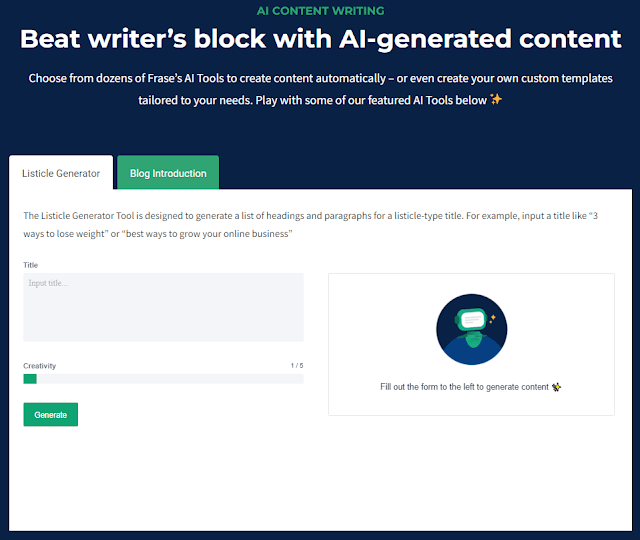
Frase operates at the intersection of AI generation and Search Engine Optimization (SEO). Rather than merely drafting text, Frase assists users throughout the entire content lifecycle—from initial research and topic outlining to automated drafting and search engine optimization.
Core Features: Automated content brief generation, search engine result page (SERP) analysis, content scoring metrics, and optimization recommendations.
Pricing Structure:
Solo Plan: $14.99/month ($12/month billed annually) with 4 document credits.
Basic Plan: $44.99/month ($39.99/month billed annually) with 30 document credits.
Team Plan: $114.99/month ($99.99/month billed annually) with unlimited document credits for up to three user seats.
Strategic Advantage: Exceptional for SEO professionals and content strategists who prioritize search visibility and data-driven ranking performance.
4. Article Forge
Article Forge differentiates itself through a streamlined, keyword-driven approach. Unlike competitors that require detailed multi-step prompts and outlines, Article Forge generates complete, end-to-end articles based solely on a primary target keyword.
Core Features: Fully automated long-form generation, built-in keyword research integration, and a guarantee that generated text successfully passes Copyscape plagiarism checks.
Pricing Structure: 30-day money-back guarantee (no free trial).
Strategic Advantage: Unmatched efficiency for managing PBNs (Private Blog Networks), niche affiliate sites, or high-volume informational blogs on a strict budget.
5. Rytr
Rytr.me is an accessible, budget-friendly AI writing assistant tailored for students, small business owners, and solo bloggers who require a straightforward tool without a steep learning curve.
Core Features: Built-in plagiarism checker, multi-language support, tone selection, and dozens of pre-built copywriting use cases.
Pricing Structure: Offers a limited free plan generating up to 5,000 characters per month.
Saver Plan: $9/month or $90/year.
Strategic Advantage: Cost-effective entry point for casual users and small businesses seeking basic content automation.
6. Writesonic
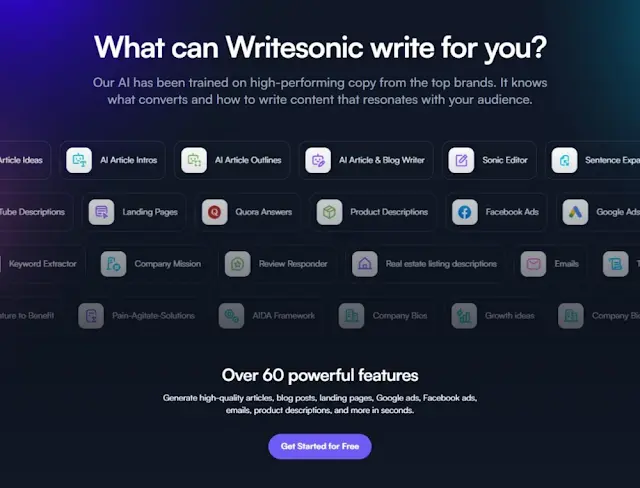
Writesonic is recognized for its versatility in generating marketing copy, landing page text, and full-length articles, supplemented by integrated grammar enhancement and plagiarism detection tools.
Strategic Advantage: Excellent balance of affordability and long-form generation capabilities for independent entrepreneurs.
7. CopySmith
CopySmith is an enterprise-grade AI content generation suite built to streamline collaborative workflows, bulk content creation, and personal or professional document drafting.
Core Features: Bulk product description generation, Shopify and WooCommerce integrations, content management dashboards, and extensive template variety.
Pricing Structure: Free trial available without credit card requirements.
Starter Plan: $19/month.
Enterprise Plan: Custom pricing tailored to organizational scale.
Strategic Advantage: Seamless integration with e-commerce platforms makes it indispensable for online retailers managing extensive product inventories.
8. Hypotenuse.ai
Hypotenuse.ai specializes in transforming raw data and brief guidelines into polished, publication-ready copy, with a particular emphasis on e-commerce and retail product storytelling.
Core Features: Bulk e-commerce copy generation, automated image generation utilities, content batching, and an intuitive user interface.
Pricing Structure: Free trial period available.
Starter Plan: $29/month.
Growth Plan: $59/month.
Enterprise Plan: Custom pricing upon inquiry.
Strategic Advantage: Streamlines the arduous task of writing unique descriptions for thousands of distinct retail items.
9. Kafkai
Kafkai is a niche-focused AI writing utility built specifically for SEOs, digital marketers, and programmatic content publishers seeking automated article generation across specialized industries.
Core Features: Niche content generation, multi-article batch creation, and specialized training models for distinct industry verticals.
Pricing Structure: Free trial available. Paid tiers scale by volume:
Strategic Advantage: Lowest cost-per-article ratio for high-volume, programmatic SEO strategies.
10. Peppertype.ai
Peppertype.ai functions as a virtual copywriter designed to accelerate the ideation and drafting phases of digital publishing, making it an ideal companion for content marketing teams and bloggers.
Core Features: Rapid content scaling, interactive dashboard, collaborative team workspaces, and numerous content expansion tools.
Pricing Structure: Free trial available.
Personal Plan: $35/month.
Team Plan: $199/month.
Enterprise Plan: Custom pricing.
Strategic Advantage: Rapid output generation with a strong focus on collaborative team editing environments.
Official Statements & Industry Perspectives
Industry analysts and digital marketing pioneers agree that artificial intelligence represents a fundamental shift in how digital information is consumed and produced.
"Artificial intelligence is no longer a futuristic concept reserved for tech laboratories; it is the operational backbone of modern content marketing. Tools like Jasper, Copy.ai, and Frase do not replace human creativity—they amplify it, liberating creators from the mechanical drudgery of outlining and drafting so they can focus on strategy, empathy, and innovation."
— Digital Marketing Strategist & Industry Observer
Furthermore, search engine representatives have repeatedly emphasized that search quality guidelines do not penalize content solely because it is generated by AI. Instead, algorithms continue to evaluate material based on Expertise, Authoritativeness, and Trustworthiness (E-E-A-T). Consequently, successful content creators utilize AI as a force multiplier—generating the foundational draft, which is subsequently refined, fact-checked, and enriched by human editorial oversight.
Future Outlook: The Next Horizon of Automated Publishing
As artificial intelligence models continue to advance at an exponential rate, the future of content generation will likely witness several transformative developments:
Hyper-Personalization: AI systems will increasingly analyze real-time consumer behavior data to generate dynamic, individualized marketing copy tailored to specific recipient profiles.
Multimodal Integration: Seamless synthesis of text, high-definition imagery, video scripts, and audio generation within unified dashboard environments.
Enhanced Fact-Checking Mechanisms: Integration of live web-browsing capabilities directly into language models, drastically reducing instances of factual inaccuracies or outdated references.
Autonomous Editorial Workflows: End-to-end automation where AI agents research, draft, optimize, fact-check, and publish content directly to content management systems with minimal human intervention.
Final Thoughts
The modern content creator is frequently overwhelmed by the sheer volume of daily communication requirements. Balancing blog publication schedules, social media engagement, email marketing campaigns, and SEO optimization leaves little room for deep strategic thinking.
While AI writing assistants cannot completely replace human intuition, empathy, and strategic vision, they offer an unparalleled combination of speed, cost-efficiency, and scale. Among the top-tier solutions evaluated in this report, Jasper AI remains a premier choice for generating high-quality, nuanced content across complex subjects. However, the optimal selection ultimately depends on individual requirements, technical expertise, and budgetary constraints.
Organizations and independent creators are encouraged to leverage trial periods, evaluate specific workflow integrations, and adopt a hybrid model—merging the raw processing power of artificial intelligence with rigorous human editorial standards to achieve unprecedented digital productivity.