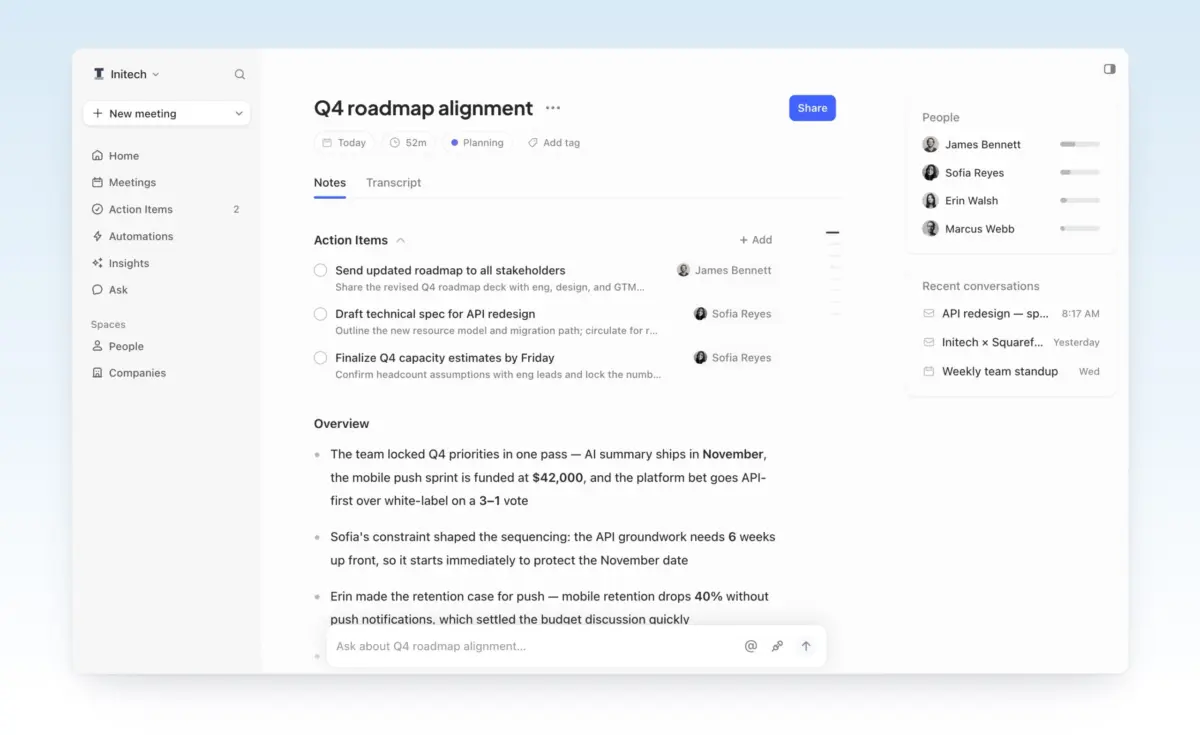
Executive Overview
The market for AI-powered meeting note-takers has rapidly evolved from a novel productivity niche into one of the most fiercely contested battlegrounds in the software-as-a-service (SaaS) industry. As tech giants and venture-backed startups scramble to capture user attention, the barrier to entry has plummeted, forcing companies to re-evaluate their monetization strategies. In a direct response to this intensifying competitive pressure, the Y Combinator-backed startup Circleback has announced a major restructuring of its business model: the introduction of a permanent free subscription tier and a significant price reduction for its premium offerings.
Historically operating behind a strict paywall with a limited trial period, Circleback’s pivot to a freemium model represents a calculated risk to widen its user acquisition funnel. Under the new pricing structure, users can transcribe an unlimited number of meetings at no cost, subject to a 30-day data retention limit. Premium plans have also been slashed from a starting price of $20.83 per month to $15 per month (billed annually).
This strategic shift comes at a time of remarkable capital efficiency for the San Francisco-based startup. Founded in 2023 by Ali Haghani and Kevin Jacyna, Circleback has maintained an extraordinarily lean footprint. Operating with a team of just eight employees, the company reports profitability and an annual recurring revenue (ARR) of over $1 million per employee—translating to an estimated ARR of roughly $8 million. By leveraging its strong financial positioning, Circleback aims to convert its product into its primary marketing vehicle, eschewing traditional paid advertising in favor of organic, product-led growth.
Detailed Chronology: The Commoditization of the Meeting Note-Taker
To understand Circleback’s pricing pivot, one must examine the rapid succession of product launches and funding rounds that have reshaped the meeting assistant landscape over the past several years. What began as simple speech-to-text transcription has transformed into an AI-driven workflow ecosystem where note-takers draft action items, integrate with developer tools, and query meeting history using natural language.
[2023] Circleback Founded by Ali Haghani & Kevin Jacyna
   │
[2024] Circleback raises $2.5M Seed Round; achieves profitability
   │
[Mid-2026] Granola introduces limited-history free tier
   │
[Aug 5, 2026] Wispr launches "Wispr Flow" dictation & meeting note-taker
   │
[Aug 19, 2026] Calendly integrates meeting note-taker directly into scheduling stack
   │
[Present] Circleback launches unlimited free tier, slashes paid plans to $15/mo
The Crowded Arena of 2026
The summer of 2026 marked a flashpoint of product convergence. On August 5, 2026, the dictation app Wispr expanded its ecosystem by launching its own dedicated meeting note-taker and scheduling platform, leveraging its proprietary voice-processing models to capture market share. Just two weeks later, on August 19, 2026, scheduling giant Calendly threw its hat into the ring, integrating a native meeting note-taker directly into its scheduling stack. By bundling transcription with booking, Calendly threatened to cut off dedicated note-takers at the point of scheduling.
Concurrently, heavily funded vertical specialists have continued to hoard capital. Competitors like Read AI, Fireflies, and Granola have raised tens of millions of dollars from top-tier venture capital firms, utilizing aggressive customer acquisition strategies to lock in enterprise clients.
The Freemium Precedent
Circleback’s move to a free tier is not without precedent; rather, it is an adoption of a defensive industry standard. A few months prior to Circleback’s announcement, competitor Granola introduced a similar tier that offered unlimited transcriptions but restricted access to historical data. This "retention-gate" model allows users to experience the core value of the product daily while creating a natural monetization trigger when historical search and long-term storage become necessary for team collaboration. Facing a steep drop-off in user retention at the end of its previous trial period, Circleback realized that a high-friction paywall was limiting its virality in a market where users expect instant, low-barrier utility.
Dissecting Circleback’s New Tier Architecture
The restructuring of Circleback’s offering divides its platform into two distinct tiers, designed to balance user acquisition with high-margin enterprise monetization.
┌─────────────────────────────────────────────────────────────────┐
│                     CIRCLEBACK TIER COMPARISON                  │
├────────────────────────────────┬────────────────────────────────┤
│           FREE TIER            │           PAID TIER            │
│       (Product-Led Growth)      │      ($15/month, Annually)     │
├────────────────────────────────┼────────────────────────────────┤
│ • Unlimited meeting recording  │ • Unlimited meeting recording  │
│ • 30-day transcription history │ • Unlimited permanent history  │
│ • Mobile & Apple Watch apps    │ • Full API & MCP Access        │
│ • AI-powered transcript query  │ • Advanced team integrations   │
│ • Linear & Slack integrations  │ • Dedicated customer support   │
└────────────────────────────────┴────────────────────────────────┘
The Free Tier: Top-of-Funnel Friction Removal
The newly introduced free tier is designed to be highly functional, avoiding the "crippled software" trap that plagues many SaaS free trials. Key features include:
- Unlimited Recording: Users are not capped on the number of meetings or minutes they can record per month, eliminating the anxiety of running out of credits mid-meeting.
- 30-Day History Limit: Transcripts and summaries remain accessible for 30 days, after which they are archived and require a premium upgrade to access.
- Cross-Platform Accessibility: Free users retain access to Circleback’s mobile and Apple Watch applications, allowing for on-the-go offline recordings and quick summary views.
- Basic Integrations: The free tier includes native integrations with Linear (for project management) and Slack (for team communication), alongside the ability to query meeting transcripts using natural language AI.
The Paid Tier: Developer-Centric and Enterprise-Ready
Priced at $15 per month when billed annually, the premium tier represents a 28% price reduction from the previous entry point of $20.83 per month. It targets power users, developers, and collaborative teams by unlocking:
- Infinite Retention: Full, unrestricted access to the user’s entire meeting archive.
- Model Context Protocol (MCP) Access: In a nod to technical teams, Circleback provides full access to its API and the Model Context Protocol. This allows developers to hook their meeting data directly into local LLM workflows, custom internal tools, and IDE agents.
- Deep Workflow Integrations: Access to the full suite of enterprise integrations, enabling automatic syncing of action items across multi-platform tech stacks.
Supporting Context & Metrics: The Power of Extreme Capital Efficiency
While venture capital-backed competitors burn through millions of dollars in paid customer acquisition costs (CAC) on platforms like Google and Meta, Circleback has chosen a path of extreme capital efficiency.
Circleback Financial Profile (Estimates based on disclosed metrics):
┌───────────────────────────┬───────────────────────────┐
│ Metric                    │ Value                     │
├───────────────────────────┼───────────────────────────┤
│ Founded                   │ 2023                      │
│ Total Capital Raised      │ $2.5 Million (2024 Seed)  │
│ Current Headcount         │ 8 Employees               │
│ ARR per Employee          │ >$1,000,000               │
│ Total Estimated ARR       │ ~$8,000,000               │
│ Profitability Status      │ Profitable since 2024     │
│ Paid Marketing Spend      │ $0 (Google/Meta Ads)      │
└───────────────────────────┴───────────────────────────┘
Analyzing the $1M ARR-per-Employee Phenomenon
An annual recurring revenue of over $1 million per employee is an elite metric in the software industry. Typically, high-performing, late-stage public SaaS companies target $250,000 to $500,000 in ARR per employee. Circleback’s ability to generate roughly $8 million in ARR with a team of eight highlights several structural advantages:
- Low Operational Overhead: By automating customer support, relying on robust self-serve onboarding, and keeping engineering cycles highly focused, the team minimizes non-technical headcount.
- High Product-Market Fit: Achieving this scale without a dedicated outbound sales army suggests strong organic demand and word-of-mouth referral mechanics within tech-forward organizations.
- Zero-Dollar Ad Spend as a Moat: By refusing to participate in the bidding wars of Google and Meta Ads, Circleback avoids inflating its CAC. Instead, the cost of hosting and processing meetings for free-tier users is classified directly as a marketing expense. This "product-as-marketing" approach ensures that capital is spent on server costs for actual users rather than ad impressions for passive scrollers.
Official Statements & Executive Strategy
Circleback’s leadership is transparent about the reality of modern software distribution: a product can only win if users can experience its value without immediate financial friction.
Reflecting on the limitations of their previous trial-only model, Co-Founder Ali Haghani noted that the friction of a time-bound trial was causing premature user churn.
"If we just open the gates and allow more people to use the product, that’s gonna bring Circleback in front of more people," Haghani stated. "Then we’re very good at making the product good and monetizing those users."
This philosophy underpins the product-led growth (PLG) playbook. In the AI space, where user habits are still being formed, capturing mindshare is often more critical than immediate monetization. By allowing users to integrate Circleback into their daily workflows for free, the startup bets that the product will become indispensable within 30 days.
Despite operating in a market crowded with competitors backed by massive war chests, Haghani remains unfazed by the funding disparity.
"We are consistently competing and winning customers against much bigger companies, both in terms of number of people and funding raised," Haghani said. "And I feel like there is now more of an appetite to win."
Regarding future capitalization, Circleback is in the enviable position of not needing to raise funds to survive. Haghani clarified that while venture capitalists have shown significant interest, the company will only pursue additional fundraising when capital can directly solve a specific, identifiable bottleneck in their growth trajectory. Until then, self-sustainability remains their primary competitive advantage.
Future Outlook: The Survival of the Leanest
The AI meeting assistant sector is rapidly approaching a period of consolidation. As large language models become cheaper and more commoditized, the underlying technology of transcription and summarization is no longer a defensible moat.
The Platform Integration Threat
The long-term threat to independent players like Circleback does not just come from peer startups, but from platform monopolies. Microsoft Teams (via Copilot), Google Meet (via Gemini), and Zoom (via Zoom AI Companion) are increasingly bundling sophisticated meeting summarization directly into their core enterprise suites at little to no extra cost.
To survive, independent tools must offer superior workflow integrations and cross-platform flexibility. A user who uses Zoom for external client pitches, Google Meet for internal standups, and Microsoft Teams for partner calls needs a unified repository that aggregates intelligence across all three platforms. This is where Circleback’s focus on developer-friendly integrations, API access, and the Model Context Protocol (MCP) becomes crucial. By positioning itself as an open, cross-platform intelligence layer rather than a closed ecosystem, Circleback can appeal to engineering-heavy organizations that value data portability and custom LLM integrations.
Conclusion
Circleback’s introduction of a free tier is a classic tactical maneuver in a market undergoing rapid commoditization. By lowering prices, eliminating trial friction, and relying on its highly efficient cost structure, the startup is leveraging its profitability as a weapon. While heavily funded competitors may burn through their reserves trying to acquire users through paid channels, Circleback’s lean, self-sustaining model allows it to play the long game—proving that in the AI era, capital efficiency can be just as powerful as a massive venture capital war chest.