Executive Overview
For roughly a decade, the Chief Product Officer (CPO) role in B2B software was, by most accounts, a comfortable endeavor. The playbook was predictable: you brought your coffee mug into the office, laid out an annual shipping calendar, bumped non-essential features to the following quarter, and assured anxious investors that requested capabilities were "on the roadmap." Eventually, those features arrived.
That era officially expired at the close of 2024.
Today, every enterprise B2B product leader is operating under immense pressure to ship revenue-generating, autonomous AI agents ASAP. The stakes are no longer theoretical. When Atlassian successfully monetized its AI suite, its stock skyrocketed roughly a third in a single trading session. Meanwhile, the rest of the software industry remains locked in the grueling, high-stakes trenches of deployment, trying to transform static products into agentic systems without breaking the bank—or their customers’ trust.
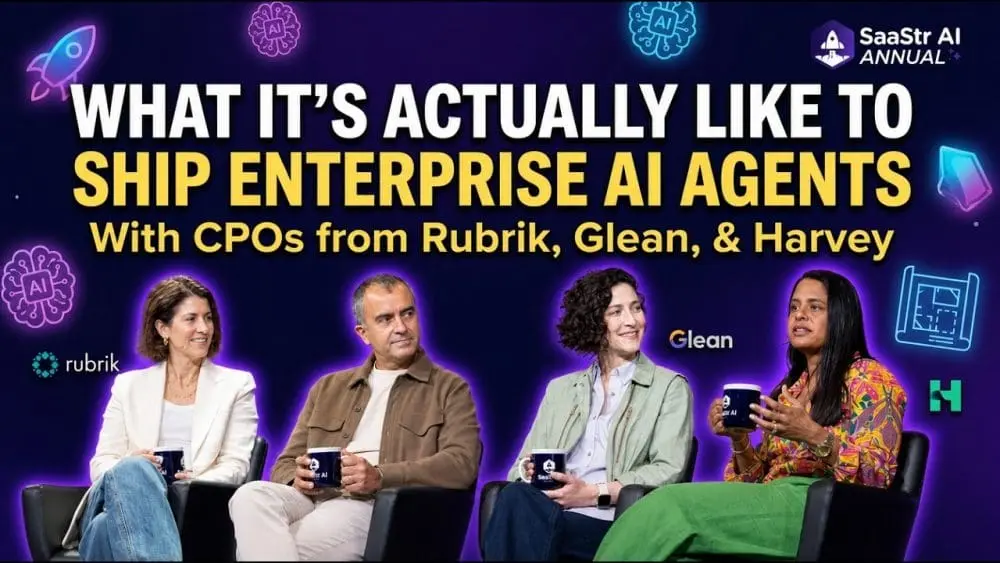
To dissect this unprecedented operational shift, SaaStr banned traditional, sterile conference panels at SaaStr AI in favor of high-caliber, peer-driven roundtables. We gathered four prominent CPOs who know each other well to discuss the harsh realities of this transition: Anneka Gupta (CPO at Rubrik), Emrecan Dogan (CPO at Glean), Anique Drumright (CPO at Harvey), and Rachel Wolan (then-CPO at Webflow).
Though they sell to entirely different verticals—Rubrik protects security teams who cannot tolerate a single operational failure; Glean builds the cross-functional context layer that powers other agents; Harvey sells to elite law firm partners who fund software purchases directly out of their own personal earnings—they share one fundamental challenge: how to build, scale, and govern agents that take real-world actions without destabilizing mission-critical operations.
Detailed Chronology: The Evolution from Passive RAG to Autonomous Agents
The journey from conversational chatbots to autonomous agents has happened at breakneck speed, reshaping product development cycles across the enterprise landscape.
2023–Early 2024: The Era of Passive Retrieval
When the generative AI wave first hit the enterprise, most companies rushed to deploy Retrieval-Augmented Generation (RAG) applications. Products ingested technical documentation and setup guides, allowing users to query a system and receive synthesized answers. As Rubrik’s Anneka Gupta noted, these early implementations were essentially "okay answers based on whatever was in the documentation." They were static, passive, and low-risk because the AI wasn’t doing anything—it was merely reading.
Mid-2024: The Agentic Awakening
As foundational models matured, enterprise customers quickly grew tired of searching and reading. They demanded action. The mandate shifted from "Tell me how to fix this" to "Fix this for me." This required an entirely new class of software architecture. Product teams began discovering that retrofitting conversational layers onto legacy UIs was mathematically and architecturally insufficient.
Late 2024–2025: The Monetization Tipping Point
By late 2024 and into 2025, the market drew a hard line between companies generating actual ARR from AI and those merely running experimental wrappers. Atlassian’s massive stock valuation jump following successful AI monetization proved that enterprise buyers were willing to pay premium prices for verified agentic workflows. However, this success exposed a brutal bottleneck: building agents requires rewriting core product infrastructure.
Supporting Context & Metrics: The 9 Hard Realities of Agent-First Product Development
During the SaaStr AI roundtable, nine core realities emerged, shedding light on the architectural, cultural, and financial hurdles of building enterprise agents.
1. An Agent Roadmap is a Second Build of Your Whole Product
Rubrik operates in cyber recovery—a domain where customers rely on the platform to restore data, applications, and identities after falling victim to ransomware or catastrophic breaches. Naturally, Rubrik cannot afford to ship features that destabilize an already compromised environment.
"It’s been actually a much more challenging problem to build agents within our product than I think I thought it was going to be a year ago," Gupta explained.
The ultimate vision is absolute: everything possible through the traditional graphical user interface (UI) should eventually be possible agentically, culminating in an environment where users operate Rubrik entirely via chat. Achieving this requires building the entire product a second time within a conversational interface, introducing entirely new vectors for failure.
Product teams must count workflows before committing to aggressive deployment dates. Furthermore, development must always begin with non-destructive agents. Rubrik’s initial agentic workflow handles forward-capacity planning—a tedious, day-long manual chore. The agent reads, analyzes, and recommends, never touching production systems. Destructive or modifying actions are strictly gated behind mandatory human-approval workflows.
2. In Cyber Recovery, Never Let the Model Improvise
A critical architectural lesson from Rubrik is the strict separation of duties between the generative model and the deterministic system. In high-stakes environments like cyber recovery, probabilistic behavior is unacceptable.
"In a recovery scenario you don’t want to be guessing and you don’t want to be using like a probabilistic mechanism for recovery," Gupta emphasized.
The LLM is utilized exclusively to generate and explain the recovery plan by synthesizing domain expertise with customer data. However, the actual execution steps are hardcoded, deterministic, and fully auditable.
3. The Death of the Centralized AI Team
Many organizations instinctively stand up a specialized, centralized AI skunkworks team to build agentic features for the rest of the company. Rubrik deliberately rejected this model.
"How do we democratize this so that we don’t have a central team that is building all of the use cases… but every PM and every engineering team within our company is thinking from an agent first mindset?"
Managing the sheer volume of enterprise workflows requires distributing AI architecture, evaluation, and engineering responsibilities across every individual product team simultaneously.
4. Building Context Consumes Half of an AI Workday
According to Glean CPO Emrecan Dogan, enterprise users spending five hours a day with an AI assistant invest roughly half of that time in "building context"—feeding the system documents, historical decisions, unwritten tribal knowledge, and custom behavioral patterns. Retrieval is no longer the entire job; performance is ultimately capped by the richness and accuracy of the underlying enterprise context.
5. External Developer Ecosystems Outpace Proprietary UIs
Glean now operates on two distinct fronts: as a standalone enterprise assistant and as a Model Context Protocol (MCP) server that developer tools like Claude Code, Cursor, and Codex tap into directly. Dogan revealed that aggregate usage across these external developer environments is growing faster than Glean’s native UI.
However, Dogan drew a hard line between runtime MCP fetches and Glean’s deep, offline compute processing—connecting subsidiaries, legacy acquisitions, and historical employee communications to build contextual intelligence before a user even asks for it.
6. Departmental Agents in Action: From Gong Calls to Salesforce
Demonstrating the future of departmental automation, Glean showcased an agent designed for sales operations. Handling hundreds of Gong call transcripts daily, the agent extracts strategic insights, applies custom validation rules, and pushes structured updates directly into Salesforce.
The transformative value lies in institutional memory. Standard, off-the-shelf internet skills fail because they lack proprietary execution frameworks. The nuances captured by a Chief Revenue Officer over a decade of running a sales organization cannot be downloaded; they must be encoded into the agent’s contextual instruction set.
7. Harvey Deploys 180 Former Practicing Lawyers as "Legal Engineers"
Harvey has bypassed traditional software deployment models by embedding approximately 180 legal engineers—individuals who spent 8 to 10 years practicing law—directly into customer deployments. These domain experts help top-tier law firms encode internal playbooks, precedents, and institutional standards into custom agents.
8. Navigating "Partner-Pocket" Economics
Selling software to law firms presents a unique financial hurdle. High-end enterprise contracts often cannot be absorbed by a standard IT budget line; instead, they frequently displace alternative tools or are funded directly out of partners’ personal profit distributions. Despite this friction, Harvey has successfully penetrated more than 60% of the Am Law 100 across 58 countries.
9. Changing the Nature of Legal Review
The legal review cycle has fundamentally shifted. Senior partners no longer merely review marked-up draft documents produced by junior associates. Today, partners inspect the underlying prompts and agentic execution plans before any work product is generated, transforming how legal teams supervise AI-driven output.
Official Statements & Industry Perspectives
The roundtable underscored a sobering consensus regarding accountability in the agentic era. When asked directly who bears responsibility when an enterprise agent malfunctions, Rubrik CPO Anneka Gupta offered a definitive view:
"At the end of the day we’re still responsible. Even when a customer makes a mistake and something isn’t working, they blame us. And rightfully so, they should. It’s our responsibility to make it obvious what the right choices are."
This sentiment echoes across the B2B landscape. As foundation models grow increasingly powerful, customers are deploying agents into headless environments and complex UIs, executing tasks that product creators never anticipated.
Future Outlook: The Hardest Job in B2B Tech
The modern CPO must now balance four conflicting operational pillars simultaneously:
- Building autonomous agents capable of executing real-world enterprise actions.
- Managing products where a single erroneous action can terminate a multimillion-dollar account.
- Engineering bulletproof verification loops that maintain absolute customer trust.
- Accepting total legal and operational accountability for every downstream consequence of autonomous execution.
As these competing demands converge, the role of the B2B product leader has evolved from a predictable calendar manager into the ultimate architect of enterprise automation. The race to ship safe, scalable, and monetizable agents is no longer just a competitive advantage—it is the existential baseline for survival in the modern software economy.