Executive Overview
In the hyper-accelerated ecosystem of social media, where first impressions are formed in fractions of a second and algorithms reward rapid engagement, minor oversights can cascade into monumental digital phenomena. For Zach Leezer, a 30-year-old licensed clinical social worker and private practice owner based in Chicago, a harsh lesson in digital typography arrived unannounced, courtesy of an observant TikTok commenter.
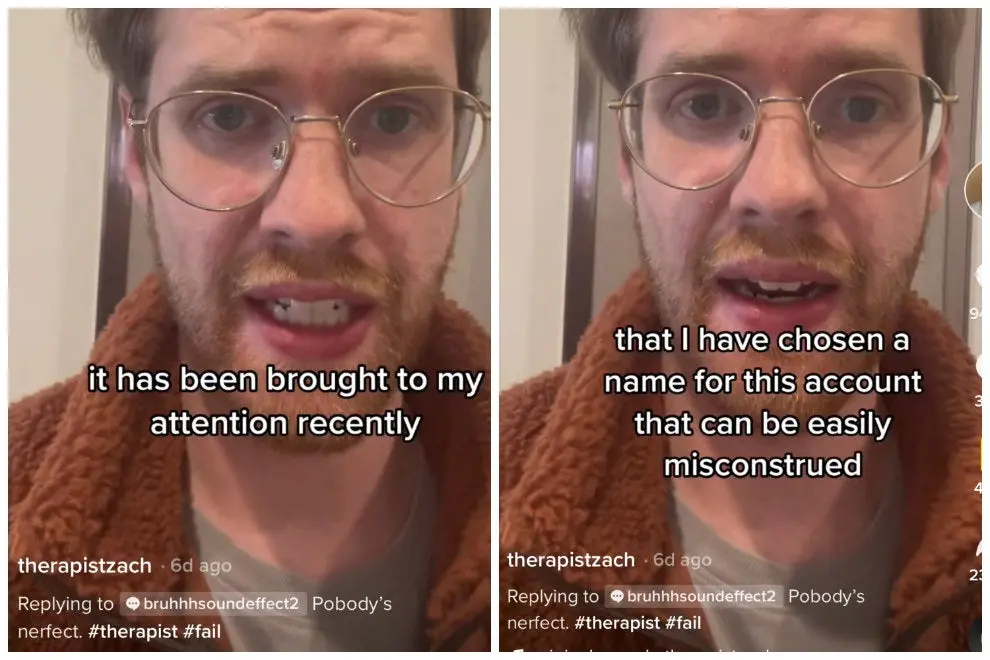
What began as a straightforward attempt to establish a professional presence on the world’s fastest-growing short-form video platform quickly spiraled into a viral mishap. The root cause? A glaring absence of spacing, capitalization, or punctuation in his chosen handle: @therapistzach. To Leezer, the moniker was an innocuous, literal combination of his profession and his given name. To the untamed masses of TikTok, however, the lack of a separator transformed the handle into an accidental optical illusion, reading infamously as “the rapist Zach.”
This inadvertent linguistic collision highlights a broader, increasingly relevant phenomenon in the digital age: the fragile line between professional branding and unintended internet absurdity. As professionals across industries—from therapists and medical practitioners to financial advisors and attorneys—increasingly flock to platforms like TikTok to democratize access to their expertise, they frequently find themselves navigating the treacherous waters of internet culture without a map.
For Leezer, the realization prompted a visceral reaction—“my blood went hot,” he recalled. Yet, rather than retreating into digital obscurity or deleting his account entirely, the young clinician chose to lean into the discomfort. In doing so, he inadvertently provided his growing audience of nearly 31,000 followers with a masterclass in the very psychological principles he preaches in his clinical practice: radical acceptance, resilience in the face of embarrassment, and the vital importance of owning one’s imperfections. This comprehensive report examines the chronology of Leezer’s viral awakening, the broader cultural context of spacing-related linguistic mishaps, the technical limitations of platform governance, and the profound intersection of digital marketing and mental health advocacy.
Detailed Chronology: From Clinical Practice to Viral Infamy
The Genesis of @therapistzach
The journey began in early 2023, when Leezer—operating his Chicago-based private practice, Unbroken Therapy—recognized the shifting paradigms of mental health outreach. Understanding that younger demographics increasingly seek mental health education and normalization on social media platforms, Leezer resolved to bridge the gap between clinical expertise and accessible digital content.
Within less than thirty days of launching his TikTok account, Leezer established a clear, focused content strategy. His videos centered on core therapeutic themes that resonate deeply with modern digital natives: navigating anxiety, fostering healthy body image, building robust self-esteem, and untangling complex interpersonal dynamics. Armed with clinical training and a genuine desire to destigmatize therapy, Leezer set out to build a community grounded in emotional intelligence.
In selecting his handle, Leezer operated with professional tunnel vision. Immersed daily in clinical terminology, psychological frameworks, and professional documentation, the word "therapist" was entirely benign to him. Combining it with his first name, "Zach," felt like the most logical, straightforward branding choice available. At the time of creation, the aesthetic considerations of camel case (capitalizing internal words) or underscores were entirely eclipsed by the urgency of getting his content online.
The Turning Point: The Comment That Changed Everything
For the first few weeks, Leezer’s account grew steadily. His content was well-received, and his engagement metrics reflected a healthy, albeit modest, early-stage audience. However, the trajectory of his digital footprint shifted dramatically on a single afternoon last week when a user dropped a casual, observational comment on one of his standard psychoeducational videos.
The commenter suggested, with deadpan neutrality, that Leezer might want to reconsider his username.
For a moment, Leezer stared at the screen, parsing the letters. Without capital letters or spacing to demarcate the boundaries between the words, the string of characters @therapistzach collapsed into a vastly different phonetic and semantic reality: “the rapist Zach.”
"In that moment, my blood went hot," Leezer recounted.
The shock of the realization was compounded by the suddenness with which context can be stripped away in digital spaces. Leezer, who had spent years cultivating a safe, empathetic, and professional environment for his clients, was suddenly forced to confront the starkly different, unfiltered reality of internet nomenclature. The oversight was entirely unintentional, yet the digital world, governed by rapid pattern recognition and dark humor, was quick to seize upon the ambiguity.
The Aftermath and Platform Constraints
As word spread across his comment section, Leezer’s follower count began to surge, crossing the threshold toward 31,000 users. While the growth was numerically positive, it was fueled in large part by the morbid curiosity and comedic appreciation of an audience that instantly recognized the classic linguistic blunder.
Compounding the immediate distress was TikTok’s platform governance. Like many social media ecosystems designed to prevent bot activity, ban evasion, and rapid identity swapping, TikTok enforces a strict policy regarding username modifications: accounts are prohibited from changing their handles within the first 30 days of creation.
Consequently, Leezer found himself digitally imprisoned by his own typographic oversight. For the duration of his account’s inaugural month, he was forced to wear the handle @therapistzach as a badge of honor, unable to deploy an underscore (@the_rapist_zach or @therapist_zach) or camel case (@TheRapistZach—though capital letters in handles do little to solve phonetic ambiguity). Rather than deleting the account and forfeiting his burgeoning community, Leezer made a calculated decision: he would wait out the restriction, lean into the absurdity, and use the moment as an organic extension of his therapeutic philosophy.
Supporting Context & Metrics: The Psychology of Linguistic Blunders
The Cultural Precedent: Accidental Portmanteaus in Pop Culture
Leezer’s viral mishap is far from an isolated incident; rather, it taps into a rich, long-standing tradition of accidental portmanteaus and typographic misinterpretations in popular media. The English language, while rich and expressive, is notoriously unforgiving when spatial markers like spaces and punctuation are omitted.
The most famous cultural touchstone for this specific linguistic slip is the legendary Saturday Night Live "Celebrity Jeopardy" sketch, featuring Darrell Hammond’s deadpan portrayal of Sean Connery. In the recurring comedic bit, Connery persistently misreads standard titles and phrases with catastrophic spacing errors, famously transforming "The Rapist" out of "Therapists" to the unending frustration of Will Ferrell’s Alex Trebek.
Similarly, television history offers the cautionary tale of Dr. Tobias Fünke from the critically acclaimed series Arrested Development. Played by David Cross, the character—desperately attempting to market himself as both a psychoanalyst and a licensed therapist—coined the self-applied professional title of "analrapist." The ensuing comedic fallout remains one of television’s most enduring explorations of branding gone disastrously wrong due to poor lexical combination.
When informed of these cultural precedents—neither of which he had previously watched—Leezer displayed a characteristic pragmatic humor. Recognizing that his blunder placed him in a long line of fictional and real-world characters who fell victim to the English language’s structural quirks helped diffuse the personal sting of the viral moment.
The Digital Marketing Dilemma for Mental Health Professionals
Leezer’s experience illuminates a wider tension within the modern wellness industry: the uneasy marriage between clinical professionalism and digital marketing.
In the pre-digital era, therapists built their practices through local referrals, hospital networks, and conservative, highly structured business cards. Today, platforms like TikTok, Instagram Reels, and YouTube Shorts have become primary customer acquisition channels for private practices. However, these platforms are engineered for brevity, punchy hooks, and algorithmic virality—elements that frequently clash with the measured, cautious, and deliberate communication style required in clinical psychology.
According to digital marketing metrics within the healthcare sector, practitioners who attempt to build personal brands online face a unique set of challenges:
- The Trust Deficit: Audiences are inherently skeptical of online authorities, making clear, unambiguous branding vital for establishing immediate credibility.
- Algorithmic Catch-22: Handles must be memorable and concise, yet conciseness without punctuation frequently invites misinterpretation.
- The Virality Paradox: While mental health content performs exceptionally well on TikTok—hashtags like
#MentalHealthboasting tens of billions of views—creators frequently find that negative or humorous anomalies attract exponentially more rapid attention than nuanced psychoeducational content.
Leezer’s rapid climb to over 30,000 followers, while catalyzed by an embarrassing typographic error, underscores how digital algorithms frequently reward human vulnerability and accidental comedy far more reliably than clinical perfection.
Official Statements & Personal Philosophy: Leading by Example
In the wake of his viral exposure, Zach Leezer did not retreat behind a statement from a public relations firm or issue a defensive clarification. Instead, true to his vocation, he addressed his audience directly, weaponizing his own embarrassment as an authentic teaching moment.
Reflecting on how he managed the sudden influx of attention, Leezer emphasized the core tenets of cognitive behavioral therapy and acceptance-commitment therapy that he routinely shares with his clients in Chicago.
"There’s a few things I tell my clients all the time," Leezer shared during interviews following the incident. "When you do something new — in this case, I’m very new to TikTok, I haven’t even been in 30 days — you’re going to mess up."
In an era defined by curated perfection, where social media feeds are meticulously scrubbed of flaws, Leezer’s willingness to publicly dissect his own blunder struck a profound chord. Rather than viewing the mistake as an existential threat to his professional reputation, he contextualized it as an inevitable byproduct of stepping outside one’s comfort zone.
"That doesn’t mean you shouldn’t try the thing, it doesn’t mean you shouldn’t go forward with it," Leezer continued. "Rarely does a mistake have the power to ruin your life."
This philosophy forms the bedrock of his digital outreach. For a therapist attempting to guide individuals through anxiety, self-doubt, and the fear of judgment, hypocrisy is the ultimate obstacle. If a clinician online preaches radical self-acceptance while panicking over a grammatical error, the disconnect is palpable. By leaning into the viral joke, Leezer effectively stress-tested his own therapeutic philosophy in front of tens of thousands of witnesses—and passed with flying colors.
"I don’t want to be the clown who embarrassed himself," Leezer admitted candidly. "But I preach that you can’t be too afraid of your mistakes, and I want to lead by example of that. I want to be known for inspiring people to do that, to be their imperfect selves, and just own it."
Future Outlook: The Next Chapter for @therapistzach
As Zach Leezer approaches the expiration of TikTok’s mandatory 30-day waiting period for username modifications, his digital trajectory has fundamentally shifted. What began as a quiet, local clinician’s experiment in digital psychoeducation has transformed into a nationally recognized viral anecdote about the perils of digital typography.
Immediate Structural Changes
Once the platform restrictions lift, Leezer’s immediate operational priority is clear: the introduction of a punctuation mark or an underscore. Whether he transitions to @therapist_zach or another clear permutation, the days of the unspaced compound handle are officially numbered.
However, Leezer has noted that he has no intention of abandoning the core conceptual brand he has built. The inadvertent virality has paradoxically accelerated his brand awareness far beyond what months of organic growth might have achieved.
Long-Term Impact on Practice and Advocacy
Looking ahead, Leezer plans to leverage his expanded platform to further his core mission: demystifying mental health care and making therapeutic concepts accessible to demographics that might otherwise never set foot in a clinician’s office.
Industry analysts observing the intersection of mental health and digital media suggest that Leezer’s handling of the situation may serve as a case study in crisis management for professionals entering the creator economy. By refusing to take himself too seriously, maintaining professional boundaries while displaying human vulnerability, and anchoring his response in established psychological principles, Leezer converted a potential public relations nightmare into an authentic bonding experience with his audience.
Ultimately, Zach Leezer’s brush with viral infamy serves as a timely reminder for writers, marketers, and digital creators alike: grammar matters, punctuation saves reputations, but grace and resilience ultimately define how we recover when the spaces between our words vanish. As Leezer continues his work—both in his Chicago private practice and across his rapidly expanding social media channels—he does so with a hardened armor of self-awareness, a renewed appreciation for English syntax, and a community of followers who have learned firsthand that imperfection is not the end of the world, but merely the beginning of an honest conversation.