Executive Overview
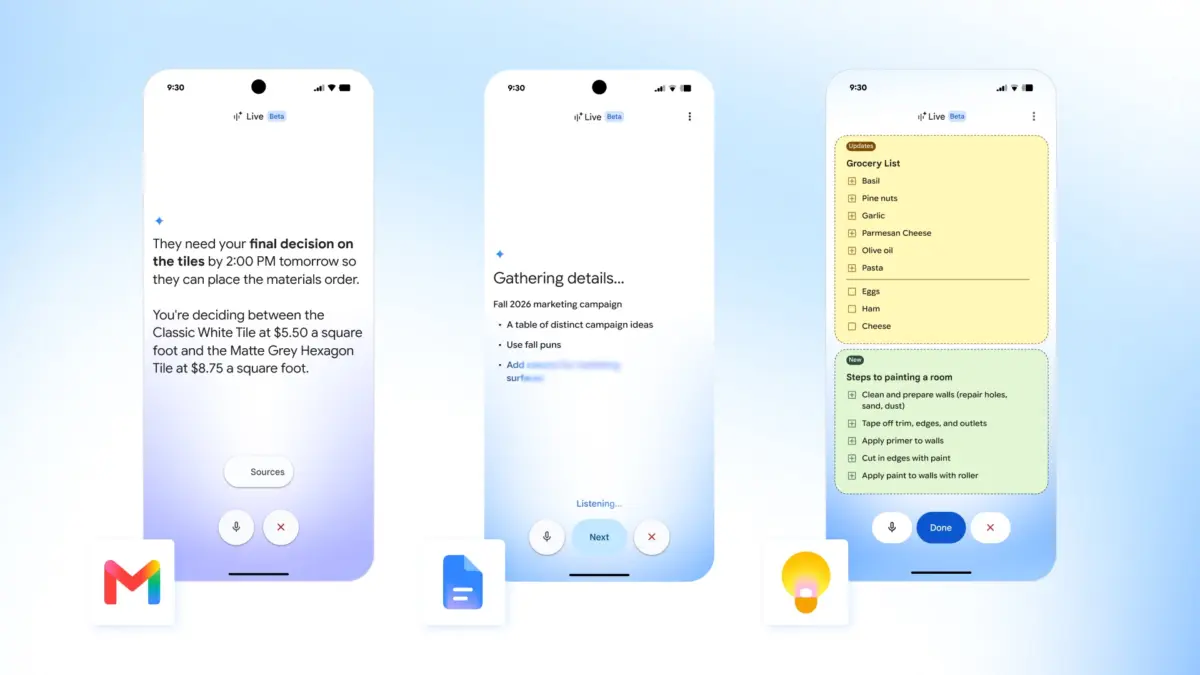
In a decisive move to solidify its dominance in the consumer and enterprise artificial intelligence markets, Google has officially launched a suite of real-time conversational AI features dubbed Gmail Live, Docs Live, and Keep Live. First previewed at the Google I/O conference in May 2026, these tools represent a significant shift in how users interact with their personal and professional data. Rather than relying on traditional search queries, manual keyboard inputs, or rigid command-based dictation, users can now engage in fluid, natural-language, two-way voice conversations with their inboxes, documents, and scratchpads.
Powered by Google’s latest Gemini architecture, the "Live" suite allows users to ask complex, cross-referenced questions about their digital lives, draft documents via real-time dictation augmented by contextual web and workspace data, and seamlessly capture thoughts hands-free.
The rollout is highly targeted. Gmail Live is immediately available to subscribers of Google’s AI Plus, Pro, and Ultra tiers, while Docs Live and Keep Live are reserved for the premium Pro and Ultra tiers. Initially launched in English for iOS and Android, Google has confirmed that a broader deployment to Google Workspace Business customers is imminent.
This launch marks a critical milestone in the ongoing platform wars. As Apple accelerates its rollout of Siri-integrated Apple Intelligence and Microsoft deepens Copilot’s integration into Windows and Office, Google is leveraging its unmatched search index, email repository, and cloud ecosystem to establish a voice-first, ambient computing standard.
Detailed Chronology: The Road to "Live" Conversational AI
The release of the "Live" suite on September 3, 2026, is the culmination of a rapid, highly calculated multi-month product cycle designed to transition Gemini from a reactive chatbot into an active, voice-driven workspace assistant.
[April 2026] Cross-App Dictation (Mac) ➔ [May 2026] Google I/O "Live" Preview ➔ [August 2026] Gemini 3.5 Transcribe & Pixel 11 "Rambler" ➔ [September 2026] Official Launch of Gmail, Docs, & Keep LiveApril 2026: Foundation of Cross-App Dictation
Google began laying the user-interface groundwork in the spring of 2026 by introducing a native Gemini application for macOS. This release featured a system-wide cross-app dictation tool, signaling Google’s intention to bypass browser limitations and integrate Gemini directly into the operating system level of desktop environments.
May 2026: The Google I/O Preview
At its annual developer conference, Google showcased the prototype versions of Gmail Live and Docs Live. The demonstrations highlighted the ability to speak directly to a mobile device to parse thousands of unread emails and construct long-form documents from simple verbal prompts. The preview set expectations for a late-year release, with Google promising to bridge the gap between speech-to-text transcription and semantic comprehension.
August 2026: The Hardware and Model Breakthroughs
The transition from experimental preview to commercial reality was accelerated by two critical announcements in August 2026:
- The Gemini 3.5 Transcribe Model: Google introduced this specialized model to drastically reduce audio-to-text latency. Optimized for real-time speech-to-text applications, the model minimizes the delay between user speech, semantic processing, and assistant response.
- The Pixel 11 Pro Launch and "Rambler": Alongside its new flagship hardware, Google introduced "Rambler," an on-device, Gemini-powered dictation tool. Rambler’s primary innovation was its real-time syntactic filtering, which seamlessly strips filler words ("um," "like," "uh"), stutters, and false starts from spoken audio, delivering clean transcriptions to downstream applications.
September 3, 2026: The Global Deployment
Building upon the Gemini 3.5 Transcribe infrastructure and the UI lessons learned from Rambler, Google officially launched Gmail Live, Docs Live, and Keep Live on mobile platforms, establishing a tiered monetization structure to offset the high compute costs associated with continuous voice-to-voice processing.
Feature Breakdown: How the "Live" Suite Operates
The "Live" product line is not merely a voice-to-text overlay; it is a highly integrated, agentic system designed to execute complex multi-step reasoning based on spoken commands.
+---------------------------------------------------------------------------------+
|                                 USER VOICE INPUT                                |
+---------------------------------------------------------------------------------+
                                         |
                                         v
+---------------------------------------------------------------------------------+
|                         GEMINI 3.5 TRANSCRIBE / RAMBLER                         |
|             (Real-time audio processing & filler word stripping)                |
+---------------------------------------------------------------------------------+
                                         |
                                         v
+---------------------------------------------------------------------------------+
|                               GEMINI REASONING                                  |
|         (Semantic query analysis & multi-source retrieval from APIs)            |
+---------------------------------------------------------------------------------+
                    /                    |
                   /                     |
                  v                      v                      v
        [GMAIL LIVE API]          [DOCS LIVE API]        [KEEP LIVE API]
        - Search & synthesize     - Draft generation     - Structured lists
        - Cross-referencing       - Multi-source RAG     - Hands-free notes
                                        |                      /
                                        |                     /
                    v                    v                    v
+---------------------------------------------------------------------------------+
|                                USER INTERFACE                                   |
|               (Real-time transcription & natural voice output)                  |
+---------------------------------------------------------------------------------+
Gmail Live: Natural-Language Inbox Synthesis
Rather than typing keywords into a search bar and manually filtering through message threads, users can engage Gmail Live in a continuous voice conversation.
- Conversational Queries: A user can ask, "Did I get that invoice from the contractor last week, and does it match the quote we discussed over chat?"
- Dynamic Search and Synthesis: The assistant queries the inbox, retrieves the relevant email, cross-references it with chat histories, and verbally synthesizes the answer.
- Live Transcription: As the user speaks and the assistant replies, a real-time transcript is displayed on-screen, allowing the user to tap on cited emails or attachments instantly.
Docs Live: Context-Aware Document Generation
Docs Live converts the traditional blank page into a collaborative dictation canvas.
- Multi-Source Retrieval-Augmented Generation (RAG): When a user verbally outlines a document—such as saying, "Draft a project proposal for the marketing campaign based on our last client meeting notes in Drive and the feedback email sent by Sarah yesterday"—Docs Live pulls data from Google Drive, Gmail, Google Chat, and the open web to generate a structured draft in real-time.
- Iterative Editing: Users can edit the document verbally, giving instructions like, "Make the tone more professional," or "Insert a table summarizing the budget metrics from my last email."
Keep Live: The Ambient Scratchpad
Keep Live addresses the friction of mobile note-taking by providing an always-ready, hands-free capture tool.

- Intelligent Structuring: Users can dictate unstructured thoughts while on the move, and Keep Live will automatically format them. For example, dictating a chaotic stream of cooking ideas will prompt the app to organize a clean recipe, complete with categorized ingredient lists and step-by-step instructions.
- Task Automation: It can convert spoken reminders into actionable, time-sensitive checklists that sync directly with Google Tasks and Calendar.
Supporting Context, Competitive Landscape & Market Metrics
The launch of the "Live" suite highlights a broader industry race to transition AI from static web interfaces (chatboxes) to highly integrated, ambient voice agents.
The Competitive Matrix
Google’s rollout directly challenges its primary rivals, each of whom is pursuing a distinct voice and workspace strategy:
| Feature / Metric | Google "Live" Suite | Microsoft Copilot (Office) | Apple Intelligence (Siri) | OpenAI Advanced Voice |
|---|---|---|---|---|
| Primary Platforms | Android, iOS (Workspace soon) | Windows, macOS, Web | iOS, iPadOS, macOS | iOS, Android, macOS |
| Data Integration | Gmail, Docs, Drive, Keep, Web | Outlook, Word, OneDrive | On-device apps, Messages, Mail | Web search (limited workspace) |
| Core Voice Engine | Gemini 3.5 Transcribe | Azure Speech / GPT-4o | Local Siri Models + Private Cloud | GPT-4o Realtime |
| Monetization Tier | AI Plus ($19.99/mo), Pro, Ultra | Copilot Pro ($20/mo) | Free on compatible hardware | ChatGPT Plus ($20/mo) |
Google’s distinct advantage lies in its massive, deeply entrenched Workspace ecosystem. While OpenAI offers superior standalone voice-to-voice conversational models, it lacks native access to users’ historical document repositories, email systems, and calendar data. Microsoft possesses the enterprise footprint but has historically struggled with consumer-facing mobile experiences, an area where Google’s Android dominance and robust iOS app ecosystem provide an immediate distribution advantage.
Monetization and Compute Dynamics
By gating Docs Live and Keep Live behind its premium AI Pro and Ultra subscription tiers (typically priced at $19.99 per month and higher), Google is addressing the immense computational overhead of real-time voice AI.
Processing continuous, low-latency audio streams requires specialized TPU (Tensor Processing Unit) clusters operating at high utilization rates. By segmenting these features, Google is ensuring that high-frequency users subsidize the infrastructure costs, while simultaneously creating a compelling upgrade path for casual users currently on free or lower-tier plans.
Official Strategy and Corporate Positioning
While Google has kept its internal performance metrics confidential, the corporate positioning surrounding the "Live" launch reveals a clear strategic objective: making Gemini the default "cognitive layer" of daily life.
Industry analysts note that Google’s rapid-fire deployment of voice tools—spanning April’s Mac dictation, August’s Pixel 11 "Rambler" feature, and today’s "Live" workspace features—points to a coordinated push to capture user intent at the voice level.
During the initial preview at Google I/O, company executives emphasized that the future of computing is conversational and multi-modal. By shifting the user interface from typing and searching to speaking and listening, Google aims to minimize friction, keeping users inside its ecosystem. The rapid transition to Workspace Business clients, expected in the coming weeks, further signals Google’s intent to capture the enterprise productivity market before Microsoft’s Copilot voice integrations achieve widespread adoption.
Future Outlook: The Road to Agentic Autonomy
The launch of Gmail, Docs, and Keep Live is a foundational step toward fully autonomous, agentic workflows. As these tools mature, several key trends and challenges are expected to shape their evolution:
1. From Assistance to Agentic Execution
Currently, the "Live" suite operates primarily as an assistant—retrieving information, drafting text, and organizing notes based on direct prompts. The next logical phase is agentic execution, where Gemini will be authorized to take actions on behalf of the user. For example, a future iteration of Gmail Live could not only find an invoice but also verbally ask the user for authorization to pay it, draft the transaction details, and execute the payment via integrated financial APIs.
2. The Local vs. Cloud Hybrid Compute Model
To reduce latency and address privacy concerns, Google is expected to transition more of the "Live" processing on-device. While large-scale semantic synthesis across years of Gmail data will remain cloud-based, initial speech processing, filler-word filtering (via Rambler technology), and quick-action Keep commands will increasingly run locally on specialized mobile NPU (Neural Processing Unit) hardware, such as the chips powering the Pixel 11 series.
3. Enterprise Security and Data Governance
As Google prepares to roll out these features to Workspace Business customers, it will face intense scrutiny regarding data privacy and governance. Enterprises will require absolute guarantees that voice recordings and confidential corporate data accessed by Docs Live are not used to train public Gemini models. Google’s ability to deploy robust, compliant, and isolated tenant environments for voice-data processing will dictate the adoption rate of these tools in highly regulated sectors like finance, healthcare, and legal services.
By successfully launching Gmail Live, Docs Live, and Keep Live, Google has set a new benchmark for how conversational AI can be woven into the fabric of daily productivity. The battle is no longer about who has the smartest chatbot, but who can most seamlessly integrate an intelligent, listening assistant into the tools where users spend their lives.