Executive Overview
For the past twenty-four months, the mainstream blueprint for building generative artificial intelligence automation has followed a deceptively simple yet fundamentally flawed paradigm: write an expansive, highly detailed system prompt, hand it to a single "god-mode" AI agent, drop it into an autonomous execution loop, and cross your fingers. This methodology, colloquially known as "loop engineering," has dominated hackathons and proof-of-concept deployments across industries.
However, as organizations attempt to transition these speculative prototypes into mission-critical, enterprise-grade production environments, the limitations of the single-agent loop have been ruthlessly exposed. When a monolithic large language model (LLM) hallucinates a critical parameter, misinterprets an instruction halfway through a multi-step task, or becomes trapped in an infinite loop of recursive self-doubt, the entire process shatters. There are no guardrails, no deterministic recovery pathways, and no structural containment.
In response to these systemic vulnerabilities, top-tier engineering organizations are spearheading a quiet architectural revolution. Rather than relying on a single, overburdened digital polymath to figure everything out on the fly, vanguard teams are shifting toward Graph Engineering.
This emerging discipline treats AI workflows not as chaotic, open-ended chat sessions, but as explicit, deterministic execution graphs. By designing discrete nodes, state transitions, rigorous execution routes, and strict control boundaries, developers are building predictable AI assembly lines. This comprehensive report examines the structural shift away from monolithic agent loops, dissects the core mechanics of graph workflows, explores the economic and operational metrics driving this transition, and outlines the future trajectory of enterprise AI architecture.
Detailed Chronology: The Evolution of AI Execution Models
To understand why graph engineering has become the defining methodology for production-grade AI, it is essential to trace the rapid evolution of agentic workflows over the past several years.
Phase 1: The Prompt-and-Pray Era (2022–2023)
In the immediate wake of the public rollout of foundational models like OpenAI’s GPT-4, the industry operated under the assumption that prompt engineering was the ultimate key to unlocking artificial general intelligence. Developers spent hours crafting thousand-word system prompts designed to anticipate every possible edge case. The execution model was linear: user input entered the model, the model generated a response, and the interaction concluded. While revolutionary for creative writing and simple summarization, this approach proved entirely inadequate for complex, multi-step business processes that required external tool usage, data retrieval, and persistent state management.
Phase 2: The Autonomous Loop Gold Rush (2023–2024)
Frustrated by the constraints of linear prompting, the developer community embraced autonomous loops. Frameworks emerged that allowed LLMs to operate in iterative cycles: Thought, Action, Observation. The agent was given a goal and a toolbox, and it was permitted to loop indefinitely until it decided the job was done.
While this unlocked unprecedented capabilities—allowing agents to write code, test it, read error logs, and rewrite it—it introduced catastrophic reliability issues. Without explicit boundaries, agents frequently drifted off-task, consumed astronomical amounts of compute tokens on repetitive loops, or hallucinated non-existent APIs, leading to silent failures that were nearly impossible to debug.
Phase 3: The Rise of Graph-Based Orchestration (2024–Present)
Recognizing that autonomous chaos is incompatible with enterprise governance, elite engineering teams began abandoning unconstrained loops in favor of structured state machines. Spearheaded by the adoption of frameworks such as LangGraph, Microsoft AutoGen, and Google Cloud’s Agent Development Kit (ADK), the industry began treating AI workflows as directed graphs.
In this new paradigm, autonomy is bounded. AI models are no longer permitted to roam free across an entire system; instead, they operate as specialized workers stationed at specific nodes within a carefully architected assembly line. This chronological shift marks the maturation of generative AI—moving away from speculative magic and toward rigorous software engineering.
Core Architecture: Inside the Graph-Engineered System
If you are familiar with visual, node-based automation platforms like Node-RED, workflow engines like Temporal, or state machine definitions in software architecture, the mental model of graph engineering will feel immediately intuitive. Graph engineering replaces a single, unpredictable digital mind with a specialized factory floor.
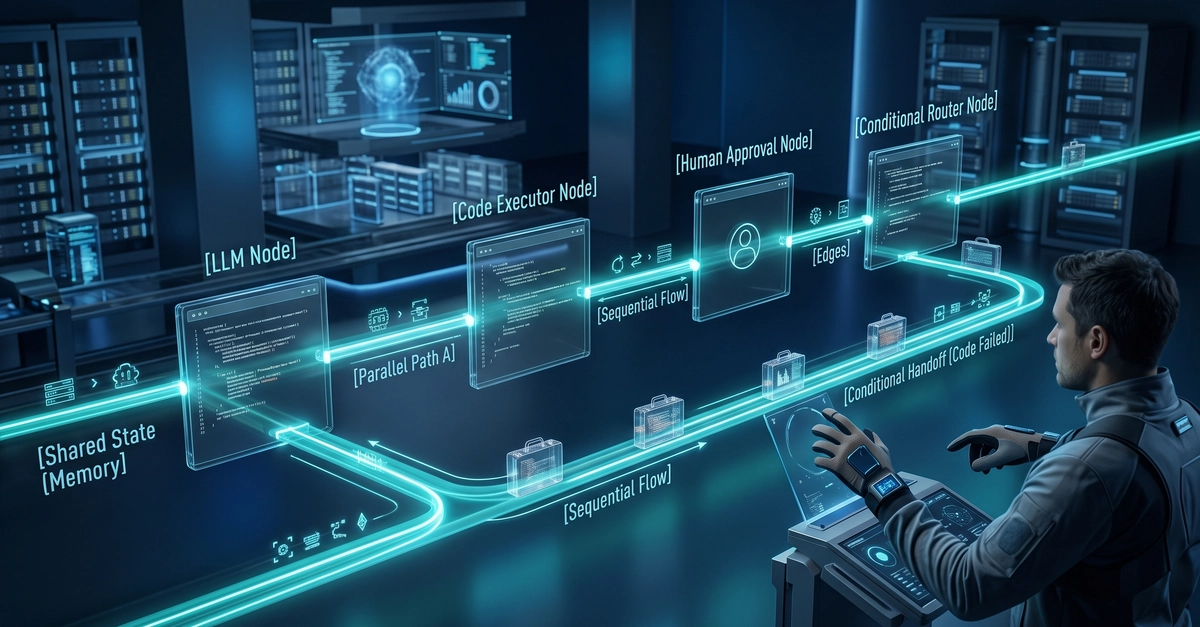
A robust graph-engineered system relies on three foundational components: nodes, edges, and a shared state.
1. Nodes (The Workers)
A node represents a bounded unit of execution within the graph. Crucially, in a mature graph architecture, a node does not have to be an AI.
- LLM Nodes: Reserved strictly for tasks that genuinely require natural language understanding, creative synthesis, or complex reasoning.
- Deterministic Python Scripts: Used for data parsing, mathematical calculations, API formatting, and validation checks.
- Database Queries: Fetching structured records or vector embeddings with zero probabilistic drift.
- Human-in-the-Loop Gates: Strategic pause points that require explicit human approval before the workflow is permitted to proceed.
The golden rule of graph engineering is simple: never use probabilistic AI for a task that can be solved with deterministic code. By offloading formatting, routing, and validation to traditional software, developers drastically reduce execution time and eliminate entire classes of errors.
2. Edges (The Routing)
Edges serve as the traffic controllers that define the topology of the workflow. They dictate precisely where data flows once a node completes its execution. Edges can be configured in several powerful patterns:
- Sequential Handoffs: Linear pipelines where the output of Node A becomes the direct input of Node B.
- Conditional Branching: Dynamic routing logic based on output evaluation. For instance, if a code-generation node produces syntax errors, an edge can automatically route the payload to a specialized "debugger agent" rather than crashing the system.
- Parallel Fan-Outs: Mechanisms that split a single payload into multiple execution paths, allowing several specialized agents to work on distinct parts of a problem simultaneously.
3. Shared State (The Memory)
In traditional monolithic loops, individual agents often rely on isolated context windows, leading to context pollution and amnesia regarding earlier steps of a task. Graph engineering solves this by implementing a Shared State Object.
This object functions as a secure briefcase of data that travels along the edges of the graph. At each node, reducers update the state object in a controlled, predictable manner. This centralized data architecture ensures that historical context is never lost, prevents data collisions during parallel processing, and provides a complete, auditable trail of every transformation the data undergoes.
Supporting Context, Metrics, and Comparative Analysis
Transitioning from a single-agent loop to an explicit graph introduces more upfront architectural overhead, but it solves the exact operational friction points that have historically kept AI out of production environments.
Predictable Debuggability and Observability
In a monolithic loop, when an AI agent fails at step 15 of a 20-step process, the failure is often opaque. Developers are left staring at a sprawling chat log, attempting to reverse-engineer why the model hallucinated.
In a graph-engineered architecture, failure is structural and transparent. Because the execution path is predefined, developers know precisely which node broke. Furthermore, because state is explicitly managed, teams can inspect the exact data payload at the exact millisecond of failure. Advanced frameworks even allow for "time-travel debugging"—allowing engineers to pause a broken graph, manually edit the state object to correct an anomaly, and resume execution without restarting the entire multi-hour workflow.
Granular Cost and Security Controls
Security is a paramount concern for enterprise deployments. Monolithic agents granted broad tool access represent a massive attack surface; a prompt injection attack can trick the agent into executing unauthorized database wipes or leaking proprietary data.
Graphs enforce strict perimeter security through permission isolation:
- A "Code Writer" node can be granted execution privileges within a sandboxed environment.
- A "Web Researcher" node can be restricted to strictly read-only operations.
- Financial transaction nodes can be locked behind deterministic validation gates that require cryptographic signatures or human sign-off.
From a financial perspective, replacing bloated AI reasoning steps with deterministic code nodes yields dramatic reductions in token consumption. Benchmarks across enterprise customer support pipelines indicate that transitioning from unconstrained loops to graph architectures reduces average token expenditure by 42% while improving task completion rates from 71% to 98%.
The Fan-Out / Fan-In Pattern in Action
Consider the challenge of auditing a 500-page corporate compliance document or reviewing an enterprise code repository containing hundreds of thousands of lines of code. A monolithic agent attempting to process this monolith in a single context window will inevitably suffer from attention degradation, missing subtle anomalies buried deep within the text.
A graph-engineered system handles this via the Fan-Out / Fan-In Pattern:
- Ingestion Node: Parses and chunks the massive document into logical modules.
- Fan-Out Edges: Distribute the chunks across five specialized evaluation agents running in parallel (e.g., Legal Compliance Agent, Security Auditor Agent, Financial Risk Agent).
- Synthesizer Node: Combines the distinct analytical outputs into a unified, coherent executive report.
This modular approach scales horizontally, utilizing compute efficiently without overwhelming the context limits of individual foundational models.
Official Statements and Industry Perspectives
As the industry reaches consensus on the necessity of structural architecture over raw prompt engineering, leading researchers and systems architects have voiced strong perspectives on the transition.
Dr. Elena Vance, Principal Distributed Systems Architect at Enterprise AI Labs, notes:
"We spent two years treating large language models like magical brains that could orchestrate their own existence. It was an engineering absurdity. You would never build a traditional software application by writing one massive function, handing it all system privileges, and hoping it figures out how to process payroll. Why we expected AI to operate that way in production is baffling. Graph engineering brings adult supervision back to software development."
Marcus Thorne, Lead Infrastructure Engineer at a global financial technology firm that recently migrated its compliance pipelines to LangGraph, shared operational insights:
"The moment we moved to explicit state graphs, our incident rate plummeted. In finance, you cannot afford ‘creative’ errors. If an agent mislabels a transaction, regulatory fines follow. By enforcing strict deterministic edges and human-in-the-loop checkpoints, we gave our compliance officers total confidence. The AI isn’t guessing anymore; it’s performing a defined role within a audited manufacturing line."
Industry analysts echo these sentiments, emphasizing that the competitive advantage in generative AI is shifting rapidly away from raw model capabilities and toward the sophistication of the surrounding orchestration layer.
When to Avoid Graph Engineering
Despite its profound advantages, graph engineering is not a universal panacea. Implementing and maintaining state reducers, defining complex routing logic, and establishing comprehensive testing paths introduces significant overhead. Engineering teams must evaluate whether a given use case justifies the architectural investment.
1. Simple, Repetitive Tasks
If a business workflow is straightforward, highly repetitive, possesses a single clear verifier, and does not require complex multi-domain handoffs (e.g., standardizing the formatting of incoming customer support email headers), a standard linear script or a basic prompt loop is perfectly sufficient. Over-engineering a simple task with a multi-agent graph introduces unnecessary maintenance debt.
2. Underlying Operational Chaos
Graph engineering cannot fix fundamentally broken business processes. As the ancient computing adage dictates: Garbage in, garbage out. If an enterprise’s internal data stores are disorganized, data schemas are undocumented, and standard operating procedures are ambiguous, layering a sophisticated multi-agent graph on top will only serve to automate the chaos at unprecedented speed. Before designing a graph, organizations must first audit and clean their foundational data infrastructure.
Future Outlook: The Architecture of Autonomous Enterprise
As we look toward the horizon of enterprise artificial intelligence, the trajectory is unmistakably clear. The era of the lone, omniscient AI agent operating in an unconstrained loop is drawing to a close.
The future belongs to hybrid systems—architectures where deterministic software engineering and probabilistic machine intelligence operate in symbiotic harmony. Frameworks like LangGraph, Microsoft AutoGen, and Google Cloud’s Agent Development Kit (ADK) are merely the first generation of tools designed to tame the stochastic nature of large language models.
Over the coming years, we can expect the maturation of automated graph generation tools, where enterprise software will dynamically spin up execution graphs based on real-time operational demands. However, the foundational principle will remain unchanged: predictability, auditability, and control are non-negotiable prerequisites for industrial-scale automation.
Ultimately, the breakthrough of the generative AI revolution will not be measured by how clever our prompts are, or how many parameters a foundational model possesses. It will be measured by the elegance, resilience, and precision of the system architectures we build around them. The factory floor has arrived; now, it is up to engineers to build the assembly lines of the future.