Executive Overview
In an era dominated by relentless hustle culture and the grueling demands of high-performance athletics, the modern fitness landscape is undergoing a quiet revolution. For decades, the prevailing narrative surrounding endurance sports—particularly marathon running—has been one of uncompromising sacrifice. Athletes were conditioned to believe that achieving peak physical condition required predawn wake-up calls, monastic discipline, absolute deprivation, and a willingness to embrace suffering as a daily baseline.
Enter Hong, a Berlin-based designer, international flight attendant, and veteran marathoner currently preparing for her seventh 42-kilometer race. Hong’s journey challenges the very foundation of traditional endurance training orthodoxy. Once a self-proclaimed non-runner who valued the comfort of her snooze button above all else, she has carved out a distinct philosophy that bridges the gap between high-level athletic achievement and radical self-care. Her approach proves that consistency does not require misery, and that pushing physical boundaries can coexist harmoniously with comfort, community, and a vibrant social life.
This in-depth feature explores Hong’s weekly training regimen, dissecting how she balances a demanding dual-career schedule with serious athletic pursuits. By examining her holistic integration of cross-training, mental health strategies, nutritional rewards, and community engagement, we uncover a blueprint for sustainable endurance sports participation. Hong’s story is not merely a personal anecdote; it is a case study in the modern paradigm shift toward sustainable, joyful fitness that redefines what it means to be a runner in the 21st century.
Detailed Chronology: A Week in the Life of a Balanced Marathoner
Balancing a multifaceted career as a designer and a flight attendant while training for a marathon requires meticulous time management, psychological resilience, and an unwavering commitment to personal well-being. Hong’s weekly schedule offers a masterclass in how to integrate high-intensity physical output with professional responsibilities and a rich cultural life.
Monday: Rhythm, Resistance, and Canine Companionship
The week begins with the friction common to many working professionals: transitioning from a restful weekend into a high-pressure corporate and travel schedule. As a designer and flight attendant, Hong’s weeks are inherently unpredictable. To safeguard her motivation against the fatigue of erratic sleep schedules and jet lag, she relies on psychological anchors.
Her primary tool for combating low energy days is her curated running playlist. Ranging from pulsating techno and house to upbeat disco, music acts as a visceral stimulus that transforms a sluggish mindset into an engaged one. When fatigue threatens to derail her pace, Hong employs a unique behavioral hack: she starts singing. Regulating her breath through vocalization forces her to slow down, transforming a potentially grueling training session into an enjoyable, rhythmic experience that frequently elicits smiles from amused onlookers.
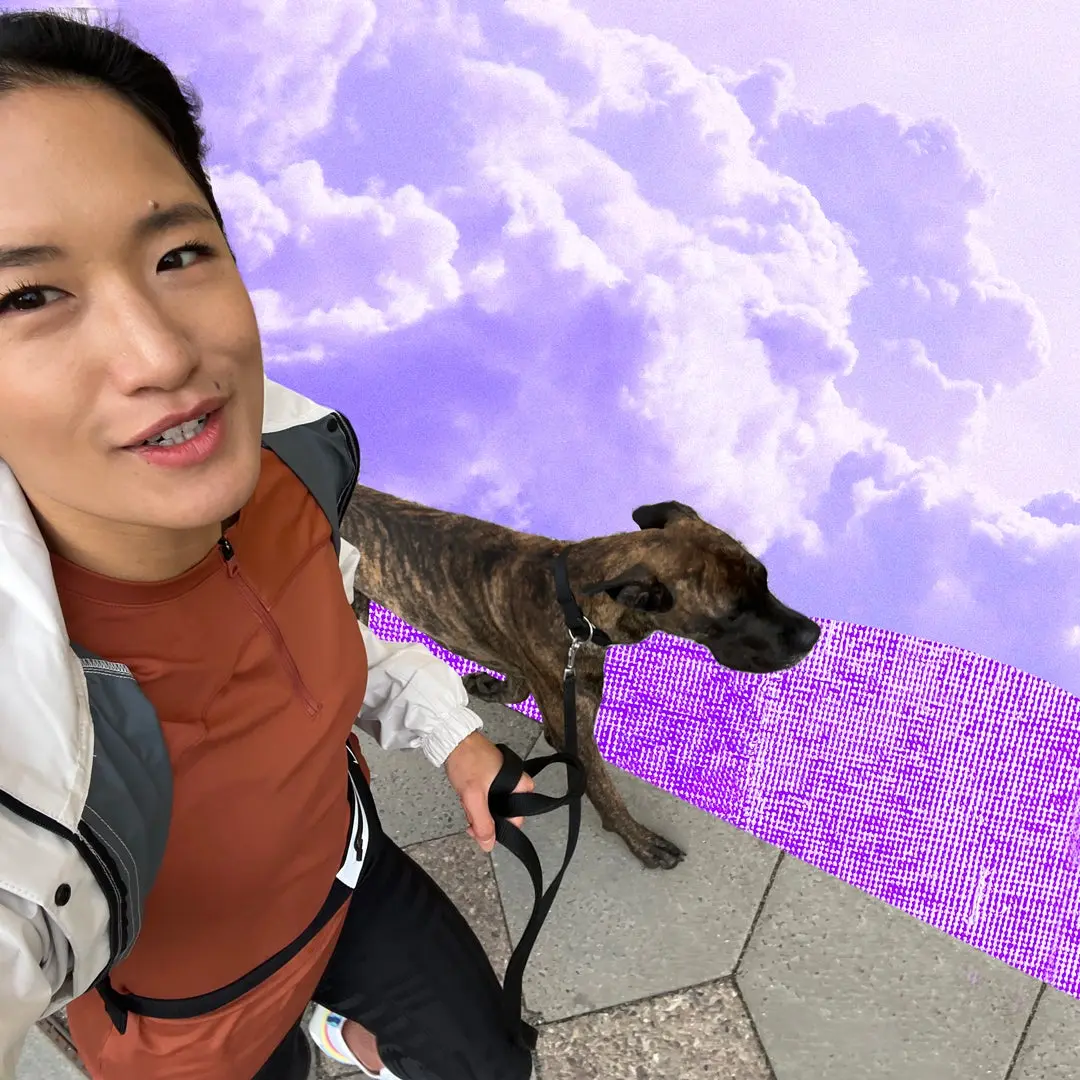
To inject spontaneity and social connection into her Monday routine, Hong regularly borrows a friend’s energetic rescue dog, Mia. The dynamic of running with a high-energy canine alters the mechanical and mental focus of the workout. In the opening kilometers, Mia pulls the pace forward; in the final stretches, Hong’s superior endurance takes over. This symbiotic exercise session highlights a core tenet of Hong’s philosophy: movement is fundamentally social and exploratory, rather than purely mechanical.
Tuesday: The Architecture of Injury Prevention
True to her holistic philosophy, Hong treats rest and cross-training not as secondary considerations, but as foundational pillars of her athletic framework. Tuesday is intentionally devoid of running. Instead, she engages in a structured regimen of yoga, targeted strength training, and specialized physical therapy sessions.
This multi-disciplinary approach is designed to fortify the body against the repetitive impact forces inherent in marathon preparation. By building a robust musculoskeletal foundation through strength work and maintaining joint mobility through yoga, Hong ensures that she can push her limits during high-intensity runs without compromising structural integrity. This comprehensive conditioning guarantees that she avoids the debilitating burnout and overuse injuries that plague many amateur endurance athletes, enabling her to step back into her running shoes rapidly after designated rest periods.
Wednesday: Professional Realities and Cultural Integration
With the global nature of her profession as a flight attendant, Hong’s schedule demands flexibility. Wednesday serves as a crucial buffer in her weekly cadence. Recognizing that social deprivation and professional stress can negatively impact athletic performance just as much as physical overtraining, she actively prioritizes her mental and social well-being.
Rather than forcing a subpar workout when her body or schedule demands respite, Hong dedicates her Wednesday to cultural enrichment, often visiting contemporary art exhibitions in Berlin. This intentional separation from athletic metrics allows her psychological recovery to match her physical recuperation, maintaining the equilibrium necessary for long-term athletic sustainability.
Thursday: Pushing Thresholds and Technical Gear
While comfort is a central theme of Hong’s philosophy, it is balanced by a profound appetite for self-improvement and competitive challenge. Thursday is designated as her high-intensity track workout day—a session explicitly designed to test anaerobic thresholds, speed endurance, and mental toughness.
Preparing for a marathon requires confronting physical discomfort, but Hong approaches these intense intervals with calculated strategy. Footwear plays an indispensable role here. To mitigate the high-impact stress of fast-paced track running across varied urban surfaces, Hong relies on advanced footwear technology, specifically citing models like the Nike Invincible 3. The combination of high-energy-return cushioning and secure structural support provides the psychological confidence needed to execute high-speed intervals without fear of instability or acute trauma.
Friday: Active Recovery and Social Recharge
Following the physiological stress of Thursday’s track session, Friday is characterized by active recovery. Aside from a gentle restorative yoga sequence, Hong avoids structured cardiovascular exertion.
Instead, she pours her renewed energy into her local community, catching up with friends and exploring Berlin’s vibrant creative spaces. This deliberate curation of her social calendar underscores the reality that elite-level amateur training does not require social isolation. By nurturing her intellectual and interpersonal connections, Hong maintains the holistic health that fuels her physical ambitions.
Saturday: Urban Exploration and Mindful Mileage
Saturday morning belongs to Hong’s signature long-run route along Berlin’s historic Landwehrkanal. Transitioning seamlessly across diverse terrains—from unforgiving urban asphalt to soft grass and muddy paths—this weekly ritual acts as a moving meditation.
Equipped with an engaging podcast or simply tuned into the ambient acoustic backdrop of the city, Hong uses this time to decouple from her professional obligations. The run is deliberately paced to allow for environmental engagement, observing the city waking up and interacting with fellow urban explorers. The session culminates in a ritualistic reward: a specialty coffee and a carefully selected artisanal snack from a local market stall in Kreuzberg. This post-run reward serves as both a physiological replenishment mechanism and a psychological anchor, celebrating the completion of another milestone.
Sunday: Collective Endurance and Gastronomic Anticipation
The culmination of Hong’s training week takes place on Sunday through her participation in the Joy Run Collective, a local running community that has fundamentally shaped her athletic journey. Together, the group tackles extended endurance runs through the expansive, scenic landscapes of Berlin’s Tiergarten.
Enduring longer durations and cooler ambient temperatures demands rigorous preparation, from thermal layering to nutritional strategizing. However, the collective effort transforms a potentially isolating physical trial into a shared cultural experience. The post-run ritual is equally sacred: a communal brunch featuring artisanal dumplings prepared by group members—a culinary reward that Hong admits serves as a primary psychological motivator throughout her high-mileage training blocks.
Supporting Context & Metrics: The Paradigm Shift in Modern Endurance Sports
To contextualize Hong’s journey, one must examine the broader socio-cultural evolution of endurance sports over the past decade. Historically dominated by rigid training logs, chronometric obsession, and an ascetic rejection of pleasure, the running community has experienced a profound demographic and philosophical shift.
The Rise of the Everyday Athlete
According to industry reports from global running organizations, participation in recreational running has seen a dramatic influx of non-traditional demographics. Women, creative professionals, and individuals balancing demanding careers now make up the fastest-growing segment of marathon entrants. These athletes reject the "no pain, no gain" dogma of the 20th century, favoring instead a model rooted in longevity, holistic wellness, and community integration.
Psychological Metrics of Consistency vs. Intensity
Sports psychology research increasingly supports Hong’s empirical observation that comfort and consistency are inextricably linked. A study published in the Journal of Applied Sport Psychology highlights that athletes who integrate intrinsic motivational factors—such as social connection, sensory pleasure (music, scenery), and post-exercise rewards—exhibit significantly lower rates of psychological burnout and physical injury compared to those driven purely by external metrics and punitive training regimens.
Traditional Training Model:
[High Intensity] ---> [Physical Suffering] ---> [Psychological Burnout] ---> [Injury]

Hong's Balanced Model:
[Comfort & Community] ---> [Sustainable Consistency] ---> [Long-term Performance] ---> [Resilience]
By prioritizing footwear technology that reduces impact fatigue, incorporating mental health buffers like art and yoga, and leveraging community accountability, Hong has constructed a resilient athletic profile. At age 30, she reports being healthier, fitter, and possessing greater physical self-awareness than she did in her twenties—a testament to the efficacy of the balanced training paradigm.
Official Perspectives: Expert Insights on Sustainable Running
The philosophy championed by athletes like Hong is increasingly validated by leading voices in sports science, physical therapy, and athletic coaching.
The Sports Scientist’s View
Dr. Elena Rostova, a leading exercise physiologist specializing in endurance mechanics, notes that the modern amateur athlete faces unique stressors that professional athletes do not.
"Amateurs have to navigate cognitive fatigue from corporate jobs, irregular sleep schedules due to travel, and complex social obligations," Dr. Rostova explains. "When you force a rigid, high-stress training regime onto an already taxed nervous system, cortisol levels spike, recovery stalls, and injury rates skyrocket. Athletes who adopt a flexible, pleasure-inclusive approach—incorporating social runs, adequate cross-training, and mental rest—consistently achieve better long-term physiological adaptations than those who try to force compliance through sheer willpower."
The Podiatrist and Footwear Technologist’s View
Commenting on the role of gear in maintaining training longevity, senior footwear developer Marcus Vance emphasizes the evolution of protective athletic equipment.
"The democratization of marathon running requires equipment that adapts to the runner, rather than forcing the runner to adapt to rigid constraints," Vance states. "Innovations in high-energy foam and adaptive upper construction, such as those found in modern high-mileage trainers, are designed precisely to absorb the repetitive shock of urban terrain. This allows athletes like Hong to push their limits on the track on Thursday and comfortably log long miles on the canal path on Saturday without incurring micro-traumas that sideline their progress."
Future Outlook: The Next Frontier of Accessible Athletics
As Hong prepares to lace up her running shoes for her seventh marathon, her journey serves as a prophetic glimpse into the future of endurance sports. The old guard of punishing, exclusionary athletics is rapidly giving way to a more inclusive, balanced, and sustainable movement culture.
The implications of this shift are profound. As brands, communities, and training programs increasingly embrace the philosophy that performance and pleasure are not mutually exclusive, the barriers to entry for endurance sports will continue to dissolve. Individuals who previously felt alienated by the intimidating subculture of elite marathoning are finding their place within communities like the Joy Run Collective, proving that high-level athletic achievement is accessible to anyone willing to commit to consistency—one comfortable, musical, dog-accompanied step at a time.
For Hong, the finish line of her seventh marathon is not an endpoint, but merely another waypoint in a lifelong journey of self-discovery. Her ultimate lesson remains simple yet revolutionary: Consistency and comfort do not have to be mutually exclusive. By refusing to compromise her well-being for the sake of arbitrary athletic standards, she has redefined what it means to conquer 42 kilometers—proving that with the right mindset, the journey to the starting line can be just as joyful as crossing the finish.
Hong’s 3 Pillars for Sustainable Running Success
- Prioritize Comfort and Protection: Invest in versatile, high-tech footwear and apparel that mitigate impact forces and provide psychological confidence across varied urban terrains.
- Curate Your Motivation Matrix: Utilize auditory stimuli (playlists featuring high-energy genres like techno, house, and disco) and social elements (running companions and canine partners) to transform tedious miles into engaging experiences.
- Integrate Reward Loops: Pair rigorous physical output with holistic recovery protocols, cultural exploration, and anticipated culinary rewards to sustain long-term mental and physical engagement.